
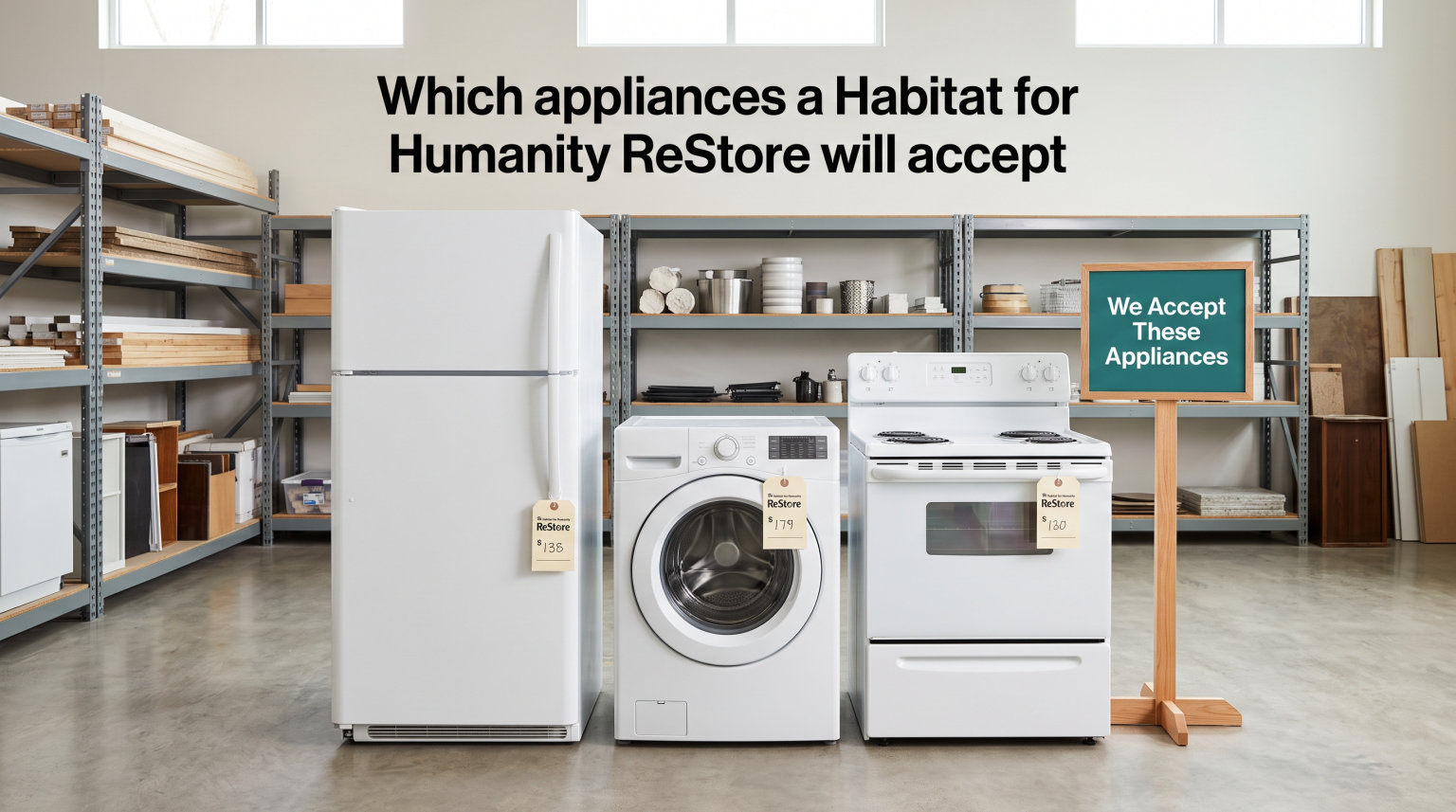
If you have a working fridge, washer, or stove gathering dust in your garage, a Habitat for Humanity ReStore will likely take it off your hands for free. ReStore is the nonprofit home improvement store run by Habitat for Humanity, and it accepts a wide range of gently used appliances to resell at a discount. The proceeds fund affordable housing construction in your local community.
In this guide, I break down exactly which appliances a Habitat for Humanity ReStore will accept in 2026, what condition they need to be in, and how the donation process works. I also cover what ReStore won’t take so you don’t waste a trip.
Table of Contents
What Habitat ReStore Accepts: The Big Picture
Habitat ReStore accepts most major household appliances in good, working condition and typically less than 7 years old. Each of the more than 900 ReStore locations across the U.S. and Canada operates independently, so the exact list varies by store, but the national guidelines are consistent.
According to Habitat’s national donation guidelines, ReStore accepts new and gently used appliances that can be resold to support the mission of building affordable homes. Think of ReStore as a nonprofit version of a home improvement store, where every sale helps a family get into a safe place to live.
Before you load up the truck, keep these three rules in mind:
The appliance must work fully on arrival.
It must be reasonably clean and free of major damage.
It must include its power cord and any essential parts.
Full List of Appliances Habitat ReStore Accepts
Most ReStores accept these major and small appliances. When in doubt, call your local store before hauling anything over.
Kitchen Appliances
Refrigerators and freezers (chest, upright, and standard top-freezer or side-by-side)
Dishwashers (must have a stainless steel interior and be manufactured in 2014 or later)
Ranges and ovens (electric stoves and ovens only; gas ranges have extra rules)
Microwaves (countertop and over-the-range, working condition)
Range hoods (in working order, complete with filters)
Laundry Appliances
Washing machines (top-load and front-load)
Dryers (electric dryers are widely accepted; gas dryers are restricted)
Climate and Water Appliances
Air conditioners (window and portable units, working order)
Air purifiers and dehumidifiers
Water heaters (must be manufactured after 2014 under EPA lead laws)
Ceiling fans and portable fans
Small Kitchen Countertop Appliances
Toasters, toaster ovens, blenders
Coffee makers
Stand mixers and food processors
From my experience donating a 4-year-old stainless steel fridge, the bigger and more expensive the appliance, the more eager your local ReStore will be to accept it. They turn around quickly on refrigerators, washers, and dryers because demand from buyers is steady.
Condition Requirements: What “Gently Used” Means
Every appliance you donate to Habitat ReStore must be in working, resale-ready condition. “Working” means the appliance powers on, runs a full cycle without error, and does the job it was built to do. “Resale-ready” means a buyer could plug it in and use it the same day.
The Non-Negotiables
Fully functional: no error codes, no broken buttons, no leaks, no overheating.
Clean inside and out: empty of food, lint, or detergent residue.
Complete: all knobs, racks, shelves, drawers, filters, and original accessories included.
Power cord attached: no missing or frayed cords, no third-party adapters.
No major cosmetic damage: deep dents, cracked glass, or rust are reasons to reject.
Why Condition Matters So Much
ReStore’s business model depends on selling donated items to fund home-building. If an appliance breaks down on a buyer’s floor, it hurts the brand and the mission. That’s why most ReStores test electrical appliances before they go on the sales floor, and many offer a 30-day return window to protect buyers.
If you wouldn’t be comfortable selling it to a friend at a garage sale, it’s probably not ready for ReStore either.
Age Restrictions and the EPA 2014 Lead Law
Habitat ReStore enforces age limits because older appliances are more likely to fail, pose safety risks, or carry outdated water-line materials. The two most common rules you’ll see are:
The 7-Year Age Limit
Most ReStores require appliances to be no older than 7 years. Some locations stretch this to 8 years for larger items. If your appliance is on the bubble, check the serial number plate, which is usually on the back or inside the door, and cross-reference the manufacturing date.
The 2014 EPA Lead Law Rule
Under the 2014 Reduction of Lead in Drinking Water Act, all newly installed plumbing fixtures and water-handling appliances must use lead-free materials. As a result, most ReStores will only accept dishwashers and water heaters manufactured in 2014 or later. Older units may leach lead from solder and internal components, so they don’t meet the safety bar.
Gas Appliance Age Rules
For gas dryers and gas ranges, ReStores are even stricter. Many locations refuse gas appliances older than 5 years, and some refuse used gas appliances entirely unless they are still sealed in original packaging. Gas lines introduce safety and liability concerns that electric appliances simply don’t have.
Here’s a quick rule of thumb I use when sorting my own appliances before donating:
2014 or newer for dishwashers and water heaters.
Within 7 years for refrigerators, washers, and electric dryers.
Within 5 years for gas ranges and gas dryers, or simply call ahead.
What Habitat ReStore Does NOT Accept
Knowing what ReStore won’t take saves you time and a wasted trip. Common rejection categories include:
Broken or non-working appliances: if it doesn’t run, ReStore can’t sell it.
Gas dryers and gas ranges older than 5 years: safety restrictions vary by location.
Trash compactors and wall ovens: hard to test and install, low resale demand.
Electronics: TVs, computers, monitors, and printers are usually rejected due to low resale value and rapid obsolescence.
Items missing parts: a washer without its drain hose or a microwave without a turntable will be turned away.
Recalled items: any appliance on an active recall list is automatically rejected.
Items with hazardous residue: appliances stained with chemicals, paint, or oil are not accepted.
If your appliance is rejected, your local ReStore team will usually explain why and may suggest a recycling partner. Some communities hold annual appliance recycling events, and scrap-metal recyclers will pick up non-working units for free because of the steel and copper value.
How to Donate: Pickup, Drop-Off, and Tax Deductions
Donating to Habitat ReStore is straightforward. Here’s the process I walk through with my own donations.
Step 1: Find Your Local ReStore
Use the Habitat ReStore locator at habitat.org to find the store nearest you. Each store lists its phone number, hours, and the categories it currently accepts, since needs change based on local demand.
Step 2: Call Ahead or Submit the Online Form
For large appliances, most ReStores ask you to submit photos and a description through their online donation form or by email. Include the brand, model number, age, and condition so the staff can confirm acceptance before you arrive.
Step 3: Choose Pickup or Drop-Off
Many ReStores offer free pickup for large appliances within a certain radius. Some charge a small flat-rate pickup fee, often around $50, especially for items that need to be disconnected. Smaller countertop appliances must be dropped off at the store.
Step 4: Disconnect and Prepare
Built-in appliances like dishwashers and wall ovens typically need to be disconnected before pickup. Some ReStores have staff or volunteers who can help with disconnections, but most expect you to handle it. Make sure water lines are capped and power is off.
Step 5: Get Your Tax Receipt
Every donation to a ReStore is tax deductible. You’ll receive a donation receipt at the time of pickup or drop-off. For items valued over $500, you’ll need to complete IRS Form 8283 and possibly get a qualified appraisal. Use the donor’s guide or talk to your tax advisor for specifics.
FAQs
Does Habitat for Humanity take old appliances?
Yes, Habitat for Humanity ReStore accepts older appliances in good working condition, but most locations enforce a 7-year age limit and require dishwashers and water heaters to be manufactured in 2014 or later. If your appliance is older or not working, your local ReStore can usually point you to a recycling partner.
What kitchen items are most needed for donation?
ReStore sees the highest demand for refrigerators, dishwashers, electric ranges, washers, and dryers. Stainless steel and clean, modern-looking units sell fastest, so these are the kitchen items most needed by your local ReStore.
Does Habitat ReStore pick up appliances for free?
Many ReStores offer free pickup for large appliances within a service radius, though some charge a flat pickup fee around $50 for items that require disconnection. Small countertop appliances must be dropped off at the store directly.
How old can an appliance be to donate to Habitat ReStore?
Most ReStores require appliances to be less than 7 years old. Dishwashers and water heaters must be manufactured in 2014 or later to comply with EPA lead laws. Gas dryers and gas ranges often have a stricter 5-year limit, and some ReStores won’t accept used gas appliances at all.
Does Habitat ReStore take gas stoves or gas dryers?
ReStore accepts gas stoves and gas dryers in some locations, but only if they are newer than 5 years and still in working order. Many ReStores refuse used gas appliances entirely because of safety and liability concerns, so always call your local store before scheduling a donation.
Conclusion
Habitat ReStore makes it easy to donate a Habitat for Humanity ReStore accepted appliance when the item works, is reasonably clean, and meets the age rules. Your donation keeps usable goods out of landfills, helps fund affordable housing in your community, and puts a tax deduction in your pocket. Before you load up, call your local ReStore to confirm what they currently accept and whether they offer free pickup.