
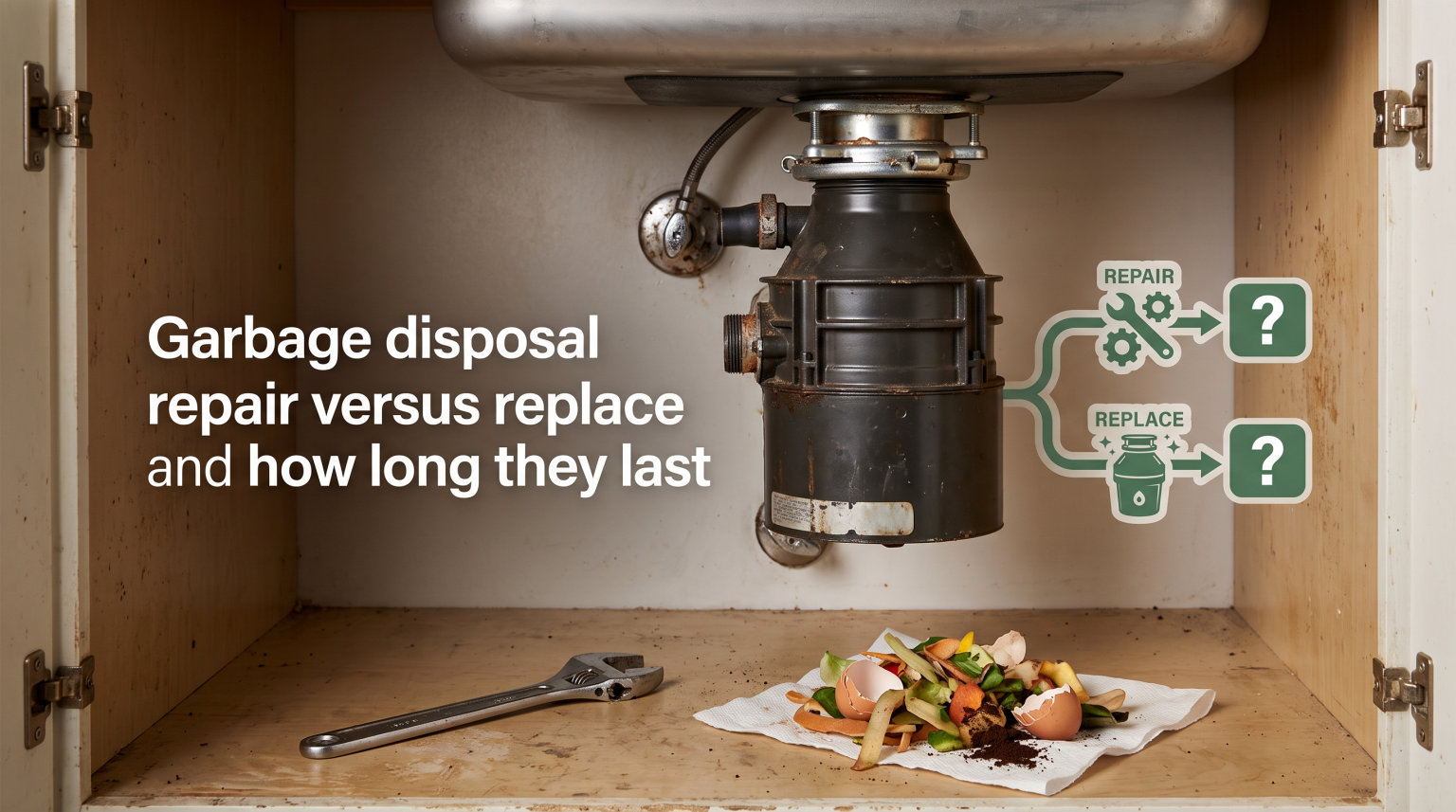
Most garbage disposals last between 10 and 15 years with proper care, and the decision to repair or replace one usually comes down to age, cost, and the specific problem at hand. If your unit is under 5 years old and has a single fixable issue, repair is almost always the right call. If it is over 8 years old and showing multiple failure signs like leaking from the bottom, a humming motor that won’t spin, or persistent clogs, replacement saves you money in the long run.
Our team has spent weeks comparing homeowner repair experiences on forums, reading service company guides, and tracking real cost data to bring you this complete guide for 2026. We break down the exact problems you can fix yourself, the warning signs that mean your disposal is done, and the 50% rule that simplifies the entire decision.
Table of Contents
How Long Does a Garbage Disposal Last?
The average garbage disposal lasts 10 to 15 years, though lifespan varies significantly based on usage, water quality, and what you put down it. Entry-level units (1/3 HP) typically reach the lower end at 8 to 10 years. Mid-range 1/2 HP models last 10 to 12 years. Premium 3/4 HP and 1 HP units with stainless steel grind chambers can run 15 years or longer when maintained well.
Three main factors determine whether your disposal hits 8 years or 18 years. The first is horsepower and build quality. A cheap contractor-grade unit installed during a kitchen remodel will not last as long as a Badger 5 or Evolution Compact. The second is usage patterns. A family of five running the disposal three times a day puts far more wear on it than a single person using it twice a week.
The third factor is what you feed it. Fibrous foods like celery, corn husks, and asparagus wrap around the impeller. Grease solidifies inside the grind chamber. Hard items like fruit pits and bones wear down the shredder ring over time. Avoid these items and your disposal will outlive its warranty by years.
Common Garbage Disposal Problems and What They Mean
Before you can decide between repair and replacement, you need to diagnose what is actually wrong. We pulled together the six most common problems homeowners report and matched each one to its real-world fixability.
Won’t Turn On or Hums Without Spinning
A disposal that does nothing when you flip the switch usually has a tripped reset button or a tripped circuit breaker. Look for the small red or black button on the bottom of the unit and press it firmly. If that does not work, check your home’s electrical panel for a tripped breaker.
A disposal that hums but does not spin is jammed. The motor has power but something is blocking the impeller. Insert a 1/4 inch Allen wrench into the hex socket on the bottom of the unit and crank it back and forth to free the jam. Once the flywheel moves freely, press the reset button and try again.
If the unit still hums after you clear the jam and reset it, the motor is likely burned out. This is a replacement situation, not a repair.
Leaking from the Bottom or Sides
Leaks fall into two categories: fixable and terminal. A leak from the dishwasher inlet on the side, the drain pipe connection, or the sink flange above the unit is usually a worn gasket you can replace in 20 minutes with a $10 part. These leaks are almost always repairable.
A leak from the bottom of the disposal itself means the internal seal has failed. Water is escaping the grind chamber housing. This is the death sentence for the unit. No service technician can reseal a failed housing economically. Replace the disposal.
Forum users repeatedly confirm this rule. One homeowner on Reddit described their 12-year-old InSinkErator Badger 500 suddenly leaking from the bottom plate. The plumber’s quote was the same as a new unit plus installation. Replacement won on every count.
Frequent Clogs and Jams
Occasional clogs happen to every disposal. Frequent clogs tell a different story. If you are clearing jams every few weeks despite proper use, the shredder ring or impeller is worn down. Parts inside the grind chamber lose their sharp edge over time and stop breaking food into small particles.
A single jam from a bone or fruit pit is repairable with the Allen wrench trick and a reset. A pattern of jams from normal kitchen scraps signals end-of-life wear. At that point, replacement is more cost-effective than continued service calls.
Slow Draining or Weak Grinding
If water backs up into your sink while the disposal runs, the drain line is clogged. First, try running the disposal with cold water for 30 seconds to flush the line. If that does not clear it, the clog is downstream in the P-trap or branch line, not in the disposal itself.
Weak grinding force, where the disposal sounds slow or struggles to break down food, indicates motor wear. This symptom combined with any other failure sign usually means the unit is near the end of its service life.
Bad Smells That Won’t Go Away
A faint odor is normal and fixable. Grind a cup of ice with a few lemon or orange peels to scour the chamber and freshen the smell. Pour a small amount of dish soap down while running cold water. The smell should clear in a day or two.
A persistent rotten smell that returns within hours of cleaning means food is trapped in areas you cannot reach. This happens when the impeller wears down and stops pushing waste through. The smell is a symptom of a deeper mechanical problem, not a cleaning issue.
Loud Noises Without Grinding
A properly working disposal makes a steady grinding hum, not a clanking or rattling noise. Loud metallic sounds usually mean a hard object (utensil, bone, glass) is inside the chamber. Always turn off the power and use tongs or pliers to remove foreign objects. Never put your hand in a disposal, even after flipping the switch.
If loud grinding continues with no foreign object, the shredder ring is loose or damaged. This requires disassembly and is often not worth the labor cost on older units.
When to Repair Your Garbage Disposal
Repair makes sense in three clear situations. The first is age. If your disposal is under 5 years old and has a single identified problem, repair almost always wins. You have years of useful life left and the parts are likely still under warranty.
The second is problem type. Simple fixes like a tripped reset button, a clogged drain line, a loose dishwasher inlet, or a single jam cleared with an Allen wrench cost $0 to $50 in parts. These repairs take 15 minutes and require no plumber.
The third is the 50% rule. Calculate the repair quote. If it is less than 50% of the cost of a comparable new unit, repair makes financial sense. For example, if a plumber quotes $120 to replace a gasket and a new mid-range disposal costs $180, repair is the smart move.
I used this rule myself last year when my 4-year-old disposal started leaking from the dishwasher inlet. A $12 gasket and 20 minutes of work fixed it for good. The unit is still running fine in 2026.
When to Replace Your Garbage Disposal?
Replacement is the right call when the unit shows terminal failure signs or when repair costs climb too high. We recommend replacement in five specific situations.
Age over 8 years with multiple issues. A disposal approaching a decade of service with two or more unrelated problems has likely reached the end of its mechanical life. Continued repairs throw good money after bad.
Bottom leak. As covered above, water leaking from the bottom of the unit means internal seal failure. The housing is compromised. No repair path exists for this failure mode.
Motor failure or burn-out. If the disposal hums but does not spin even after you clear the jam and press reset, the motor windings have failed. Motors are not user-serviceable parts. Replace the unit.
Rusted or corroded grind chamber. Visible rust on the bottom plate or housing means the structural integrity is gone. A Reddit user described discovering a small hole rusted through the bottom plate during a routine sink clean. The disposal had to come out that week.
Repair quote exceeds 50% of replacement cost. Use the 50% rule in reverse. If a repair quote is more than half the price of a new unit with installation, you are better off putting that money toward a fresh start with a full warranty.
Repair vs Replace: Cost Breakdown
Here is what homeowners actually pay in 2026 for the most common scenarios. These figures come from plumbing service quotes, home improvement retailer data, and real user reports on homeowner forums.
DIY repair costs: $0 to $25 for reset buttons, Allen wrenches, and basic gaskets. $10 to $40 for replacement splash guards, dishwasher inlet hoses, or drain flanges.
Professional repair costs: $80 to $150 for a service call and minor fix. $150 to $300 for motor or seal replacement labor on a unit where parts are still available.
Replacement unit costs: $65 to $120 for entry-level 1/3 HP models. $120 to $250 for mid-range 1/2 HP units. $250 to $500 for premium 3/4 HP and 1 HP disposals.
Professional installation: $150 to $350 for a plumber to remove the old unit, install the new one, and verify all connections. Total with a mid-range unit typically lands between $300 and $600.
One Reddit user shared that they paid $240 just to have a plumber unjam their disposal. That same fix took the homeowner about 10 minutes once they watched a YouTube tutorial and bought a $6 Allen wrench set. This is the exact scenario where DIY knowledge pays for itself.
Maintenance Tips to Extend Garbage Disposal Lifespan
You can easily add 3 to 5 years to your disposal’s life with these habits. They cost nothing and take seconds each time you use the unit.
Always run cold water. Cold water solidifies grease and food particles so the disposal can grind them into small pieces. Hot water melts grease, which then re-solidifies in your drain pipe. Cold is always correct.
Run the disposal for 30 seconds after the grinding sound stops. This flushes the last bits of waste through the chamber and into the drain line. Stopping the disposal the moment the noise quiets leaves residue behind.
Clean with ice and citrus monthly. Drop a tray of ice cubes plus a few lemon or orange peels into the disposal and run it for 30 seconds. The ice scours the chamber walls and sharpens the impeller. The citrus neutralizes odor. This is the cheapest maintenance routine that works.
Never put these items down the disposal: grease, coffee grounds, eggshells in large quantities, pasta, rice, bread, fibrous vegetables (celery, corn husks, asparagus), potato peels in bulk, bones, fruit pits, or non-food items.
Schedule a deep clean twice a year. Pour half a cup of baking soda into the disposal, followed by one cup of white vinegar. Let it fizz for 10 minutes, then flush with hot water. This breaks down organic buildup inside the chamber.
Address problems immediately. A disposal that starts humming differently or draining slower needs attention right away. Small issues become expensive failures when ignored.
FAQs
Is it cheaper to repair or replace a garbage disposal?
Repair is cheaper for units under 5 years old with a single fixable problem like a tripped reset, a clogged drain, or a loose gasket. Replacement becomes cheaper once the unit is 8 or more years old, has multiple problems, or has a bottom leak indicating internal seal failure. Use the 50% rule as your guide: if the repair quote exceeds 50% of a comparable new unit plus installation, replace instead.
How many years should a garbage disposal last?
Most garbage disposals last between 10 and 15 years. Entry-level 1/3 HP units typically reach 8 to 10 years, mid-range 1/2 HP models reach 10 to 12 years, and premium 3/4 HP and 1 HP units with stainless steel components can run 15 years or longer. Lifespan depends on usage frequency, what you put down the unit, and whether you follow basic maintenance like running cold water and cleaning with ice monthly.
What do plumbers think of garbage disposals?
Plumbers generally view garbage disposals as useful appliances that reduce drain clogs and kitchen waste, but they caution against overloading units or using them as a substitute for a trash can. Most plumbers recommend mid-range 1/2 HP continuous feed units for typical households. When a disposal fails, professional plumbers often suggest replacement over repair for units over 8 years old because new parts availability becomes limited and labor costs approach the price of a fresh installation.
What is the average cost for a plumber to replace a garbage disposal?
A plumber typically charges $150 to $350 for labor to replace a garbage disposal, depending on your location and the complexity of the job. Combined with a mid-range replacement unit costing $120 to $250, total professional replacement usually lands between $300 and $600. Some metropolitan areas with higher labor rates can push the total to $700 or more. DIY replacement is the main cost-saving option, with most homeowners spending $65 to $180 on the unit alone.
Final Verdict on Garbage Disposal Repair Versus Replace
The garbage disposal repair versus replace decision comes down to age, problem type, and cost. Under 5 years old with one issue, repair it. Over 8 years old with multiple problems or a bottom leak, replace it. Use the 50% rule whenever a repair quote lands in the gray zone. Run cold water every time, clean with ice monthly, and avoid putting grease, fibrous vegetables, and bones down the unit. These simple habits keep your disposal grinding strong well past the 10-year mark in 2026.