
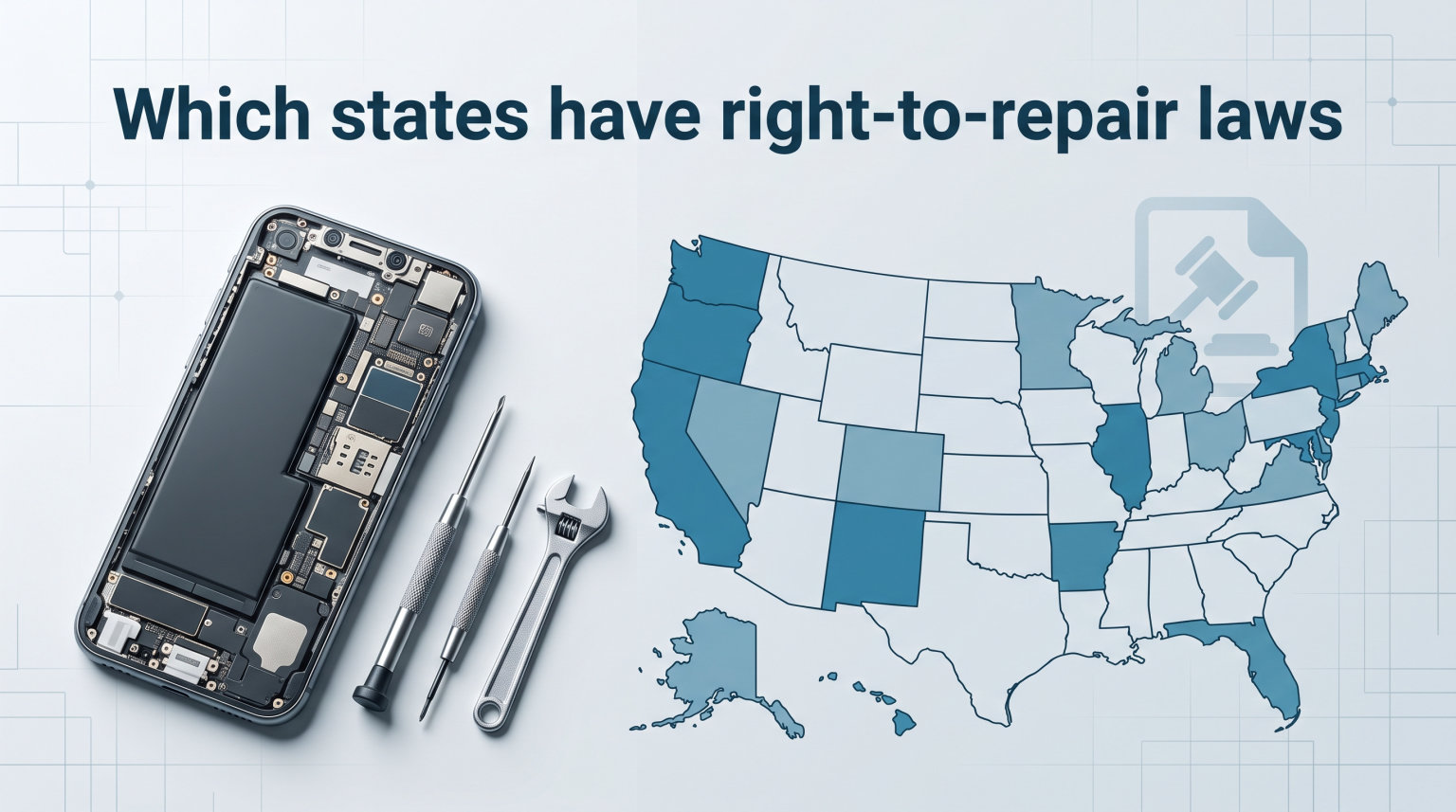
Eight states have enacted right to repair laws covering consumer electronics in 2026: California, Colorado, Connecticut, Maine, Minnesota, New York, Oregon, Texas, and Washington.
I have been tracking the right to repair movement since Colorado passed the first major consumer electronics law in 2022, and the pace has surprised me. What started as a single-state experiment has now spread to nearly a fifth of the country, with more than 25 additional states actively debating bills in 2026.
This guide breaks down every state that has an enforceable right to repair law on the books, what each law actually covers, and how lawmakers are pushing the boundaries of product repair access. I will also walk you through pending legislation, federal efforts, and how you can use these laws the next time your phone, laptop, or tractor breaks.
Table of Contents
What Is Right to Repair?
Right to repair laws require manufacturers to give consumers and independent repair shops fair access to the parts, tools, software, and documentation needed to fix products they own.
The idea is simple: if you bought a device, you should control how it gets fixed. In practice, these laws force manufacturers to stop hoarding repair resources behind authorized service networks.
The right to repair movement covers three main product categories. Consumer electronics includes smartphones, laptops, tablets, and gaming consoles. Automotive covers motor vehicles and their telematics systems. Agricultural and disability equipment covers tractors, combines, and powered wheelchairs.
All 50 states have now introduced right to repair legislation, according to the Repair Association. Eight states have enacted laws for consumer electronics, and several states have laws covering specific sectors like cars and farm equipment.
What unites these laws is the principle that manufacturers cannot use technical locks, restricted parts, or exclusive service agreements to push consumers toward expensive authorized repair channels. The Magnuson-Moss Warranty Act already protects consumers from having warranties voided for using third-party parts, and state laws reinforce that federal protection.
Why Right to Repair Laws Exist
Repair costs have risen faster than device prices in many categories. A smartphone screen replacement through an authorized channel can cost half the price of a new device, while third-party shops often do the same job for a fraction of the cost.
Environmental concerns also drive the movement. The Public Interest Research Group estimates that extending the lifespan of consumer electronics by even one year could save millions of tons of e-waste annually.
Rural communities and farmers face particular challenges when equipment breaks down. Waiting days for an authorized technician can mean lost crops or stalled harvests, which is why farm equipment right to repair laws have bipartisan support.
States With Enacted Right to Repair Laws in 2026
Eight states have enacted right to repair laws covering consumer electronics as of 2026, plus several states with automotive-specific or equipment-specific laws.
For consumer electronics repair, the eight states are California, Colorado, Connecticut, Maine, Minnesota, New York, Oregon, Texas, and Washington. I count nine states because Maine’s law extends to consumer electronics beyond the automotive sector.
For automotive repair, Massachusetts has the longest-standing right to repair law, dating back to 2012. Maine passed a similar automotive law in 2024 that includes telematics data for model year 2026 and newer vehicles.
For farm equipment, multiple states have passed laws requiring manufacturers to share diagnostic tools, software, and repair documentation. These laws grew out of the 2016 John Deere tractor repair dispute.
The complete list of states with enforceable right to repair laws in 2026 includes:
California (SB 244, AB 1163, SB 1595)
Colorado (HB 24-1121)
Connecticut (HB 5142)
Maine (automotive right to repair, LD 1531)
Massachusetts (automotive right to repair, 2012)
Minnesota (Digital Fair Repair Act)
New York (Digital Fair Repair Act)
Oregon (SB 1596)
Texas (HB 2963)
Washington (SB 5936)
State by State Breakdown and Effective Dates
Each state’s right to repair law takes effect on a different timeline, and the scope varies depending on what the legislature agreed to.
I have compiled the effective dates for every active law so you can see what is enforceable right now and what is coming soon.
California
California passed the first right to repair law in the United States in 2022, and expanded it in 2023 and 2024. The original SB 244 took effect July 1, 2024, covering consumer electronics like smartphones, laptops, and tablets. AB 1163 expanded coverage to include home appliances in 2025. SB 1595 took effect in 2026 and addresses parts pairing restrictions.
California’s laws require manufacturers to provide parts, tools, and documentation for seven years after a product is manufactured. The 2025 expansion covers appliances for three years.
Colorado
Colorado’s HB 24-1121 took effect January 1, 2026. The law covers consumer electronics, including wheelchairs, and requires manufacturers to provide parts, tools, and documentation for five years.
Colorado has been praised as having one of the broadest right to repair laws in the country. It includes powered wheelchairs, which is meaningful for the disability community.
Connecticut
Connecticut’s HB 5142 took effect July 1, 2026. The law covers consumer electronics and requires manufacturers to provide parts, tools, and documentation for three years after manufacture.
Maine
Maine has two distinct right to repair laws. The original automotive law took effect in 2014. The newer LD 1531 took effect January 1, 2026, covering consumer electronics and extending the automotive law to include telematics data access for model year 2026 and newer vehicles.
Massachusetts
Massachusetts passed the first right to repair law in the United States in 2012, covering automotive telematics. The law took effect for model year 2018 and newer vehicles.
Massachusetts voters also passed a 2020 ballot measure expanding automotive right to repair, which extends the telematics access requirement to all connected vehicles.
Minnesota
Minnesota’s Digital Fair Repair Act took effect July 1, 2026. The law covers consumer electronics and requires manufacturers to provide parts, tools, and documentation for three years.
New York
New York’s Digital Fair Repair Act took effect July 1, 2026. The law covers consumer electronics for five years after manufacture and includes powered wheelchairs.
Oregon
Oregon’s SB 1596 took effect January 1, 2026. The law covers consumer electronics for seven years and includes explicit language about parts pairing restrictions.
Texas
Texas became the 8th state to enact a consumer electronics right to repair law when Governor Greg Abbott signed HB 2963 in 2025. The law took effect September 1, 2026, and covers consumer electronics for three years after manufacture.
Washington
Washington’s SB 5936 took effect January 1, 2026. The law covers consumer electronics and requires manufacturers to provide parts, tools, and documentation for three years.
Automotive and Mobility Right to Repair Laws
Automotive right to repair laws are older than consumer electronics laws, with Massachusetts leading the way in 2012.
The automotive right to repair framework requires manufacturers to provide diagnostic tools, repair manuals, and telematics data through standardized platforms. This allows independent mechanics to work on modern vehicles with computer-controlled systems.
Massachusetts Automotive Right to Repair
Massachusetts’ 2012 law was the first in the nation to require manufacturers to provide access to vehicle diagnostic and telematics systems. The 2020 ballot measure extended this access to real-time data through in-vehicle applications.
Maine Automotive Right to Repair
Maine’s LD 1531 took effect in 2026 and updated the automotive right to repair framework to include telematics data for model year 2026 and newer vehicles. This was a significant expansion because modern vehicles share extensive data with manufacturers through cellular connections.
Other Automotive Right to Repair Activity
Several other states have pending automotive right to repair legislation in 2026. New Jersey, Pennsylvania, and Vermont have introduced bills that would mirror the Massachusetts framework.
Farm equipment right to repair laws are also spreading. States including Colorado, Minnesota, and Washington have enacted equipment-specific provisions that cover tractors, combines, and other agricultural machinery.
What Products Are Covered Under Right to Repair Laws
Right to repair laws cover a wide range of consumer products, but the exact scope varies by state.
Most consumer electronics right to repair laws cover smartphones, tablets, laptops, desktop computers, gaming consoles, and similar devices. Some states extend coverage to home appliances, powered wheelchairs, and agricultural equipment.
Devices Typically Covered
The most commonly covered products include:
Smartphones and tablets
Laptops and desktop computers
Gaming consoles and accessories
Smart home devices
Home appliances (in California)
Powered wheelchairs (in Colorado, New York, Oregon)
Agricultural equipment (in multiple states)
What Manufacturers Must Provide
When a right to repair law applies, manufacturers must give consumers and independent repair shops access to:
Replacement parts at fair and reasonable prices
Specialized tools needed for repair
Repair manuals and technical documentation
Diagnostic software and firmware updates
Security credentials needed for pairing new parts
Manufacturers cannot void warranties solely because a consumer used a third-party repair shop or non-authorized parts. This is already required by the federal Magnuson-Moss Warranty Act, but state laws make enforcement clearer.
What Fair and Reasonable Means
Most right to repair laws include a “fair and reasonable” pricing standard. This typically means parts must be priced similarly to what manufacturers charge authorized repair centers, and documentation must be available at the cost of reproduction.
Manufacturers cannot bundle repair-parts access with extended warranty purchases or other unauthorized services. This requirement prevents the kind of vendor lock-in that originally motivated the right to repair movement.
Excluded Products and Parts Pairing Restrictions
Right to repair laws do not cover every product, and parts pairing remains a controversial issue even in states with strong laws.
Most laws explicitly exclude several categories. Video game consoles, because of cheating concerns. Medical devices, because of FDA regulation. Motor vehicles, because of separate automotive laws. Safety-critical systems like airbags and braking components.
Common Exclusions
Products typically excluded from right to repair laws include:
Video game consoles and anti-cheat systems
Medical devices regulated by the FDA
Motor vehicles subject to automotive right to repair laws
Safety-critical systems (airbags, anti-lock brakes)
Products where cybersecurity would be compromised
The Parts Pairing Problem
Parts pairing is the practice of software-locking components so that only authorized parts work with a device. Even if you can buy a replacement screen, the device may refuse to function without manufacturer authorization.
Apple’s iPhone parts pairing is the most famous example. After a screen replacement, the iPhone shows a warning message and may disable certain features until the part is “authorized” through Apple’s proprietary tools.
Oregon’s SB 1596 and California’s SB 1595 directly address parts pairing. These laws require manufacturers to provide software tools that allow authorized parts pairing, but critics argue they do not go far enough.
Forum discussions on Reddit and other platforms show that consumers remain frustrated by parts pairing restrictions even in states with strong right to repair laws. The laws require manufacturers to provide tools, but do not always require manufacturers to make parts pairing work as smoothly as authorized channels.
Pending State Legislation in 2026
More than 25 states have active right to repair bills in 2026, and several are likely to pass before the end of the year.
The states with the most active right to repair legislation include Vermont, New Jersey, Pennsylvania, Illinois, Ohio, and Virginia. Bills in these states cover consumer electronics, agricultural equipment, or both.
States to Watch in 2026
Three states are particularly likely to pass right to repair laws in 2026:
Illinois has a Digital Fair Repair Act that has passed one chamber and is expected to be signed into law.
Vermont has a consumer electronics bill that cleared committee in June 2026.
New Jersey has a comprehensive bill that combines consumer electronics and automotive provisions.
Industry Response
Manufacturer lobbying has slowed some bills, but public support remains strong. A 2024 Consumer Reports survey found that 84% of Americans support right to repair legislation, regardless of political affiliation.
Apple, which once opposed right to repair laws, announced in 2022 that it would begin selling parts and tools to consumers. The company has since expanded its self-service repair program to additional products.
Federal Right to Repair Legislation
Federal right to repair legislation has been introduced but not enacted, leaving the United States with a patchwork of state laws.
The Fair Repair Act and the REPAIR Act are the two main federal bills. The Fair Repair Act would require manufacturers to provide parts, tools, and documentation for consumer electronics. The REPAIR Act focuses on automotive telematics data access.
Federal Bill Status in 2026
Neither bill has passed both chambers of Congress as of mid-2026. The Fair Repair Act has been reintroduced in the current Congress and has support from both parties. The REPAIR Act has bipartisan backing but has stalled in committee.
Federal legislation would create a uniform standard across all 50 states, eliminating the patchwork problem that consumers and manufacturers face today.
Federal Trade Commission Action
The Federal Trade Commission has issued reports in favor of right to repair and has brought enforcement actions against manufacturers that unfairly restrict repairs. The FTC Nixing Itself in the Teeth of Repair Restrictions Act is expected to be finalized in 2026.
Executive Branch Position
The current administration has expressed support for right to repair at the federal level. The 2021 executive order on promoting competition included right to repair directives, and that position has continued under subsequent administrations.
Federal preemption of state laws is unlikely, given the bipartisan support for right to repair. States are likely to continue passing their own laws even if federal legislation passes.
How to Use Your Right to Repair as a Consumer?
If you live in a state with a right to repair law, you have specific rights that manufacturers must respect.
I have repaired my own devices for years, and the process is easier than most people think. Here is how to exercise your rights under state right to repair laws.
Step 1: Confirm Your State Has a Law
Check the list above to see if your state has an active right to repair law. If you live in one of the eight states with consumer electronics right to repair laws, you have specific protections.
Step 2: Find Authorized Parts
Manufacturers must provide parts at fair and reasonable prices. Most major manufacturers now have self-service repair programs. Apple’s Self Service Repair, Samsung’s Self-Repair, and Google’s iFixit partnership are the most established options.
You can also buy parts from independent suppliers like iFixit, Injured Gadgets, and mobile defender. These suppliers often offer parts at lower prices than manufacturer programs.
Step 3: Access Documentation
Manufacturers must provide repair manuals, diagnostic tools, and technical documentation. Some manufacturers publish this information on their websites. Others require you to request it directly.
iFixit has assembled repair manuals for thousands of devices, and many of these are free to access. The community-driven model means you can often find a guide before the manufacturer publishes one.
Step 4: Verify Your Warranty Rights
Under the federal Magnuson-Moss Warranty Act, manufacturers cannot void your warranty solely because you used a third-party repair shop or non-authorized parts. State right to repair laws reinforce this protection.
If a manufacturer refuses to honor a warranty after a third-party repair, you can file a complaint with your state Attorney General or the FTC.
Step 5: Report Violations
If a manufacturer refuses to provide parts, tools, or documentation in a state with an active right to repair law, you can report the violation to your state Attorney General. Several states have already issued fines and consent decrees against manufacturers that violate right to repair laws.
Frequently Asked Questions
How many US states have the right to repair?
Eight states have enacted right to repair laws covering consumer electronics in 2026: California, Colorado, Connecticut, Maine, Minnesota, New York, Oregon, Texas, and Washington. Several additional states have automotive-specific or equipment-specific right to repair laws, including Massachusetts and Maine for motor vehicles.
What is the right to repair legislation in 2026?
Right to repair legislation in 2026 consists of state laws requiring manufacturers to provide consumers and independent repair shops with access to replacement parts, specialized tools, repair documentation, and diagnostic software. Federal legislation has been proposed but not enacted, leaving the United States with a patchwork of state laws covering consumer electronics, automotive telematics, and agricultural equipment.
Which states have right to repair laws for cars?
Massachusetts has had an automotive right to repair law since 2012, and Maine updated its automotive law in 2026 to include telematics data for model year 2026 and newer vehicles. New Jersey, Pennsylvania, and Vermont have pending automotive right to repair bills. The federal REPAIR Act would create a national automotive right to repair standard but has not passed.
Did the federal Right to Repair Act pass?
No federal right to repair law has passed as of 2026. The Fair Repair Act would cover consumer electronics, and the REPAIR Act would cover automotive telematics. Both bills have bipartisan support but have stalled in Congress. States continue to pass their own laws while federal legislation is debated.
What does the right to repair law mean for consumers?
Right to repair laws mean consumers can choose where to get their devices fixed, including independent repair shops and self-repair. Manufacturers must provide parts, tools, and documentation at fair prices, and cannot void warranties solely because third-party parts or services were used. This typically saves consumers money and reduces e-waste.
Conclusion
Eight states have enacted right to repair laws covering consumer electronics in 2026, with more on the way and federal legislation gaining momentum.
The right to repair movement has reached a tipping point. What began with Massachusetts’ automotive law in 2012 has expanded to cover consumer electronics, home appliances, wheelchairs, and farm equipment across nine states. The trajectory is clear: more states will pass right to repair laws in 2026 and beyond, and federal legislation is likely to follow within the next few years.
If you live in one of these states, the laws are real and enforceable. You have the right to repair your own devices, the right to choose independent repair shops, and the right to expect manufacturers to provide parts, tools, and documentation at fair prices. Check your state’s specific law to see exactly what is covered and how to report violations.