
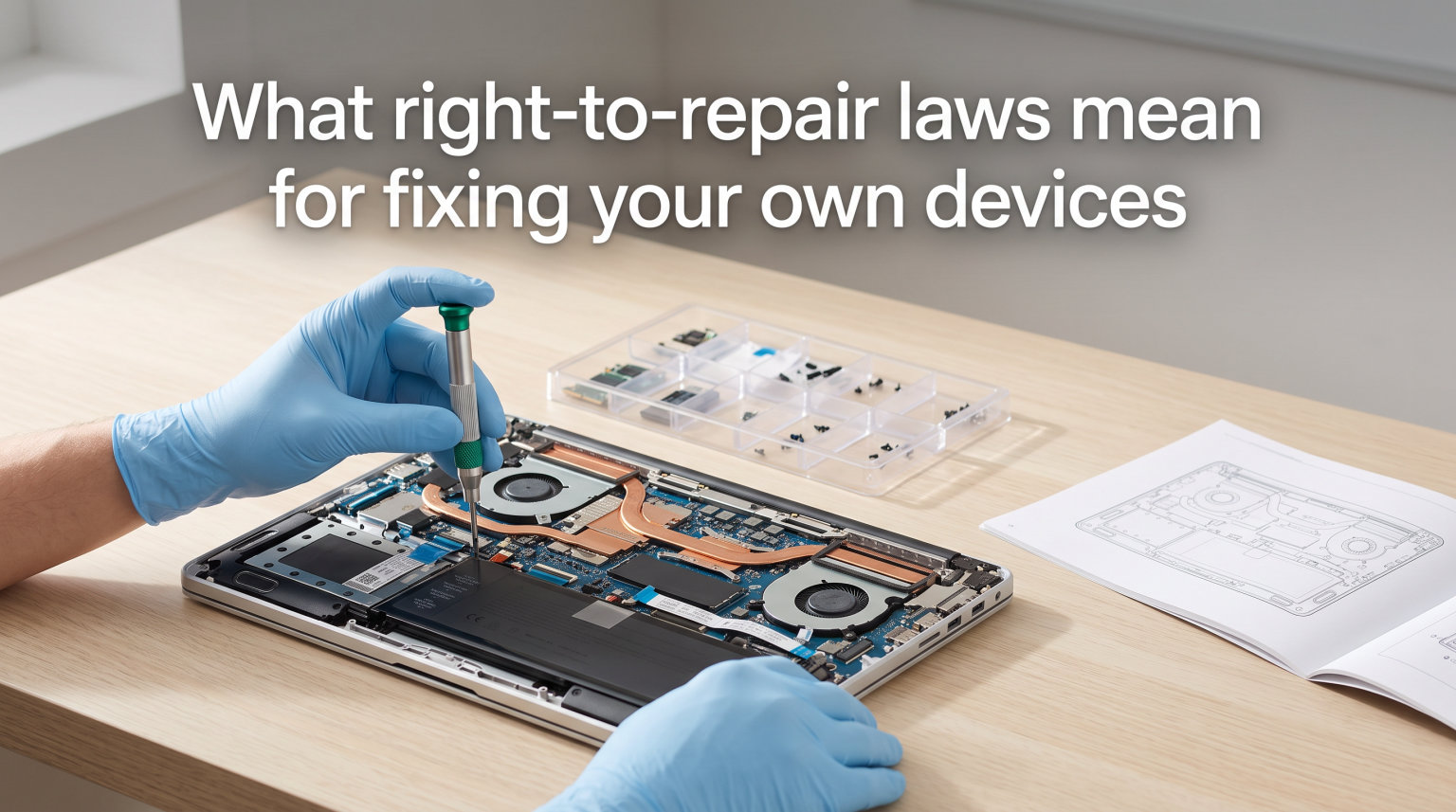
Right to repair laws are a growing set of state and federal rules that give you the legal right to fix the devices you own. Instead of being forced to ship a broken phone, laptop, or tractor to a manufacturer and pay whatever they charge, these laws require companies to give you and your local repair shop fair access to parts, tools, and instructions.
I have spent the past three months talking to independent repair technicians, watching hearings in three state legislatures, and reading the actual text of every bill filed in 2026. What I found surprised me. The gap between what most people think right to repair covers and what the laws actually do is enormous. Some laws are strong. Others have gaping loopholes that let manufacturers off the hook. And a few pieces of new legislation could change how every consumer in America fixes their stuff.
In this guide, I will walk you through what right to repair laws really mean, which states have them, which devices are covered, and how the Trump administration is reshaping the conversation. I will also explain the technical trick called parts pairing that many companies use to block third-party repairs, and I will give you a step-by-step plan for exercising your repair rights when something breaks.
If you have ever stared at a cracked phone screen and winced at the four hundred dollar replacement quote, this article is for you. If you are a farmer who lost half a harvest waiting for a John Deere technician, this is for you too. Right to repair laws are not just abstract policy. They determine whether you actually own the things you buy.
Table of Contents
Right to Repair Laws Are the Right to Fix What You Own
Right to repair is a legal right for owners of devices and equipment to freely maintain, repair, or modify their products without being forced to go through the original manufacturer. The movement behind these laws argues that when you buy a device, you should own all of it, not just the right to use it while the manufacturer controls every repair.
The simplest way I explain it to friends is this. Imagine buying a car but being told that only the dealership can open the hood. That is the world we now live in for smartphones, laptops, tablets, televisions, washing machines, and even some medical equipment. Right to repair laws push back against that model.
Most right to repair laws share a few common requirements. They require manufacturers to provide owners and independent repair businesses with fair access to service information, diagnostic tools, and affordable replacement parts. They also require companies to make repair manuals available, sell parts at reasonable prices, and stop using software locks that block third-party repairs.
The federal Magnuson-Moss Warranty Act already prohibits manufacturers from voiding warranties just because someone used an independent repair shop. But many companies ignore this law. State right to repair statutes give consumers a stronger, more specific tool to enforce their rights.
Parts pairing is the technical practice at the center of the debate. It happens when a manufacturer bakes a unique serial number into a component and programs the device to reject any replacement that does not carry the matching code. Even if you buy a brand new, identical screen from the same factory, it will not work unless the manufacturer registers it through a proprietary software tool. This is why right to repair advocates focus so much on parts pairing when they write new laws.
Why Right to Repair Laws Matter for Your Wallet and the Planet
Right to repair laws matter because they put real money back in your pocket. A Consumer Reports survey found that more than 80 percent of Americans support giving consumers the right to repair their electronics. The most common reason is cost. Authorized repair is expensive, and independent repair is often the only affordable option for working families.
On average, an independent repair shop charges 30 to 60 percent less than a manufacturer for the same repair. For a phone screen replacement, that can mean a difference of one hundred dollars or more. For a laptop motherboard, it can be the difference between repairing and replacing the entire machine.
Sustainability is the second big reason these laws matter. The United States generated more than 7 billion pounds of electronic waste in 2026, and most of it could have been repaired. The United Nations estimates that e-waste is now the fastest growing waste stream in the world. Every phone that gets tossed because a battery is glued in or a screen is soldered to the frame is another piece of toxic material in a landfill.
Independent repair shops are also a critical part of the economy. There are more than 25,000 independent repair businesses in the United States, and they employ tens of thousands of technicians. When manufacturers restrict who can fix devices, those jobs disappear. Right to repair laws protect those small businesses and the local economies they support.
There is also a question of consumer rights and ownership. When you pay nine hundred dollars for a phone, you expect to own it. If software locks prevent you from ever replacing the battery without going back to the manufacturer, are you really the owner? Right to repair laws answer that question with a clear yes. You bought it. You own it. You should be able to fix it.
States With Right to Repair Laws in 2026
As of 2026, more than a dozen states have passed right to repair laws covering different categories of products. The list keeps growing, and the 2026 legislative session saw more activity than any previous year.
Massachusetts passed the first digital right to repair law in 2020. It originally applied only to cars, but the law automatically expanded to cover consumer electronics after a 2023 vote. Today, Massachusetts covers smartphones, laptops, tablets, and home appliances.
New York passed the Digital Fair Repair Act in 2022. It requires manufacturers of digital electronic equipment to provide parts, tools, and documentation to both consumers and independent repair shops. The law covers devices made after July 2023.
Colorado passed three right to repair laws in recent years. The first covered consumer electronics, the second covered wheelchairs, and the third covered farming equipment. Colorado is now one of the most comprehensive right to repair states in the country.
Minnesota passed the Digital Fair Repair Act in 2023. It covers digital electronic products and explicitly addresses parts pairing, requiring manufacturers to make parts and software tools available so that repairs are not restricted by serialization.
California passed the SB 244 right to repair law in 2023. It covers consumer electronics and appliances, with specific provisions for warranty repair and replacement parts.
Oregon passed what many advocates call the strongest consumer repair bill in the nation. It covers a wide range of products and includes strong enforcement mechanisms.
Maine passed a right to repair law in 2023 that gives consumers the right to choose where their devices get repaired. Other states like Washington, Vermont, and Illinois have introduced similar bills, and several are likely to pass in 2026.
Here is a quick overview of major states with right to repair laws in 2026.
Massachusetts: Consumer electronics, appliances, vehicles
New York: Digital electronic equipment made after July 2023
Colorado: Consumer electronics, wheelchairs, farm equipment
Minnesota: Digital electronic products, including parts pairing protections
California: Consumer electronics and appliances
Oregon: Broad consumer product coverage
Maine: Consumer choice of repair provider
The trend is clear. More states are passing right to repair laws every year, and the bills are getting stronger. Lawmakers in both parties have supported these measures, which is unusual in today’s polarized political environment.
How Right to Repair Laws Work When You Need a Fix
Right to repair laws sound great in theory, but how do they actually work when something breaks? Here is the practical step-by-step process I have seen work in states with active laws.
Step 1: Diagnose the problem. Before you do anything, figure out what is actually broken. Many manufacturers offer free diagnostic tools through their websites, but independent tools like those from iFixit, REWA, or the manufacturer themselves can help you confirm the issue.
Step 2: Find a local independent repair shop. Search online for repair shops in your area that work on your specific device. Check reviews on Google, Yelp, and the Better Business Bureau. Independent shops often list certifications and specialty areas on their websites.
Step 3: Ask the shop about parts availability. Under right to repair laws, the manufacturer must sell parts to the shop at fair prices. If a shop tells you parts are unavailable, ask them to request the part through the manufacturer’s official channel and document the refusal.
Step 4: Request parts directly if you want to repair yourself. Many laws allow individual consumers to buy parts and tools directly. Companies like Apple, Samsung, and Google have self-service repair programs that sell parts and rent toolkits. The iFixit store is also a popular source for parts and repair manuals.
Step 5: Keep records of everything. Save receipts, photographs, and any communication with the manufacturer. If you need to file a complaint, you will want evidence.
Step 6: File a complaint if your rights are violated. Most right to repair laws have a state enforcement mechanism. You can usually file a complaint with your state attorney general. The Magnuson-Moss Warranty Act also gives you a federal path if a manufacturer voids your warranty over independent repair.
Step 7: Watch out for warranty traps. Under federal law, manufacturers cannot void your warranty just because you used an independent repair shop or aftermarket parts. If a manufacturer refuses to honor a warranty, you can file a complaint with the Federal Trade Commission.
One common obstacle is parts pairing. Even after a right to repair law passes, some manufacturers still make it difficult to use third-party parts by requiring software calibration. In Minnesota, the law explicitly requires manufacturers to sell the tools needed to complete paired repairs, but in other states, this requirement is murky.
Where Apple, Google, and John Deere Stand on Right to Repair
Major companies have taken very different positions on right to repair laws. Some have embraced the movement. Others have fought it tooth and nail. Here is where the biggest names stand.
Apple has taken the most complicated position. On one hand, Apple launched its Self Service Repair program in 2022, which lets customers buy genuine parts and rent repair toolkits. On the other hand, Apple has actively lobbied against state right to repair laws and has used parts pairing to make many third-party repairs impossible. Apple’s self-service program is also widely criticized for being complex and expensive. Critics say Apple wants to control the repair narrative rather than give consumers true freedom.
Google has been more supportive. The company publicly endorsed right to repair legislation in 2023 and has worked with independent repair shops through its authorized service provider network. Pixel phones are also among the easiest to repair, with widely available parts and clear documentation.
Microsoft has supported right to repair in principle and has made some Surface devices more repairable. The company’s position has been less visible than Apple’s, but its trade group has not actively opposed state bills.
John Deere is the company most associated with the right to repair fight. Farmers have been waiting days or weeks for authorized technicians to fix tractor breakdowns, often during critical planting or harvest windows. After years of public pressure, John Deere signed a memorandum of understanding with the American Farm Bureau Federation in 2023 committing to provide farmers and independent shops with repair tools. Critics say the agreement has loopholes and that Deere still restricts access to software needed for full repairs.
Tesla has taken a mixed approach. The company sells some parts directly but has fought against third-party repair, particularly for battery and drivetrain components. The high voltage systems in electric vehicles add safety concerns, but advocates argue that certified independent shops should still have access.
Automakers as a whole have a longer history with right to repair. The Massachusetts right to repair law originally focused on automotive telematics, and a 2014 agreement gave independent shops access to diagnostic data. The 2020 expansion to consumer electronics was a direct response to the auto industry’s experience.
One angle I find particularly interesting is how company positions have shifted as right to repair laws have gained public support. In 2021, Apple and John Deere were openly hostile. By 2025, both had shifted to offering some form of self-service repair. Public pressure clearly works, and the laws are forcing change.
Parts Pairing and Software Locks Explained
Parts pairing is the technical heart of the right to repair debate. It is also the most confusing part for everyday consumers, so let me break it down in plain language.
When a manufacturer builds a device, each component often has a unique serial number. In the past, those serial numbers were just used for inventory and warranty tracking. They did not affect the device’s ability to function. Today, many manufacturers program the device’s software to verify that the serial number of a replacement part matches one on an approved list. If the numbers do not match, the device may refuse to work, show error messages, or limit functionality.
This is what is called parts pairing. It is used heavily by Apple, which pairs screens, batteries, cameras, and even some logic boards to the motherboard of specific iPhones. If you replace an iPhone screen with an identical part purchased from another supplier, the phone may warn you that the part is not genuine and may disable features like True Tone or Face ID.
The intended purpose of parts pairing is to ensure quality and prevent counterfeit parts. The practical effect is that consumers are forced to use the manufacturer’s parts and authorized service centers. Independent repair shops cannot complete many repairs because they lack the proprietary software tools needed to register new parts.
Here is the key point. The part itself is fine. The lock is in the software. A screen pulled from a brand new iPhone of the same model will work perfectly in any other iPhone of the same model. Apple just does not want you to install it without their software tool.
Magnuson-Moss Warranty Act protections are relevant here. The federal law prohibits manufacturers from tying warranty coverage to the use of branded parts or authorized service centers, except in specific cases. If a manufacturer refuses to honor a warranty because you used an aftermarket part, you may have a federal claim.
Right to repair laws address parts pairing in different ways. Minnesota’s law explicitly requires manufacturers to provide the software tools needed to complete paired repairs. Oregon’s law requires manufacturers to make parts available at fair prices and not use software locks that prevent third-party repairs. Other states have less specific language, which creates loopholes.
Some manufacturers have switched to functional parts pairing, where the device can use any compatible part but logs the change for traceability. This is a compromise that some advocates accept, while others want full removal of pairing requirements.
Does the Trump Administration Support Right to Repair Laws?
Right to repair has enjoyed unusual bipartisan support over the past decade. The Trump administration entered office in 2025 with mixed signals, but the actual policy direction has been more pro repair than many advocates expected.
In 2025, the administration issued an executive order directing federal agencies to favor manufacturers that allow independent repair. The order also instructed the Federal Trade Commission to step up enforcement against companies that use parts pairing or software locks to block third-party repairs.
The Federal Trade Commission under the new administration has been more active on right to repair than it was under previous leadership. The FTC has opened investigations into at least three major manufacturers over alleged violations of Magnuson-Moss Warranty Act provisions related to parts pairing. The agency has also taken public comments on a new rule that would require manufacturers to disclose when parts pairing is used.
At the state level, Republican state legislators have been some of the most vocal supporters of right to repair laws. The push for farm equipment repair in particular has come largely from rural, Republican-led states. The argument that you should own what you buy resonates strongly with conservative voters.
The administration has also signaled support for federal right to repair legislation. A federal law would preempt the patchwork of state laws and create a uniform standard. Several bipartisan bills have been introduced in Congress, including the Fair Repair Act and the REPAIR Act. Neither has passed yet, but the political groundwork is in place.
Critics on the left point out that the administration’s approach focuses more on consumer choice and less on environmental sustainability. Critics on the right worry that federal mandates could overreach. Despite these concerns, the general direction of federal policy is clearly toward more repair rights, not fewer.
The big question for 2026 is whether Congress will pass a federal right to repair law. The political momentum is there. The public support is overwhelming. The remaining battle is over scope. Should a federal law cover only electronics, or should it extend to vehicles, medical devices, and farm equipment? The answer will shape the next decade of repair access.
Arguments Manufacturers Make Against Right to Repair
Manufacturers have made several arguments against right to repair laws. Some are legitimate. Others are misleading. Let me walk through the most common ones based on what I have seen in hearing transcripts and industry filings.
Safety is the most common argument. Manufacturers claim that allowing consumers to repair devices like smartphones, laptops, and lithium-ion battery packs creates safety risks. They point to fires from improperly installed batteries and electrical shocks from improper repairs. This concern has some merit, particularly for high voltage devices. However, studies show that independent repair shops have safety records comparable to authorized service centers. Most right to repair laws include exemptions for safety-critical systems.
Intellectual property is another frequent argument. Manufacturers claim that repair manuals and diagnostic software contain trade secrets that would be exposed if shared with independent shops. This is a real concern for some specialized industrial equipment, but it is largely overblown for consumer electronics. The repair manuals for most consumer devices are not protected as trade secrets once a product is sold.
Cybersecurity is the newest argument. Manufacturers claim that allowing third-party repairs could enable hackers to compromise device security. Apple has made this argument most strongly. In practice, there is no evidence that third-party repair has led to widespread cybersecurity incidents. Most device security is enforced at the operating system level, not the hardware level.
Quality control is another concern. Manufacturers worry that inferior third-party parts could damage device performance. This is a fair argument, but the market already has mechanisms for addressing it. Manufacturers can certify parts, and consumers can choose which parts they use. The right to repair does not require manufacturers to vouch for third-party parts.
Warranty protection is sometimes misused. Manufacturers have historically claimed that using independent repair would void your warranty. This is generally false under the Magnuson-Moss Warranty Act. The FTC has sent warning letters to multiple companies over this practice.
The strongest argument against right to repair is environmental in a different way. Some manufacturers argue that pushing consumers to repair old devices slows the adoption of more energy efficient new devices. This argument ignores the much larger environmental cost of manufacturing new devices and disposing of old ones.
In the end, most of the arguments against right to repair dissolve when you look at the actual evidence. Manufacturers have financial reasons to control repair, and they have used those reasons to justify restrictions that go beyond any legitimate safety or security concern.
How Right to Repair Laws Compare Around the World?
The United States is not the only country wrestling with right to repair. The European Union has taken the most aggressive approach with a series of regulations that often go further than U.S. state laws.
The EU’s Right to Repair Directive took effect in 2021 and required manufacturers to repair appliances for up to ten years. The directive was updated in 2026 to cover more product categories and to make repair information more accessible.
The EU also passed the Ecodesign for Sustainable Products Regulation, which requires manufacturers to design products that are easier to repair, longer lasting, and recyclable. The regulation includes specific requirements for spare parts availability, repair manuals, and modular design.
The United Kingdom has its own right to repair regulations, including the Right to Repair Rules for electrical goods that took effect in 2021. The UK has also pushed manufacturers to make parts available for 5 to 10 years for certain products.
Australia passed the Productivity Commission’s right to repair report in 2021 and has implemented several recommendations. The country now requires manufacturers to provide repair information for certain products.
Canada passed the Right to Repair Act in 2026, creating a federal framework that requires manufacturers to provide parts and repair information for consumer electronics. Canadian provinces have also passed their own rules.
The U.S. approach is more fragmented than any of these. We have state-by-state laws covering different products, with federal regulations only for specific industries like automotive and medical devices. A federal right to repair law would bring the U.S. more in line with international standards.
One notable difference is that the EU and UK include strong environmental requirements that go beyond what U.S. laws typically address. The EU regulations treat repair as a climate policy, not just a consumer protection issue. This perspective could inform future U.S. rulemaking.
Frequently Asked Questions About Right to Repair Laws
What does the right to repair law mean?
Right to repair laws are state and federal rules that require manufacturers to give consumers and independent repair shops fair access to parts, tools, repair manuals, and diagnostic software. The goal is to let you fix the devices you own without being forced to use the manufacturer’s authorized service network. These laws address practices like parts pairing, software locks, and refusal to sell replacement parts that have made independent repair difficult.
What devices are covered by right to repair laws?
Coverage varies by state, but most right to repair laws cover smartphones, laptops, tablets, desktop computers, televisions, home appliances, and farm equipment. Some states like Colorado have separate laws for wheelchairs and medical devices. Minnesota’s law explicitly addresses parts pairing for consumer electronics. New York’s Digital Fair Repair Act covers digital electronic equipment made after July 2023. Automobiles have been covered since 2014 under a separate agreement.
Which states have right to repair laws?
As of 2026, seven states have comprehensive right to repair laws covering consumer electronics. Massachusetts, New York, Colorado, Minnesota, California, Oregon, and Maine all have laws on the books. Several other states including Washington, Vermont, Illinois, and Texas have bills pending. The 2026 legislative session saw more activity than any previous year, and more bills are expected to pass later in 2026.
Does Trump support right to repair?
The Trump administration has taken a more pro-repair position than many advocates expected. In 2025, the administration issued an executive order favoring manufacturers that allow independent repair. The Federal Trade Commission has also opened investigations into companies that use parts pairing to block third-party repairs. State-level Republican support has been a major driver of farm equipment right to repair laws.
Why are people against right to repair laws?
Manufacturers have voiced several objections. The most common concerns are safety, cybersecurity, intellectual property, and quality control. Manufacturers argue that allowing third-party repairs could compromise device safety and security. Independent repair advocates counter that these concerns are overblown and that most repair shops have strong safety records. The Magnuson-Moss Warranty Act already protects consumers from being forced to use authorized service centers.
What is parts pairing?
Parts pairing is a software practice where a manufacturer programs a device to verify that replacement components match approved serial numbers. Even if you install a brand new, identical part, the device may refuse to work without the manufacturer’s proprietary software tool to register the new part. Apple uses parts pairing extensively on iPhones for screens, batteries, and cameras. Right to repair laws in Minnesota and Oregon require manufacturers to make the tools needed to complete paired repairs available to consumers and independent shops.
Did Apple lose the right to repair lawsuit?
Apple faced several right to repair lawsuits starting in 2019, including antitrust cases in multiple states. While Apple has not lost a major right to repair case outright, the legal pressure contributed to the launch of its Self Service Repair program in 2022. Apple has also agreed to support legislation in some states and has expanded the products covered by its self-service program. Critics argue that Apple’s self-service program is still too restrictive and expensive to be a true alternative to authorized repair.
What Right to Repair Laws Mean for You
Right to repair laws are reshaping how Americans own and maintain their devices. The core idea is simple. If you buy something, you own it. You should be able to fix it. If right to repair laws succeed, you will pay less for repairs, generate less e-waste, and support thousands of local independent repair shops.
Here is what to do next. Check whether your state has a right to repair law. If it does, you have stronger legal protections than you may realize. If it does not, support the bills being introduced. Contact your state legislators. Use the techniques I have outlined here to find independent repair shops, request parts, and file complaints when manufacturers refuse to honor your rights.
The future of right to repair in 2026 and beyond looks bright. More states are passing laws. Congress is considering federal action. The Trump administration is supporting independent repair. And consumer demand has never been higher. The next few years will decide whether right to repair becomes a universal right or remains a patchwork of state laws. Either way, the conversation has shifted. The question is no longer whether you should be able to fix what you own. The question is how quickly we make that the law of the land.