
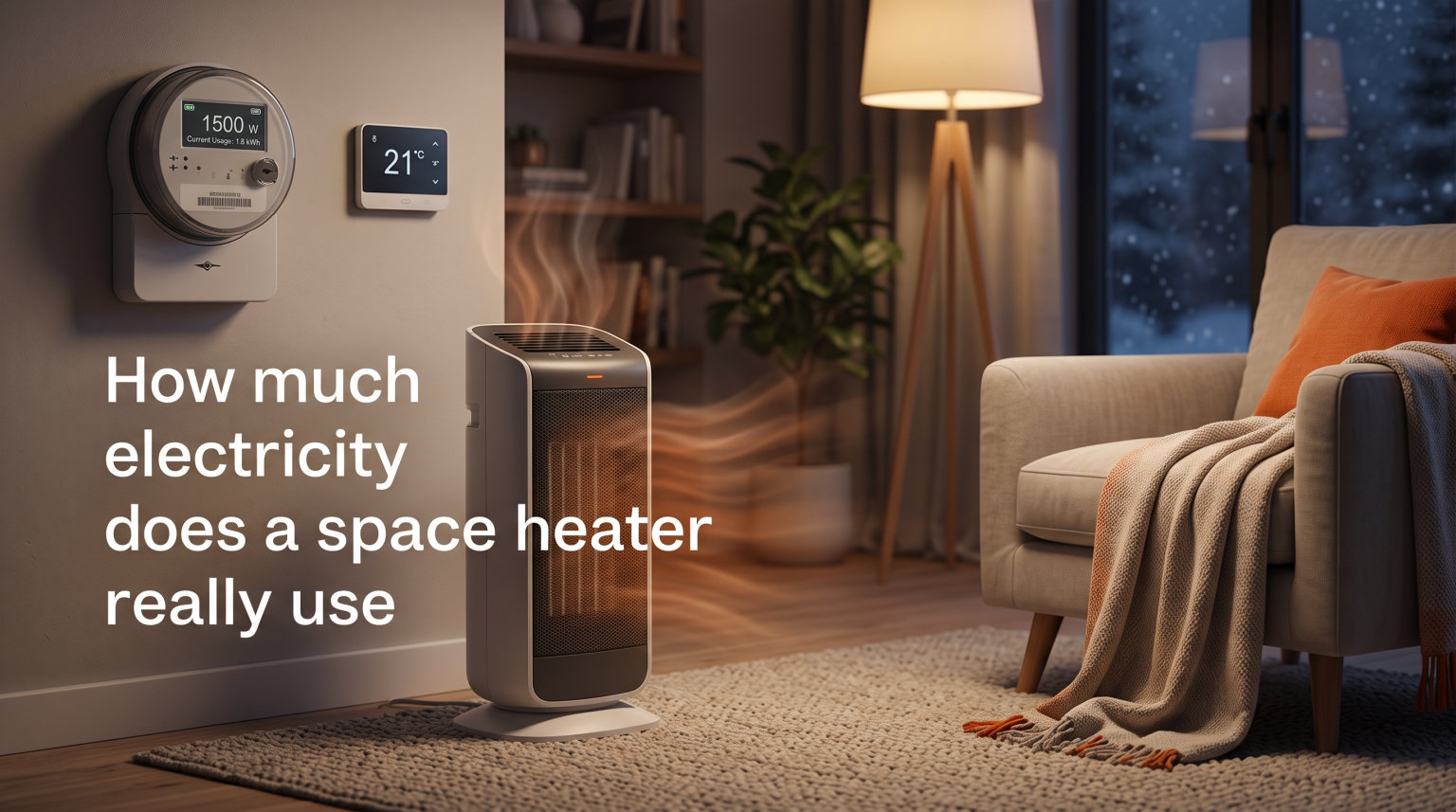
When winter temperatures drop, I hear the same question from friends, neighbors, and readers all the time: how much electricity does a space heater really use?
The short answer is that a typical 1500W space heater pulls 1.5 kilowatt-hours (kWh) of electricity every hour it runs. At the average U.S. residential rate of about 16 cents per kWh, that translates to roughly $0.20 to $0.25 per hour of operation. Run one eight hours a day and you’re looking at around $2.10 per day, or close to $64 per month. But that headline number misses the real story.
In this guide, I’ll break down the actual watts, kWh, and dollars behind space heater electricity usage. I’ll also share real bill experiences from Reddit users, compare space heaters to central heating, and give you practical tips to keep your bill in check. By the end, you’ll know exactly what your heater costs to run and whether it’s actually saving you money.
Table of Contents
How much electricity does a space heater use per hour?
Most electric space heaters use between 750 watts and 1500 watts on their highest setting, with smaller units drawing as little as 400 watts. The wattage rating tells you the rate at which the heater consumes electricity, similar to how a car’s horsepower tells you its maximum output.
A 1500W heater running at full power consumes 1.5 kWh per hour. A 750W heater on low consumes 0.75 kWh per hour. The smaller the room and the better the insulation, the less time the heater actually runs because the thermostat cycles it on and off.
To calculate your cost, multiply the wattage by hours of use, then divide by 1000 to get kWh, then multiply by your local electricity rate.
Understanding watts, kilowatts, and kilowatt-hours
Think of electricity flowing through your home’s wires like water flowing through a pipe. Voltage (measured in volts) is the water pressure pushing the electricity through.
Amps (amperes) measure the volume of electrical current flowing. Watts measure how fast the device uses that electricity, calculated as volts multiplied by amps.
A kilowatt-hour (kWh) is the unit your utility actually bills you for. One kWh means using 1000 watts continuously for one hour. That single number determines what appears on your monthly statement. A 1500W space heater running for one hour burns through 1.5 kWh. Running for 8 hours uses 12 kWh. That matters because a single kWh in the U.S. averages about 16 cents but ranges from 10 cents in Washington State to over 40 cents in parts of California and Hawaii.
Understanding this distinction matters because the wattage on the label tells you the rate, but the kWh on your bill tells you the cost.
How much does running a space heater cost per day, week, and month?
Let me show you the math using three realistic scenarios: occasional use, moderate use, and heavy use. These figures assume a 1500W heater and the U.S. national average rate of about 16 cents per kWh. Your actual cost depends on your local rate, which I’ll cover below.
Cost breakdown table at 16 cents per kWh
1 hour: 1.5 kWh = about $0.24
8 hours (typical workday): 12 kWh = about $1.92
24 hours (constant use): 36 kWh = about $5.76
1 week (8 hrs/day): 84 kWh = about $13.44
1 month (8 hrs/day): 336 kWh = about $53.76
1 month (24/7): 1,080 kWh = about $172.80
These numbers match what Consumer Reports found in their testing: a 1500W heater on high costs roughly $2.10 per 8-hour day or $64 per month. The slight variation comes from different assumed rates.
Real-world bill experiences from Reddit users
Numbers on paper are useful, but I wanted to know what real people actually see on their bills. Reddit threads on r/electrical, r/Frugal, and r/homeowners reveal a wide range of experiences.
One user reported a $162 increase on their monthly bill after running a 1500W heater 24/7 at a rate of 15 cents per kWh. Another user ran an 800W heater for 8 hours every night and saw only a $43 monthly increase.
Several users who used heaters occasionally (a few hours here and there) reported increases of just $20 to $40 per month. The pattern is clear: heavy, constant use produces dramatic bill jumps, while occasional zone heating produces modest increases that many users found manageable.
One Reddit user summed it up well: “I was expecting a $200 bill and got hit with $87. I was actually relieved.”
State-by-state cost variations
Where you live dramatically affects what you pay. According to recent EIA data, Louisiana residents enjoy rates around 10 cents per kWh, making a 1500W heater cost about $0.15 per hour. In California, where rates exceed 30 cents per kWh in some areas, that same hour costs $0.45 or more.
A heater running 8 hours daily could cost $28 per month in Louisiana or over $105 per month in California.
Is it cheaper to use a space heater or central heating?
The honest answer is: it depends on your situation. The comparison isn’t as simple as “space heaters use more electricity” because the math changes based on how you use both systems.
Central heating (whether gas, oil, or electric furnace) heats your entire home. A space heater warms one room. If you only need to warm one room and can lower your thermostat for the rest of the house, a space heater almost always wins. This strategy is called zone heating, and it’s the primary way space heaters save money.
When space heaters save money
Space heaters make economic sense when you spend most of your time in one or two rooms. Common scenarios include working from a home office, sleeping in a cold bedroom, or spending evenings in a living room while the rest of the house stays cooler.
Many homeowners lower their central thermostat to 60°F and use a space heater to bring their primary room to 68°F to 70°F. The savings come from avoiding heating unused space.
A 2,000-square-foot home with central heat set to 70°F uses far more energy than heating one 150-square-foot room to 70°F with a space heater. The Department of Energy notes that zone heating can reduce heating bills by 20% to 40% for households that adopt the practice consistently.
When central heating wins
Central heating beats space heaters when you need to heat most of your home. Running five or six space heaters across different rooms typically costs more than running a gas furnace, because electric resistance heating is less efficient than gas heating.
A gas furnace might convert 80% to 95% of fuel energy into heat, while electricity generated from natural gas at a power plant loses significant energy along the way to your home.
If your home is well-insulated, central heating also tends to be more consistent. Space heaters can overheat one corner while leaving cold spots in others, which wastes energy as people crank them higher trying to compensate.
How to reduce space heater electricity usage and save money?
Yes, you can cut your space heater’s electricity usage significantly with a few practical adjustments. Whether you’re trying to save money or reduce your environmental footprint, the tips below help you get the most warmth from every kWh.
Use the right size heater for the room
Bigger isn’t always better. A 1500W heater in a small bedroom is overkill. The room heats up quickly, the thermostat cycles off, but the startup surges still consume energy.
A 750W heater in a properly sized room runs more steadily and uses less total electricity. General rule: you need about 10 watts per square foot of floor space. A 150-square-foot room needs a 1500W heater; a 100-square-foot room works fine with a 750W unit.
Improve insulation first
I learned this the hard way running a heater in my old drafty apartment. No space heater can compete with a leaky window. Before you invest in a bigger unit, seal gaps around windows and doors with weatherstripping.
Add a draft stopper to doors and close vents in unused rooms. These small changes can cut your heating needs by 10% to 20%.
Use thermostat and eco modes
Modern heaters with digital thermostats and eco modes cycle power based on actual room temperature rather than running continuously. This alone can reduce energy consumption by 20% to 30% compared to older units with manual controls.
Set the thermostat to your comfort level (usually 68°F to 70°F) and let the heater manage itself.
Lower the central thermostat
If you’re using a space heater as supplemental heat, drop your central thermostat to 55°F or 60°F. Each degree you lower the thermostat saves roughly 1% to 3% on heating costs. Combining zone heating with a lower central setting produces the biggest savings.
Time your usage strategically
Some utilities offer time-of-use rates, charging less during off-peak hours. Running your heater during these cheaper windows reduces costs. Also, heat the room before you need it rather than running it all day. A 150-square-foot room reaches comfortable temperatures in 15 to 30 minutes.
Consider solar offset
If you have solar panels, a space heater’s electricity cost can effectively drop to near zero during sunny daytime hours. EnergySage notes that homeowners with solar can offset space heater costs entirely when usage aligns with peak solar production.
For night use, a home battery backup system can store solar energy to run the heater at no ongoing electricity cost.
What safety risks come with space heater electricity use?
Space heaters cause about 1,700 home fires per year in the United States, according to the Consumer Product Safety Commission. Most incidents involve heaters placed too close to furniture, bedding, or curtains, or units left running unattended.
Don’t exceed your circuit’s capacity
A 1500W heater draws 12.5 amps on a standard 120V circuit. Most household circuits are rated for 15 or 20 amps. Running a space heater on the same circuit as other high-draw appliances (vacuum, hair dryer, microwave) can trip breakers or, worse, overheat wiring.
Plug your heater directly into a wall outlet, never into an extension cord or power strip. Extension cords can overheat under sustained high loads and become a fire hazard.
Look for safety certifications
Only use heaters certified by a nationally recognized testing laboratory like UL, ETL, or CSA. Modern safety features to look for include tip-over protection (automatic shutoff if knocked over), overheat protection (automatic shutoff if internal temperatures get too high), and cool-touch exteriors.
These features cost slightly more upfront but significantly reduce fire and burn risks.
Maintain safe clearances
Keep the heater at least three feet from anything flammable: curtains, furniture, bedding, paper, and clothing. Place it on a flat, hard surface like tile or hardwood. Never run a space heater on carpet, which can trap heat underneath the unit and create a fire risk.
Never leave a heater unattended
Turn off the heater when you leave the room or go to sleep. Unattended running is the leading cause of space heater fires. If you need overnight heating, look for models specifically designed for bedroom use with enhanced safety features and automatic timers.
Frequently asked questions about space heater electricity use
How much will a space heater raise your electric bill?
A 1500W space heater running 8 hours per day adds about 360 kWh to your monthly usage. At the U.S. national average rate of 16 cents per kWh, that’s approximately $58 to $64 extra on your electric bill. Actual impact varies by your local electricity rate and how often the heater cycles on.
How much does it cost to run a 1500W space heater for 24 hours?
Running a 1500W heater continuously for 24 hours consumes 36 kWh. At 16 cents per kWh, that’s about $5.76 per day, or roughly $172 per month. Most users don’t run heaters at full power 24/7 because the thermostat cycles off once the room reaches the set temperature.
Is it cheaper to turn up the heat or use a space heater?
It depends on your situation. If you’re heating just one or two rooms, a space heater combined with a lower central thermostat usually costs less. If you need to heat most of your home, central heating typically wins because gas furnaces are more efficient than electric resistance heating. Zone heating with a space heater saves 20% to 40% for most households.
Do space heaters use a lot of electricity compared to other appliances?
Yes, space heaters are among the most power-hungry household appliances. A 1500W heater uses as much electricity as 15 standard LED light bulbs running simultaneously, or roughly half the draw of a hair dryer. They use more electricity than refrigerators, televisions, or laptops, but less than central air conditioning or electric ovens.
Bottom line on space heater electricity use
So how much electricity does a space heater really use? A standard 1500W unit pulls 1.5 kWh per hour at full power, costing roughly $0.20 to $0.25 per hour at average U.S. rates.
Run moderately (8 hours a day) and you’ll add $50 to $65 to your monthly bill. Run constantly and that figure climbs past $170. The key insight is that space heaters make financial sense when used for targeted zone heating, not whole-home heating.
Seal drafts, choose the right size for your room, use the thermostat, and you’ll keep your bills manageable. For more energy-saving strategies or to compare heating options, check out our other guides on home efficiency and winter preparation.