
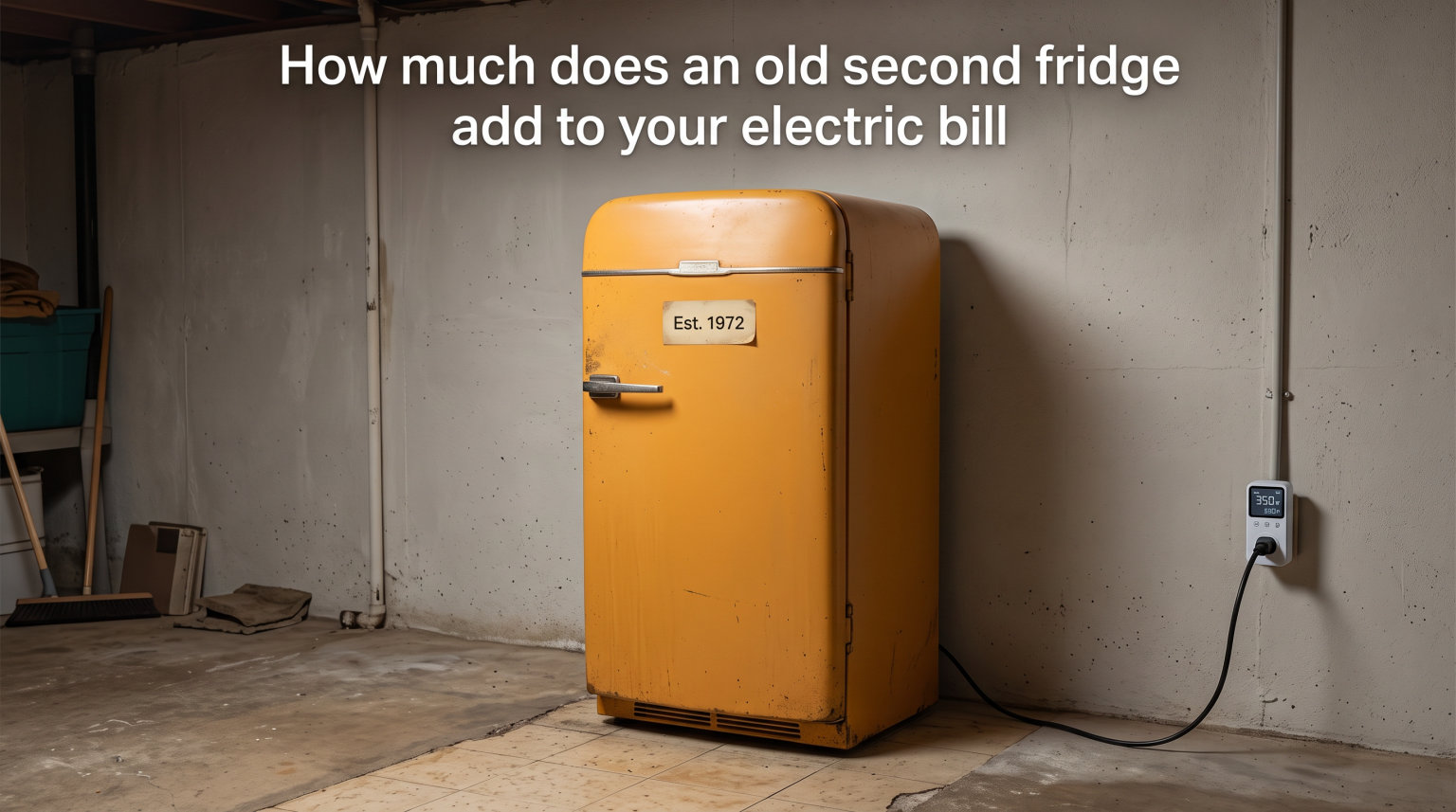
That old second fridge humming in your garage could quietly be adding $97 to $200 every year to your electric bill. I dug into Department of Energy data, ENERGY STAR ratings, and dozens of real-world electricity measurements to break down exactly what that backup refrigerator is costing you in 2026.
Whether you inherited the unit when you bought the house or moved your old kitchen fridge to the basement after an upgrade, knowing the true operating cost is the first step to deciding whether to keep, replace, or retire it. In this guide, I will show you exactly how much an old second fridge adds to your electric bill, how to calculate your specific costs, and when replacement actually pays off.
Table of Contents
How Much Does an Old Second Fridge Add to Your Electric Bill?
An old second fridge (15 to 25 years old) typically adds between $97 and $200 per year to your electric bill, depending on its age, size, and your local electricity rate. The national average for households running a second refrigerator is roughly $130 annually in added cost.
The Department of Energy and utilities like LCEC report that the average second fridge consumes 750 to 1,000 kilowatt-hours (kWh) every year. At the 2026 national average electricity rate of about 16 cents per kWh, that translates to roughly $120 to $160 per year out of your pocket.
Older units tell a much worse story. A top-freezer refrigerator from the 1980s with 19 to 21.4 cubic feet of capacity uses about 2,000 kWh per year. That works out to roughly 55 cents per day, $16.67 per month, and $200 per year at the older 10-cent rate, and closer to $320 per year at current average rates.
For comparison, a brand-new ENERGY STAR refrigerator costs only $35 to $80 per year to run. That gap is exactly why the old second fridge is such a sneaky line item on so many utility bills.
Cost Breakdown by Refrigerator Age
Refrigerator age is the single biggest factor in operating cost. Here is how annual energy use and cost break down by era, based on ENERGY STAR and Department of Energy data.
Pre-1990 (1980s and older) refrigerators use 1,800 to 2,000 kWh per year, costing $200 to $320 annually at today’s average rates.
1990s refrigerators use 700 to 900 kWh per year, costing $110 to $145 annually.
2000s refrigerators use 500 to 700 kWh per year, costing $80 to $115 annually.
Modern ENERGY STAR refrigerators (2026 models) use 350 to 500 kWh per year, costing just $35 to $80 annually.
The pattern is clear: every decade of age roughly doubles the energy cost. A pre-1990 refrigerator costs more than double what a similarly sized modern model costs to operate, according to Consumer Reports testing.
For context, back in 1972 the average refrigerator used nearly 2,000 kWh per year. Today’s most efficient models sip as little as 350 kWh. That is roughly a 5x improvement in 50 years.
If your second fridge was manufactured before 2000, the math overwhelmingly favors replacement.
How to Calculate Your Specific Refrigerator Cost
The fastest way to know exactly what your old second fridge costs you is to multiply its annual kWh usage by your electricity rate. Here is the simple formula I use.
Annual cost = Annual kWh x Electricity rate per kWh
You can find your electricity rate on any utility bill, usually listed in cents per kWh. The 2026 national average is about 16 cents, but it varies widely by state. Louisiana and Washington residents pay around 11 to 12 cents, while Hawaii, California, and New England residents often pay 25 to 40 cents per kWh.
There are three reliable ways to find your fridge’s kWh usage:
1. Check the yellow Energy Guide label if it is still attached to the unit.
2. Look up the model number on the manufacturer’s website or the ENERGY STAR product database.
3. Plug the fridge into a Kill A Watt meter for 24 hours, then multiply the daily reading by 365.
For example, one Reddit user measured their older refrigerator at 1.4 kWh per day, which equals about 511 kWh per year. At 16 cents per kWh, that is roughly $82 per year, just for that one unit. Another user measured an old full-size fridge at 0.952 kWh per day, which still adds up to about $56 per year.
Why Old Refrigerators Burn So Much Electricity
Old refrigerators are energy hogs for four main reasons: outdated compressors, degraded door seals, deteriorating insulation, and the absence of smart defrost cycles.
Compressors in pre-2000 fridges run less efficiently and longer per cycle than modern inverter compressors. That constant humming directly translates into higher kWh consumption.
Door seals, also called gaskets, harden and crack over time. Even a small gap lets cold air escape, forcing the compressor to work overtime. A single bad seal can add 10 to 15 percent to operating cost.
Insulation inside older walls breaks down and settles, reducing thermal resistance. Modern fridges use vacuum-insulated panels that simply did not exist 30 years ago.
Older defrost systems also run on fixed timers instead of adaptive sensors, meaning they often heat the evaporator coil when it is not needed.
Refrigerators are typically one of the top three energy-consuming appliances in any home, alongside heating and cooling equipment and water heaters. An aging second unit can account for up to 10 percent of your total household electricity use, which is exactly what runs up your electric bill the most in many cases.
Garage Refrigerators Cost Even More
A second fridge in the garage typically costs 30 to 50 percent more to operate than the same unit indoors, because it works harder against extreme temperatures.
In summer, a 90-degree garage forces the compressor to run almost continuously to hold a safe temperature. In winter, many older fridges in unheated garages actually run their internal heaters just to keep the freezer compartment cold enough.
If your garage regularly hits 90 degrees or drops below 40 degrees, your old second fridge could cost $150 to $250 per year instead of the usual $100 indoor average.
Reddit users consistently report their biggest energy surprises come from garage fridges, not indoor units. This is one reason utility rebates for fridge recycling often target garage units specifically.
Mini Fridge vs Full-Size Second Fridge Cost
Mini fridges are cheaper to run than full-size second fridges, but the costs still add up over a year. Here is how the two compare side by side.
Mini fridge: $0.10 to $0.25 per day, or about $36 to $90 per year.
Full-size second fridge (15 to 25 years old): $0.30 to $0.55 per day, or about $110 to $200 per year.
A modern ENERGY STAR mini fridge can run as cheaply as $20 to $30 per year, while an old one might cost $60 or more. If you only need to store a few beverages or extra produce, swapping an old full-size second fridge for a small modern mini fridge can save $80 to $150 per year.
Should You Keep Your Old Second Fridge?
Keep your old second fridge only if it costs less than $50 per year to operate and you use it regularly. Otherwise, replacement usually pays for itself within two to four years.
Here is the decision framework I use:
Replace the fridge if it is older than 15 years, your annual cost exceeds $120, you rarely use more than half its capacity, or it sits in a hot garage.
Keep it if it is less than 10 years old, costs under $60 per year to run, you genuinely need the space for holidays or bulk storage, or a replacement is not in the budget right now.
Always calculate the payback period before deciding. Divide the cost of a new ENERGY STAR fridge by your annual savings. If you save $150 per year, a $900 refrigerator pays for itself in six years, which is well within the typical 12 to 15 year lifespan of a modern unit.
Many utility companies also offer $30 to $50 rebates plus free pickup when you recycle an old fridge, which shortens the payback period even further.
How to Cut Energy Costs from Your Second Fridge?
You can trim 10 to 30 percent off your old second fridge’s operating cost with seven simple changes, even before deciding to replace it.
1. Replace worn door gaskets to stop cold air leaks. A twenty-dollar gasket kit often pays for itself in a few months.
2. Pull the unit at least 2 inches away from the wall for airflow around the condenser.
3. Clean the condenser coils twice a year with a coil brush or vacuum attachment.
4. Set the fresh-food compartment to 37 degrees Fahrenheit and the freezer to 0 degrees Fahrenheit.
5. Keep the fridge at least half full to maintain temperature stability, using jugs of water if needed.
6. Move it out of direct sunlight and away from ovens, water heaters, and dryers.
7. Unplug it entirely if you only use it seasonally, such as during holidays or summer parties.
If you can comfortably live without the second fridge for several months of the year, simply unplugging it during the off-season is the single biggest savings move available. Utility rebate programs will often haul it away for free and pay you in the process.
FAQs
How much electricity does a 20 year old refrigerator use?
A 20 year old refrigerator typically uses 700 to 900 kWh per year, which costs about $110 to $145 annually at the 2026 national average electricity rate of 16 cents per kWh.
How much does an extra fridge add to an electric bill?
An extra fridge adds about $97 to $200 per year to your electric bill, depending on its age, size, and your local electricity rate. A 1980s-era second fridge can push that figure above $300 in high-rate states.
What runs up your electric bill the most?
Heating and cooling, water heating, and refrigerators are the top three energy consumers in most homes. An old second refrigerator can account for up to 10 percent of total household electricity use.
Is it worth it to get a second fridge?
A second fridge is worth it only if you regularly need extra storage, the unit is energy efficient, and the annual cost fits your budget. Most old second fridges cost more to keep than to replace.
How much does it cost to run a 25 year old refrigerator?
A 25 year old refrigerator typically costs $130 to $200 per year to run, consuming about 1,000 to 1,250 kWh annually. In high-rate states, that figure can climb above $250.
The Bottom Line on Your Old Second Fridge
Knowing how much an old second fridge adds to your electric bill gives you real control over your utility costs. For most households, replacing a 15-plus-year-old second fridge with a modern ENERGY STAR model pays for itself within four years, and often much faster in high-rate states.
Run the numbers with your own measured kWh and your actual electricity rate. The answer is usually the same: that quiet garage unit is louder on your wallet than you think, and retirement is the cheapest option.