
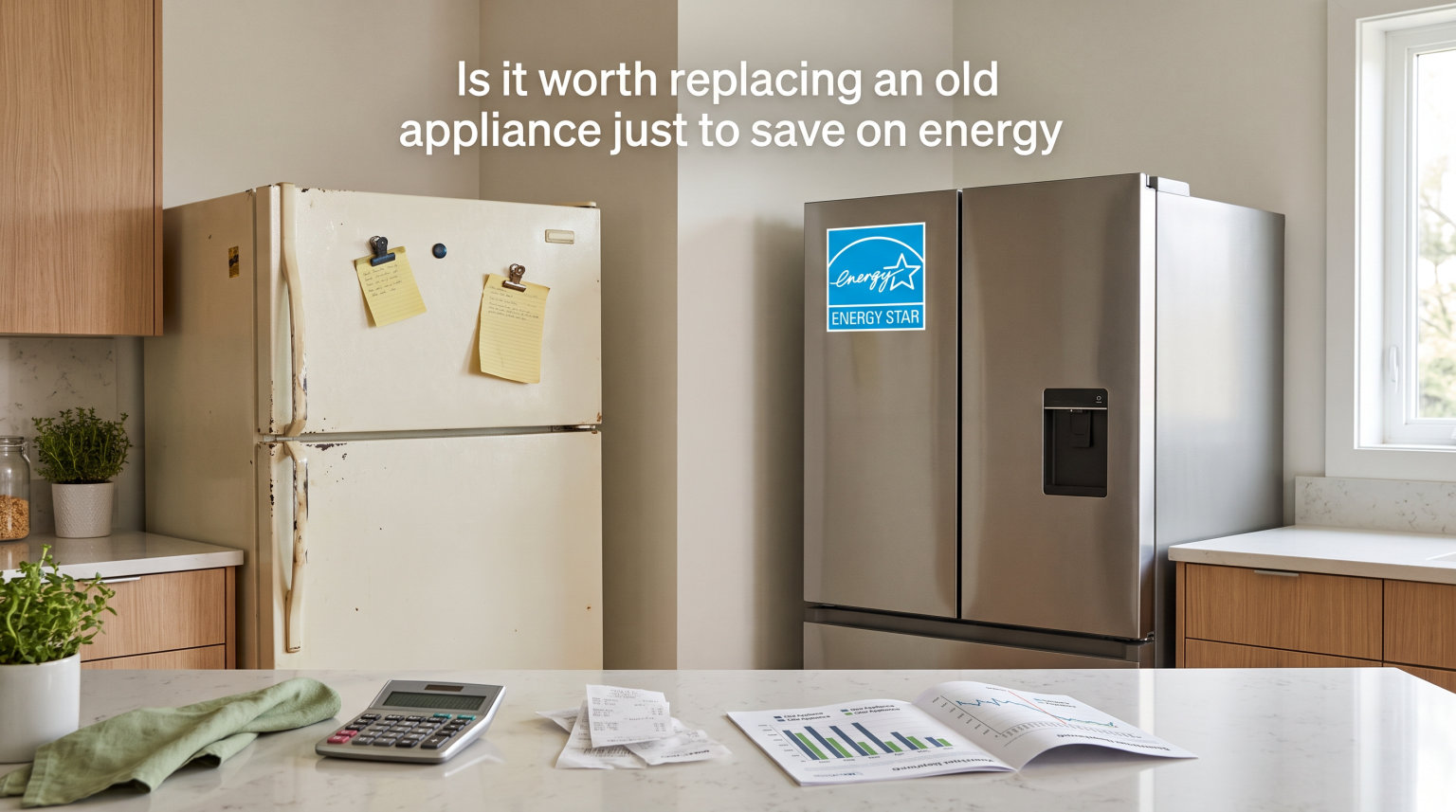
Is it worth replacing an old appliance just to save on energy? My short answer: yes, when the projected energy savings over the appliance’s remaining life exceed the replacement cost. That decision usually lands on the 50% rule plus a simple break-even calculation.
I have walked dozens of homeowners through this exact math on Reddit threads, in friend-group texts, and across my own kitchen, so let me show you the framework I use every time.
Old appliances can cost 15 to 66 percent more to run than new Energy Star models, according to the Department of Energy. That gap sounds promising on paper, but the upfront price of a new refrigerator, furnace, or washer often runs $800 to $3,500. The question is whether the savings actually pay you back before the appliance needs another repair.
Below is the exact decision framework I lean on, plus the dollar-by-dollar ROI for the most common household appliances in 2026.
Table of Contents
Quick Summary: When Replacement Pays Off
Before we dive into formulas, here is the bottom-line shortcut I use with anyone who asks me this question.
- Refrigerator (15+ years old): Replacement typically pays back within 4 to 6 years. Energy savings of $80 to $120 per year are realistic.
- HVAC system (12+ years old): Replacement is the single biggest energy win, often saving $300 to $600 per year on heating and cooling.
- Water heater (10+ years old): Savings of only $30 to $60 per year, so usually replace only on failure.
- Washing machine and dryer (8+ years old): Modest $20 to $40 per year savings; replace mainly for features or breakdowns.
- Oven and range: Gas-to-electric or old electric replacements rarely pay back through energy alone.
If your appliance is past its expected lifespan and a repair quote comes in above half the price of a new unit, replacement almost always wins. Now let me show you why.
The 50% Rule: Your First Decision Filter
The 50% rule is the most common starting point for the repair-versus-replace question. It works like this: if the estimated repair cost is more than 50% of the price of a comparable new appliance, replace it. If the repair is under 50%, repair it.
Here is how I apply it with real numbers. Suppose your 14-year-old refrigerator breaks down and a repair shop quotes $650 to replace the compressor. A comparable new Energy Star fridge costs $1,200. The repair is 54% of the new price, so the rule says replace. You also need to factor in the energy savings, which we will cover in a moment, but the 50% rule is your first sanity check.
The rule also accounts for something most people forget: a second failure. Once an appliance passes the halfway point of its lifespan, the chance of a second breakdown within two years climbs sharply. That is why repair technicians often push replacement after age 7 on washers and age 10 on refrigerators. Pay the 50% threshold once and you might pay it again in 18 months.
Average Appliance Lifespan by Type
Knowing how long an appliance should last tells you whether you are dealing with an aging unit or one that simply had bad luck. Here are the average service lives reported by the Department of Energy and major manufacturers.
- Refrigerators: 12 to 17 years
- Washing machines: 10 to 14 years
- Dryers: 10 to 13 years
- Dishwashers: 8 to 12 years
- Electric water heaters: 10 to 15 years
- Gas water heaters: 15 to 20 years
- Central air systems: 12 to 17 years
- Furnaces: 15 to 20 years
- Ovens and ranges: 15 to 20 years
If your appliance is past the lower end of these ranges, every repair decision deserves a closer look. If it sits in the middle of the range, repair usually makes sense unless the cost is unusually high. I keep this list taped inside a kitchen cabinet so I can check it the next time something starts making that suspicious clicking sound.
How to Calculate Your Annual Energy Cost
The next piece of the puzzle is what your current appliance actually costs to run, and how that compares with a new model. The formula is straightforward.
Annual cost = (Wattage / 1,000) x Hours used per day x 365 x Your electricity rate per kWh
Let me run a real example with a refrigerator. A 20-year-old fridge often pulls around 800 watts when the compressor cycles on. It runs about 8 hours per day in a typical kitchen. At the U.S. average electricity rate of about 17 cents per kWh in 2026, the math works out to 0.8 x 8 x 365 x $0.17, which equals $397 per year. A new Energy Star fridge uses roughly 350 watts and runs 6 hours per day, costing about $130 per year. That is a $267 annual difference, and it lines up with the $80 to $120 savings Energy Star quotes because real-world usage varies. Even at the conservative end, you save real money every year.
To find your own numbers, look at the yellow EnergyGuide label on a new model to see estimated yearly kWh. For your current appliance, the wattage is usually on a sticker inside the door frame or on the back of the unit. Your kWh rate appears on any monthly electric bill.
Break-Even Analysis: The Simple Formula
Break-even is the moment when your energy savings have paid for the new appliance. The formula is equally simple, and I use it every time I am tempted by a big purchase.
Break-even (in years) = Net cost of new appliance / Annual energy savings
Net cost means the price of the new unit minus any rebates, tax credits, or trade-in value you receive. Annual energy savings is the difference between what your old appliance costs to run and what the new one is projected to cost.
Let me run the refrigerator example again. A new Energy Star fridge at $1,200 minus a $50 utility rebate equals $1,150 net cost. If your old fridge costs $397 per year and the new one costs $130, the annual savings are $267. Divide $1,150 by $267 and you get 4.3 years to break even. If the fridge lasts another 12 years, you pocket roughly $2,054 in pure savings after the payback. That is a strong yes.
Now compare that with a water heater scenario. A new heat-pump water heater at $1,800 minus a $300 federal tax credit equals $1,500 net cost. If the old electric water heater costs $520 per year to run and the new one costs $460, your annual savings are only $60. Break-even hits at 25 years, longer than the unit will actually last. That is a clear no on energy savings alone, which is why most people only replace water heaters when they fail.
Appliance-by-Appliance ROI Breakdown
Now let me put real numbers behind the most common appliances people ask me about, using the average U.S. electricity rate of about 17 cents per kWh in 2026. I will note when gas rates shift the picture.
Refrigerators: The Clearest Winner
Refrigerators run 24/7, so even small efficiency gains add up fast. A 15-year-old fridge uses roughly 800 to 1,200 kWh per year, while a new Energy Star model uses 350 to 500 kWh. That translates into $80 to $120 in annual savings and a break-even of 4 to 6 years for most households. The Dollar Stretcher and SafeElectricity both confirm this range in their breakdowns.
HVAC Systems: The Biggest Savings by Far
Heating and cooling eat roughly half of a typical home energy bill, so an aging HVAC system is where replacement really shines. A 15-year-old furnace running at 80% efficiency burns about 30% more fuel than a modern 95% model. With natural gas averaging $1.30 per therm, that is $300 to $500 per year in fuel savings. Central air conditioners from the early 2000s use 20 to 40% more electricity than current SEER2-rated units, saving another $150 to $300 annually. Total HVAC replacement often pays back in 7 to 10 years.
Water Heaters: Slow Payback
Standard electric and gas water heaters see modest gains from new models, in the $30 to $60 per year range. Heat-pump water heaters save more, around $300 per year, but they cost roughly $1,800 installed. Replace these units when they fail, unless you specifically want the heat-pump upgrade for environmental reasons.
Washing Machines and Dryers: Features Over Energy
Modern front-load washers use about 30% less energy and 50% less water than top-loaders from the 1990s, saving $20 to $40 per year. Heat-pump dryers save another $50 to $100 per year compared with conventional electric dryers. Replacement here usually pays back in 6 to 8 years, but most people replace for features like steam cycles or larger capacity rather than pure energy savings.
Ovens, Ranges, and Dishwashers: Skip the Energy Argument
Cooking appliances use less than 5% of household energy, so even a 30% efficiency gain barely moves the bill. Induction cooktops are faster and safer but save only $10 to $20 per year versus older electric coils. Dishwashers see slightly larger gains of $20 to $30 per year with Energy Star models. Replace these when they break or when you want the new features.
Decision Framework: When to Repair vs Replace
Here is the five-step checklist I run through whenever a major appliance acts up. It pulls everything above into a single decision flow.
Step 1: Check the age. If the appliance is past the midpoint of its expected lifespan, lean toward replacement. Under that midpoint, lean toward repair.
Step 2: Get a repair quote. If the repair is under 50% of a comparable new unit, repair it. Above 50%, replacement almost always wins.
Step 3: Estimate your annual energy savings. Use the formula above. Subtract old operating cost from new operating cost. If savings are under $30 per year, energy alone will not justify the purchase.
Step 4: Calculate break-even. Divide the net price of the new appliance by your annual savings. Anything over 10 years is usually a no for energy alone.
Step 5: Factor in regional costs and rebates. Electricity rates vary from 11 cents per kWh in states like Washington to 25 cents per kWh in California and Hawaii, which swings the math by 50% or more. Always check for state and federal rebates before deciding. Many utilities offer $50 to $300 for recycling old refrigerators, and federal tax credits cover 30% of heat-pump installations up to $2,000 in 2026.
There is also an environmental angle worth weighing. The International Energy Agency estimates that household appliances account for roughly 15% of global residential electricity demand. Replacing a 20-year-old fridge cuts its lifetime carbon footprint by about 4 tons of CO2, equivalent to driving 9,000 miles. That is a real benefit, even if the dollar savings alone do not push you over the line.
Frequently Asked Questions
What is the 50% rule for appliances?
The 50% rule says you should replace an appliance when the repair cost exceeds 50% of the price of a comparable new unit. For example, if a $700 repair on a refrigerator would buy a new model for $1,200, the rule recommends replacement.
Does a 20 year old refrigerator use a lot of electricity?
Yes. A 20-year-old refrigerator typically uses 800 to 1,200 kWh per year, compared with 350 to 500 kWh for a new Energy Star model. At average U.S. electricity rates in 2026, that is roughly $200 to $300 in extra annual operating cost.
Which appliances save the most energy when replaced?
HVAC systems, especially furnaces and central air conditioners, deliver the biggest savings at $300 to $600 per year combined. Refrigerators are second, saving $80 to $120 per year because they run around the clock.
Should I replace an appliance before it breaks?
Only if break-even math works out within a reasonable timeframe, usually under 10 years. Preventive replacement rarely beats waiting for a failure, because you risk replacing something that would have run another 5 years for free.
Are old appliances worth repairing for environmental reasons?
Repairing is often the greener choice when the unit has years of life left. Manufacturing a new refrigerator generates roughly 500 kg of CO2. If your current fridge will run another 5 years, repairing it keeps that embodied carbon out of the atmosphere.
Final Verdict on Replacing Old Appliances for Energy Savings
So, is it worth replacing an old appliance just to save on energy? For refrigerators and HVAC systems past their expected lifespan, almost always yes. For water heaters, ovens, and dishwashers, replacement only makes sense on failure or for new features.
The smartest move is to grab the 50% rule, run your own break-even math, and check for rebates before signing anything. In 2026 alone, those rebates can shave hundreds off a new fridge or heat-pump install, and the dollar savings start flowing on day one.