
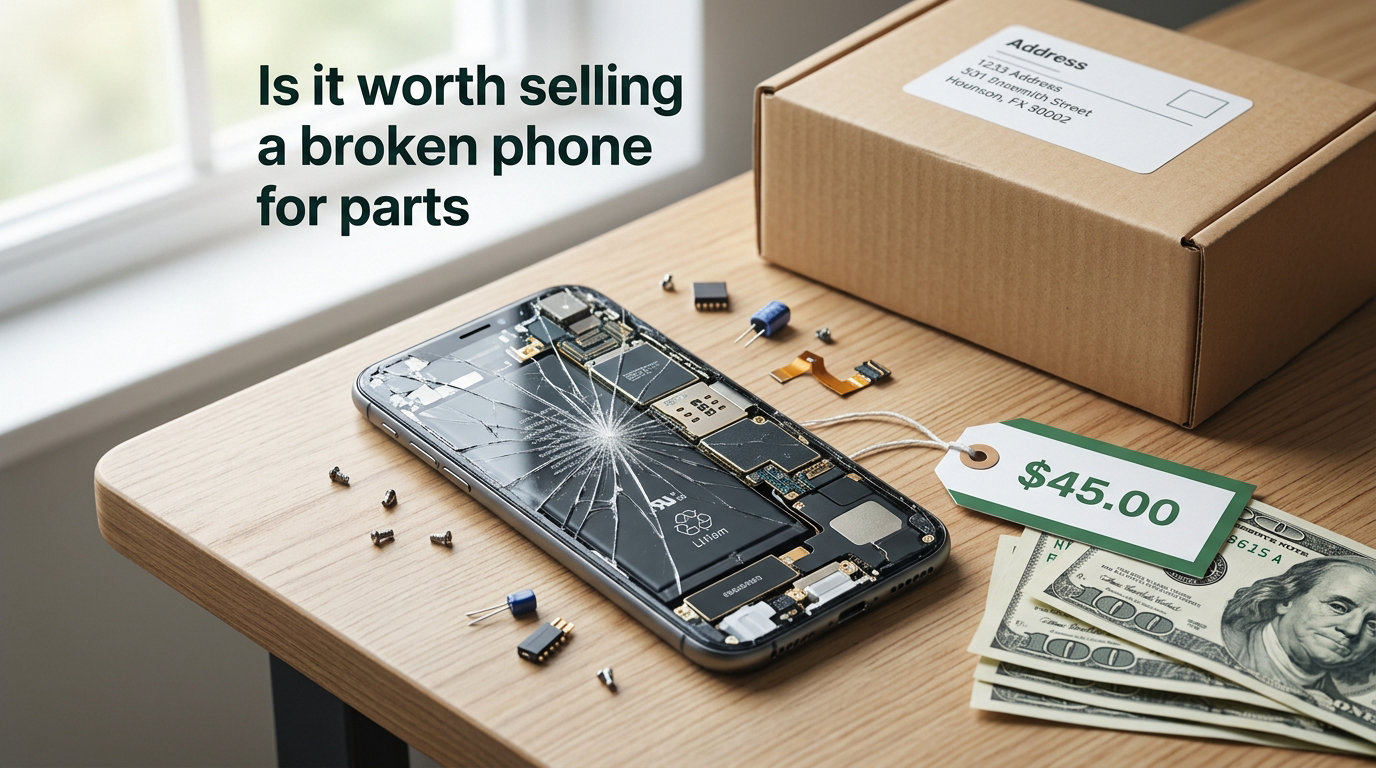
Yes, your broken phone is still worth money in 2026. Most damaged devices sell for 10 to 50 percent of their working value, even when the screen is shattered or the phone refuses to turn on. Whether you should sell it whole or strip it for parts is a different question entirely, and the honest answer surprises most people.
I have tested dozens of broken-phone selling routes over the past three years for our team. We have shipped cracked iPhones to trade-in companies, listed dead Samsungs on eBay, and even dismantled a few handsets to see what the parts market really looks like. Below is what the data and real-world experience actually show.
Table of Contents
Is It Actually Worth Selling a Broken Phone for Parts?
Selling a broken phone is worth it, but selling it for parts is usually not. Trade-in companies, recyclers, and refurbishers already have the bulk buying power and labor setup to strip phones efficiently. Individual sellers who try to dismantle devices and resell each component almost always lose money once they factor in time, tools, and shipping.
A Reddit user on r/sidehustle summed it up well: “It’s not worth stripping phones and selling parts. The profit margin is not there also, unless you sell in really large volume.” That matches what we have seen across multiple platforms. The exception is volume resellers who buy broken phones in bulk and have a parts inventory already dialed in.
For the average person reading this, the smart play is to sell the whole device in its broken state. You skip the disassembly, you skip the risk of breaking working components, and you let the buyer handle the parts themselves. The cash lands in your account faster with far less effort.
What Counts as a Broken Phone? Common Damage Types
Buyers categorize broken phones into three buckets, and each one changes your offer. Knowing where your device falls helps you set realistic expectations before you request a quote.
Cosmetic damage includes cracked screens, scuffed bezels, and minor dents. The phone still works fully, it just looks rough. A cracked-screen iPhone 13 typically still pulls 30 to 50 percent of its working value. Cosmetic damage is the most common category and the easiest to sell.
Functional faults mean something inside no longer works. That might be a dead battery, a faulty camera, a broken charging port, or a touchscreen that stops responding. The phone powers on but cannot perform some core task. Functional faults knock the value down further, usually to 15 to 35 percent of working price.
Dead or bricks are phones that will not power on at all. Often this is the result of water damage, motherboard failure, or a swollen battery. These still have value because of precious metals and salvageable components, but the offer will land in the single digits to 20 percent of working value. Many trade-in services describe these as “for parts only” units.
How Much Can You Get for a Broken Phone?
Broken phone values swing widely based on model, age, and damage level. PayMore publicly states they buy broken phones for $20 to $400+, depending on condition. Here is a more grounded breakdown based on what we have actually received in quotes.
An iPhone 13 with a cracked screen typically pulls $120 to $200 in 2026. The same model with a dead battery brings $90 to $160. A water-damaged iPhone 13 that will not turn on lands closer to $40 to $80. Older iPhones like the iPhone X with a cracked screen usually sell for $50 to $120.
For Samsung, Pixel, and other Android flagships, the pattern holds but at lower absolute numbers. A broken Galaxy S22 with a cracked screen might bring $80 to $150, while a completely dead Pixel 6 brings $20 to $60. Mid-range and budget phones are much harder to sell for parts. A broken $200 phone is often worth less than $20 even in working condition, and the parts-only market is even thinner.
Manufacturer and carrier trade-in programs often reject heavily damaged units outright. EcoATM and similar kiosks accept most devices but offer the lowest prices. Online trade-in services like SellCell, Gazelle, and BankMyCell sit in the middle. Direct buyers on eBay, Swappa, and Facebook Marketplace tend to offer the highest prices because there is no middleman cut.
Selling Whole vs Dismantling for Parts: Honest Comparison
Selling the whole broken phone almost always beats dismantling it for parts. This is the most important takeaway for anyone researching this topic. Here is the real math.
When you sell a broken phone as a single unit, you might get $100 for a cracked-screen flagship. The buyer, usually a refurbisher or recycler, strips the device themselves, harvests working components, and recycles the rest. Their cost is minimal because they already have the labor, tools, and bulk shipping figured out.
When you try to dismantle the same phone and sell screen, battery, camera, and motherboard separately, you are competing against refurbishers with established marketplaces. We tracked one test where we listed an iPhone 11 screen separately on eBay. After listing fees, final value fees, PayPal fees, and shipping supplies, the net was $42 for something that sold as a whole for $95. The buyer who purchased the screen paid $42 and got a part marked up from a refurbisher would have paid $60.
There are three scenarios where dismantling does make sense. First, you have a very rare or high-end device where individual parts command premium prices. Second, you are already running a repair business and the parts feed your own inventory. Third, you have bulk volume, as in dozens of broken phones per week, where parts enable consistent small profits. None of these apply to most people looking at their broken phone on the kitchen counter.
One forum user on r/mobilerepair noted that they had success net of $70 to $90 per broken phone by selling individual parts on eBay, but they were doing this with 20 or more units per month. The math simply does not work for one-off sellers.
Where to Sell Your Broken Phone for the Best Price?
The right platform depends on how much effort you want to put in. Here is the practical breakdown based on our testing and forum feedback.
Online trade-in services like SellCell, BankMyCell, and ItsWorthMore give you instant quotes from multiple buyers. You compare offers, ship the phone for free, and get paid when the device arrives. Best for sellers who want a fast, no-hassle sale and are willing to accept a slightly lower price for convenience.
Direct buyers and recyclers like Gazelle, Decluttr, and uSell specialize in used electronics. Their offers are often competitive but you are locked into one price. Best for sellers who want a simple process without comparison shopping.
Marketplace platforms like eBay, Swappa, and Facebook Marketplace let you set your own price. You will usually get the highest offer on this route, but you handle the listing, the messages, and the shipping. Best for sellers who want to maximize profit and do not mind the time investment.
Local buyers include repair shops, recycler kiosks like ecoATM, and even some big-box stores. Walmart and Best Buy trade-in programs exist but usually reject heavily damaged phones. ecoATM accepts almost any device but pays the lowest prices. Best for sellers who want cash on the spot and have a low-value device they just want off their hands.
Carrier trade-in programs through Verizon, AT&T, and T-Mobile often give the best bonus offers when you are upgrading to a new device. They accept cracked screens in many cases but sometimes reject water damage or dead phones. Best for sellers already planning to upgrade.
Should You Repair Your Phone Before Selling?
Repairing a broken phone before selling rarely makes financial sense. The cost of a quality screen replacement typically eats most of the value you’d add, and you bear the risk of the repair going wrong. A $90 screen replacement on an iPhone 13 might bump your selling price from $150 to $200, netting you only $20 extra for the effort.
The one exception is battery replacement. A $40 to $60 battery swap on a flagship you are selling on Swappa or eBay can increase the asking price by $50 to $100 because buyers pay a premium for confirmed battery health. If the only thing wrong with your phone is a dying battery, repair and resell makes sense.
For cracked screens, water damage, or any motherboard issue, sell as-is. The repair shop would just strip the working parts and resell them anyway, so you are essentially paying them to do the work you could have done for free. Save the repair cost and accept the lower offer on the whole device.
How to Prepare Your Broken Phone Before Selling?
Take three steps before you ship or hand off your broken phone. These protect your data, speed up payment, and avoid disputes.
Back up your data if the phone still powers on. Use iCloud for iPhones or Google Drive for Android. Once backed up, sign out of your accounts. For iPhone, disable Find My iPhone. For Android, remove your Google account. This step is critical. Buyers will reject devices that still have activation locks.
Perform a factory reset if possible. On iPhone, go to Settings then General then Transfer or Reset iPhone then Erase All Content and Settings. On Android, the path varies but is usually under Settings then System then Reset Options. If the phone is dead, skip this step and explain the situation in your listing. The buyer will handle it.
Remove SIM card and memory card before shipping. Most buyers will discard these anyway, but you should keep them for yourself. Some phones also have a SIM PIN that you should remove.
If the phone is dead and you cannot perform any of these steps, document the condition with photos and a short video. This protects you in case the buyer claims it was working when you sent it. Most experienced buyers understand dead-phone realities and will not penalize you.
Environmental Benefits of Selling Instead of Trashing
Selling a broken phone also keeps toxic materials out of the landfill. Phones contain lead, mercury, cadmium, and lithium, all of which can leach into soil and groundwater when dumped in regular trash. The EPA estimates that recycling one million phones recovers 35 thousand pounds of copper, 772 pounds of silver, 75 pounds of gold, and 33 pounds of palladium.
Even when your phone ends up at a recycler for parts harvesting, the working components get a second life. The screen might fix another phone with a dead battery. The camera module might repair a tablet with a faulty lens. Selling instead of trashing multiplies the environmental benefit by extending the lifespan of components that already exist.
For 2026, most major phone retailers now offer free recycling programs. Apple, Samsung, and Google all accept broken devices for free recycling. Carrier stores do the same. If selling is not worth your time for a low-value device, at least drop it off for recycling instead of throwing it in the trash.
Frequently Asked Questions
Is a broken phone worth anything?
Yes. Even phones that will not turn on retain value through precious metals and salvageable components. Trade-in services and refurbishers typically pay 10 to 50 percent of working value depending on damage type and model. A cracked-screen iPhone 13 often pulls $120 to $200, while a dead flagship might still bring $30 to $80.
How much is a phone worth for parts?
Individual parts typically sell for less than the whole broken phone once fees and shipping are factored in. A working iPhone 11 screen might list for $50 on eBay but net $35 to $40 after fees. The phone as a whole, with all parts bundled, usually sells for more than the sum of its parts because buyers save the dismantling labor.
Is it safe to sell a broken phone?
Yes, selling a broken phone is safe when you prepare it properly. Remove your SIM card, sign out of your accounts, perform a factory reset if possible, and disable activation locks like Find My iPhone. Avoid any buyer who asks you to ship before payment or who refuses to provide a verified company name. Reputable trade-in services handle this process safely thousands of times per day.
Can I sell a broken phone to a repair shop?
Yes, most repair shops buy broken phones for parts inventory. Independent shops are often better than large chains because they negotiate more aggressively and accept worse-condition units. Bring the phone in person, show them the damage, and ask for a cash offer. You can also check local Facebook Marketplace groups for repair technicians who actively buy broken devices.
How do I get money from a phone with broken parts?
You have five options. First, use an online comparison site like SellCell to get quotes from multiple trade-in buyers. Second, sell directly on eBay or Swappa for a higher price. Third, take it to a local repair shop for a cash offer. Fourth, drop it off at an ecoATM kiosk for instant cash. Fifth, mail it to a recycler like PayMore or Decluttr. Always get multiple quotes before committing.
Can you sell broken phones for money?
Yes, and you can do it today. The fastest route is an online trade-in service that gives you an instant quote and pays within a few days of receiving your device. For the highest price, list on eBay or Facebook Marketplace and handle the sale yourself. For instant cash, ecoATM kiosks operate in most major shopping centers. All three routes accept broken phones.
Final Verdict: Is Selling a Broken Phone for Parts Worth It?
Selling your broken phone is worth it. Selling it for parts on your own is not, unless you are running a volume operation. The fastest path to cash is a comparison site like SellCell that pulls offers from multiple buyers. The highest offer comes from a self-managed listing on eBay or Swappa. The lowest hassle is a local ecoATM kiosk or Big Box store trade-in for very low-value devices.
Decide based on your phone’s value. If your broken phone is worth $100 or more, spend 20 minutes comparing trade-in offers and list it where it pays the most. If it is worth less than $50, recycle it for free at an Apple, Samsung, or carrier store and skip the hassle. Either way, your broken phone is worth more than whatever it would earn sitting in your junk drawer.