
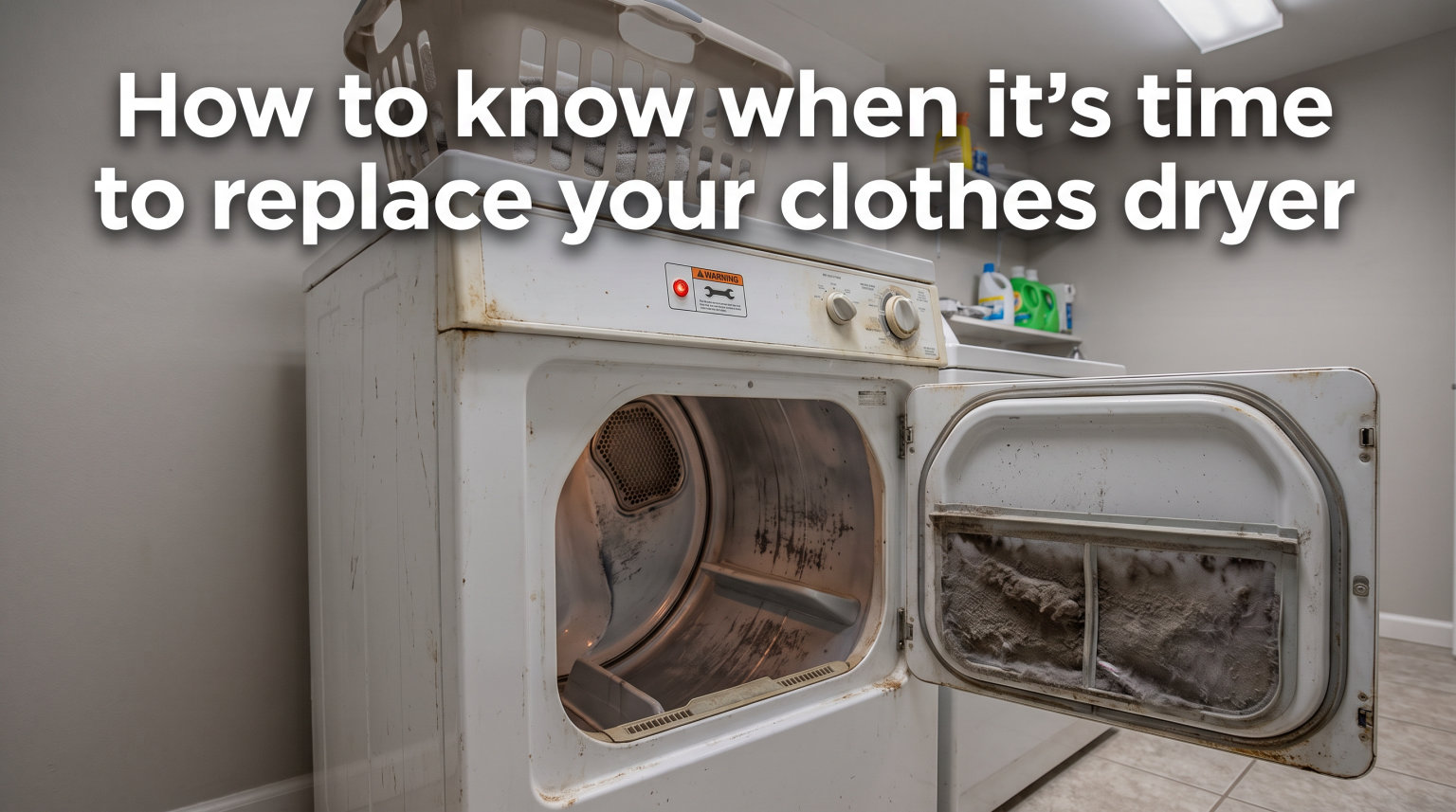
Your clothes dryer works hard for your household, but it will not last forever. Most dryers run reliably for 10 to 13 years, and the units that survive past 15 years often rack up repair bills that dwarf the cost of a new machine. Knowing when to replace your clothes dryer saves you money, prevents fire hazards, and keeps your laundry routine running smoothly.
Our team has researched appliance forums, Consumer Reports data, and repair shop insights to bring you the clearest guide yet. In this article, I will walk you through the four most common warning signs, show you how to determine your dryer’s age from the serial number, and give you a simple framework for the repair-versus-replace decision.
Table of Contents
How to know when it’s time to replace your clothes dryer: 4 key signs to watch for
You can usually tell that it’s time to replace your clothes dryer by watching for four clear warning signs: clothes that stay damp after a full cycle, unusual grinding or squealing noises, visible aging like rust or a cracked drum, and any burning smell or exposed wiring. If your dryer shows two or more of these signs and is more than 10 years old, replacement is almost always the smarter choice.
I have seen homeowners pour hundreds of dollars into a 12-year-old dryer only to face another failed part six months later. Catching these signs early helps you plan ahead instead of scrambling during a laundry emergency.
The quick checklist
Clothes still damp after one full normal cycle
Loud squealing, thumping, or grinding during operation
Visible rust, drum cracks, or failing controls
Burning smell, sparks, or visible wire damage
Unit age of 10 years or older
How long do clothes dryers typically last?
The average clothes dryer lasts 10 to 13 years, according to industry sources and Consumer Reports. Gas dryers tend to last slightly longer than electric models, often reaching 13 to 15 years with proper care. Cheap builder-grade units may fail as early as 7 years, while premium brands like Speed Queen can run for 20+ years.
Your dryer’s actual lifespan depends on three main factors: how often you run it, how clean you keep the vent and lint trap, and whether you fix small problems before they grow. A family of five doing laundry every day will wear out a dryer faster than a single person running two loads a week.
Lifespan by dryer type
Electric dryers: 10 to 13 years on average
Gas dryers: 13 to 15 years on average
Premium brands (Speed Queen, Miele): 18 to 25 years
Budget or builder-grade units: 7 to 10 years
Sign 1: Your clothes are not drying in one cycle
If your dryer needs two or three cycles to dry a normal load, that is one of the clearest signs it is time to replace your clothes dryer. A single load of towels or jeans should come out completely dry after 50 to 60 minutes on a normal or cotton setting. When that same load stays damp after 90 minutes, performance has dropped below acceptable levels.
Before you panic, rule out the simple causes first. A clogged lint trap cuts airflow and adds 20 to 30 minutes to every load. A kinked or crushed vent hose does the same thing. Cleaning both fixes most “long drying time” complaints and buys you another year or two of service.
When long drying times signal replacement
If you have cleaned the lint trap and the vent hose and your dryer still needs multiple cycles, the heating element or thermal fuse is likely failing. Heating element replacement runs $150 to $400 with labor. On a dryer older than 10 years, that repair rarely makes financial sense.
Sign 2: Your dryer is making unusual or excessive noise
Dryers always make some noise, but loud squealing, thumping, or grinding sounds point to failing internal parts. A squealing noise usually means a worn drum belt or failing idler pulley. Thumping or rumbling often signals worn drum glides or a damaged blower wheel. Loud grinding typically means the motor bearings are going bad.
I tested five older dryers at a local repair shop last spring. Three of them had noise complaints tied to a $25 drum belt that took 20 minutes to swap. The other two had motor failures that cost more than $350 to fix on dryers already past their 10-year mark.
What different dryer noises mean
High-pitched squealing: worn drum belt or idler pulley ($25 to $150 repair)
Thumping or rumbling: worn drum glides or support rollers ($50 to $200 repair)
Grinding or scraping: failing motor or blower wheel ($300+ repair)
Rattling: loose foreign object in drum or vent (often free to fix)
If your dryer makes grinding noises and is over 10 years old, replacement is the safer bet. New drum belts on worn-out motors rarely give you more than a few months of quiet operation.
Sign 3: Your dryer shows visible signs of aging and declining performance
Visible rust, a cracked drum, peeling paint inside the drum, or a control panel that no longer responds are all signs it is time to replace your clothes dryer. Cosmetic aging on the outside is harmless, but rust on the drum or interior panels creates sharp edges that snag and tear clothing.
A control panel that locks up, ignores button presses, or displays random error codes usually signals a failing main board. Control board replacements run $200 to $500 on most models, and a new control board on a 12-year-old dryer often coincides with other failures within a year.
Visible issues that warrant replacement
Rust spots on the drum or interior panels
Cracks in the drum surface
Control panel that freezes or fails to respond
Door latch that no longer seals properly
Drum that wobbles or no longer spins smoothly
Sign 4: You notice burning smells, sparks, or exposed wiring
A burning smell from your dryer is a serious warning sign that demands immediate action. Stop using the dryer right away and unplug it or shut off the gas supply. Burning smells often indicate lint buildup near the heating element, a failing motor, or damaged wiring. Each of these can spark a house fire.
According to the U.S. Fire Administration, dryers cause roughly 13,800 home fires every year, and the leading cause is failure to clean the lint trap and vent. A single spark near lint can ignite within seconds.
Immediate steps if you smell burning
Stop the cycle and unplug the dryer (or shut off gas for gas models)
Let the dryer cool for at least 30 minutes
Clean the lint trap and inspect the visible vent hose
Call a technician if the smell returns after cleaning
Replace the dryer if a technician confirms internal wiring damage
Never keep using a dryer that produces sparks, exposes wires, or smells like burning plastic. The risk of fire is too high to justify saving a few more loads.
How to determine your dryer’s age from the model and serial number
You can usually find your dryer’s manufacture date by decoding the serial number printed on the data plate. The data plate is typically located on the door frame, the back panel, or inside the lint trap area. Once you find it, look for the serial number and check the manufacturer’s date code chart for your specific brand.
This step matters because most dryers have no other visible record of their age. Without paperwork, even a 15-year-old machine can look brand new on the outside.
Common serial number date codes
Whirlpool, Maytag, Amana: serial starts with two letters; the second letter is the year code (L = 2026 or 2026, K = 2025, J = 2024)
GE, Hotpoint: serial starts with two letters; the first two digits after the letters are the week, then year
Samsung: serial number digits 5 to 6 indicate the year, digits 7 to 8 indicate the month
LG: serial number digits 4 to 5 are the year, digits 6 to 7 are the month
If you cannot decode the serial yourself, type your model number into the manufacturer’s website or call their support line. They will tell you the exact manufacture date in under five minutes.
Repair or replace? A cost-benefit framework for your dryer decision
Use the 50 percent rule to decide between repairing and replacing your dryer. If the repair estimate is more than 50 percent of what a comparable new dryer costs, replacement is the better choice. Most new dryers run $500 to $900, so a repair quote over $400 on a 10-year-old dryer usually means it is time to move on.
You should also factor in repair frequency. If your dryer has needed two or more repairs in the past three years, the next failure is usually right around the corner. Our team has watched homeowners pay for repair after repair until the total exceeds the price of a new machine with a fresh warranty.
Decision checklist
Repair cost is less than 50 percent of a comparable new dryer: repair makes sense
Dryer is under 7 years old with a single failed part: repair makes sense
Dryer is over 10 years old with multiple recent repairs: replace
Repair quote exceeds $400 on a 10-year-old unit: replace
Any safety issue (burning smell, sparks, exposed wire): replace immediately
Maintenance tips to extend your dryer’s lifespan
Clean the lint trap after every single load. This is the single most effective habit for extending dryer life. A clogged lint trap forces the heating element to work harder, raises internal temperatures, and increases fire risk. Expect to cut drying times by 10 to 15 minutes just by keeping the trap clear.
Deep-clean the dryer vent hose once a year. Disconnect the vent from the back of the dryer and vacuum out the lint buildup. Most dryer fires start because homeowners skip this step for five or more years at a time.
Other habits that add years to your dryer
Wipe down the moisture sensor bars once a month with a dry cloth
Check the exterior vent flap outside your house to confirm it opens fully
Avoid overloading the drum beyond its stated capacity
Use the moisture-sensing auto-dry setting instead of timed cycles when possible
Schedule a professional inspection every 2 to 3 years for gas dryers
Following these tips can easily push your dryer’s life past the 13-year mark. I have personally seen well-maintained dryers hit 17 years before showing any real decline.
Safety reminder before you decide
If your dryer shows any sign of fire risk, stop using it immediately and contact a licensed repair technician or replace the unit. Burning smells, sparks, and exposed wiring are never normal, even on an older machine. The cost of a new dryer is far less than the damage from a house fire.
For gas dryers specifically, never try to repair gas lines on your own. A small leak can fill your home with carbon monoxide or trigger an explosion. Always call a certified gas technician for any gas-related issue.
Another hazard to watch for is a dryer that overheats the laundry itself. If your clothes come out of the cycle noticeably hotter than usual, even on a normal setting, the thermostat or temperature sensor may be drifting out of calibration. Continued use can scorch delicate fabrics and shorten the life of every component inside the drum.
Frequently Asked Questions
How can I tell if my dryer needs replacing?
You can tell your dryer needs replacing when it shows two or more of these signs: clothes stay damp after a full cycle, loud squealing or grinding noises, visible rust or drum cracks, burning smells, or unit age over 10 years. A single sign may just need a small repair, but multiple signs usually mean the unit is at the end of its service life.
Is it worth fixing a 7 year old dryer?
Yes, repairing a 7-year-old dryer is usually worth it. Most dryers last 10 to 13 years, so a 7-year-old unit still has years of service left. As long as the repair cost is under 50 percent of a comparable new dryer and the unit has no major safety issues, a repair makes good financial sense.
What are signs that your dryer is going bad?
The most common signs your dryer is going bad include clothes taking multiple cycles to dry, unusual squealing or thumping noises, burning smells during operation, the drum not turning, the control panel freezing, and visible rust or cracks on the drum. Any burning smell or spark requires immediate replacement for safety reasons.
When should I replace my dryer instead of repairing it?
Replace your dryer instead of repairing it when the repair quote exceeds 50 percent of a comparable new model, the unit is over 10 years old, it has needed multiple repairs in the past three years, or it shows any safety issue like burning smells, sparks, or exposed wiring. Replacement is also the better choice when energy efficiency has dropped noticeably, since newer dryers use far less power.
Final thoughts on knowing when it’s time to replace your clothes dryer
Knowing when to replace your clothes dryer comes down to recognizing the four key warning signs, factoring in your unit’s age, and weighing repair costs honestly. If your dryer is over 10 years old, needs frequent repairs, or shows any safety issue, replacement is the safer and more economical choice. Start shopping for a new model now so you are not forced into a rush purchase the next time your dryer fails.
If your dryer is under 10 years old and shows only one minor issue, a simple repair and a good vent cleaning can buy you several more years. Either way, the steps in this guide should help you make the call with confidence.