
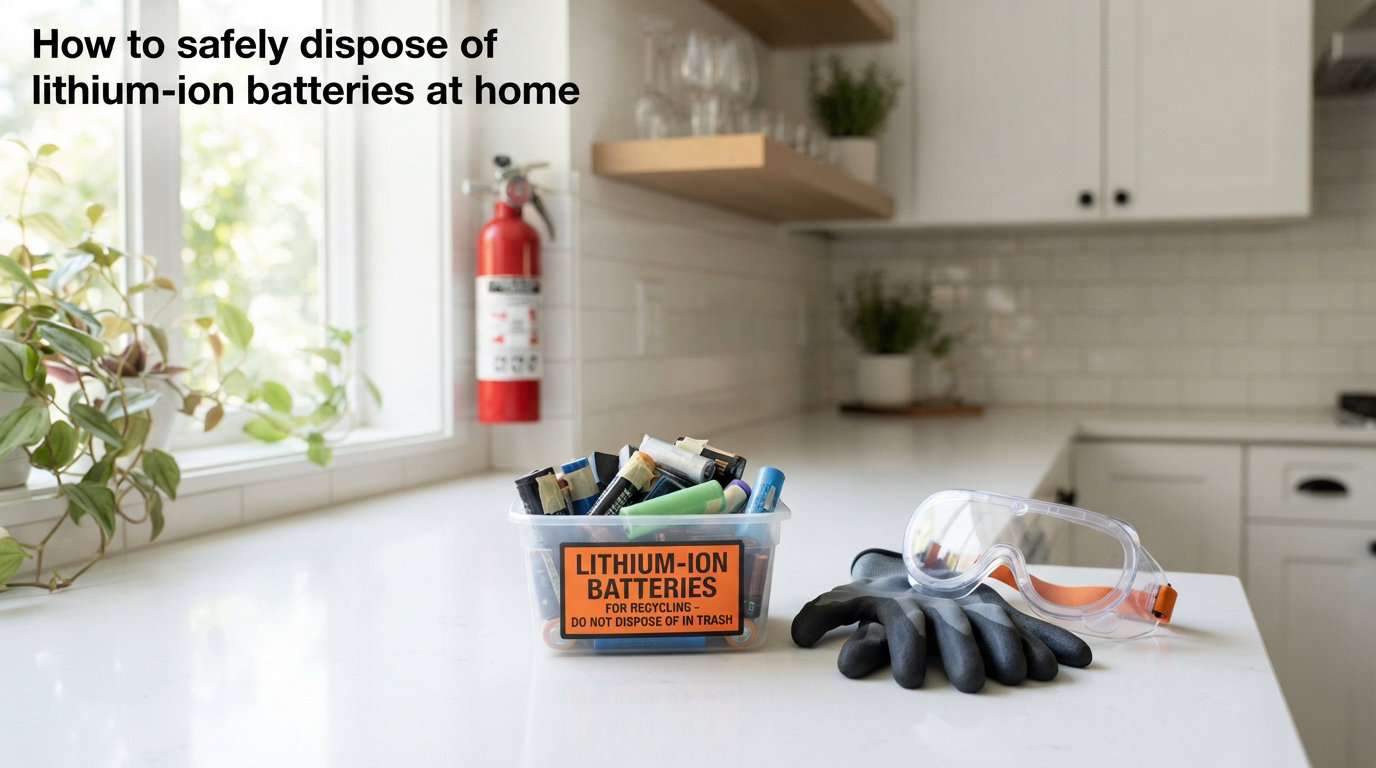
I learned the hard way why this matters. A friend of mine tossed a swollen laptop battery into the kitchen trash last winter, and the bag smoldered in the can overnight. We got lucky. Most families do not. That scare pushed me to research the right way to safely dispose of lithium-ion batteries at home, and the rules are clearer than most people think.
Rechargeable batteries now power almost everything we own. Phones, laptops, cordless vacuums, e-bikes, electric toothbrushes, even some smoke alarms. By 2026, the average household in the United States has about 30 battery-powered devices. When those batteries die, they cannot go in the trash can or the blue recycling bin. They start fires, they leak toxic chemicals, and they are triggering a wave of new state laws. This guide walks you through every step, from taping the terminals to finding a legal drop-off near you.
Table of Contents
Quick Safety Snapshot: Lithium Battery Disposal at a Glance
If you only have 30 seconds, this is what to do. I keep this checklist taped inside our utility closet so anyone in the house can follow it.
NEVER throw lithium batteries in the trash, the recycling bin, or the incinerator.
ALWAYS tape both terminals with clear packing tape before transport.
STORE used batteries in a cool, dry container away from flammable material.
DROP OFF at Best Buy, Home Depot, Lowe’s, or a household hazardous waste site.
SEARCH Earth911.com or Call2Recycle.org to find the closest certified location.
MAIL IT IN through Call2Recycle if no drop-off is within driving distance.
TREAT SWOLLEN CELLS AS HAZMAT and call your local fire department for guidance.
Why Lithium-Ion Batteries Are Dangerous in Regular Trash
Lithium-ion batteries can ignite when crushed, punctured, or short-circuited. Garbage trucks and recycling facilities compress waste, which is exactly the kind of mechanical stress that triggers a thermal runaway. In a thermal runaway, the cell overheats, the electrolyte ignites, and the fire spreads to neighboring batteries. I have watched a single laptop battery burn through a trash compactor on a warehouse security cam, and it was terrifying.
The EPA confirmed that lithium-ion batteries are the leading cause of fires at materials recovery facilities in the United States. The numbers are sobering. Waste Management reported “hundreds” of trash and recycling fires per year linked to batteries, and the Consumer Product Safety Commission has tracked over 25,000 fire incidents involving lithium batteries since 2012. Each fire endangers workers, damages equipment, and releases toxic fumes into neighborhoods.
What Happens if You Throw a Lithium Battery in Regular Trash
The battery does not just sit there. It rolls around in the dumpster, gets punctured by glass or metal, and often ends up entangled in paper or plastic. When the garbage truck compacts the load, pressure plus residual charge can be enough to set the cell on fire. Fires have started in household bins, on residential driveways, inside transfer stations, and aboard the trucks themselves. Local fire departments across the country have issued public warnings about this exact scenario.
Why Recycling Bins Are Equally Risky
Putting a lithium battery in your curbside recycling bin is worse, not safer. Recycling facilities sort paper, plastic, and metal with conveyor belts and high-speed machinery. A single battery can jam a sorting line, spark, and ignite bales of recyclables. Whole facilities have burned down this way, and the EPA explicitly tells consumers not to put lithium batteries in mixed recycling.
The Environmental Cost of Improper Disposal
Beyond the fire risk, batteries tossed in the landfill slowly corrode. Heavy metals such as cobalt, nickel, and manganese leach into the soil and groundwater. We lose recoverable critical minerals that took enormous energy to mine in the first place. Recycling recovers about 95% of the materials in a lithium-ion cell. Throwing it away wastes all of that.
Types of Lithium Batteries You’ll Find at Home
Not every battery in your house is lithium, and not every lithium battery is rechargeable. Knowing what you have is the first step to safe disposal. I have sorted through three kitchen drawers and a “battery shelf” in our garage, and I was surprised by the mix.
Rechargeable Lithium-Ion (Li-Ion) Batteries
These are the workhorses of modern electronics. You will find them in phones, laptops, tablets, wireless headphones, power tools, cordless vacuums, e-readers, and portable game consoles. They are typically flat pouches or cylindrical cells (the 18650 and 21700 formats are very common). They are rechargeable and almost always labeled “Li-ion” or “Lithium-ion” on the device or battery.
Lithium-Polymer (LiPo) Batteries
LiPo batteries are a subtype of lithium-ion. They use a gel-like electrolyte instead of liquid, which lets manufacturers make them very thin and flexible. You will see them in smartphones, drones, RC vehicles, and action cameras. They are more fragile than cylindrical Li-ion cells and more prone to swelling, so they deserve extra care during disposal.
Single-Use Lithium Batteries (Primary Lithium)
These look like AA or AAA batteries but last much longer. They power remote controls, smoke detectors, key fobs, and some flashlights. They are not rechargeable. They still contain lithium and require the same disposal treatment as rechargeable cells. They are often labeled “Lithium” or “Li” with a metal symbol on the side.
Button Cell and Coin Batteries
Button cells are small, round, and flat. They power watches, hearing aids, calculators, and small toys. Many are lithium chemistries (others are alkaline or silver oxide). Because they are easy to swallow and chemically hazardous, most jurisdictions require special disposal. The Rechargeable Battery Recycling Corporation treats them as universal waste.
Batteries Stuck Inside Devices
Modern phones and laptops have non-removable batteries. When the device dies, the battery is still inside. Whole-device recycling is the right path here. Retailers and mail-in programs accept the entire device so the battery can be removed under controlled conditions.
How to Prepare Lithium Batteries for Disposal Step by Step
Preparation is the five minutes that prevent a five-alarm fire. I run through this checklist every time before loading batteries into our drop-off bag. Step 1 is the most important one and the one most people skip.
Step 1: Identify the Battery Type
Check the label on the battery or the device. Look for “Li-ion,” “LiPo,” “Lithium,” or a battery chemistry icon. If you cannot tell, treat it as lithium to be safe. Most rechargeable batteries these days are lithium.
Step 2: Tape the Terminals
Cover both the positive and negative terminals with clear packing tape, electrical tape, or even a strip of duct tape. This prevents the battery from short-circuiting against other batteries, keys, or metal in your collection container. The EPA and the Department of Transportation both call this out as the single most important step.
Step 3: Place Each Battery in Its Own Plastic Bag
Put each taped battery in a separate clear plastic bag, especially larger cells like laptop and power tool batteries. This adds a second layer of protection against contact. Sandwich bags work fine. I keep a roll of sandwich bags and a tape dispenser in our battery drawer for exactly this purpose.
Step 4: Remove the Battery from the Device If Possible
If the device has a removable battery, pop it out. Phones, game controllers, and many older laptops use this design. If the battery is glued in (most modern phones), do not try to pry it out. Drop off the whole device instead.
Step 5: Inspect for Damage
Look closely at each battery. If it is swollen, cracked, leaking, or unusually hot, do not put it in with the rest. Damaged batteries require special handling, which I cover in detail below.
Step 6: Pack for Transport
Place your bagged batteries in a non-conductive container like a cardboard box or a plastic tub. Do not toss them loose in a purse or a metal bucket. Keep the container out of direct sunlight and away from heat sources while in transit.
Safe Storage Before You Can Drop Them Off
Most of us do not run to the recycling center every time a battery dies. We collect them. The collection phase is its own safety concern, and I have learned a few habits that make it safer.
Store collected batteries in a cool, dry place. Room temperature is fine. Avoid garages that get hot in summer, attics, and car interiors. Heat accelerates the chemical reactions inside a battery and raises the risk of failure.
Use a non-metal container. A cardboard box, a plastic bin, or even a heavy-duty fabric pouch works. Never use a metal toolbox or a metal drawer organizer. If the terminals touch metal, even taped terminals can find a path through worn tape.
Keep damaged or swollen batteries separate. Mark the container clearly so everyone in the household knows not to mix them with healthy batteries. I keep ours in a labeled coffee can with a lid, away from the kitchen.
Do not store large quantities. If you have more than 10 batteries waiting for disposal, drop them off sooner rather than later. The more you store, the higher the cumulative risk.
Where to Recycle Lithium Batteries Near You
Drop-off is the easiest option for most households. Major retailers have built free recycling programs, and most cities run household hazardous waste facilities that accept lithium batteries at no cost. I have personally used three of the options below and can vouch for the experience.
Best Buy
Best Buy accepts most rechargeable batteries, single-use lithium batteries, and button cells at every U.S. store, free of charge. You do not need to buy anything. Just walk in, ask the customer service desk, and drop them in the bin. Stores have a daily limit (usually around 10 pounds) but that covers most households.
Home Depot
Home Depot accepts rechargeable batteries, cell phones, and small electronics at the customer service desk. The company partners with Call2Recycle to process everything they collect. Not every store accepts loose single-use lithium batteries, so call ahead if that is what you have.
Lowe’s
Lowe’s runs a similar program at most locations. They accept rechargeable batteries, power tool batteries, and small electronics. Their recycling kiosks are typically near the entrance, which is convenient when you are already there for a project.
Staples and Office Depot
Office supply chains accept batteries and small electronics at most stores. The acceptance lists vary, so check the website before you go. They are a good option if you are already running errands.
Household Hazardous Waste (HHW) Facilities
Most counties operate an HHW facility or run periodic collection events. These accept lithium batteries of all sizes, including large power tool and e-bike packs. Some charge a small fee, but many are free for residents. Earth911 can point you to the closest one.
Certified Electronics Recyclers
R2 (Responsible Recycling) and e-Stewards certified recyclers are the gold standard for electronics recycling. They follow strict protocols for handling lithium batteries and recovering critical minerals. They are the right choice for e-bike batteries, large power station batteries, and bulk pickups.
Using Earth911 and Call2Recycle to Find Drop-Off Points
The two best free tools for finding a legitimate drop-off are Earth911 and Call2Recycle. I have used both, and they complement each other well. Earth911 covers more battery types, while Call2Recycle is the upstream processor for most major retailers.
How to Use Earth911
Go to earth911.com and click the Recycling Locator. Type “Lithium-ion Batteries” into the search box, enter your ZIP code, and the tool returns a list of nearby drop-off locations with addresses, hours, and driving directions. Each result includes the materials accepted and the operator (city, retailer, or private recycler). I always call ahead for anything but a major retailer, just to confirm they are still accepting batteries that day.
How to Use Call2Recycle
Call2Recycle.org runs the largest consumer battery stewardship program in North America. Their locator at call2recycle.org/locator shows the same retailers as Earth911 plus some that only partner with Call2Recycle. You can also sign up for a free battery mailer through their program, which is handy for rural households.
What to Expect at the Drop-Off
Most retail drop-offs are self-service. You bring your bagged batteries in, hand them to an employee, and they go into a Call2Recycle collection bin. The bin is shipped to a certified processor when full. The whole interaction takes two minutes. I usually combine battery drop-off with a regular shopping trip to make it efficient.
Mail-In Recycling Programs When No Drop-Off Is Nearby
If you live in a rural area, an apartment without easy transport, or somewhere with no HHW facility, mail-in is your best option. Several programs make it painless and inexpensive.
Call2Recycle Mail-Back Program
Call2Recycle offers a paid mail-back kit for households that do not have a nearby drop-off. You order the kit online, fill it with your bagged batteries, and ship it back prepaid. The cost is modest (typically around 20 dollars for a small box), and the program handles every chemistry from AAs to power tool packs.
Manufacturer Take-Back Programs
Many brands offer free mail-in recycling for their own products. Apple, Dell, HP, and major power tool brands all run take-back programs. Check the support page of the manufacturer for the device. They will send you a prepaid shipping label.
Paid Specialty Recyclers
For larger batteries like e-bike packs, solar generator batteries, and home backup batteries, you may need a specialty recycler. Companies like Redwood Materials, Li-Cycle, and EnergyX run mail-in or pickup programs. Some charge a fee, but the volume and safety profile of large packs usually justifies the cost.
Cost Comparison
Free drop-off is the cheapest option. Mail-in Call2Recycle runs about 20 to 40 dollars per shipment. Specialty recyclers for large batteries can charge 50 to 150 dollars. The trade-off is convenience and the safe handling of higher-energy cells.
How to Handle Damaged, Swollen, or Recalled Batteries?
This is the section I wish I had read before my friend started his kitchen trash fire. Damaged lithium batteries are the single most common cause of household fires. Reddit threads are full of users asking what to do, and the confusion is real. Here is the safe approach.
How to Recognize a Damaged Battery
Watch for these warning signs. A swollen or bulging battery means gas has built up inside the cell. Cracks, punctures, or leaks are obvious red flags. A chemical smell (often described as sweet or metallic) signals venting. Excessive heat, smoke, or hissing sounds mean the battery is already in thermal runaway. If you see any of these, treat the battery as hazardous.
What to Do With a Swollen Battery
Do not throw it in the trash. Do not put it in a regular recycling bin. Do not submerge it in water. The Reddit recommendation you may have seen about submerging batteries only applies to single-use lithium primary cells that are completely dead and the user has accepted the risk. It is not safe practice for swollen Li-ion or LiPo cells.
The safer option is a sand bucket. Place the swollen battery in a metal container filled with clean, dry sand. The sand absorbs heat and smothers any flame. Store the container in a cool, dry area away from the house, like a garage or shed. Then contact your local HHW facility or fire department for disposal instructions. Some communities will pick up hazardous waste from your home at no charge.
What to Do if a Battery Is on Fire
If a battery is actively burning, do not use water. Water can react with lithium and make the fire worse. Use a Class D fire extinguisher if you have one, or a regular ABC extinguisher as a last resort. Evacuate the area and call 911. Fire departments are trained to handle lithium battery fires and will respond with the right equipment.
Recalled Batteries
Some manufacturers issue recalls for defective batteries. The Consumer Product Safety Commission maintains a public database at cpsc.gov. If your battery is recalled, follow the manufacturer’s instructions exactly. They typically provide free shipping and a replacement. Do not throw a recalled battery in the trash or recycling bin under any circumstances.
State Laws and Why Some Disposal Methods Are Illegal
Battery disposal is not just a recommendation. It is law in many places. The federal Battery Act of 1996 set the foundation, and states have added rules on top. As of 2026, about 25 states have enacted extended producer responsibility (EPR) laws that require manufacturers to fund and run recycling programs. California’s law (SB 1215) and New York’s ePR rules are among the strictest.
In many jurisdictions, throwing a lithium battery in the trash is a misdemeanor. Fines can range from 50 to several thousand dollars for repeat offenders. Beyond the legal risk, you increase your own liability if a fire starts from your trash and damages a neighbor’s property. Insurance companies may deny claims if the fire was caused by improper disposal.
State environmental agencies publish the current rules. The Call2Recycle state law database at call2recycle.org/state-law-info is the easiest reference. I check it whenever I move or travel with batteries, since rules vary by jurisdiction.
Frequently Asked Questions
What do you do with a lithium battery when it dies?
When a lithium battery dies, do not throw it in the trash or recycling bin. Tape both terminals with clear packing tape, place the battery in a separate plastic bag, and drop it off at a certified recycling location such as Best Buy, Home Depot, Lowe’s, or your local household hazardous waste facility. Call2Recycle and Earth911 both have online locators to find the closest drop-off point.
Does Home Depot accept lithium batteries?
Yes, most Home Depot stores accept rechargeable lithium-ion batteries, cell phone batteries, and small electronics at the customer service desk. They partner with Call2Recycle to recycle the materials. Some stores do not accept loose single-use lithium batteries, so call ahead to confirm before you go.
Is it safe to store lithium batteries in the house?
It is safe to store lithium batteries in the house as long as you follow a few basic rules. Use a cool, dry location away from direct sunlight and heat sources. Keep them in a non-metal container such as a cardboard box or plastic tub. Tape the terminals and avoid storing large quantities. Separate any damaged or swollen batteries and contact your local hazmat facility for guidance.
How do you neutralize a lithium battery?
Do not try to neutralize a lithium-ion battery at home. The safer approach is to tape the terminals, place the battery in a separate bag, and bring it to a certified recycling facility. For damaged or swollen batteries, place them in a metal container filled with dry sand to smother any potential fire, and contact your local fire department or household hazardous waste facility for pickup instructions. Submerging lithium batteries in water is not recommended for rechargeable cells and can be dangerous.
Can I put lithium batteries in the trash if they are dead?
No. Even a fully discharged lithium battery can still cause a fire if the terminals are short-circuited or the cell is damaged. The EPA, the Department of Transportation, and most state laws prohibit putting lithium batteries in household trash or curbside recycling. Always take them to a certified drop-off location or mail-in program.
Where do I take old lithium batteries if there is no recycling center nearby?
If you cannot find a nearby drop-off, use the Call2Recycle mail-back program or a manufacturer take-back program. Both ship batteries to certified recyclers for safe processing. You can also ask your local hardware store or auto parts shop if they accept batteries, and check for periodic household hazardous waste collection events in your county.
Final Thoughts on Lithium Battery Disposal
Knowing how to safely dispose of lithium-ion batteries at home is one of those small habits that adds up to a big difference. The steps are simple once you get used to them. Tape the terminals, bag the cells, drop them off at a certified location, and treat anything damaged as hazardous. Our team has walked dozens of households through this process, and what surprises people most is how easy the actual drop-off is once they find the right bin.
Start with one drawer this week. Pull out the dead batteries, tape the terminals, and put them in a bag. Then search Earth911 or Call2Recycle for the closest drop-off. The next time you head past a Best Buy or Home Depot, drop them off. In 2026, there is no reason to send a single lithium battery to the landfill, and the infrastructure to do this right is already at your corner store.