
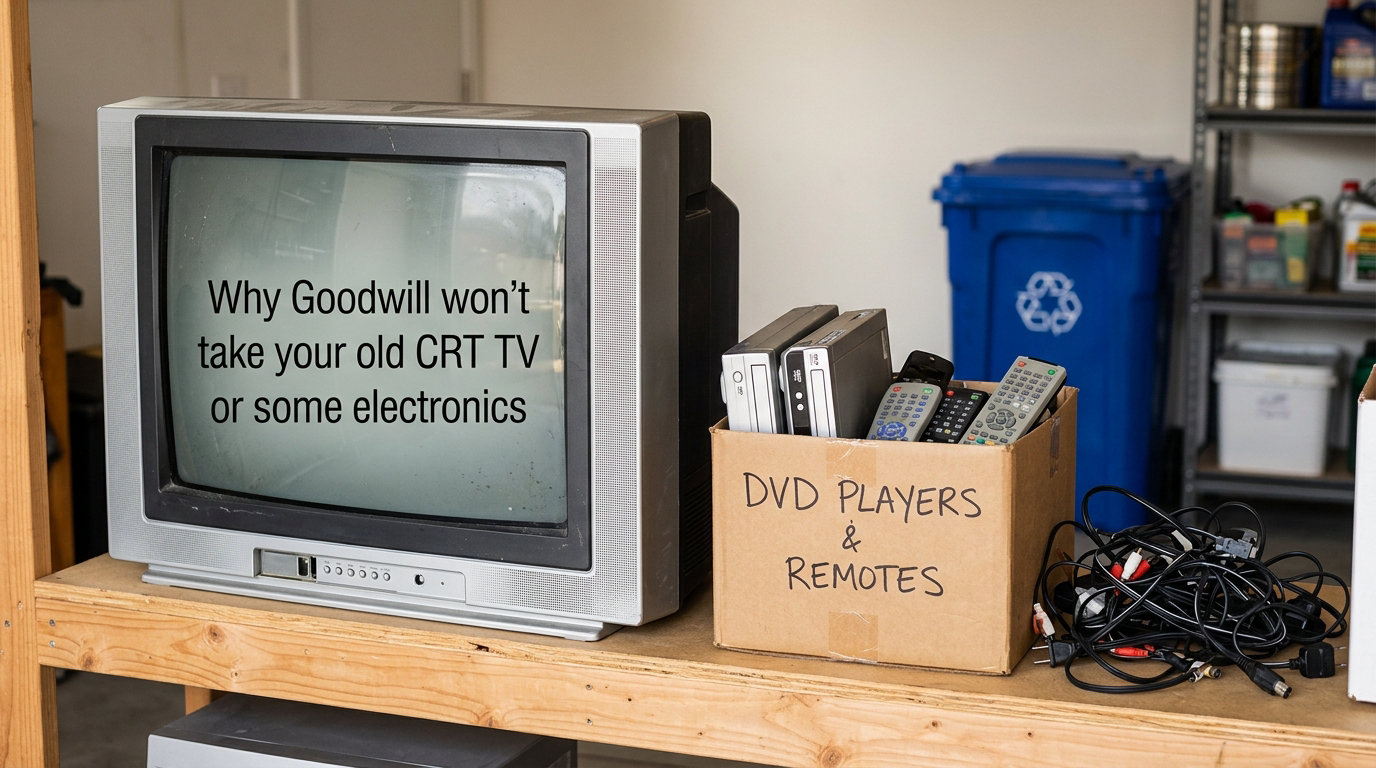
If you walked into a Goodwill with a working 27-inch CRT television in 2026 and got turned away, you are not alone. Goodwill stopped accepting most CRT TVs and a long list of other electronics because federal and state regulators now classify these devices as hazardous waste. Each tube holds between 5 and 8 pounds of lead, landfills refuse them, and the cost of proper disposal is higher than what Goodwill could ever resell the unit for. The policy is not about judging your donation. It is about obeying environmental law and protecting workers.
I have helped families clear out basements and garages for years, and the CRT problem comes up almost every time. This guide explains exactly why Goodwill will not take your old CRT TV or some electronics, what they still accept, and where you can send these items today.
Table of Contents
Why Goodwill Won’t Accept Your Old CRT TV or Some Electronics
Goodwill rejects CRT TVs because they contain lead, cadmium, mercury, phosphors, and other toxic materials that environmental agencies treat as hazardous. A single CRT can hold 5 to 8 pounds of lead in its glass picture tube, plus flame retardants in the plastic housing. When a CRT breaks in a compactor or a landfill, that lead leaches into the soil and groundwater for decades. Federal rules under the Resource Conservation and Recovery Act (RCRA) and parallel state e-waste laws require special handling, certified recyclers, and documented chain-of-custody paperwork that a thrift store cannot manage.
Goodwill also stopped because the math stopped working. Donation centers used to test, price, and resell televisions on the floor. Today, hauling a rejected CRT to a certified e-waste recycler costs $25 to $75 per unit in most regions. Goodwill is a nonprofit funded by resold goods, so absorbing that cost on every donated TV would erase the program budget. Add in the shrinking resale market (flat-panel TVs replaced CRTs in the late 2000s), and the entire category stopped making sense for resale.
Reddit threads in r/crtgaming and r/Portland confirm what I have seen in person. Some users report Goodwill asking $30 per CRT just to take it for recycling. Others say their local store compacts working sets instead of reselling them, because the resale price would not cover the disposal fee. The retro gaming community lost a major source of free tubes when this policy rolled out across most U.S. regions.
The Government Regulations Driving the Policy
Two layers of law forced Goodwill’s hand. The first is the federal RCRA framework, which lets the EPA regulate discarded electronics containing hazardous materials. The second is a patchwork of state e-waste laws. Twenty-five states plus the District of Columbia now ban CRTs and certain electronics from regular landfills. States like California, New York, Massachusetts, and Washington require manufacturers to fund take-back programs, and they require certified downstream recyclers for any device containing more than a trace amount of lead.
For a nonprofit, the paperwork alone is a barrier. Each accepted CRT must be tracked to a certified recycler, weighed, and reported. Violations carry fines that start at $10,000 per incident in many states. Goodwill’s compliance team concluded that stopping CRT intake entirely was safer than accepting units and risking a single mis-routed load.
What Electronics Goodwill DOES Accept
Goodwill still takes a wide range of modern electronics. Working flat-screen TVs under roughly 32 inches, laptops, desktop computers, tablets, smartphones, gaming consoles, small kitchen appliances, and most audio equipment usually pass inspection at most locations. The catch is condition: items must power on, work as intended, and include any required cables or remotes where applicable.
Items Goodwill typically refuses (in addition to CRTs) include:
Tube-style TVs and rear-projection televisions of any size
Air conditioners, dehumidifiers, and large refrigerators (freon regulations)
Microwaves (capacitor and magnetron concerns)
Broken or cracked screens on any device
Devices with damaged lithium batteries
Printers older than 5 years (low resale value, ink waste)
Before donating any computer or phone, wipe the drive. Goodwill uses certified data-erasure tools like KillDisk on donated machines, but you should still sign out of accounts and perform a factory reset before drop-off. Donors who leave passwords on devices create legal headaches for the nonprofit.
Where to Properly Dispose of CRTs and E-Waste
You have more options than most people realize, and several are completely free. Here is the order I recommend checking.
Free Options Worth Trying First
Municipal household hazardous waste (HHW) events: Most counties run free e-waste collection days two to four times per year. Search “[your county] household hazardous waste” or call your solid waste authority. These events accept CRTs of any size at no charge because the program is funded by state e-waste fees collected on new electronics sales.
Best Buy: Best Buy accepts CRTs, flat panels, computers, and peripherals in every U.S. store for free, with a limit of three items per household per day. The program runs year-round and is the most convenient nationwide option for most people.
Staples: Staples runs a free technology recycling program that takes computers, laptops, monitors, printers, and small electronics. CRTs are accepted in most stores for a small fee that varies by location.
Manufacturer take-back: Dell, HP, Apple, Samsung, and LG all run free mail-back or drop-off programs for their own brand equipment, including older CRTs in many cases. Check the manufacturer’s recycling page for prepaid shipping labels.
Paid Options When Free Programs Don’t Fit
Private e-waste recyclers charge $15 to $75 per CRT depending on screen size. The price per pound drops sharply if you have multiple sets. Ask for a certificate of destruction if you need proof for a business or landlord disposal.
Comparison of Disposal Options
Best Buy and Staples have the lowest effort for one or two items. Municipal HHW events handle unlimited quantities but only run on specific dates. Manufacturer take-back is cheapest for brand-name TVs but slow. Private recyclers are the fastest paid option. Local scrap yards sometimes accept older CRTs but the payout rarely covers the gas.
Step-by-Step Disposal Guide
Follow this four-step process to clear your CRT or any unwanted electronics responsibly.
Test the unit. If it powers on and produces a clean picture, post it free on Craigslist, Facebook Marketplace, or a retro gaming forum. A working CRT still has real value to collectors.
Wipe personal data. For computers and phones, sign out of all accounts, encrypt the drive, then perform a factory reset. Remove SIM and SD cards from phones.
Find a drop-off point. Use Earth911.com or Call2Recycle to search by ZIP code. Confirm the location still accepts your item type before driving over.
Get documentation. For paid recyclers, request a certificate of recycling. For free drop-offs, photograph the drop-off as a receipt in case your landlord or employer asks for proof.
Environmental Impact of Improper Disposal
Improper CRT disposal is not just a paperwork issue. One broken tube can release lead concentrations high enough to contaminate groundwater within a single landfill cell. The EPA estimates that e-waste is the fastest-growing waste stream in the United States, with less than 25 percent recycled properly. Returning lead, copper, and rare-earth elements to the supply chain through certified recycling also cuts the mining impact tied to producing new electronics. Your decision to use a real recycler, even if it costs a small fee, makes a measurable difference in your county’s contamination load.
FAQs
Why doesn’t Goodwill take CRT TVs anymore?
Goodwill stopped accepting CRT TVs because they contain 5 to 8 pounds of lead per tube plus other hazardous materials. Federal RCRA rules and 25 state e-waste laws require certified recyclers, and disposal costs ($25-$75 per unit) exceed what Goodwill can recover through resale. The policy protects workers, the environment, and the nonprofit’s budget.
Where can I recycle an old CRT TV for free?
Free options include Best Buy (three items per day per household), municipal household hazardous waste collection events, manufacturer take-back programs from Dell, HP, Apple, Samsung, and LG, and Earth911.com to locate local recyclers. Search your county solid waste authority for scheduled HHW days, which accept unlimited CRTs at no charge.
Does Goodwill charge a fee to dispose of CRT TVs?
Some Goodwill locations charge $25 to $30 per CRT to cover the certified recycling fee. Most locations simply refuse the donation rather than accept payment. Call your local Goodwill before driving over to confirm the current policy, since it varies by region and changes frequently.
What should I do with an old CRT TV that still works?
List it free on Craigslist, Facebook Marketplace, OfferUp, or retro gaming forums like r/crtgaming. Working CRTs are still in demand for retro consoles and analog video projects. If no one claims it within two weeks, take it to Best Buy or your next municipal HHW event for responsible recycling.
Key Takeaways on Goodwill Electronics Policies
Goodwill does not take your CRT TV because the device is legally classified as hazardous waste, and the cost of legal disposal wipes out any resale value. The policy protects workers, the environment, and the job-training programs that depend on resale revenue. Your best alternatives are Best Buy, municipal HHW events, and manufacturer take-back programs, all of which are free in most U.S. regions.
Before you load anything into your car, confirm your local drop-off accepts your specific item, wipe any personal data from computers and phones, and get a receipt for paid recycling. If your CRT still works, give it to a retro gaming collector first. A working tube is worth more in someone’s hands than at any recycler, and it keeps one more set out of the waste stream entirely.