
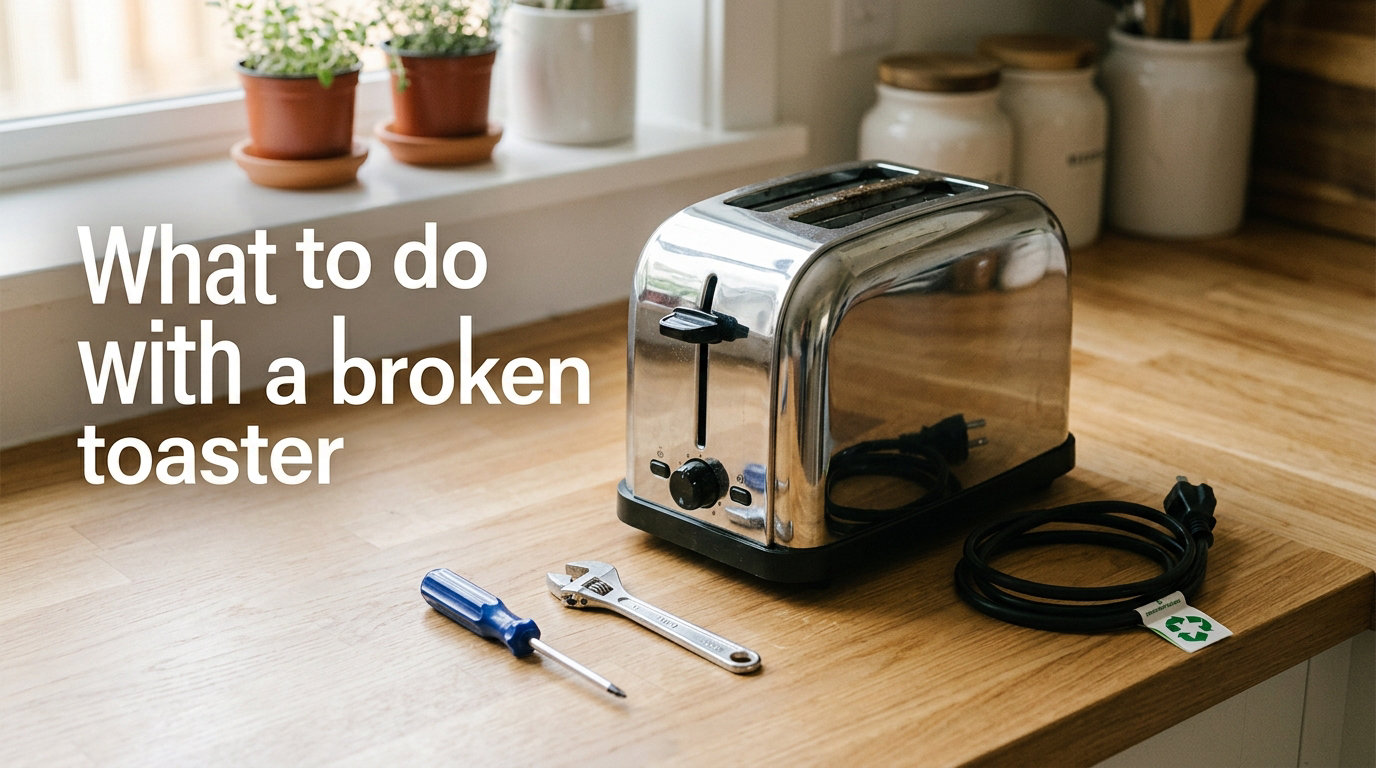
When your toaster stops working, you might be tempted to toss it in the trash and buy a new one. But a broken toaster is classified as e-waste, which means it requires special handling rather than a trip to your regular garbage bin. Throwing small appliances away sends recoverable metals like copper, aluminum, and steel straight to landfills where they sit for decades.
The good news is that you have at least seven responsible options. You can recycle a broken toaster at a certified e-waste center, drop it off at retailers like Best Buy or Staples, donate it if it still works, repair it yourself, or even repurpose it with creative upcycling ideas. Each route keeps hazardous materials out of the environment and reclaims valuable resources.
In this guide, I’ll walk you through exactly what to do with a broken toaster, step by step. We’ll cover repair options, donation routes, recycling centers, retailer programs, junk removal, and creative reuse ideas that most guides skip entirely. By the time you finish reading, you’ll know exactly how to handle that dead appliance sitting on your counter.
Table of Contents
What to Do With a Broken Toaster: Your Options at a Glance
If you are wondering what to do with a broken toaster, here are your main options, ranked from most to least effort-efficient:
- Repair it — Many toasters fail due to a simple fuse or crumb buildup. A 15-minute fix could save you money and waste.
- Donate it — If the toaster still works, local charities, shelters, and thrift stores may take it off your hands.
- Sell or give it away — Post it on Facebook Marketplace or Freecycle for free pickup.
- Recycle at an e-waste center — Certified electronics recyclers break down toasters and recover metals, glass, and wiring.
- Use a retailer take-back program — Stores like Best Buy and Staples accept small electronics for recycling at no charge.
- Schedule junk removal — Services like 1-800-GOT-JUNK handle pickup and proper disposal for a fee.
- Upcycle it — Turn the housing, cord, or heating elements into something new and useful.
Never throw a toaster in your regular trash or curbside recycling bin. Most municipal recycling programs are not equipped to process small appliances, and the internal wiring can damage sorting equipment.
Is Your Toaster Actually Broken? Try Repairing It First
Before you get rid of anything, take ten minutes to check whether your toaster actually needs replacing. A surprising number of “broken” toasters just need a thorough cleaning or a cheap part swap. Repair should always be your first consideration because it is the most environmentally friendly option and costs almost nothing.
Reddit users on r/fixit frequently report that toasters fail in predictable ways. The lever won’t stay down, one side stops heating, or the bread comes out barely warm. Most of these issues trace back to crumb buildup, a blown thermal fuse, or a loose wire connection. All three are fixable at home with basic tools.
Common Toaster Problems and Quick Fixes
Here are the most common toaster failures and how to address them:
- Lever won’t stay down: Unplug the toaster, turn it upside down, and shake out accumulated crumbs. Open the crumb tray and clean thoroughly. Crumbs jam the latch mechanism more often than people realize.
- One slot stops heating: The nichrome heating element wire on one side may have broken. You can solder a replacement wire, though this requires disassembling the toaster housing.
- Toaster trips the breaker: This usually indicates a short circuit caused by moisture or a damaged heating element. Let the toaster dry completely for 24 hours before testing again.
- Toast comes out unevenly: Clean the heating elements with a dry brush. Built-up residue creates hot and cold spots across the wires.
Always unplug the toaster before attempting any repair. If you are not comfortable working with small appliances, skip straight to recycling or donation.
Is It Worth Repairing a Toaster?
For most budget and mid-range toasters, repair is not cost-effective if you need to pay a technician. A service call typically runs $50 to $100, while a new basic toaster costs $25 to $40. The math favors DIY repair only when the fix takes under 30 minutes and parts cost less than $10.
However, if you own a high-end toaster like a Breville or Dualit that cost $150 or more, professional repair or a manufacturer parts order often makes financial sense. Premium toasters are built with replaceable components specifically designed for a longer service life.
Forum discussions on Reddit consistently show that users who successfully fix their own toasters are those tackling simple problems like fuse replacement or crumb cleaning. Anything involving the circuit board or heating element usually leads people to recycle and replace.
Donate a Toaster That Still Works
If your toaster still functions but you are upgrading or decluttering, donation is an excellent option. Working toasters are in constant demand at thrift stores, shelters, and community organizations. Just make sure the appliance is clean and fully operational before dropping it off.
Goodwill accepts small kitchen appliances at most locations, but policies vary by region. Call your local store before driving over to confirm they take toasters. Salvation Army, Habitat for Humanity ReStore, and local homeless shelters often accept working small appliances as well.
You can also check with community groups on Facebook or Nextdoor. Many people moving into their first apartment or recovering from a house fire desperately need basic kitchen items. A working toaster can go to someone who truly needs it within hours of posting.
Avoid donating broken toasters to charity. Thrift stores are not repair shops, and broken electronics create disposal costs for organizations that operate on tight budgets. If it does not work, recycle it instead.
Sell or Give Away an Old Toaster
A working toaster in decent condition can sell for $10 to $25 on local marketplaces. Even non-working toasters sometimes get snapped up by DIY repair enthusiasts who want the parts or the challenge of fixing something.
Facebook Marketplace, Craigslist, and OfferUp are your best bets for local pickup. List the toaster with honest photos and a clear description of its condition. If it has a minor issue like a stuck lever, mention it in the listing rather than hiding it.
Freecycle.org and the “Buy Nothing” groups on Facebook are perfect for giving away appliances for free. Post your toaster, set it on your porch, and let someone pick it up. This takes the least effort of any option and guarantees the toaster finds a second life rather than a landfill.
Recycle Your Broken Toaster at a Certified E-Waste Center
Recycling is the most responsible option for a toaster that no longer works and cannot be repaired. A broken toaster is considered electronic waste because it contains a circuit board, copper wiring, heating elements, and a power cord. All of these components contain recoverable materials that certified recyclers extract and sell back to manufacturers.
To find a certified e-waste recycler near you, use the Earth911 recycling directory at earth911.com. Enter “small appliances” and your zip code to see a list of nearby drop-off locations. You can also search for facilities certified by e-Stewards or R2 (Responsible Recycling), which are the two most recognized third-party certification programs in the United States.
Most e-waste centers accept toasters for free, though some may charge a small fee of $5 to $10 for items with mixed materials. Call ahead to confirm their policies and hours before making the trip.
Many cities also host periodic household hazardous waste collection events where residents can drop off electronics and small appliances at no charge. Check your municipal website for upcoming collection dates in 2026.
What Materials Get Recovered From a Recycled Toaster
When a certified recycler processes a toaster, they separate it into distinct material streams. Here is what gets recovered:
- Steel and iron — The outer housing and internal frame are typically made of rolled steel, which is fully recyclable and infinitely reusable.
- Copper wiring — The power cord and internal wiring contain copper, one of the most valuable and recyclable metals on earth.
- Aluminum — Some toaster models use aluminum heat reflectors and structural components that recyclers melt down for reuse.
- Nichrome wire — The heating elements are made from a nickel-chromium alloy that specialist recyclers can recover.
- Plastic components — Knobs, levers, and housing trim are separated and processed separately.
According to recycling industry data, a typical two-slice toaster yields about 60 to 70 percent recoverable metal by weight. That material goes straight back into manufacturing, reducing the need for virgin mining and the environmental damage that comes with it.
Use a Retailer Take-Back Program
Several major retailers offer free electronics recycling programs that accept small kitchen appliances, including toasters and toaster ovens. These programs are convenient because you can drop off your broken toaster during a regular shopping trip.
Best Buy accepts up to three items per household per day at no charge. Their recycling program covers most small electronics and kitchen appliances. Check the Best Buy recycling page for a full list of accepted items before heading to the store.
Staples runs a similar program and accepts small electronics for recycling in-store. They occasionally offer trade-in credit for working electronics, though toasters typically do not qualify for credit.
Home Depot and Walmart participate in regional recycling programs, but their acceptance policies vary widely by location. Call your local store to confirm whether they accept small appliances before making a special trip.
If you are buying a replacement toaster, ask the retailer if they offer an old-appliance take-back service. Some stores will recycle your old unit for free when you purchase a new one.
Schedule a Junk Removal Service
If you have multiple broken appliances or bulky items to dispose of, a junk removal service like 1-800-GOT-JUNK can handle the whole load at once. They sort items and route recyclable materials to proper facilities rather than dumping everything in a landfill.
This option costs money, typically $75 to $150 for a single pickup depending on your location and the volume of items. It makes the most sense when you are clearing out a kitchen renovation, an estate, or a storage unit with several appliances at once.
For a single toaster, junk removal is overkill. Stick with free options like retailer drop-off or an e-waste center instead.
Upcycle Your Broken Toaster: Creative Ideas
No competitor guide covers upcycling in depth, but creative reuse is one of the most satisfying answers to what to do with a broken toaster. If the housing is intact but the electronics are dead, the metal and glass components can find new life in unexpected ways.
Turn the housing into a planter. Remove the internal electronics, fill the cavity with soil, and plant herbs or succulents. The chrome housing looks surprisingly modern on a windowsill and makes a great conversation piece.
Harvest the nichrome wire. DIY enthusiasts use salvaged heating element wire for foam-cutting tools, custom heaters, and electronics projects. The wire is durable, heat-resistant, and free.
Salvage the power cord. A standard appliance power cord works for many repair and DIY electronics projects. Cut the cord at the toaster housing, strip the ends, and save it for future use.
Make a retro art piece. Vintage chrome toasters have a mid-century aesthetic that looks striking mounted on a canvas or displayed as industrial decor. A non-functional toaster can become a unique wall sculpture.
Upcycling keeps materials out of the waste stream entirely and gives you a creative project in the process. Just make sure you fully remove and safely dispose of the circuit board and any capacitors before repurposing the housing.
How to Prepare a Toaster for Recycling: Step-by-Step
Proper preparation helps your toaster get processed safely and efficiently at any recycling facility. Follow these steps before dropping off your appliance:
Step 1: Unplug and disconnect. Make sure the toaster is completely unplugged and has cooled down. If it was recently used, wait at least one hour for the heating elements to reach room temperature.
Step 2: Clean out all crumbs. Open the crumb tray and shake the toaster over a trash can or sink. Use a dry brush to remove residue from the slots. This prevents food waste from contaminating the recycling stream.
Step 3: Cut the power cord. Use wire cutters to sever the power cord about two inches from the toaster body. This is a safety measure that prevents accidental use of a broken appliance. Keep the cord separate, as recyclers process copper wiring independently.
Step 4: Remove detachable parts. Take off any removable knobs, trays, or accessories. Bag small pieces separately so they do not get lost during transport.
Step 5: Check for glass. If your toaster has a glass window or tempered glass panel, note this when dropping it off. Some recyclers handle glass separately from metal.
Step 6: Transport carefully. Place the toaster in a box or bag to prevent loose parts from shifting during transport. Deliver it to your chosen recycling location.
These steps take about 15 minutes and make a real difference in how effectively the recycler can process your appliance. Skipping preparation can result in the facility rejecting the item or processing it less efficiently.
What NOT to Do With a Broken Toaster
There are a few things you should never do with a broken toaster. These mistakes can cause safety hazards, environmental damage, or legal issues depending on where you live.
Do not throw it in the regular trash. In many states, including California, New York, and Illinois, it is illegal to dispose of electronics in standard garbage. These laws classify small appliances as e-waste that must go through certified recycling channels. Violating disposal laws can result in fines ranging from $50 to several hundred dollars.
Do not put it in curbside recycling. Municipal recycling programs handle paper, plastic, glass, and aluminum cans. They are not equipped to process mixed-material electronics like toasters. Putting a toaster in your blue bin can damage sorting equipment and contaminate other recyclables.
Do not hold the lever down manually. Reddit users on r/mildlyinfuriating frequently describe roommates holding a broken toaster lever down with a fork or heavy object. This is a serious fire hazard. If the auto-shutoff mechanism is broken, the heating elements can stay on indefinitely and ignite the bread or surrounding materials.
Do not attempt repairs while plugged in. Even unplugged toasters can retain a charge in capacitors. If you open the housing, avoid touching the circuit board and internal wiring directly.
Frequently Asked Questions
Can I throw a broken toaster in the bin?
No, you should never throw a broken toaster in the regular trash bin. Toasters are classified as electronic waste because they contain circuit boards, copper wiring, and heating elements. In many states including California, New York, and Illinois, disposing of small electronics in standard garbage is illegal and can result in fines. Take your broken toaster to a certified e-waste recycler, a retailer like Best Buy, or a community recycling event instead.
How do I get rid of my toaster?
The best way to get rid of a toaster depends on its condition. If it still works, donate it to a thrift store or list it free on Freecycle. If it is broken, take it to a certified e-waste recycling center, drop it off at Best Buy or Staples through their free electronics recycling program, or schedule a junk removal pickup. Always cut the power cord and clean out crumbs before recycling.
Is it worth it to repair a toaster?
Repairing a toaster is only worth it for simple fixes you can do yourself, such as cleaning out crumbs or replacing a blown thermal fuse. For budget and mid-range toasters costing under $50, professional repair at $50 to $100 per service call does not make financial sense. However, premium toasters from brands like Breville or Dualit that cost $150 or more are designed with replaceable parts and are often worth repairing.
Can you recycle a toaster or toaster oven?
Yes, you can recycle both toasters and toaster ovens. They are classified as e-waste and can be dropped off at certified electronics recycling centers, retailer take-back programs at Best Buy or Staples, or community household hazardous waste collection events. A typical toaster yields 60 to 70 percent recoverable metal by weight, including steel, copper, aluminum, and nichrome heating wire.
What is the average lifespan of a toaster?
The average lifespan of a standard toaster is 6 to 8 years with regular use. Budget models may fail sooner after 3 to 5 years, while premium toasters from brands like Dualit can last 15 years or more with proper maintenance. Signs that a toaster is nearing the end of its life include uneven toasting, a lever that will not stay down, and visible damage to the heating elements.
Does Goodwill accept broken toasters?
No, Goodwill does not accept broken toasters or non-working electronics. Thrift stores only take functional items they can resell, and broken appliances create disposal costs for the organization. If your toaster still works, Goodwill will gladly accept it. If it is broken, take it to a certified e-waste recycler or a retailer with a take-back program instead.
Wrapping Up: Make the Responsible Choice
Figuring out what to do with a broken toaster does not have to be complicated. Start by checking whether a simple repair can bring it back to life. If not, donate or sell a working unit, or recycle a broken one through a certified e-waste center, retailer take-back program, or community collection event.
The key takeaway is simple: never throw a toaster in the regular trash. Every broken toaster contains copper, steel, aluminum, and other materials that can be recovered and reused. By choosing responsible disposal, you keep hazardous components out of landfills and give valuable resources a second life.
Grab your toaster, follow the preparation steps above, and drop it off at the nearest recycling option on your next errand run. It takes 15 minutes and makes a real environmental difference.