
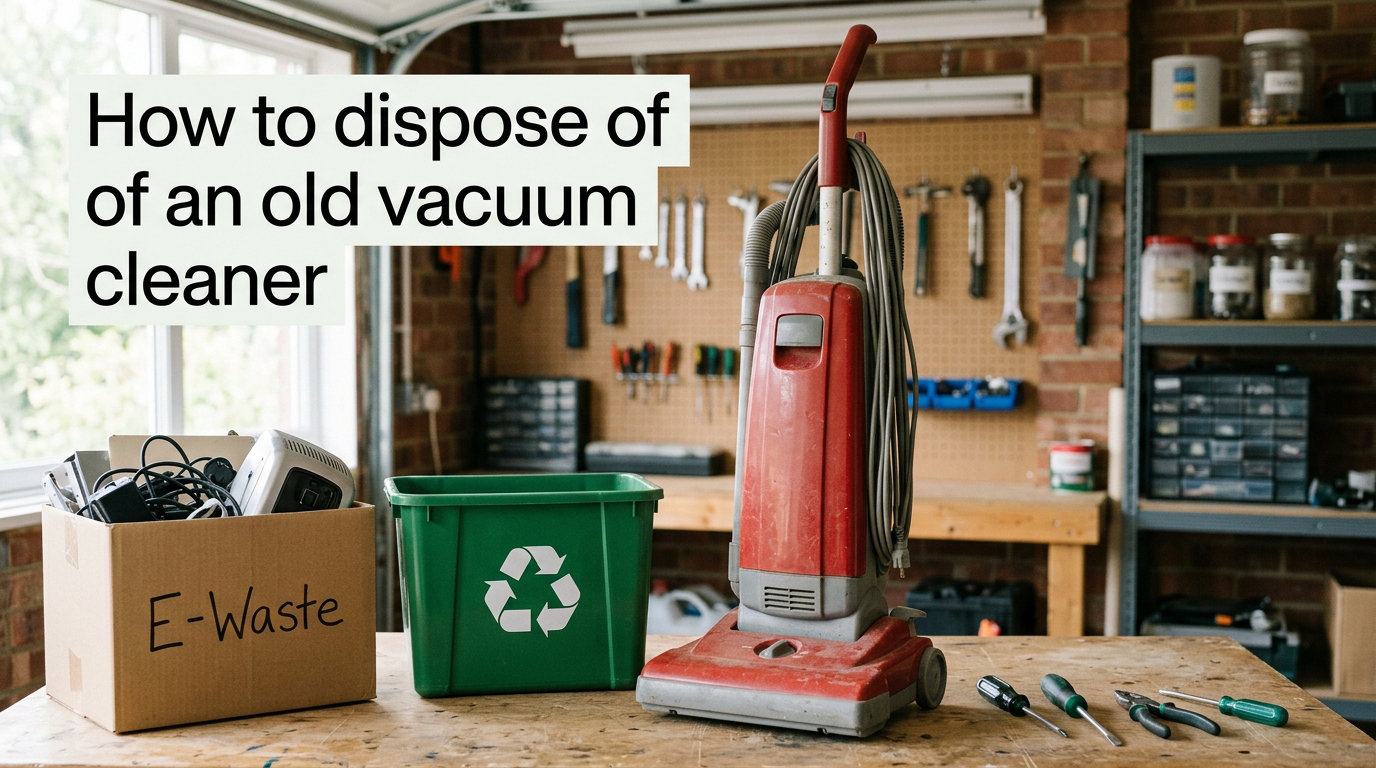
Learning how to dispose of an old vacuum cleaner is easier than most people think. Your options include recycling it, donating it, trading it in, or repurposing parts.
I’ve helped friends and family clear out closets, garages, and basements for over a decade. In that time, I’ve seen vacuums sit in corners for years because nobody knew what to do with them. Most people assume the trash is the only option, but that’s rarely the best one. In this guide, I’ll walk you through every realistic disposal method so you can pick the one that fits your situation.
Table of Contents
Can you put an old vacuum cleaner in the bin?
Yes, you can put an old vacuum cleaner in the bin in most areas, but only as a last resort. In many cities, vacuum cleaners are classified as small electrical appliances and must be recycled rather than tossed in the regular trash.
Before you bag it up, check your local waste rules. Counties like Hennepin in Minnesota and several districts in California require small appliances to go through e-waste channels. Some municipalities only accept vacuums in curbside junk pickup, not in the regular bin. The fastest way to be sure is to search your city or county’s “what goes where” tool.
When the trash is acceptable
If your vacuum has no removable battery and your local program allows it, bagging it in plastic and putting it in the trash bin is acceptable. This is the typical guidance in places that don’t yet have small-appliance recycling mandates. Even then, I always recommend removing the dust bag or canister first, sealing it in a separate bag, and adding it to your regular household waste.
Check whether your vacuum still works before disposal
If the vacuum still runs, you have more eco-friendly options than throwing it away. A working vacuum has real value to someone else, and handing it off keeps plastic and motors out of the landfill a little longer.
Plug it in, turn it on, and listen for unusual noises. If the motor sounds strained, the brush roll won’t spin, or it loses suction immediately, repair may be worth considering. A new belt or filter often brings a vacuum back to life for under $20. I picked up a used Dyson at a garage sale last summer that just needed a $9 filter, and it’s now my workshop vacuum.
Donate a working vacuum cleaner
Donating a working vacuum is one of the most eco-friendly disposal methods available. Charities and resale shops accept used vacuums all the time, and they redistribute them to families, shelters, and thrift shoppers who need them.
Places like Goodwill, the Salvation Army, Habitat for Humanity ReStores, and local women’s shelters typically welcome small working appliances. Some areas have specialty programs like Arc’s Value Village in Minnesota or Fix-It Clinics where volunteers repair broken items before resale. Call ahead before dropping anything off, because donation centers often have rules about whether they accept electrical items.
Where to donate a vacuum cleaner
For a working vacuum, you have several donation routes:
- Local thrift stores: Goodwill, Salvation Army, and independent resale shops usually accept working vacuums.
- Habitat for Humanity ReStores: These home-focused resale shops often welcome small appliances.
- Community shelters: Domestic violence shelters and housing transition programs frequently need vacuums.
- Churches and schools: Many accept small appliances for fundraising sales or community giveaways.
- Online giveaways: Facebook Marketplace, Freecycle, Buy Nothing groups, and Craigslist “free” listings move vacuums fast.
Sell or trade in your old vacuum cleaner
You can recover value by selling the vacuum or using a trade-in program. Even older or used vacuums hold real value, especially cordless stick models from brands like Dyson, Shark, and Tineco.
Where to sell a used vacuum
List the vacuum on Facebook Marketplace, eBay, or OfferUp. Working Dyson, Miele, and Kirby vacuums can sell for anywhere from $40 to several hundred dollars depending on model and condition. Include clear photos of the model number, attachments, and any wear. I’ve sold two used vacuums in the past three years, and both went within a week.
Pause before you throw a “broken” vacuum away. Even non-working vacuums can be sold for parts on eBay. Brush rolls, filters, batteries, and motors are popular replacement components.
Trade-in programs at major retailers
Best Buy runs a recycling program that accepts small household appliances, including vacuums, at most store locations. The standard recycling is free, and it’s a solid option when the vacuum is dead. Best Buy also offers a trade-in credit program for working electronics, though vacuum trade-in values are usually modest at $5 to $20.
Manufacturer programs work differently. Dyson, Shark, and iRobot have all run mail-in trade-in promotions at various points, especially around Black Friday and spring promotions. Dyson has historically offered a dedicated recycling program for its cordless models where you mail the old unit back and receive credit toward a new one.
Recycle your vacuum cleaner properly
Vacuum cleaners are small electrical appliances that can be recycled at most e-waste drop-off points. The motors, circuit boards, metals, and plastics can all be recovered when the unit is processed through a certified recycler.
Find a vacuum recycling drop-off location
Several national programs accept vacuum cleaners:
- Best Buy stores: Drop off at the customer service desk. Most stores accept vacuums regardless of brand.
- Staples stores: Many locations accept small electronics and small appliances for free recycling.
- Home Depot and Lowe’s: Some locations partner with local recyclers for appliance drop-off. Call ahead.
- Municipal hazardous waste facilities: Most counties host monthly collection events for small appliances, batteries, and e-waste.
- Earth911 and Call2Recycle: These directories let you search by ZIP code for the nearest certified e-waste recycler.
In California specifically, the state e-waste program covers most small appliances, and many retailers offer free take-back when you buy a new one. The UK’s Recycle Your Electricals program is a model for the rest of the world: supermarkets, car parks, and designated roadside areas all offer free electrical drop-off points including vacuum cleaners.
Handle batteries safely before disposal
Always remove and recycle batteries separately before disposing of the vacuum body. Cordless vacuums contain lithium-ion batteries that can catch fire if punctured, compressed, or exposed to heat in a trash compactor.
How to remove the battery safely
- Unplug the vacuum and make sure it’s powered off completely.
- Look for the battery compartment, usually near the handle or base of the unit.
- Use a screwdriver to remove the cover and lift the battery out gently.
- Place the battery in a non-conductive bag or wrap the terminals with tape so they don’t short-circuit.
- Drop the battery at a Call2Recycle location, an automotive store like AutoZone, or a household hazardous waste event.
Never throw lithium-ion batteries in the regular trash or recycling bin. They cause roughly 65% of all garbage truck fires in the United States, according to EPA data. A little extra care goes a long way.
DIY repurposing ideas for old vacuum parts
Old vacuum parts can be repurposed into useful household tools. This is the most overlooked disposal method, and it’s the one that gives a vacuum a second life instead of sending it to a processor.
- Use the hose as a dust grabber: Cut the hose to a useful length and attach it to a small dustpan for benchtop cleanup in your workshop.
- Salvage the motor: Small universal motors work great for DIY projects like homemade blowers, small wind tunnels, or even homemade dremel-style tools.
- Reuse the brush roll: The rotating brush works perfectly for cleaning dryer lint traps or HVAC vents with a battery drill.
- Repurpose the filter: HEPA filters make great air filters for garages, workshops, and window units if you build a small frame.
- Use the body for storage: The shell of an upright vacuum makes a quirky planter or garden tool caddy.
I keep the motor and hose from every vacuum I’ve retired. They come in handy for projects at least once a year.
Environmental impact of proper disposal
Vacuum cleaners contain motors, plastics, and metals that can leach into the environment if landfilled. The average vacuum weighs about 12 pounds, and roughly 70% of that is recoverable material: steel, copper, aluminum, and various plastics.
When a vacuum is thrown in the trash, it ends up in a landfill where the metals slowly break down and the plastic fragments into microplastics. Lithium-ion batteries from cordless models can leak heavy metals and toxic electrolytes into the soil and groundwater. Recycling a single vacuum recovers roughly 8 pounds of metal that can be melted down and reused, which saves the energy of mining and refining new ore.
Donating or selling a working vacuum is even better. It avoids the entire recycling process and gives someone a tool they need. Repairing it yourself, when possible, is the most sustainable option of all.
Step-by-step disposal process
- Test the vacuum. Plug it in and confirm whether it works. If it does, donate or sell it first.
- Decide on your preferred method. Donation, sale, trade-in, recycling, or DIY repurposing all beat the trash.
- Remove the battery. For cordless vacuums, take out the battery and recycle it separately at a Call2Recycle site.
- Empty the dust bag or canister. Seal the contents in a plastic bag and place it in your regular household waste.
- Clean the unit. Wipe down the exterior and remove any loose debris before donating or recycling.
- Find a drop-off point. Use Earth911 or your municipal website to locate the nearest e-waste recycler.
- Drop it off or schedule a pickup. Many cities offer curbside junk pickup for large appliances like vacuums.
If recycling isn’t available in your area, bag the vacuum in plastic and place it in the trash with batteries removed. This is the least eco-friendly option, but it’s still compliant in most regions.
Frequently asked questions
Can you put an old vacuum cleaner in the bin?
Yes, you can put an old vacuum cleaner in the bin in most areas, but only as a last resort. Many cities and counties require small appliances to go through e-waste recycling programs instead. Check your local waste rules before tossing it in the trash.
How to throw away an old vacuum cleaner?
Empty the dust bag or canister, remove any batteries, and bag the vacuum in plastic. Then drop it at a local e-waste facility, a Best Buy or Staples recycling bin, or place it in the trash if your municipality allows it. Donation is the better option if the vacuum still works.
Does Best Buy take old vacuums for recycling?
Yes, Best Buy accepts most small household appliances including vacuum cleaners at its customer service desks for free recycling. Some locations also offer trade-in credit for working units. There is no purchase required for the standard recycling program.
Can I put a vacuum cleaner in my garbage can?
In most regions, you can put a vacuum cleaner in your garbage can once the battery has been removed. However, many cities require small electrical appliances to be recycled rather than landfilled. Always check your local rules before binning it.
What are three common household things that cannot be recycled?
Three common household items that cannot go in curbside recycling are lithium-ion batteries, light bulbs (especially CFLs), and certain plastics like polystyrene foam. Batteries must be dropped at specialty recyclers, light bulbs at hardware stores, and foam at specialized drop-off points. Vacuum cleaners, batteries included, must be handled as e-waste.
Final thoughts on vacuum cleaner disposal
Knowing how to dispose of an old vacuum cleaner comes down to one simple rule: don’t put it in the trash until you’ve tried the better options. Donate it, sell it, trade it in, recycle it, or repurpose the parts. Each of those methods keeps a vacuum out of the landfill and gives the materials a second life. Pick the option that fits your situation, and you’ll be doing your part for the environment in 2026 and beyond.