
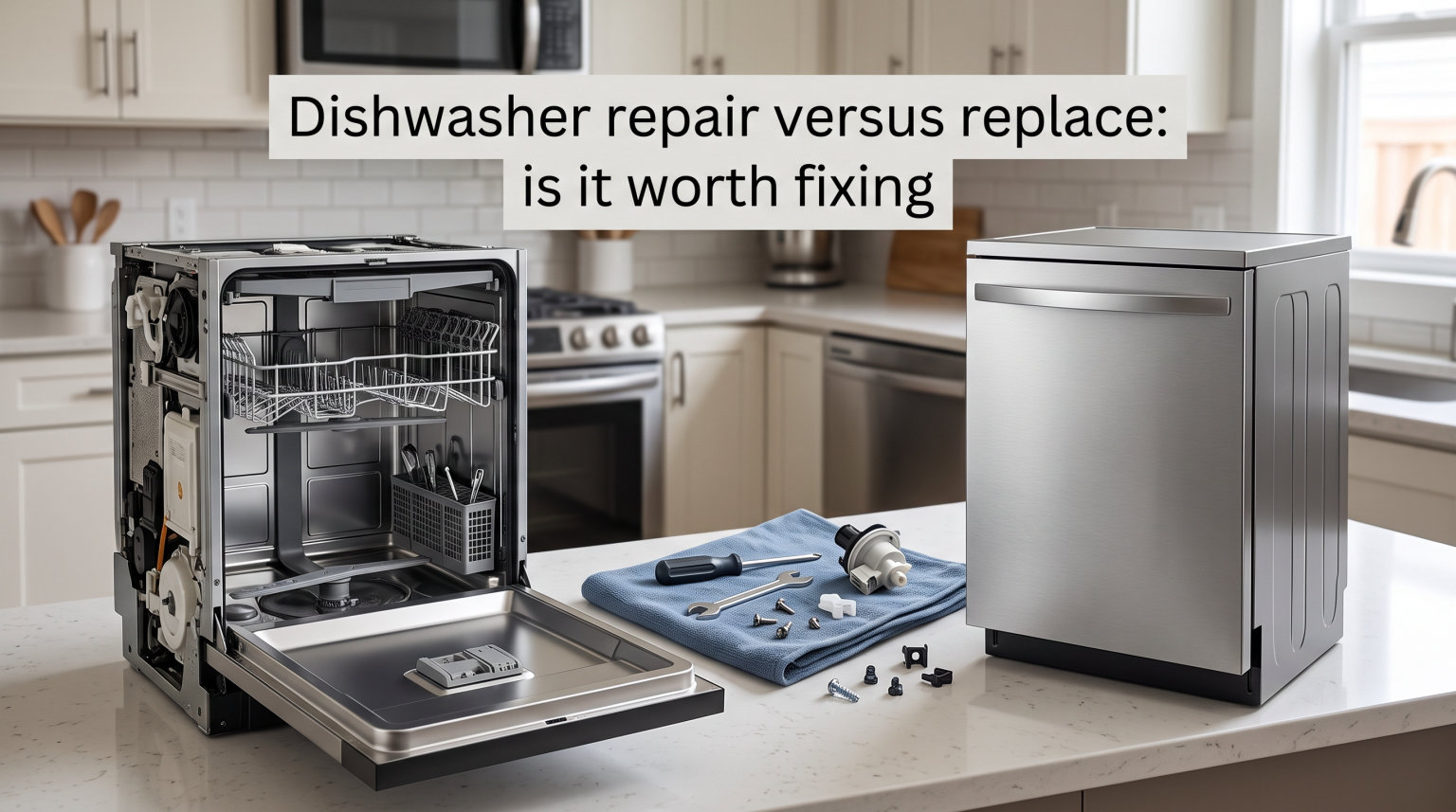
When your dishwasher suddenly stops mid-cycle or leaves dishes caked in residue, you face the same decision thousands of homeowners wrestle with every month. The dishwasher repair versus replace question is not as simple as a yes or no answer.
I have helped friends, family members, and neighbors work through this exact dilemma dozens of times. The right call depends on three things: how old your machine is, how much the repair costs, and how often it has broken down before.
The good news is that you can reach a confident decision in about ten minutes once you know the framework. Repair professionals, consumer surveys, and thousands of real homeowner experiences all point to the same set of rules.
In this guide, I will walk you through the exact decision framework, real cost data for 2026, common problems and what they cost to fix, and real user case studies from people who have been in your shoes. By the end, you will know exactly whether to call a repair technician or start shopping.
Let us start with the quick answer.
Table of Contents
Dishwasher Repair Versus Replace: The Quick Answer
It is worth fixing a dishwasher if the repair costs less than 50 percent of a new unit’s price and the machine is under nine years old. You should replace it if the repair exceeds half the replacement cost, the unit is over 12 years old, or it has needed multiple repairs in the past year.
The median professional dishwasher repair costs $142, according to Consumer Reports survey data. A typical new dishwasher runs $400 to $1,200 installed. That math usually favors repair for single, straightforward problems on younger machines.
But here is the catch. Dishwashers lose value faster than most people expect. Once yours crosses the nine-year mark with a major component failure like a pump motor or control board, replacement almost always makes more financial sense.
The rest of this guide breaks down exactly how to apply that logic to your specific situation, with real numbers and real examples.
The 50 Percent Rule Explained
The 50 percent rule is the gold standard for appliance repair decisions, and it comes up constantly in technician forums and homeowner communities. It is the single most useful guideline you will find.
Here is how it works. If the total cost of a repair, parts plus labor, is more than 50 percent of what a replacement would cost, you should replace the appliance instead. If the repair comes in under that threshold, fixing is usually the smarter financial move.
Let me give you a concrete example. Say your dishwasher needs a new wash pump motor. The part costs $150 and labor runs another $120, bringing your total repair to $270. A comparable new dishwasher with installation runs about $700. Since $270 is well under $350, which is half of $700, the repair wins.
Now flip the scenario. Your control board fails and the quote comes back at $380. That is over half the cost of a new unit. At that point, you are investing more than half the price of a fresh machine into one that may break again next month.
The 50 percent rule is a guideline, not a law. But it keeps you from throwing good money after bad on a machine that is already on its way out.
How Long Should a Dishwasher Last? Age and Lifespan Guidelines
The average dishwasher lasts between 9 and 15 years, with most units landing around 12 years of service. How you use yours, the water hardness in your area, and brand quality all push that number up or down.
Age is the single biggest factor in the dishwasher repair versus replace decision. Here is a practical breakdown to guide your thinking.
Under 5 years old: Almost always worth repairing. Your machine is in its prime, and most failures at this stage are isolated component issues that are either covered under warranty or relatively cheap to fix.
5 to 8 years old: Usually worth repairing for the first major failure. Start watching costs more carefully. A single $150 repair makes perfect sense, but three repairs in two years does not.
9 to 12 years old: The gray zone. Minor repairs under $200 can extend life by another year or two. But any major component failure, especially the pump motor or control board, should trigger serious replacement consideration.
Over 12 years old: Replace. At this age you are living on borrowed time. Even if you fix one problem, another component is likely aging out right behind it. Newer machines also run far more efficiently than units from over a decade ago.
Real user experiences from appliance forums confirm this pattern. Wash pump motor failures commonly hit around the six-year mark, which is repairable. But those same users report that a second major failure by year ten usually signals the end of the road.
Average Dishwasher Repair Costs by Problem
Knowing what your specific problem typically costs to fix is the fastest way to judge whether repair makes sense. Here are the most common dishwasher repairs and their typical cost ranges, based on technician data and parts pricing for 2026.
Pump motor replacement ($200 to $450): This is one of the most common and most expensive failures. The wash pump motor circulates water through the spray arms. When it fails, dishes come out dirty or the machine makes a loud grinding noise. At this price point on a machine over eight years old, replacement starts looking attractive.
Heating element replacement ($150 to $300): If your dishwasher stops drying dishes or fails mid-cycle with a heating error, the heating element is the likely culprit. This is a moderately priced repair that usually pays off on machines under ten years old.
Control board replacement ($200 to $600): The electronic control board is the brain of your dishwasher. When it fails, you may see random behavior, button malfunctions, or a complete failure to start. This is the repair that most often pushes a decision toward replacement, because the cost can rival a budget new unit.
Door latch repair ($100 to $200): A relatively cheap fix. If your dishwasher will not start because the door is not registering as closed, the latch switch is the usual suspect.
Drain hose or pump clearing ($100 to $250): When your dishwasher will not drain, the fix is often simple and affordable. This is one repair that is almost always worth doing regardless of age.
Thermal fuse replacement ($100 to $180): A blown thermal fuse prevents the dishwasher from starting at all. It is cheap and fast to replace, making this one of the most worthwhile repairs you can make.
Spray arm replacement ($50 to $120): If water distribution is poor and dishes are not getting clean, a clogged or cracked spray arm is an easy, low-cost fix that almost always pays for itself.
Labor typically runs $70 to $100 per hour, with most repairs completed in one to two hours. Most technicians also charge a service call fee of $75 to $150, which is sometimes credited toward the repair if you decide to proceed.
Common Dishwasher Problems: Fixable or Replacement-Worthy?
Not every problem carries the same weight in the repair versus replace equation. Some issues are clear repair candidates, while others should make you think twice about investing more money.
Almost always worth fixing:
Dishwasher will not drain, usually a clogged hose or drain pump
Dishes come out dirty, often a clogged spray arm or faulty wash pump on younger units
Door will not latch or machine will not start, typically a latch switch or thermal fuse
Water leaks from the door, usually fixed with a door gasket replacement
Machine is unusually loud during operation, often pump or spray arm debris
These problems typically cost under $250 to resolve and often much less. On any machine under nine years old, they are clear repair candidates.
Should trigger replacement evaluation:
Control board failure on a machine over eight years old
Wash pump motor failure on a machine over seven years old
Multiple component failures within the same year
Rust visible inside the tub or on the racks
Repeated leaks from multiple points
Parts becoming discontinued for your specific model
When you see two or more of these warning signs together, the repair bills start stacking up faster than a new machine would cost. Forum users consistently report that the third repair in 18 months is the moment they wish they had replaced instead of repaired.
Signs You Should Replace Your Dishwasher
Sometimes the decision becomes obvious once you know what to look for. Here are the clearest signals that replacement is your best path forward.
Your dishwasher is over 12 years old. At this age, every repair is borrowed time. Efficiency gains alone from a new Energy Star model can offset part of the purchase cost over a few years of use.
The repair quote exceeds half the cost of a new unit. The 50 percent rule exists for a reason. Once you cross that line, you are investing in a declining asset rather than solving a problem.
You have already paid for two or more repairs in the past year. A pattern of breakdowns means your machine is in systemic decline, not experiencing isolated bad luck with individual parts.
Your dishes consistently come out dirty even after repairs. If cleaning performance has dropped and fixes have not restored it, internal components are wearing out together and no single repair will fix that.
Rust is visible in the tub or on the racks. Rust means the interior structure is degrading, and no repair reverses that process once it begins.
Your energy and water bills have crept up. Older machines use significantly more resources than current models. A new Energy Star dishwasher uses about 30 percent less water than units from a decade ago.
Signs You Should Repair Your Dishwasher
On the flip side, plenty of situations make repair the clear and obvious winner. Here is when fixing makes more sense than replacing.
Your dishwasher is under eight years old with its first major problem. One failure on a relatively young machine does not signal the end. Most dishwashers handle one significant repair without further issues for years.
The repair cost is under $200. At this price point, even on an older machine, the math favors fixing. You would need years of additional trouble to make replacement the better financial choice.
The problem is a single, well-known issue. Drain clogs, thermal fuses, and door latches are common, cheap, and reliable repairs. Technicians fix these daily with very high success rates.
Your machine is still under warranty. If manufacturer or extended warranty coverage applies, repairs may be free or heavily discounted. Always check this before paying anything out of pocket.
You have a premium brand known for longevity. Bosch, Miele, and KitchenAid units often justify higher repair costs because their baseline lifespan is longer. Users on appliance forums note that investing in a factory-authorized repair for a high-end brand frequently adds several more years of reliable service.
You love your current machine’s performance. If it cleans well, runs quietly, and fits your kitchen perfectly, a targeted repair preserves something that already works for you. That satisfaction has real value beyond the dollars.
Real User Case Studies: When Repair Paid Off and When It Did Not
Data and rules are helpful, but real experiences make the decision tangible and relatable. I have compiled two representative scenarios from homeowner discussions across appliance forums and community threads.
Case Study 1: The Repair That Paid Off. A homeowner on r/HomeImprovement had a seven-year-old Bosch dishwasher that suddenly stopped draining. A technician diagnosed a clogged drain pump and quoted $165 total for the repair. Since her unit was under nine years old and this was its first problem, she chose to repair.
That was over three years ago, and the machine still runs perfectly today. She spent $165 instead of $800-plus on a replacement, and gained three additional years of service and counting. The lesson here is clear: a single, affordable repair on a quality mid-life machine is almost always the right call.
Case Study 2: The Repair Spiral. A homeowner on r/Frugal had a ten-year-old Whirlpool that needed a new wash pump motor, costing $340. Four months later, the control board failed with a $290 repair quote. Two months after that, the heating element went out.
By the time of the third repair, he had spent over $750 on a machine worth roughly $300 used. He finally replaced it with a new Energy Star model for $620 and has had zero issues since. The lesson: one expensive repair on an aging machine often foreshadows more failures to come.
His experience matches what forum veterans repeatedly advise. If your first major repair is on a machine over nine years old, seriously consider replacement before signing that first work order.
The Environmental Cost of Repairing Versus Replacing
The dishwasher repair versus replace question is not just about money. It carries real environmental weight, and this angle gets far too little attention in most guides you will find online.
Manufacturing a new dishwasher requires steel, plastic, copper, electronic components, and significant energy input. The embodied carbon footprint of producing and shipping a single dishwasher is estimated at hundreds of pounds of CO2 emissions. When you repair instead of replace, you avoid that entire manufacturing impact.
However, there is a counterpoint that matters. Older dishwashers use more electricity and water than modern units. A dishwasher from 2012 can use 30 to 50 percent more water than a current Energy Star certified model. Over several years of daily use, the operational savings of a new efficient machine can offset its manufacturing footprint.
So where does the balance fall? From a purely environmental standpoint, the best move is to repair and extend the life of your current machine as long as it is still running efficiently. Once an old dishwasher starts consuming noticeably more water and energy, or requires repeated repairs that each carry their own parts-manufacturing footprint, replacement becomes the greener choice.
The most sustainable approach is straightforward. Repair minor issues to maximize lifespan, then replace with the most efficient model you can afford when a major failure hits an aging unit. That strategy respects both your wallet and the planet.
Your 60-Second Dishwasher Decision Checklist
Use this checklist to reach a confident decision in under a minute. Answer each question honestly, then count how many point toward replacement.
1. How old is your dishwasher?
Under 8 years: Lean toward repair
8 to 12 years: Evaluate repair cost carefully
Over 12 years: Lean toward replacement
2. What is the repair quote?
Under $200: Repair is almost always worth it
$200 to half of replacement cost: Repair usually wins
Over half of replacement cost: Replace
3. How many repairs has it needed in the past year?
Zero or one: Repair makes sense
Two or more: Replacement is likely smarter
4. Is it still under warranty?
Yes: Repair, potentially for free
No: Factor the full cost into your decision
5. Is performance still satisfactory when the machine is working?
Yes: Repair to preserve what works
No, it is declining: Replace for better results
If three or more of your answers point toward replacement, trust the pattern. The checklist is designed to surface what your gut probably already knows.
FAQs
Is it worth paying someone to fix a dishwasher?
Yes, if your dishwasher is under eight years old and the repair costs less than half the price of a new unit. The median professional repair costs about $142, which is far less than the $400 to $1,200 you would spend on a replacement. For single, common issues like drain clogs or door latch failures, professional repair almost always pays off.
What is the most common failure on a dishwasher?
The most common dishwasher failures are wash pump motor problems, drain pump clogs, and heating element failures. Wash pump motor issues typically surface around the six-year mark and cause poor cleaning performance or grinding noises. Drain problems and thermal fuse failures are also frequent but much cheaper to fix.
What is the average life expectancy of a dishwasher?
The average dishwasher lasts 9 to 15 years, with most units reaching about 12 years. Lifespan depends on usage frequency, water hardness, brand quality, and routine maintenance. Premium brands like Bosch and Miele often exceed 15 years with proper care, while budget models may struggle to reach the ten-year mark.
What is the 50 rule for appliance repair?
The 50 percent rule states that if a repair costs more than 50 percent of the price of a new replacement, you should replace the appliance instead. This guideline prevents overspending on aging machines and is widely recommended by repair technicians and consumer organizations alike.
Which dishwasher brand is easiest to repair?
Bosch and Whirlpool are generally considered among the easiest dishwasher brands to repair due to wide parts availability and established service networks. Bosch units last longer but can have pricier replacement parts. Whirlpool and its subsidiary brands like Maytag and KitchenAid offer affordable, widely available components that keep repair costs down.
Conclusion: Making Your Final Decision
The dishwasher repair versus replace decision ultimately comes down to three factors: age, cost, and pattern. If your machine is young, the repair is affordable, and this is an isolated issue, fixing it is almost always the right call.
If your dishwasher is over a decade old, the repair quote is creeping past half the cost of a new unit, or you have already been down this repair road before, trust the signals and replace.
You now have the 50 percent rule, the age guidelines, real cost data for 2026, actual user experiences, and a quick checklist to guide you. Use them together, and you will make a decision you can feel confident about for years to come.