
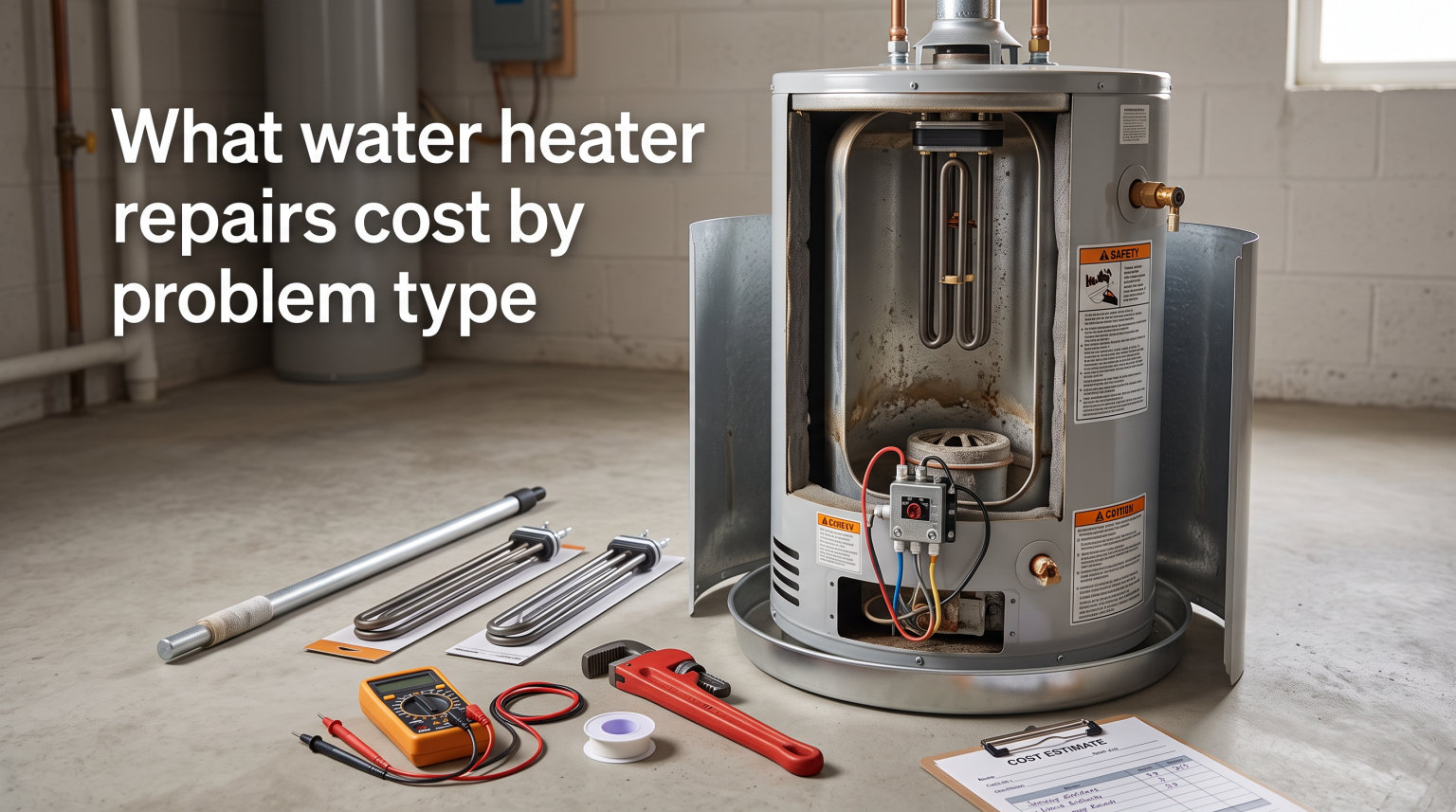
When your shower runs cold or you hear banging from the utility closet, the first question that hits you is simple: how much is this going to cost? Water heater repair cost varies dramatically depending on what exactly went wrong, ranging from around $100 for a minor fix to over $1,775 for a major component failure. The national average homeowner spends about $600 on a typical repair, but that number tells you almost nothing without knowing which part failed and why.
This guide breaks down water heater repair cost by problem type so you can walk into any service call knowing what to expect. I have pulled pricing data from multiple industry sources, homeowner reports from forums, and contractor pricing structures to give you numbers you can actually use. Whether you are staring down a $300 thermostat replacement or wondering if it is time to throw in the towel and replace the whole unit, the information below will help you make a confident decision.
Here is what we cover: the three tiers of repair costs (minor, medium, and major), a component-by-component breakdown with parts versus labor pricing, gas versus electric versus tankless cost differences, a repair-versus-replace decision framework, and practical tips for keeping your bill as low as possible.
Table of Contents
Quick Answer: What Does Water Heater Repair Cost?
The average water heater repair cost runs between $228 and $1,017, with most homeowners paying around $600 for a typical service call. Minor repairs like thermostat or pilot light fixes cost $100 to $350, while major repairs such as gas control valve replacement or tank-related issues run $750 to $1,775 or more. Labor makes up 40 to 60 percent of your total bill, with service call fees typically adding $50 to $150 on top of parts and labor.
For a full replacement instead of a repair, expect to pay $1,600 to $5,400 depending on the unit type and installation complexity.
Water Heater Repair Cost by Problem Type
Water heater repair cost falls into three tiers based on severity and the complexity of the fix. Knowing which tier your problem sits in gives you a reliable budget range before you even pick up the phone.
Minor Repairs ($100 to $350)
Minor repairs cover the most common and affordable fixes: thermostat adjustments, pilot light relighting, thermocouple swaps, and pressure relief valve replacements. These jobs typically take 30 to 60 minutes and require inexpensive parts.
A thermocouple replacement, for example, uses a part that costs $10 to $50 but the total bill often lands around $150 to $300 once you factor in the service call and labor. Homeowners on forums report paying $225 to $300 for these quick fixes, which sometimes take a technician only 30 to 40 minutes to complete.
Common minor repairs include:
Pilot light and thermocouple repair ($150 to $300)
Electric thermostat replacement ($150 to $350)
Pressure relief valve replacement ($150 to $350)
Tank flushing and sediment removal ($100 to $250)
Pilot assembly replacement ($150 to $350)
Medium Repairs ($200 to $750)
Medium repairs involve more expensive components and longer labor times. These typically address heating element failures, gas valve problems, dip tube deterioration, and anode rod replacement. The parts cost more, and the technician often needs to partially drain the tank.
An electric heating element replacement is one of the most common medium repairs. The element itself costs $20 to $100, but the total job runs $200 to $500 because the tank must be drained and the component accessed. Gas control valve replacements are even pricier, with the valve alone costing $100 to $300.
Typical medium repairs include:
Electric heating element replacement ($200 to $500)
Gas control valve replacement ($250 to $550)
Dip tube replacement ($150 to $300)
Anode rod replacement ($200 to $400)
Flame sensor replacement ($150 to $350)
Major Repairs ($750 to $1,775+)
Major repairs address serious component failures or system-wide problems. At this tier, you need to seriously weigh whether repair makes financial sense or if replacement is the better investment. Major repairs often involve electrical system failures, expansion tank and pressure system overhauls, or work that requires significant reconfiguration.
A leaking tank is the most common major issue, and unfortunately it is usually not repairable. Tank corrosion means the unit has reached end of life, and your repair cost effectively becomes a replacement cost of $1,600 to $5,400.
Major repair scenarios include:
Expansion tank and pressure system overhaul ($200 to $900)
Full electrical system repair ($300 to $1,000)
Ventilation and flue system repair ($300 to $1,200)
Multiple component replacement ($500 to $1,775)
Tank leak and corrosion diagnosis (usually leads to replacement)
Here is how the three tiers compare side by side:
| Tier | Cost Range | Typical Repairs | Time to Complete |
|---|---|---|---|
| Minor | $100 to $350 | Thermostat, pilot light, thermocouple, valve | 30 to 60 minutes |
| Medium | $200 to $750 | Heating element, gas valve, dip tube, anode rod | 1 to 3 hours |
| Major | $750 to $1,775+ | Electrical system, pressure system, multi-component | 3+ hours or multiple visits |
Detailed Cost by Component and Part
Breaking down water heater repair cost by specific component gives you the most accurate budgeting tool. Each part has a different price point, and labor costs shift based on how difficult the component is to access and replace.
Thermostat Replacement ($150 to $400)
The thermostat controls your water temperature, and a failed one means water that is too hot, too cold, or completely unheated. Electric water heaters have two thermostats (upper and lower), and gas units use a single gas control thermostat. The part costs $20 to $150, with labor adding $100 to $250.
Heating Element Replacement ($200 to $500)
Heating elements only exist in electric water heaters, and most units have two. A failed element means you get lukewarm or cold water. Each element costs $20 to $100, but the total job runs $200 to $500 because the tank needs draining and the element requires careful installation to avoid leaks.
Gas Control Valve Replacement ($250 to $550)
The gas control valve regulates gas flow to the burner and is one of the priciest single components. When it fails, your gas water heater stops heating entirely. The valve itself runs $100 to $300, and labor adds $150 to $250 because the job involves gas line work that requires careful leak testing.
Anode Rod Replacement ($200 to $400)
The anode rod is a sacrificial component designed to attract corrosive elements and protect your tank lining. When it wears out, your tank starts corroding from the inside. The rod costs $25 to $75, but replacement is labor-intensive because the old rod is often stuck. Total cost runs $200 to $400.
Dip Tube Replacement ($150 to $300)
The dip tube directs cold water to the bottom of the tank for heating. When it cracks or dissolves, you get lukewarm water intermittently. The part is cheap at $10 to $50, but labor pushes the total to $150 to $300. Forum users have noted that a $25 dip tube can quickly become a $300 bill with labor included.
Pressure Relief Valve Replacement ($150 to $350)
The temperature and pressure relief valve is a safety device that prevents your tank from over-pressurizing and potentially exploding. If it is leaking or stuck, it needs immediate replacement. The valve costs $15 to $50 with labor at $100 to $250.
Thermocouple and Pilot Assembly ($150 to $350)
Gas water heaters rely on a pilot light and thermocouple to keep the burner running. If your pilot light will not stay lit, the thermocouple is the usual suspect. A thermocouple costs $10 to $50, while a full pilot assembly runs $30 to $100. With labor, expect $150 to $350 total.
Expansion Tank Installation ($80 to $300)
An expansion tank absorbs excess pressure created when water heats and expands. Many older homes do not have one, and code requirements increasingly require them. The tank costs $40 to $150, and installation labor runs $50 to $150 depending on plumbing access.
Tank Leak and Corrosion ($0 to Repair, $1,600+ to Replace)
A leaking tank is almost never repairable. Once the steel tank itself corrodes through, the entire unit needs replacement. You will not pay for a repair here. Instead, you are looking at a full replacement cost of $1,600 to $5,400 depending on the unit type.
Here is a full component cost breakdown for quick reference:
| Component | Parts Cost | Labor Cost | Total Cost |
|---|---|---|---|
| Thermostat | $20 to $150 | $100 to $250 | $150 to $400 |
| Heating Element | $20 to $100 | $150 to $300 | $200 to $500 |
| Gas Control Valve | $100 to $300 | $150 to $250 | $250 to $550 |
| Anode Rod | $25 to $75 | $150 to $300 | $200 to $400 |
| Dip Tube | $10 to $50 | $100 to $250 | $150 to $300 |
| Pressure Relief Valve | $15 to $50 | $100 to $250 | $150 to $350 |
| Thermocouple | $10 to $50 | $100 to $200 | $150 to $300 |
| Expansion Tank | $40 to $150 | $50 to $150 | $80 to $300 |
| Tank Flush | N/A | $100 to $250 | $100 to $250 |
Gas vs Electric vs Tankless Repair Costs
Repair costs differ significantly depending on your water heater type. Gas units tend to have more components that can fail, while electric units have fewer parts but expensive heating elements. Tankless water heaters have their own unique cost profile.
Gas water heater repair cost averages $250 to $600 per service call. The additional gas-specific components (pilot assembly, thermocouple, gas control valve, burner assembly) create more failure points. Gas repairs also require technicians with specific certifications, which can increase labor rates.
Electric water heater repair cost runs slightly lower at $200 to $500 per visit. Electric units have fewer moving parts, but heating element and thermostat failures are common and require draining the tank for access.
Tankless water heater repair cost typically ranges from $300 to $800. These units have complex internal components like flow sensors, circuit boards, and heat exchangers. While they last longer with proper maintenance, individual component failures tend to cost more to fix.
| Heater Type | Average Repair Cost | Most Common Repair | Lifespan |
|---|---|---|---|
| Gas (Tank) | $250 to $600 | Pilot assembly, gas valve | 8 to 12 years |
| Electric (Tank) | $200 to $500 | Heating element, thermostat | 10 to 15 years |
| Tankless | $300 to $800 | Flow sensor, descaling | 15 to 20+ years |
Labor Cost Breakdown: What You Are Actually Paying For
Labor typically makes up 40 to 60 percent of your total water heater repair cost. Understanding exactly what that labor covers helps you evaluate whether a quote is fair. Many homeowners feel frustrated when they see a $25 part on a $300 invoice, but the labor portion reflects more than just wrench-turning time.
Plumbers charge $75 to $200 per hour on average, with most charging a flat service call fee of $50 to $150 just to come out and diagnose the problem. Some contractors waive the diagnostic fee if you proceed with the repair, while others apply it as a credit toward your final bill.
That labor rate covers several things most people do not consider:
Travel time and fuel to and from your home
Liability insurance and licensing fees
Diagnostic time identifying the actual problem
Safety procedures (gas leak testing, electrical shutoff)
Cleanup and proper disposal of old parts
Warranty coverage on the work performed
For water heater replacement specifically, labor for installing a 50-gallon gas unit typically runs $500 to $1,500 depending on your area and installation complexity. Forum reports show replacement costs varying from $1,600 to $4,000 for the same job depending on the contractor.
Repair vs Replace: The 50% Rule
The 50 percent rule is a straightforward decision framework: if your repair cost exceeds 50 percent of what a new water heater would cost, replacement is usually the better financial choice. This rule becomes even more important as your unit ages.
Here is how to apply it. Say your water heater is 10 years old and you get a $600 repair quote. A new unit with installation would cost $2,500. Since the repair is only 24 percent of replacement cost, repairing makes sense. But if that same $600 repair hits a 12-year-old unit, you should factor in the likelihood of additional failures.
Age plays a critical role in this decision:
Under 6 years old: Almost always repair, unless the tank itself is leaking
6 to 10 years old: Repair if the cost is under 50 percent of replacement
10 to 12 years old: Lean toward replacement, especially for repeated repairs
Over 12 years old: Replace, even for minor issues, as more failures are coming
The average life expectancy of a water heater is 8 to 12 years for gas units and 10 to 15 years for electric units. If yours is approaching or past that range, sinking money into repeated repairs rarely pays off. Each repair might fix one component, but the others are aging at the same rate.
One more factor to weigh: a new unit will likely be more energy efficient than one installed a decade ago. The savings on your energy bill over time can offset part of the replacement cost, especially if you upgrade from a standard tank to a more efficient model.
Signs Your Water Heater Needs Repair
Catching water heater problems early can save you from a catastrophic failure and a much bigger bill. Here are the most common warning signs and what they typically indicate:
| Symptom | Likely Cause | Estimated Repair Cost |
|---|---|---|
| No hot water at all | Failed heating element, gas valve, or pilot assembly | $150 to $550 |
| Not enough hot water | Failed dip tube, wrong thermostat setting, sediment buildup | $100 to $400 |
| Water not hot enough | Faulty thermostat, sediment layer insulating element | $150 to $400 |
| Rusty or discolored water | Sacrificial anode rod depleted, tank corrosion starting | $200 to $400 or replacement |
| Rumbling or banging noises | Sediment buildup in tank bottom | $100 to $250 flush |
| Water pooling around base | Tank leak, failed valve, or loose connection | $150 to $350 or replacement |
| Pilot light will not stay lit | Failed thermocouple or pilot assembly | $150 to $350 |
| Hot water smells like sulfur | Bacterial reaction with depleted anode rod | $200 to $400 |
If you notice any of these symptoms, calling a plumber sooner rather than later can prevent a small repair from becoming a full replacement. A $150 thermocouple fix left unaddressed can cascade into a pilot failure that damages surrounding components.
How to Save on Water Heater Repair Costs?
You do not have to accept the first quote you receive. There are concrete steps you can take to reduce your water heater repair cost without cutting corners on quality or safety.
Here are seven proven ways to save:
1. Get at least three quotes. Contractor pricing varies dramatically. Forum users report quotes differing by $500 to $1,000 for identical jobs. Calling multiple plumbers gives you leverage and helps you spot outlier pricing.
2. Ask for itemized breakdowns. Request separate pricing for parts, labor, and the service call fee. This transparency makes it harder for a contractor to inflate the bill and lets you compare quotes apples to apples.
3. Confirm the quote includes disposal. If your repair leads to replacement, disposal of the old unit can add $50 to $150. Make sure you know whether this is included or extra.
4. Check your warranty first. Many water heaters come with 6 to 12-year warranties on the tank and 1 to 6-year warranties on parts. A covered repair costs you nothing but the service call fee.
5. Maintain your unit to prevent future repairs. Annual tank flushing removes sediment that causes heating element failure and noise. Replacing the anode rod every 3 to 5 years extends tank life by years. These maintenance tasks cost $100 to $250 but prevent repairs that run $300 to $1,000.
6. Time your repair strategically. Plumbers are busiest in winter when water heaters fail most often. Scheduling non-emergency repairs in spring or fall can sometimes yield lower rates or faster scheduling.
7. Ask about the diagnostic fee credit. Many plumbers apply the $50 to $150 diagnostic fee toward your repair cost if you proceed with the work. Always ask, because not all contractors volunteer this.
Common Budgeting Mistakes to Avoid
Even informed homeowners make predictable mistakes when budgeting for water heater repairs. Knowing these pitfalls ahead of time can save you hundreds of dollars and a lot of frustration.
Mistake 1: Only budgeting for parts. That $25 dip tube is not a $25 repair. Labor, service call fees, and taxes typically double or triple the parts cost. Always budget the total job cost, not just the component price.
Mistake 2: Accepting the first quote. A single quote gives you no reference point for fairness. Contractors in the same area can charge wildly different rates. One forum user reported getting quotes ranging from $1,500 to $5,000 for the same replacement job.
Mistake 3: Ignoring the age factor. Repairing a 12-year-old water heater often means paying for a fix that only buys you months before the next failure. Factor the unit age into every repair decision.
Mistake 4: Forgetting about accessibility costs. If your water heater is in a tight closet, crawlspace, or hard-to-reach basement corner, expect an accessibility surcharge of $100 to $300. Contractors charge more for difficult working conditions.
Mistake 5: Skipping the permit question. Some jurisdictions require permits for water heater work, especially gas line repairs. Ask whether your quote includes permit costs, which can add $50 to $200.
FAQs
What is the average cost to repair a hot water heater?
The average water heater repair cost ranges from $228 to $1,017, with most homeowners paying around $600 for a typical service call. Minor repairs like thermostat or pilot light fixes run $100 to $350, while major repairs can exceed $1,775. Labor typically makes up 40 to 60 percent of the total bill.
What is the average life expectancy of a water heater?
Gas water heaters last 8 to 12 years on average, while electric units typically last 10 to 15 years. Tankless water heaters can last 15 to 20 years or longer with proper maintenance. Factors like water hardness, maintenance frequency, and usage patterns all affect lifespan.
Why do plumbers charge so much for water heater repair?
Plumbers charge $75 to $200 per hour because that rate covers liability insurance, licensing fees, travel time, diagnostic expertise, safety procedures, and warranty coverage on work performed. A $25 part does not reflect the full cost of safely diagnosing and fixing the problem. The labor portion typically represents 40 to 60 percent of the total repair bill.
What is the average labor cost to install a 50 gallon gas water heater?
Labor to install a 50-gallon gas water heater typically runs $500 to $1,500, depending on your location and installation complexity. The total replacement cost including the unit, labor, permits, and disposal ranges from $1,600 to $3,500 for a standard installation. Difficult access or code updates can push costs higher.
Is it worth repairing an old water heater?
If your water heater is under 10 years old and the repair costs less than 50 percent of replacement, repairing is usually worthwhile. For units over 12 years old, replacement is generally the better investment even for minor issues, as aging components will continue to fail. A leaking tank is never worth repairing and always requires full replacement.
Conclusion
Understanding what water heater repairs cost by problem type puts you in control when that cold shower hits. Minor fixes like thermocouple replacements run $100 to $350, medium repairs like heating element swaps cost $200 to $750, and major failures can push past $1,775. The 50 percent rule gives you a clear framework for deciding whether to repair or replace, and getting multiple quotes means you never overpay.
Your next step is simple: identify your specific symptom from the matching table above, check your warranty and unit age, and call at least three plumbers for quotes. Walk into every service call knowing your numbers, and you will walk out with a fair deal.