
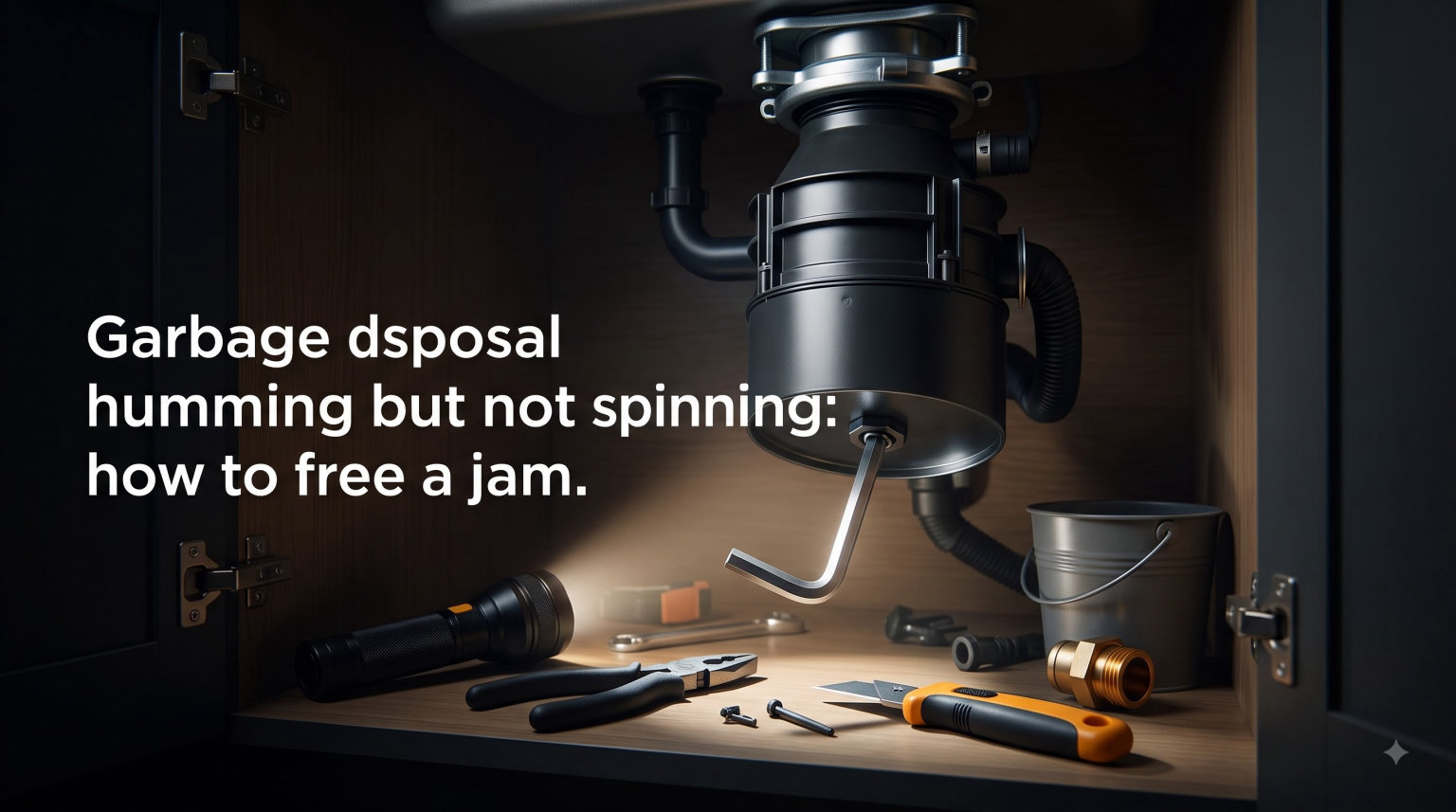
You flip the switch, and instead of the familiar grinding sound, your garbage disposal just hums. That low buzz tells you the motor is alive but the blades are stuck. Our team has walked through this exact problem dozens of times, and the good news is that most humming disposals can be freed in under 15 minutes with basic household tools.
A garbage disposal humming but not spinning almost always means something is blocking the flywheel. The motor keeps drawing power and vibrating, but it cannot rotate the impellers. If you ignore that hum, the motor will overheat and can burn out completely.
This guide walks you through exactly how to free a jammed garbage disposal step by step. We cover the hex key method, the broom handle trick that Reddit users swear by, how to use dish soap as a lubricant, and how to tell whether your disposal is jammed or the motor is dead. Updated for 2026, this is everything you need to fix the problem safely.
Table of Contents
Safety First: Disconnect the Power
Before you touch anything, cut the power to the disposal. This is the single most important step in the entire process. A disposal that hums is a disposal that has live electricity running to a motor, and you do not want your fingers anywhere near the grinding chamber while that is the case.
Turn off the wall switch first. Then go to your electrical panel and flip the circuit breaker that controls the kitchen disposal. If your home does not have the disposal on a dedicated breaker, or you cannot identify which breaker it is, unplug the unit from the outlet under the sink.
Some hardwired units have no plug at all. In that case, the breaker is your only option. Once you think the power is off, test it by flipping the wall switch and listening for any hum. No sound means the power is safely disconnected.
Why Your Garbage Disposal Is Humming But Not Spinning
That humming noise comes from the motor. When you flip the switch, electricity flows into the induction motor, which creates a magnetic field that should spin the flywheel. The flywheel is the metal disc connected to the grinding impellers inside the chamber.
When the flywheel cannot rotate, the magnetic field still builds up, and the motor windings vibrate at 60 cycles per second. That vibration is the hum you hear. The motor is essentially trying to turn but is physically blocked from doing so.
This is why leaving the disposal running while it hums is so dangerous. The motor is drawing full current and producing heat with nowhere for that mechanical energy to go. After about 30 to 60 seconds, the overload protector trips to prevent a fire, but if you keep resetting it and running the unit, you will eventually cook the motor windings.
Common Causes of a Humming Disposal
Most humming disposals fall into one of five categories. Understanding which one you are dealing with helps you pick the right fix.
A jammed flywheel is the most common culprit. Food scraps, especially fibrous items like celery or onion skins, can wrap around the impellers and lock the flywheel in place. Bones and fruit pits can wedge between the blade and the wall of the grinding chamber.
A foreign object is the second most frequent cause. Silverware, especially teaspoons and small lids, slip past the splash guard and jam the blades. This is a particularly common problem in busy households where dishes get scraped into the sink.
An overloaded or tripped motor can produce a hum if the overload protector has partially engaged. The motor tries to start but cannot draw enough current to overcome the resistance. In these cases, the disposal hums weakly rather than with its usual force.
Worn or dull blades create resistance even without a specific obstruction. Over years of use, the impellers lose their edge and begin dragging against food instead of grinding it. This gradual resistance eventually stalls the flywheel.
An electrical problem is the least common but most serious cause. A failing capacitor, loose wiring, or a burned-out start winding can prevent the motor from developing enough torque to spin. The hum in these cases sounds the same, but no mechanical jam exists to free.
How to Fix a Humming Garbage Disposal: Step-by-Step
Follow these steps in order. Each one builds on the last, and most humming disposals are fixed by step three or four. The entire process should take 10 to 20 minutes with basic tools.
Step 1: Disconnect the Power
Flip the wall switch to off. Then disconnect power at the breaker panel or by unplugging the disposal under the sink. We covered the details above, but this step matters enough to state twice. Never put anything into the grinding chamber while the disposal is connected to live power.
Step 2: Shine a Flashlight Inside
Grab a flashlight and look down into the grinding chamber through the sink drain. The rubber splash guard may need to be peeled back gently. Look for anything obviously stuck, like a spoon, a bottle cap, or a large chunk of food.
If you see a foreign object, use a pair of long needle-nose pliers or kitchen tongs to pull it out. Never reach in with your bare hands. The impeller edges are sharp, and even with the power off, you do not want to risk a cut or a slip.
Step 3: Free the Jam With a Hex Key or Allen Wrench
This is the standard fix that works for the majority of humming disposals. Look at the bottom of the unit, underneath your sink. You should see a small hex-shaped hole in the center of the motor housing.
Most disposals come with a hex key, also called an Allen wrench, that fits this hole. If you cannot find yours, any quarter-inch Allen wrench from a standard set will work. Insert the wrench into the hole and work it back and forth in both directions.
You are manually turning the flywheel from below. At first it may resist, then you will feel it break loose and spin more freely. Once it turns easily in both directions, remove the wrench and move on to the next step.
Step 4: Try the Broom Handle Trick for Stubborn Jams
What if you do not have an Allen wrench, or the hex key method does not break the jam? This is where a trick popularized on Reddit comes in. Homeowners on r/HomeImprovement and r/Plumbing have reported success with this method for years, and it works when the hex key fails.
Take a wooden broomstick or the handle of a plunger. With the power still disconnected, insert the handle through the sink drain into the grinding chamber. Wedge the end of the handle against one of the impeller blades and push to force the flywheel in a circle.
The leverage from a long handle can break loose jams that the small hex key cannot. Work the handle back and forth until the flywheel spins freely. Some users report that this works even when the Allen wrench feels completely seized.
Step 5: Use Dish Soap to Lubricate a Stuck Disposal
Another Reddit-sourced method addresses jams caused by sticky, gummy food buildup. If the flywheel is coated in grease or congealed food, mechanical force alone may not be enough. Lubrication can make the difference.
Squirt a generous amount of liquid dish soap directly into the grinding chamber through the drain. Let it sit for 10 to 15 minutes so it can penetrate and soften whatever is binding the blades. Then use the hex key or broom handle to work the flywheel back and forth.
The soap reduces friction and helps break down greasy buildup that is gluing the impellers in place. Several users on the r/LifeProTips forum report that this combination of dish soap plus manual spinning fixed disposals that had been humming for days.
Step 6: Press the Reset Button
Look on the bottom of the disposal unit for a small red or black button. This is the overload protector reset button. If your disposal overheated from humming, this button may have popped out and needs to be pressed back in.
Press the button firmly until it clicks and stays depressed. If it pops back out immediately, the motor is still too hot. Wait 15 minutes for it to cool down, then try again. Forum users note that you sometimes need to press this button multiple times over the course of an hour before it holds.
Step 7: Restore Power and Test
Turn the power back on at the breaker or plug the disposal back in. Run a steady stream of cold water into the sink. Then flip the wall switch and listen.
If you hear the normal grinding sound and the water drains freely, you have successfully freed the jam. Let the disposal run for 30 seconds with the water to flush out any remaining debris. If it still hums, repeat steps three through six, or move on to the diagnostic section below to check for motor failure.
Jammed Disposal vs Dead Motor: How to Tell the Difference
This is one of the most common questions we see, and it is the source of a lot of frustration. Homeowners spend hours trying to free a jam that does not exist because the real problem is a dead motor.
Here is the simple test. With the power disconnected, use the hex key or broom handle to try spinning the flywheel manually. If the flywheel turns freely and smoothly, with no resistance, but the disposal still hums when you turn it on, your motor is likely dead.
A jam produces mechanical resistance. The flywheel will be stuck or very hard to turn by hand. A dead motor, on the other hand, has no mechanical resistance because nothing is blocking the blades. The motor simply lacks the torque to spin the flywheel on its own.
If you confirm the flywheel spins freely by hand but the unit still hums, the problem is internal to the motor. This could be a failed start capacitor, burned-out windings, or a seized bearing. At that point, replacement is usually more cost-effective than repair.
Brand-Specific Troubleshooting Notes
Most residential disposals work the same way, but a few brand-specific details are worth knowing. None of the top competitor articles cover these differences, and users frequently search for help by brand name.
InSinkErator disposals have the hex key hole on the bottom center of the unit. Most new units ship with the Allen wrench stored in a small packet taped to the side of the disposal or tucked into the installation manual. The reset button is a small red button on the bottom, usually offset from the hex hole.
Moen disposals follow a similar layout with a center hex socket and a nearby reset button. Some Moen models use a slightly larger wrench size, so check your manual if a standard quarter-inch Allen wrench feels loose.
GE and Whirlpool units often have the reset button on the side rather than the bottom. The hex key access point is still on the bottom center. If you cannot find the hex hole on any brand, some older or budget models simply do not have one, and you will need to rely on the broom handle method from Step 4.
KitchenAid disposals, which are manufactured by Whirlpool, share the same reset button placement and hex key access. The red reset button may be partially hidden behind the mounting bracket, so feel around the lower housing.
When to Call a Professional?
Most humming disposals can be fixed at home, but some situations call for a plumber or an electrician. Knowing when to stop troubleshooting can save you from making the problem worse.
Call a professional if you notice water leaking from the bottom of the disposal alongside the humming. Leaks indicate a failed internal seal, and no amount of unjamming will fix that. The unit will need to be rebuilt or replaced.
If the reset button keeps tripping every time you run the disposal, even after you have cleared all visible jams, the motor is overheating under normal load. That points to internal damage. Similarly, if you smell burning plastic or see smoke, stop immediately and call a professional. Those are signs of electrical failure that can be a fire hazard.
If the disposal does not hum at all, meaning it is completely silent when you flip the switch, you have a different problem. Check the breaker first, then the wiring connections under the sink. A silent disposal is usually an electrical issue rather than a jam.
Preventive Maintenance Tips
The best way to deal with a jammed disposal is to prevent it from happening in the first place. A few simple habits will keep your unit running smoothly for years.
Always run cold water while the disposal is operating and for 15 seconds after you turn it off. Cold water solidifies fats and grease so they get ground up and flushed away rather than coating the inside of the chamber.
Avoid problem foods. Keep fibrous vegetables like celery, corn husks, and onion skins out of the disposal. These wrap around the impellers and are the number one cause of jammed flywheels. Also avoid bones, fruit pits, pasta, rice, and coffee grounds in large quantities.
Grind ice cubes once a month to knock loose buildup and sharpen the impellers. Drop a handful of ice cubes in, run the disposal with cold water, and let the ice do the cleaning. Some homeowners add a few citrus peels at the same time to freshen the smell.
Use dish soap regularly. A squirt of dish soap down the drain once a week, followed by hot water, keeps the grinding chamber lubricated and prevents the greasy buildup that causes stubborn jams. This is the same principle behind the dish soap fix in Step 5.
FAQs
Why is my garbage disposal humming but not spinning if it is not jammed?
If the disposal hums but the flywheel spins freely by hand with no resistance, the problem is likely a failed motor component such as a dead start capacitor or burned-out windings. The motor receives power but cannot generate enough torque to spin the blades. In most cases, the disposal will need to be replaced.
How do I unclog a garbage disposal that won’t spin?
Disconnect the power, then use a hex key or Allen wrench in the socket on the bottom of the unit to manually turn the flywheel back and forth until it breaks free. If that does not work, use a broom handle wedged against the impeller blades for extra leverage, or apply dish soap to lubricate a sticky jam before working the flywheel loose.
Can I use the disposal while it is humming?
No. Running a humming disposal forces the motor to draw full current with nowhere for the energy to go, which causes rapid overheating. Within 30 to 60 seconds the overload protector will trip. Repeatedly resetting it and running the unit again will permanently damage the motor windings and can create a fire hazard.
How do I fix a garbage disposal that is humming?
The standard fix is to disconnect power, insert an Allen wrench into the hex socket on the bottom of the unit, and work it back and forth to free the jammed flywheel. Then press the reset button on the bottom of the disposal, restore power, and test with cold water running. For stubborn jams, use a broom handle for leverage or dish soap as a lubricant.
Where is the reset button on a garbage disposal?
The reset button is a small red or black button located on the bottom of most disposal units, usually near the center or slightly offset from the hex key socket. On some brands like GE and Whirlpool, it may be on the side of the lower housing. If it has popped out, press it firmly until it clicks and stays depressed.
Conclusion
A garbage disposal humming but not spinning is one of the most common kitchen problems, and in most cases you can free the jam yourself in minutes. The key is to disconnect the power first, then use the hex key method, the broom handle trick, or the dish soap technique to break the flywheel loose. Press the reset button, restore power, and test with cold water running.
If the flywheel spins freely by hand but the disposal still hums, you are looking at motor failure rather than a jam, and replacement is the next step. Build a few preventive maintenance habits into your routine to avoid the problem coming back. With cold water, regular ice grinding, and keeping fibrous foods out of the chamber, your disposal should give you years of trouble-free service.