
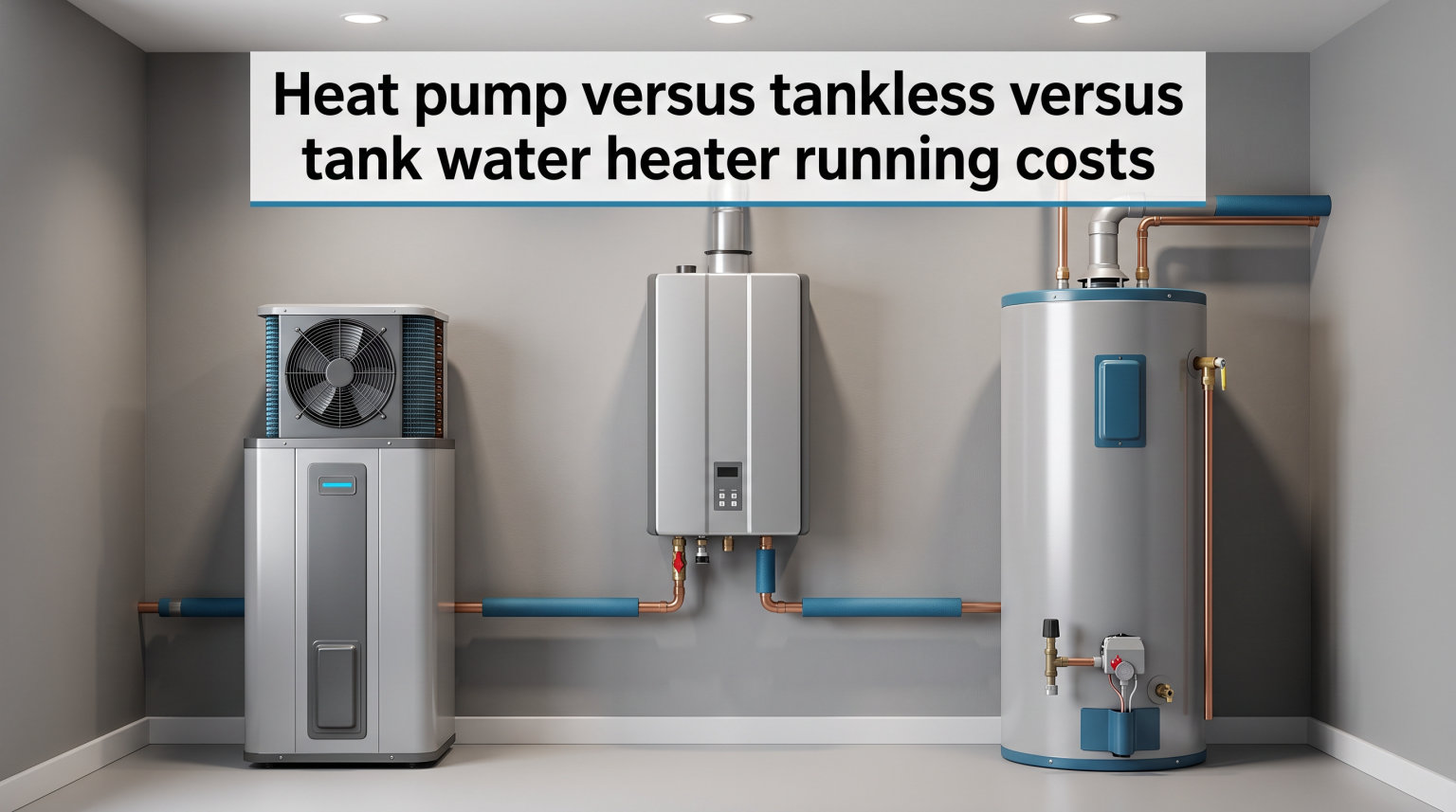
Heat pump versus tankless versus tank water heater running costs is one of the most important financial decisions a homeowner faces when it is time to replace a water heater. The three technologies take fundamentally different approaches to heating water, and those differences translate directly into hundreds of dollars of annual savings or waste on your utility bills.
Heat pump water heaters move heat from the air into your water using electricity, which makes them the cheapest option to run at roughly $200 to $350 per year. Tankless water heaters heat water on demand and cost about $500 to $650 per year to operate. Traditional tank water heaters keep a large volume of water hot around the clock and typically cost $700 to $900 per year.
In this guide, our team breaks down the real running costs of all three types so you can make a confident, money-saving choice. We cover annual operating expenses, upfront installation prices, energy efficiency, lifespan, climate performance, tax credits, and actual payback periods based on data from homeowners who shared their utility bills in online forums. By the end, you will know exactly which water heater type keeps the most money in your pocket over the long haul.
Table of Contents
Annual Operating Costs at a Glance
The quickest way to understand heat pump versus tankless versus tank water heater running costs is to look at the annual numbers side by side. These figures represent what a typical household of three to four people pays per year to keep hot water flowing, based on the national average electricity rate of approximately $0.16 per kilowatt-hour.
| Water Heater Type | Annual Operating Cost | Energy Source | Efficiency Rating |
|---|---|---|---|
| Heat Pump (Hybrid) | $200 – $350 | Electric | COP 2.0 – 3.5 |
| Tankless (On-Demand) | $500 – $650 | Electric or Gas | UEF 0.90 – 0.99 |
| Traditional Tank | $700 – $900 | Electric or Gas | UEF 0.60 – 0.75 |
As the table makes clear, heat pump water heaters dominate the running cost comparison. A household switching from a traditional electric tank to a heat pump unit can realistically save $400 to $600 every single year. Over a 13-year average lifespan, that adds up to $5,200 to $7,800 in energy savings alone.
Tankless water heaters sit in the middle. They eliminate the standby heat loss that plagues tank models, which cuts your bill noticeably compared to a storage tank. However, they still rely on electric resistance heating or gas combustion, so they cannot match the efficiency of heat transfer technology.
One Reddit user on the r/heatpumps subreddit shared a detailed breakdown that illustrates the real-world savings. They calculated that their heat pump water heater costs approximately $196 per year to operate, compared to $360 per year for their old tank unit, at an electricity rate of $0.14 per kilowatt-hour. That is a 45 percent reduction in annual water heating costs.
Your actual numbers will vary based on local utility rates, household size, hot water usage patterns, and climate. But the ranking stays the same: heat pump costs the least to run, followed by tankless, with traditional tanks being the most expensive to operate year after year.
How Heat Pump Water Heaters Work
Heat pump water heaters do not generate heat directly. Instead, they pull warmth from the surrounding air and transfer it into the water tank, much like a refrigerator running in reverse. A compressor circulates refrigerant through a closed loop, absorbing heat from ambient air and releasing it into the water through a heat exchanger wrapped around or immersed in the tank.
This heat transfer process is incredibly efficient because the system moves existing heat rather than creating new heat from scratch. The performance is measured by the coefficient of performance, or COP. A COP of 3.0 means the heater produces three units of heat energy for every one unit of electricity it consumes. Most heat pump water heaters operate at a COP between 2.0 and 3.5, making them two to three and a half times more efficient than standard electric resistance heaters.
Because they rely on ambient air temperature, heat pump water heaters work best in spaces that stay above 40 degrees Fahrenheit, such as garages, basements, or utility rooms. Most models include a backup electric resistance heating element for periods when the heat pump alone cannot keep up with demand or when the ambient air gets too cold.
How Tankless Water Heaters Work
Tankless water heaters, also called on-demand water heaters, heat water only when you turn on a hot water tap. There is no storage tank and no standby heat loss. When you open a faucet, a flow sensor detects the water movement and activates either electric heating elements or a gas burner that instantly heats the water as it passes through a compact heat exchanger.
This on-demand approach eliminates the energy waste that comes from keeping 40 to 50 gallons of water hot around the clock. The efficiency gain over a traditional tank is real, typically saving 20 to 30 percent on water heating costs for households that use 40 gallons or less per day. The savings shrink for larger families because the unit must fire more frequently and for longer stretches.
The main limitation is flow rate. A single tankless unit can typically deliver 3 to 7 gallons per minute, which means running two showers and a dishwasher simultaneously may exceed its capacity. Gas tankless units generally handle higher demand than electric models, but both require proper sizing based on your household peak usage and the temperature of your incoming groundwater.
How Traditional Tank Water Heaters Work
Traditional tank water heaters are the technology most homeowners grew up with. They consist of an insulated storage tank holding 30 to 80 gallons of water, kept constantly hot by either electric heating elements or a gas burner located at the bottom of the tank. A thermostat monitors the water temperature and kicks the heat source on whenever the temperature drops below the set point.
The advantage of this design is simplicity and reliability. Tank water heaters have been refined over decades, parts are inexpensive, and nearly every plumber knows how to install and service them. They deliver consistent hot water at high flow rates and require minimal maintenance beyond occasional anode rod replacement and flushing to remove sediment.
The downside is standby heat loss. Heat constantly escapes through the tank walls and pipes, even when nobody is using hot water. The heater must cycle on repeatedly throughout the day and night to maintain the target temperature, burning energy that provides zero benefit. This continuous reheating is the primary reason tank water heaters cost the most to operate of the three types.
Upfront Installation Costs Compared
Running costs tell only half the story when comparing heat pump versus tankless versus tank water heater options. You also need to account for what you pay on day one to get the unit purchased and installed. The upfront investment varies dramatically across the three technologies.
| Water Heater Type | Unit Cost | Installation Cost | Total Installed |
|---|---|---|---|
| Heat Pump (Hybrid) | $1,000 – $2,200 | $200 – $1,300 | $1,200 – $3,500 |
| Tankless | $500 – $2,000 | $900 – $1,900 | $1,400 – $3,900 |
| Traditional Tank | $300 – $800 | $200 – $700 | $500 – $1,500 |
Traditional tank water heaters are by far the cheapest to buy and install, which explains why they remain the default choice for budget-conscious homeowners and rental properties. A straightforward electric tank swap can cost as little as $500 total, and most installations are completed in a few hours.
Tankless water heaters carry the highest total installation cost, largely because the installation itself is complex and labor-intensive. Switching from a tank to a tankless system often requires upgrading gas lines, installing a new venting system, adding a dedicated electrical circuit, or rerouting plumbing. Gas tankless units in particular may need a larger gas supply line, which can add hundreds of dollars to the project.
Heat pump water heaters fall in between on total cost, but they frequently qualify for tax credits and utility rebates that can knock $600 to $2,000 off the effective price. When you factor in those incentives plus the energy savings, the real cost gap between heat pump and tank shrinks considerably over the first few years of ownership.
Energy Efficiency Showdown
Energy efficiency is the single biggest factor driving the difference in running costs between these three water heater types. Efficiency tells you how much of the energy you pay for actually ends up as usable hot water versus wasted as heat loss.
Heat pump water heaters are the clear champions here. Their COP of 2.0 to 3.5 means they deliver 200 to 350 percent efficiency, because they move heat rather than generate it. For every dollar of electricity you put in, you get two to three and a half dollars worth of water heating. No other water heater technology comes close to this level of performance.
Tankless water heaters achieve efficiency ratings between 0.90 and 0.99 UEF (Uniform Energy Factor), meaning they convert 90 to 99 percent of their fuel into hot water with almost no waste. Gas tankless models tend to land at the lower end because some heat escapes through the exhaust vent, while electric tankless units approach 99 percent efficiency.
Traditional tank water heaters sit at the bottom with UEF ratings of 0.60 to 0.75. That means 25 to 40 percent of the energy you pay for is lost, primarily through standby heat loss through the tank walls. Even well-insulated tanks cannot fully prevent this continuous energy bleed, which is why tanks cost the most to keep running day after day.
The efficiency gap translates directly into the annual cost differences we covered earlier. A heat pump water heater can reduce water heating energy consumption by 50 to 70 percent compared to a standard electric tank, according to the Department of Energy. That is why the running cost savings are so dramatic.
Lifespan and Long-Term Durability
Lifespan matters because a water heater that lasts twice as long effectively halves your annual ownership cost. When evaluating heat pump versus tankless versus tank water heater running costs, you need to consider how many years each unit will serve before needing replacement.
| Water Heater Type | Average Lifespan | Replacement Cycles Over 20 Years | Key Failure Points |
|---|---|---|---|
| Heat Pump (Hybrid) | 10 – 15 years | 1.5 – 2 | Compressor, refrigerant leaks |
| Tankless | 15 – 20 years | 1 | Heat exchanger, scale buildup |
| Traditional Tank | 8 – 12 years | 2 – 3 | Tank corrosion, element failure |
Tankless water heaters win the durability contest, often lasting 15 to 20 years because they have no storage tank to corrode and experience less wear from constant reheating cycles. Their primary enemy is mineral scale buildup inside the heat exchanger, which is why annual descaling is recommended, especially in hard water areas.
Heat pump water heaters typically last 10 to 15 years. The compressor and refrigerant system add complexity compared to a basic tank, and those components represent the most common failure points. When the heat pump portion fails, most units can still operate on the backup electric resistance element, though at much higher running cost.
Traditional tank water heaters have the shortest lifespan at 8 to 12 years. The constant heating and cooling cycle stresses the tank lining and heating elements. Eventually, sediment buildup and corrosion eat through the tank walls, often resulting in a leak that requires immediate replacement. Over a 20-year period, you may need to buy two or three tank units compared to one tankless.
Climate and Geographic Performance
Where you live has a significant impact on the running costs of all three water heater types, and the effects are not equal across technologies. Climate considerations are a content gap we see missing from many competitor articles, yet they can change the entire cost equation.
Heat pump water heaters thrive in warm and moderate climates where ambient air temperatures stay above 45 degrees Fahrenheit year-round. In states like Florida, Texas, and Southern California, a heat pump operates at peak efficiency all year, keeping running costs near the $200 end of the range. The unit also provides a bonus benefit in hot climates by dehumidifying and cooling the surrounding air.
In cold climates, heat pump efficiency drops significantly. When ambient temperatures fall below 40 degrees, the heat pump struggles to extract enough warmth from the air and falls back on its electric resistance heating element. Homeowners in Minnesota or Maine may see winter running costs climb toward the $350 upper limit or beyond. Forum users on r/HomeImprovement consistently report that heat pump water heaters cost more to operate during cold winter months.
Tankless water heaters are less affected by outdoor air temperature but face a different challenge: cold incoming groundwater. In northern states, groundwater can arrive at 40 degrees Fahrenheit or colder. The tankless unit must work harder and longer to raise that water to the target 120 degrees, which reduces effective flow rate and increases energy consumption. Homeowners in cold regions often need a more powerful unit or a pre-heating system to maintain adequate hot water delivery.
Traditional tank water heaters perform the same regardless of climate, which is both their advantage and their curse. They work everywhere but waste the same amount of energy everywhere. If you live in a cold climate and want the lowest running costs, a heat pump paired with a warm installation space or a high-efficiency gas tankless will typically beat any standard tank unit.
Tax Credits and Rebates That Lower Your Real Cost
The Inflation Reduction Act established a 30 percent federal tax credit for heat pump water heaters, capped at $2,000 per year. This credit directly reduces your federal tax bill when you install a qualifying unit, effectively cutting the upfront cost by nearly a third. The credit applies to equipment purchased and installed through 2026, and many heat pump models from brands like Rheem, A.O. Smith, and Bradford White qualify.
On top of the federal credit, many states and local utility companies offer additional rebates. These can range from $100 to $1,000 depending on your location and the efficiency of the unit you install. Some programs stack with the federal credit, meaning a $2,500 heat pump installation could end up costing you closer to $1,000 after all incentives are applied.
Tankless water heaters also qualify for a federal tax credit of up to $600 for high-efficiency gas models. Traditional tank water heaters generally do not qualify for federal incentives, though some utility companies offer modest rebates for high-efficiency tank models. The available incentives clearly favor heat pump technology, which narrows the upfront cost gap considerably.
Pros and Cons of Each Water Heater Type
Heat Pump Water Heater Pros and Cons
Heat pump water heaters offer the lowest running costs of any water heater type, saving $400 to $600 per year compared to a standard electric tank. They qualify for generous tax credits and rebates that can cover up to 30 percent of the installation cost. They also dehumidify and cool the surrounding space, which is valuable in hot climates.
On the downside, heat pump units require adequate space and airflow, typically needing a room of at least 1,000 cubic feet or a ducted installation. They produce operating noise from the compressor and fan, which some homeowners find noticeable in attached living spaces. Upfront costs are higher than traditional tanks, and performance drops in cold climates where the backup electric element may run frequently.
Tankless Water Heater Pros and Cons
Tankless water heaters provide endless hot water on demand, meaning you never run out during a long shower or when multiple people bathe at once. They last 15 to 20 years, the longest of any type. Their compact wall-mounted design saves significant floor space, and they eliminate standby heat loss entirely.
The trade-offs include the highest upfront installation cost, often requiring gas line upgrades, new venting, or electrical panel modifications. Simultaneous demand can exceed capacity, leaving you with lukewarm water during peak usage. Maintenance is more involved, requiring annual descaling to prevent mineral buildup in the heat exchanger. Some homeowners on forums report frustration with the temperature fluctuations and complexity of tankless systems.
Traditional Tank Water Heater Pros and Cons
Traditional tank water heaters are affordable to buy and install, with total costs as low as $500 to $1,500. They are simple, proven technology that any plumber can service quickly and cheaply. They deliver high flow rates and reliable performance in any climate, with minimal maintenance requirements beyond occasional flushing.
The biggest drawback is the highest running cost of any type, at $700 to $900 per year for electric models. They have the shortest lifespan at 8 to 12 years, meaning you replace them more often. They take up significant floor space, can run out of hot water during heavy use, and waste energy continuously through standby heat loss. Over a decade of ownership, the higher running costs and more frequent replacements make tanks the most expensive option in the long run despite the low upfront price.
ROI and Payback Period: When Do Savings Kick In
Return on investment calculations bring together everything we have covered to answer the ultimate question: how long until the extra upfront cost of a heat pump or tankless unit pays for itself through energy savings? Let us work through the numbers.
If you replace a $700-per-year electric tank with a heat pump water heater costing $2,500 installed (after a $600 tax credit), your new running cost drops to roughly $275 per year. That saves you $425 annually. Dividing the $2,500 investment by $425 in annual savings gives a payback period of approximately 5.9 years. Since the heat pump should last 10 to 15 years, you come out $2,750 to $4,875 ahead over its lifetime compared to keeping the old tank.
The tankless payback math is less favorable for running costs alone. A $3,000 tankless installation that saves $200 per year in energy costs takes about 15 years to pay back. However, the longer 15 to 20 year lifespan means you also save on replacement costs, since you avoid buying a second tank unit during that period. When you factor in avoided replacements, the effective payback drops closer to 8 to 10 years.
The Reddit user we mentioned earlier provides a perfect real-world data point. They calculated savings of $164 per year after switching from a tank to a heat pump, at their local electricity rate of $0.14 per kilowatt-hour. Even at their relatively low utility rate, the payback period was well under 10 years. Homeowners in states with higher electricity rates, such as California or Massachusetts at $0.25 to $0.30 per kilowatt-hour, see much faster payback periods of 3 to 5 years.
The bottom line on ROI: heat pump water heaters offer the fastest and largest return on investment in nearly every scenario where the installation site has adequate space and moderate temperatures. Tankless units make financial sense when you also value the endless hot water and longer lifespan, not just the energy savings.
FAQs
Why do plumbers not recommend tankless water heaters?
Some plumbers are hesitant about tankless water heaters because the installation is more complex and expensive, often requiring upgraded gas lines, new venting, or electrical panel modifications. Tankless units also require annual descaling maintenance that tank models do not, and temperature fluctuations during simultaneous demand can frustrate homeowners. However, many modern plumbers do recommend tankless systems for the right households, especially those with moderate hot water needs who value long-term efficiency and endless hot water.
How much does a heat pump cost for a 2000 sq ft home?
A heat pump water heater for a home of this size typically costs between $1,200 and $3,500 fully installed, depending on the unit capacity and installation complexity. Most 2,000 square foot homes with three to four occupants need a 50 to 65 gallon heat pump water heater. After applying the 30 percent federal tax credit worth up to $2,000, the effective cost drops to roughly $900 to $2,600. State and local utility rebates can reduce the price further.
Which is better, a tankless water heater or a heat pump water heater?
Heat pump water heaters are better for households focused on minimizing running costs, since they cost $200 to $350 per year to operate compared to $500 to $650 for tankless units. They also qualify for larger tax credits. Tankless water heaters are better for homes that need endless hot water for multiple simultaneous users, have limited floor space for a tank, or want the longest possible equipment lifespan of 15 to 20 years. The best choice depends on your priorities, climate, and hot water demand.
What is the downside of a heat pump water heater?
The main downsides of heat pump water heaters are the higher upfront cost compared to traditional tanks, the need for adequate installation space with at least 1,000 cubic feet of airflow, compressor noise during operation, and reduced efficiency in cold climates where the backup electric element runs more often. They also require a condensate drain line and perform best when installed in spaces that stay above 40 degrees Fahrenheit year-round.
Conclusion: Which Water Heater Wins on Running Costs
When it comes to heat pump versus tankless versus tank water heater running costs, heat pump water heaters win decisively with annual operating costs of just $200 to $350. They deliver the lowest long-term ownership cost, the fastest payback period, and the largest tax incentives of any type.
Tankless water heaters are the runner-up for running costs at $500 to $650 per year, and they win on lifespan and hot water delivery. Traditional tank water heaters cost the most to run at $700 to $900 per year and last the shortest time, making them the most expensive option over the long haul despite the lowest upfront price.
Our recommendation: choose a heat pump water heater if you have adequate space and live in a moderate or warm climate. Choose tankless if you need endless hot water and value longevity. Choose a tank only if your budget demands the lowest possible upfront cost or your installation space rules out the other two options.
1 thought on “Heat Pump vs Tankless vs Tank Water Heater Running Costs (2026 Guide)”