
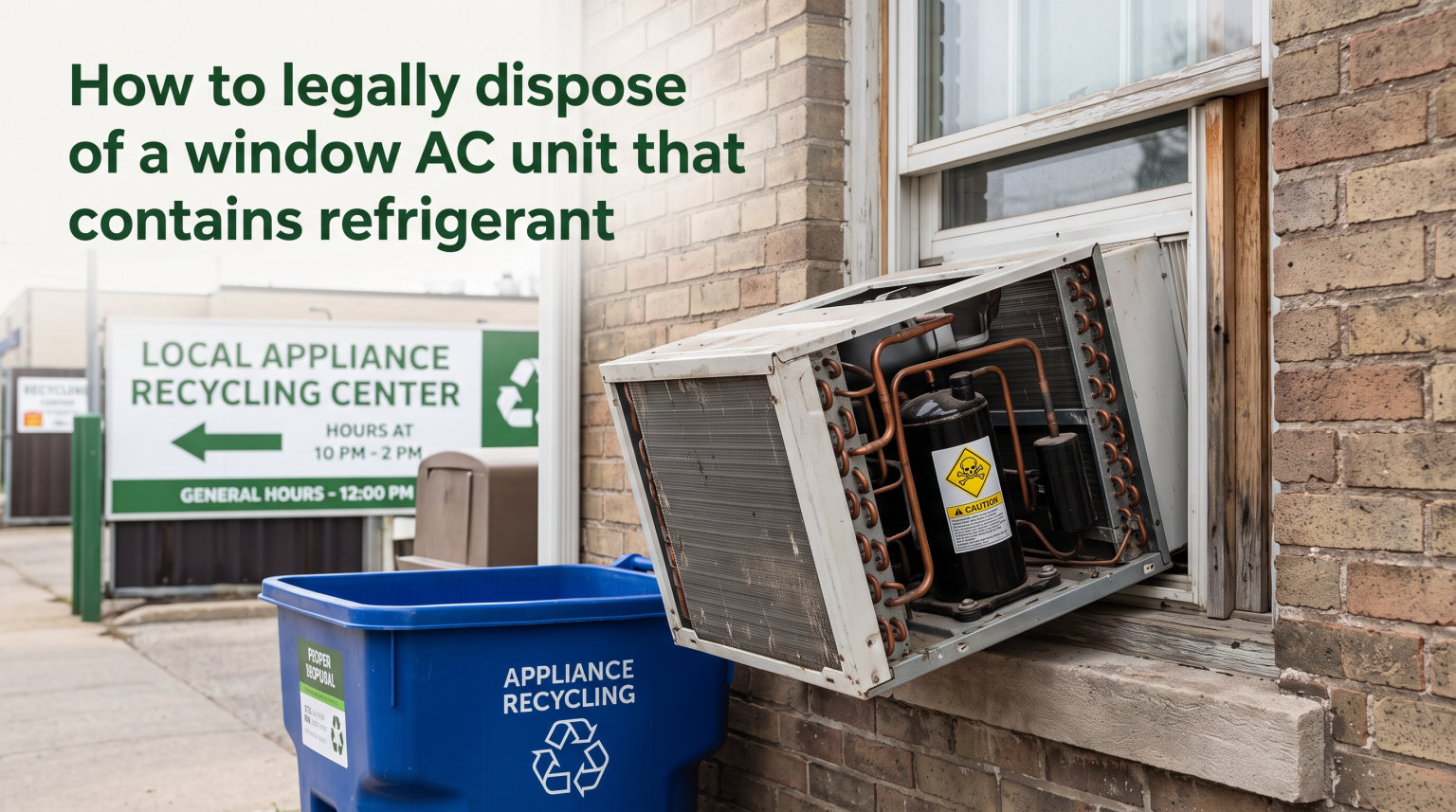
I learned the hard way that you cannot just toss an old window air conditioner in the trash. After moving into a new apartment last summer, I inherited a noisy 2003 Frigidaire unit that barely cooled. When I tried to drag it to the curb, my neighbor stopped me and warned me about federal law. That conversation sent me down a rabbit hole of EPA regulations, certified technicians, and hazardous waste drop-offs. By the time I finished, I had helped three neighbors dispose of their old units the right way. In this guide, I will walk you through exactly how to legally dispose of a window AC unit that contains refrigerant, without breaking the law or harming the ozone layer.
If you have an old window air conditioner sitting in your garage or still rattling away in its frame, this is the guide for you. Whether your unit uses R-22, R-410A, or R-32 refrigerant, the rules from the EPA Clean Air Act apply. Let me show you the legal disposal process, where to find free or low-cost programs near you, and what to avoid at all costs.
Table of Contents
Why You Cannot Throw a Window AC Unit in the Trash?
You cannot throw a window AC unit in the trash because federal law classifies refrigerant-containing appliances as hazardous waste. The refrigerants sealed inside these units are ozone-depleting substances or potent greenhouse gases. Under the Clean Air Act, releasing them into the atmosphere is illegal. Even if your AC stopped working years ago, the refrigerant is still trapped in the sealed coils. Toss the unit in a dumpster and that refrigerant can leak out, venting chemicals that damage the ozone layer or accelerate climate change.
I have seen Reddit threads where users argue that since the unit is dead, the refrigerant is gone. That is a myth. Refrigerant does not evaporate like water. It stays inside the sealed copper coils indefinitely, ready to escape the moment the unit is crushed, punctured, or left in a hot landfill. A single residential window AC can contain 6 to 20 ounces of refrigerant. That sounds small, but one pound of R-22 has the same global warming impact as nearly 1,800 pounds of carbon dioxide.
The Two Environmental Risks You Need to Know
Old refrigerants like R-22 (also called Freon) are CFCs or HCFCs. They destroy the ozone layer, which protects us from UV radiation. Newer refrigerants like R-410A and R-32 are HFCs. They do not harm the ozone layer, but they trap heat in the atmosphere thousands of times more effectively than CO2. Both kinds are regulated. Both kinds must be recovered by a certified technician before the metal shell of the unit can be recycled or scrapped.
Your local landfill will reject the unit if you try to drop it off. Most municipal curbside trash programs specifically list air conditioners as prohibited items. Even if a waste hauler takes it without asking, you are still liable under federal law for any refrigerant that escapes during transport or compaction.
EPA and Federal Legal Requirements You Must Follow
The EPA requires that all refrigerant be recovered by an EPA-certified technician before a window AC unit is scrapped, recycled, or disposed of. This rule comes from Section 608 of the Clean Air Act and applies to anyone who owns, services, or disposes of appliances containing refrigerant. Homeowners are not expected to recover refrigerant themselves. Instead, the law says you must use a certified technician or take the unit to a facility where certified technicians handle the recovery.
When I researched this for my own unit, I called three HVAC companies. Two of them charged a service fee just to come look at the appliance. The third quoted me a flat pickup fee of $85 that included refrigerant recovery and transport to a metal recycler. Prices in your area will vary, but you should expect to pay somewhere between $50 and $150 for professional removal if no free program exists nearby.
What Happens If You Skip This Step
Fines for improper disposal of refrigerant-containing appliances can reach $44,539 per violation per day under EPA civil enforcement. That number is not a typo. The EPA has pursued cases against small businesses, contractors, and even homeowners who knowingly vented refrigerant. While individual homeowners are rarely prosecuted, the law gives the EPA broad authority. Following the proper channel protects you and keeps you on the right side of the Clean Air Act.
Documentation matters too. If you hire an HVAC technician or recycler, ask for a receipt that confirms refrigerant recovery. Many states require this paperwork for hazardous waste tracking. Keep the receipt with your records for at least three years. If a certified recycler handles your unit, they will provide documentation showing the refrigerant was recovered and either reclaimed or destroyed.
Refrigerant Types Explained: R-22, R-410A, R-32, and More
The refrigerant inside your window AC determines both the disposal process and whether you need to worry about ozone-depleting chemicals. Units made before 2010 almost always contain R-22, the most heavily regulated type. R-22 production was banned in 2020 in the United States, but existing stocks can still be recovered and reused. Units made after 2010 commonly use R-410A, an HFC blend that does not harm the ozone layer but has high global warming potential.
Newest units, especially those imported from Europe or Asia, often use R-32 or R-290 (propane). These refrigerants have lower global warming potential and are gaining traction under the AIM Act. If you cannot tell what is inside your unit, check the data plate on the side or back. It will list the refrigerant type and charge weight. Knowing this helps your disposal technician plan the right recovery approach.
R-22 (Freon): Ozone-depleting HCFC. Most regulated. Most expensive to recover.
R-410A (Puron): HFC blend. Ozone-safe but high greenhouse warming potential.
R-32: Newer HFC with lower global warming potential. Gaining popularity.
R-290 (propane): Natural refrigerant with very low warming potential. Found in some compact window units.
Regardless of which refrigerant your unit uses, the disposal process is the same: a certified technician recovers the gas before the metal is recycled. Do not attempt to drain refrigerant yourself. Even small releases are illegal and the chemicals can cause frostbite or respiratory irritation.
How to Legally Dispose of a Window AC Unit: Step-by-Step
To legally dispose of a window AC unit that contains refrigerant, follow these five steps. I have used this exact process for my own unit and three of my neighbors’ units. It works in most U.S. cities, though the specific drop-off options will depend on your municipality.
Step 1: Identify the Refrigerant Type
Locate the data plate on the side or back of your unit. It will list the refrigerant type (R-22, R-410A, R-32, or another code) along with the charge weight in ounces or grams. Take a photo with your phone. This information helps your disposal technician know what equipment to bring and what regulations apply.
Step 2: Clean and Prepare the Unit
Unplug the AC and let it sit for 24 hours to allow any condensation to drain. Wipe down the exterior and remove the foam side panels if they come off easily. Do not cut into the refrigerant lines. Do not attempt to puncture or drain any part of the unit yourself. Wrap the power cord around the body of the unit so it does not snag during transport.
Step 3: Choose Your Disposal Method
Pick from one of the four options covered in the next section: municipal hazardous waste drop-off, scrap metal recycler, retailer take-back program, or junk removal service. Your choice depends on cost, convenience, and what is available in your area.
Step 4: Transport the Unit Safely
Keep the unit upright during transport. Lay it flat only if the manufacturer allows it. Truck beds and SUVs work better than sedans because of the weight. Use moving blankets or old towels to prevent scratches and to keep the unit from sliding around. Do not remove the refrigerant lines or coils before transport.
Step 5: Get Documentation
Ask the technician, recycler, or drop-off facility for a written receipt confirming that the refrigerant was recovered. Save this document for your records. If the recycler is EPA-certified, they will keep a copy on file as part of their own compliance paperwork. You can request a copy anytime within three years of the disposal.
Disposal Options: Free Municipal Programs vs Paid Recycling
You have four main options for legally disposing of a window AC unit that contains refrigerant. Each has different costs, convenience levels, and requirements. The best choice depends on your city, your schedule, and whether you want a free or paid service.
Option 1: Municipal Hazardous Waste Collection (Usually Free)
Most cities and counties run free household hazardous waste collection days several times a year. These events accept air conditioners, refrigerators, paint, batteries, and other regulated items. Some municipalities, like New York City’s DSNY, even offer scheduled appointments for CFC removal. Check your city or county website for upcoming collection events. In my area, the next one is in two months, so I am holding onto my neighbor’s old unit until then.
Option 2: EPA-Certified Scrap Metal Recycler (Free to Low Cost)
Scrap yards that handle appliances are required to have EPA-certified technicians recover refrigerant before crushing the metal. Many scrap yards accept residential AC units for free because they make money on the copper coils and aluminum frame. Call ahead to confirm they accept appliances from homeowners. Some only accept commercial volumes.
Option 3: Retailer Take-Back Programs (Varies)
Some retailers that sell new AC units will take your old one when delivering a replacement. Best Buy and Home Depot occasionally run appliance recycling promotions. Utility companies also partner with ENERGY STAR on air conditioner recycling programs that include free pickup. Check with your local utility before paying for a private service.
Option 4: Junk Removal Services ($50 to $150)
Services like 1-800-GOT-JUNK and LoadUp will haul away your old AC for a fee. They subcontract or employ EPA-certified technicians to recover refrigerant before disposal. This is the most convenient option if you cannot transport the unit yourself. Expect to pay between $50 and $150 depending on your location and how quickly you need pickup.
Cost Comparison at a Glance
Municipal hazardous waste program: Free (drop-off on scheduled days)
Scrap metal recycler: Free (some pay a small amount for copper)
Retailer or utility take-back: Free (limited availability)
Junk removal service: $50 to $150 (most convenient)
HVAC technician pickup: $75 to $200 (includes refrigerant recovery documentation)
FAQs
Is window AC refrigerant toxic?
Window AC refrigerants are not highly toxic at room temperature, but they are still hazardous. Direct skin contact with liquid refrigerant can cause frostbite, and inhaling concentrated vapors in enclosed spaces can irritate your lungs and heart. The bigger concern is environmental: refrigerants like R-22 deplete the ozone layer, while R-410A and R-32 are powerful greenhouse gases. That is why the EPA requires certified technicians to recover refrigerant before disposal.
How do I get rid of an old window AC unit?
Start by checking your city or county for a free household hazardous waste drop-off day. If none is scheduled soon, call a local scrap metal recycler to confirm they accept AC units from homeowners. You can also ask your utility company if they offer a free appliance recycling program, or schedule a junk removal service for $50 to $150. Whatever option you choose, make sure a certified technician recovers the refrigerant before the unit is crushed or scrapped.
Are window AC units considered hazardous waste?
Yes, window AC units are classified as household hazardous waste because of the refrigerant sealed inside their coils. Federal regulations under Section 608 of the Clean Air Act require that all refrigerant be recovered before the appliance is scrapped, recycled, or sent to a landfill. Even a non-working unit still contains refrigerant, so the rules apply regardless of whether the AC still cools.
What do I do with an old window AC unit?
Pick from one of four disposal routes: a municipal hazardous waste drop-off, an EPA-certified scrap metal recycler, a retailer or utility take-back program, or a paid junk removal service. Before transport, photograph the data plate to record the refrigerant type. After disposal, keep the receipt as proof that a certified technician handled the refrigerant recovery.
Final Thoughts on Disposing of Your Old AC Unit
Knowing how to legally dispose of a window AC unit that contains refrigerant protects you, your community, and the planet. Use a municipal drop-off when you can, a certified scrap yard when one is nearby, or a paid service when convenience matters most. Whatever you do, make sure an EPA-certified technician handles the refrigerant recovery and keep the paperwork. In 2026, with ozone-layer recovery still in progress and HFC regulations tightening under the AIM Act, following the proper disposal process matters more than ever.