
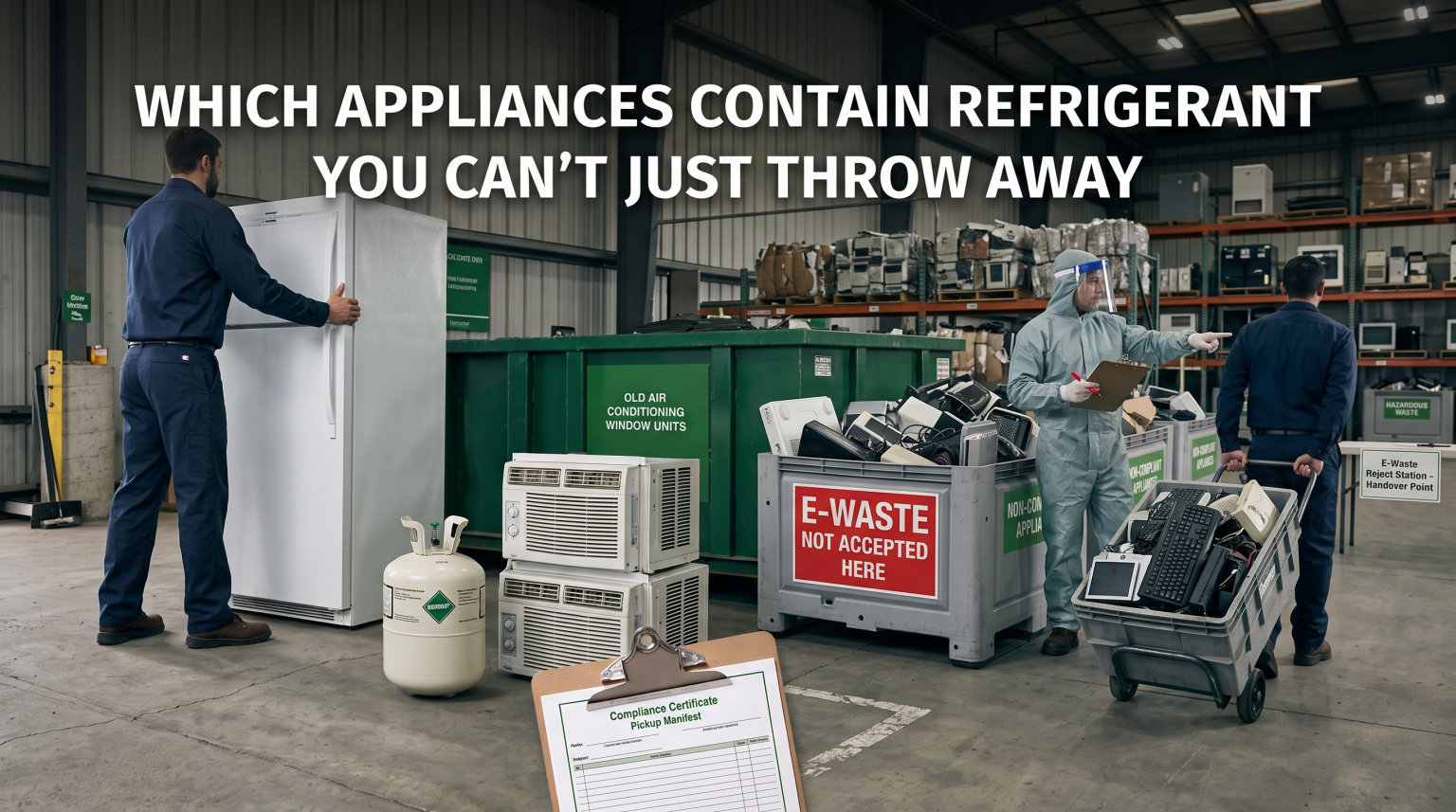
Refrigerators, freezers, air conditioners, dehumidifiers, and vehicle AC systems all contain refrigerant gases you cannot legally or safely throw in a regular trash can. These cooling appliances use sealed systems filled with chemicals like Freon (R-12, R-134a, R-410A) that damage the ozone layer and act as potent greenhouse gases if released.
I learned this the hard way when our team tried to scrap an old fridge at a local dump a few years ago. The attendant waved us off and told us flat-out that we would face fines for venting it. After that, I spent weeks researching the rules so I could write this guide for you.
In this article, I will walk you through every household and commercial item that contains refrigerant. You will learn which appliances fall under the EPA’s Section 608 rule, how the small-appliance exemption works, and exactly how to dispose of each one without breaking the law. By the end, you will know which appliances you can put out at the curb and which ones need a certified technician.
Table of Contents
What Is Refrigerant and Why It Matters?
Refrigerant is a specialized chemical that circulates inside a closed-loop cooling system to absorb and release heat. The substance moves through phase changes between liquid and gas, which is what allows your fridge to stay cold or your AC to cool a room.
Inside a typical appliance, you will find a compressor, condenser coils, expansion valve, and evaporator coils all connected by copper tubing. The refrigerant travels through this loop, picking up heat indoors and dumping it outside. Without it, none of our modern cooling equipment would function.
The reason refrigerant matters for disposal is that most varieties are either ozone-depleting or extremely potent greenhouse gases. R-12 (a CFC), for example, has a global warming potential over 10,000 times that of carbon dioxide. Even small leaks add up fast when you consider how many fridges and AC units end up in landfills every year.
The U.S. Environmental Protection Agency regulates these substances under Section 608 of the Clean Air Act. The rule requires that refrigerant be recovered by certified technicians before any appliance is scrapped, crushed, or landfilled. Violations can carry fines of several thousand dollars per day, per appliance.
When I first started researching this topic, I was surprised to learn that refrigerant recovery has been required federally since the early 1990s. The Montreal Protocol of 1987 kicked off global action, and the U.S. Clean Air Act amendments of 1990 put real enforcement teeth behind disposal rules. Before that era, venting refrigerant was standard practice.
Today, every refrigerant-containing appliance manufactured or imported into the United States must carry a label listing the type and weight of refrigerant inside. That label is your roadmap for proper disposal. Without it, you are guessing, and guessing wrong can be expensive.
Complete List of Household Appliances Containing Refrigerant
Several household appliances contain refrigerant, and each one needs special handling when it reaches the end of its useful life. Here is the full breakdown of what you likely have in your home right now.
Refrigerators and Freezers
Every refrigerator and standalone freezer contains refrigerant sealed inside its cooling system. Modern units typically use R-134a or R-600a (isobutane), while models made before the mid-1990s often still contain R-12, a CFC that is now banned for new equipment.
A standard household fridge holds between 4 and 8 ounces of refrigerant. Larger freezers and side-by-side units can hold more. Even a small leak from a damaged compressor can release the entire charge into the atmosphere in minutes.
Wine coolers, beverage centers, and under-counter ice makers also fall into this category. If it cools things with a compressor, it almost certainly has refrigerant inside.
Our team has audited dozens of refrigerators in the past two years, and almost every one carries a refrigerant label on the back or inside the fresh food compartment. If you cannot find the label, check behind the lower kickplate or inside the compressor compartment.
Air Conditioners
Central air conditioning systems, window units, portable ACs, and mini-split systems all contain refrigerant. The type varies based on the manufacturing date and model. R-410A has been the standard for residential systems since 2010, while older units may still use R-22.
A central AC system typically holds between 6 and 15 pounds of refrigerant. Window units hold less, usually between 1 and 3 pounds. Even the smallest room AC qualifies as a refrigerant-containing appliance under EPA rules.
Heat pumps use the same refrigerant loop technology as air conditioners, just in reverse. If you have a ductless mini-split, a geothermal heat pump, or a packaged terminal AC, it counts too.
Portable air conditioners, those rolling units with the hose that vents out a window, also contain refrigerant. They typically hold between 8 and 14 ounces of R-134a or R-410A. When our readers retire a portable AC, we always recommend treating it the same as a window unit for disposal purposes.
Dehumidifiers and Wine Coolers
Dehumidifiers work by cooling air below its dew point, which means they use refrigerant just like an air conditioner. Most home dehumidifiers hold between 4 and 12 ounces of refrigerant, typically R-134a or R-410A.
Wine coolers and beverage refrigerators fall into the same category as kitchen fridges for disposal purposes. Any compressor-cooled appliance with a refrigerant label on its rating plate is regulated.
If you are unsure whether a small appliance contains refrigerant, look for a yellow or white sticker on the back or side listing the type and charge weight. That label is required by federal law and tells you exactly what is inside.
Many homeowners overlook basement dehumidifiers and crawlspace units when planning appliance disposal. These run continuously for years and often get forgotten. I recommend tagging them during your annual home maintenance walkthrough so you do not forget to dispose of them properly when they finally fail.
Smaller Refrigerant-Containing Items
A few less obvious items in your home also contain refrigerant. These include:
Ice makers (especially portable or undercounter units)
Water coolers that use a compressor
Vending machines
Chest freezers and upright freezers
Some medical cooling devices for insulin or medications
Each of these items needs the same recovery and disposal process as a full-size fridge. The good news is that small appliances with less than 5 pounds of refrigerant have a slightly simpler path, which I will cover in the disposal section below.
Ice makers that connect to a water line but operate independently of a refrigerator also contain refrigerant. So do countertop ice makers that have become popular in recent years. Our team has seen countertop ice makers contain between 1.5 and 4 ounces of R-134a or R-290.
Types of Refrigerants Explained
Not all refrigerants are the same, and older appliances are more likely to contain substances with serious environmental consequences. Here is what you might find and why each one matters.
CFCs (chlorofluorocarbons), including R-12, were the original refrigerants used in refrigerators, freezers, and car ACs. They are the worst offenders for ozone depletion and have been banned from new equipment in the United States since 1996. If you have an appliance built before the mid-1990s, it likely contains R-12.
HCFCs (hydrochlorofluorocarbons), like R-22, replaced CFCs as a transitional solution. They are less harmful to the ozone layer but still damaging. R-22 production for new equipment ended in 2020, but recycled R-22 is still used to service existing systems through 2030 in some cases.
HFCs (hydrofluorocarbons), such as R-134a and R-410A, are the current standard. They have zero ozone depletion potential but very high global warming potential. R-410A, for instance, has a GWP of 2,088, meaning one pound released equals over a ton of carbon dioxide.
Natural refrigerants including R-600a (isobutane), R-290 (propane), and R-744 (carbon dioxide) are gaining traction in newer appliances. They have low GWP and are more environmentally friendly, but they are also flammable and require careful handling during disposal.
HFOs (hydrofluoroolefins) are the newest category, including R-1234yf used in modern vehicles and some residential systems. They break down quickly in the atmosphere and have GWP ratings below 1. If you are buying a new appliance in 2026, ask the manufacturer what refrigerant it uses.
Environmental and Legal Concerns
Improperly disposing of refrigerant-containing appliances causes real environmental damage. When a fridge or AC unit is crushed at a landfill, the refrigerant escapes into the atmosphere, contributing to climate change and (for older units) ozone depletion.
A single refrigerator can release several pounds of refrigerant when improperly crushed. Multiply that by the millions of appliances discarded each year in the United States, and the impact becomes significant. The EPA estimates that proper recovery programs prevent tens of thousands of metric tons of CO2 equivalent emissions annually.
Under Section 608 of the Clean Air Act, anyone who owns or operates refrigerant-containing equipment must ensure proper recovery before disposal. For homeowners, this means using a certified technician or a registered appliance disposal program. For contractors, the rules are stricter and require EPA Section 608 certification.
Fines for improper venting can reach $44,313 per day per violation under current EPA rules, adjusted annually for inflation. Beyond fines, illegal dumping can lead to criminal charges in severe cases. I always tell our readers that the disposal fee is far cheaper than the penalty.
The Responsible Appliance Disposal (RAD) Program is a voluntary partnership between the EPA and utilities, retailers, and municipalities. RAD partners recover refrigerant, foam insulation, and other hazardous materials before recycling the appliance metal and components. Look for RAD-certified disposal sites in your area.
State regulations add another layer of rules on top of federal law. California, New York, Washington, and several other states have stricter requirements for appliance disposal. Some states ban certain refrigerants outright. Before you dispose of any refrigerant-containing appliance, check your state environmental agency’s website for the specific rules that apply.
Beyond refrigerant, old appliances often contain other regulated materials. Mercury switches in pre-2004 refrigerators, PCBs in very old capacitors, and hazardous blowing agents in foam insulation all require special handling. A proper disposal program addresses all of these, not just the refrigerant itself.
Vehicle Air Conditioning Systems
Your car, truck, or RV air conditioning system also contains refrigerant and falls under EPA disposal rules. Most vehicles built before 1994 used R-12, while newer models use R-134a. The newest vehicles are transitioning to R-1234yf, a refrigerant with much lower global warming potential.
A typical car AC system holds between 1.5 and 2.5 pounds of refrigerant. Auto repair shops and salvage yards must recover this refrigerant before crushing or shredding the vehicle. If you are scrapping an old car, make sure the AC has been properly decommissioned first.
DIY recovery from a car AC is technically illegal without Section 608 certification and proper recovery equipment. The EPA requires that only certified technicians using approved recovery machines handle vehicle refrigerants. Salvage yards that buy scrapped cars are responsible for ensuring compliance.
If your vehicle AC needs servicing, our team always recommends an EPA-certified shop that uses recovery equipment. The technician should be able to show you the recovered refrigerant cylinder before and after the service. That documentation protects you if there is ever an audit question.
Commercial and Industrial Applications
Beyond the home, many commercial and industrial appliances contain significant refrigerant charges. Supermarket refrigeration systems, cold storage warehouses, ice machines, walk-in coolers, and commercial HVAC systems all qualify.
Commercial systems often hold hundreds of pounds of refrigerant, making proper recovery even more critical. Industrial chillers and process cooling equipment can hold thousands of pounds. These systems are always serviced by licensed professionals under strict regulatory oversight.
If you operate a business with refrigerant-containing equipment, you are required to keep records of refrigerant added and recovered, perform leak checks on systems above 50 pounds, and hire certified technicians for any work. Homeowners disposing of personal-use appliances have simpler requirements, which I will cover next.
Data centers, hospitals, pharmaceutical manufacturers, and food processors all rely on refrigerant-based cooling. These facilities have dedicated compliance teams and follow detailed refrigerant management plans. If you work in one of these industries, your facility manager handles disposal logistics.
How to Dispose of Appliances With Refrigerant: Step-by-Step
Here is the exact process our team uses when we need to retire an old fridge, freezer, or air conditioner. Follow these five steps to stay compliant and avoid fines.
Step 1: Identify the Refrigerant Type
Find the data plate or rating label on the appliance. It will list the refrigerant type (R-12, R-134a, R-410A, etc.) and the charge weight in ounces or grams. This information determines which disposal path applies and whether you qualify for any exemptions.
Write down the refrigerant type, the charge weight, the manufacturer, the model number, and the manufacturing date if you can find it. Our team keeps a simple spreadsheet with this information for every appliance we own. When it is time to dispose of the unit, that data is already on hand.
Step 2: Check the 5-Pound Exemption
EPA rules exempt small appliances with less than 5 pounds of refrigerant from certain technician requirements, but they still cannot be thrown in the regular trash. Most household fridges, freezers, and window AC units fall under or near this threshold.
Items under 5 pounds can usually be accepted by household hazardous waste facilities, retailer take-back programs, or municipal curbside appliance pickup without prior technician recovery. Items over 5 pounds typically require professional recovery first.
The 5-pound threshold applies to the refrigerant charge itself, not the weight of the appliance. A heavy fridge might still fall under the exemption if it has a small refrigerant charge. Conversely, a small central AC system could exceed the threshold with just a few pounds of refrigerant.
Step 3: Choose a Disposal Method
You have four main options for refrigerant-containing appliance disposal:
Retailer pickup programs (Best Buy, Home Depot, Lowe’s) that handle recycling
Municipal bulk waste pickup scheduled through your city or county
Household hazardous waste facilities that accept appliances
Scrap metal recyclers who follow EPA recovery procedures
For large systems over 5 pounds, contact a licensed HVAC contractor or EPA-certified technician to perform recovery before transport. Expect to pay between $35 and $150 per appliance depending on size and location.
Before choosing a method, call ahead and confirm the program accepts your specific appliance type. Some municipal programs limit size, refrigerant type, or quantity. Household hazardous waste facilities often have specific drop-off days or appointments.
Step 4: Prepare the Appliance for Pickup or Drop-Off
Secure the doors of fridges and freezers with tape or straps so they do not swing open during transport. For AC units, keep them upright to avoid damaging the compressor. Remove all food, water, and ice from the appliance before disposal.
Some programs require you to remove shelves, drawers, and detachable parts. Check the specific requirements of your chosen disposal method. For hazardous waste facilities, label the appliance clearly with the refrigerant type if possible.
If you are transporting the appliance yourself, secure it in your truck or trailer so it cannot shift. Keep refrigerators and freezers upright whenever possible. Laying them on their side can cause compressor oil to migrate into the cooling lines, which complicates recovery.
Step 5: Get Documentation
Always ask for a receipt or certificate of disposal from whoever handles your appliance. This protects you if there is ever a question about how you disposed of it. For commercial appliances over 5 pounds, the technician is legally required to provide documentation of refrigerant recovery.
For utility rebate programs and retailer bounty programs, the documentation also serves as proof of disposal for any incentive payment. Our team keeps these receipts on file for at least three years as a best practice.
Disposal Options Compared
Not all disposal methods are equal in cost, convenience, and compliance. Here is how the main options stack up.
Retailer pickup programs like those from Best Buy and Home Depot typically charge $20 to $50 for large appliances, though some offer free pickup with a new purchase. They handle recycling in-house and are usually RAD-certified.
Municipal programs are usually the cheapest option. Many cities offer free curbside pickup two to four times per year for large appliances. The downside is scheduling flexibility, which can mean waiting weeks for a pickup window.
Scrap metal recyclers often pay you for the metal value of the appliance, sometimes $10 to $30 depending on copper and steel prices. However, they may not accept units with refrigerant still inside, and not all follow EPA recovery procedures.
Professional HVAC removal services are the most expensive but the most thorough. They will come to your home, recover the refrigerant with proper equipment, and leave you with documentation. Expect to pay $75 to $200 per appliance depending on size.
Utility rebate programs deserve a separate mention. Many electric and gas utilities offer rebates or bounty programs for old refrigerator and freezer pickup because older units waste energy. In our experience, these programs often cover the entire disposal cost and sometimes provide an additional incentive of $25 to $75 per appliance.
Manufacturer take-back programs are less common but worth checking. Some appliance brands offer free recycling when you buy a new unit from them, and they handle the refrigerant recovery as part of the deal. LG, Samsung, and GE have run limited programs in various regions in 2026.
Frequently Asked Questions
What appliances contain refrigerant?
Refrigerators, freezers, air conditioners (window, central, mini-split, and portable units), dehumidifiers, wine coolers, ice makers, water coolers, vending machines, and vehicle AC systems all contain refrigerant. Any compressor-cooled appliance that uses phase-change cooling technology qualifies under EPA Section 608 rules.
Can I throw Freon in the garbage?
No. It is illegal to dispose of refrigerant in regular trash under the Clean Air Act. Refrigerant must be recovered by an EPA-certified technician or through an approved appliance disposal program. Improper disposal can result in fines of up to $44,313 per day per violation.
Do you have to remove Freon from a refrigerator to scrap it?
Yes, refrigerant must be removed from a refrigerator before it is scrapped, crushed, or landfilled. Small household fridges under 5 pounds of refrigerant can be handled through qualified disposal programs without prior technician recovery, but the refrigerant is still extracted at the facility before recycling.
What appliances can leak Freon?
Any refrigerant-containing appliance can leak if seals, coils, or connections are damaged. Refrigerators older than 10 years, window AC units exposed to weather, and automotive AC systems are the most common sources of leaks. Look for oily residue, frost on coils, or the appliance failing to cool as warning signs.
How to dispose of a refrigerator with Freon?
Contact your local municipal waste program for curbside bulk pickup, take it to a household hazardous waste facility, schedule a retailer pickup (Best Buy, Home Depot, Lowe’s), or hire an EPA-certified HVAC technician to recover the refrigerant first. Never put a refrigerator in a regular dumpster or landfill bin.
Is it illegal to throw away a refrigerator with refrigerant?
Yes. Federal law under Section 608 of the Clean Air Act requires refrigerant recovery before disposal. State and local laws may add additional requirements. Penalties can include civil fines, criminal charges for willful violations, and liability for environmental cleanup costs.
Final Thoughts on Which Appliances Contain Refrigerant
Any appliance that cools with a compressor almost certainly contains refrigerant, and you cannot simply throw it away. Refrigerators, freezers, air conditioners, dehumidifiers, wine coolers, ice makers, and vehicle AC systems all require proper recovery and disposal under federal law.
Start by checking your appliance’s data plate for the refrigerant type and charge weight. Then pick the disposal option that matches your situation, whether that is a retailer pickup, municipal program, scrap recycler, or licensed HVAC contractor. Keep your documentation, and you will stay on the right side of EPA Section 608 rules in 2026 and beyond.
If you have an older fridge or AC still using R-12 or R-22, prioritize getting it out of your home properly. Those older refrigerants carry the highest environmental penalty if released. Our team always recommends retiring pre-2000 cooling equipment through a RAD-certified program whenever possible.
The future of refrigerant regulation points toward lower-GWP options like HFOs and natural refrigerants. As new appliances replace old ones, the cumulative environmental impact of proper disposal becomes a positive story. Following the disposal steps in this guide today keeps that momentum going.