
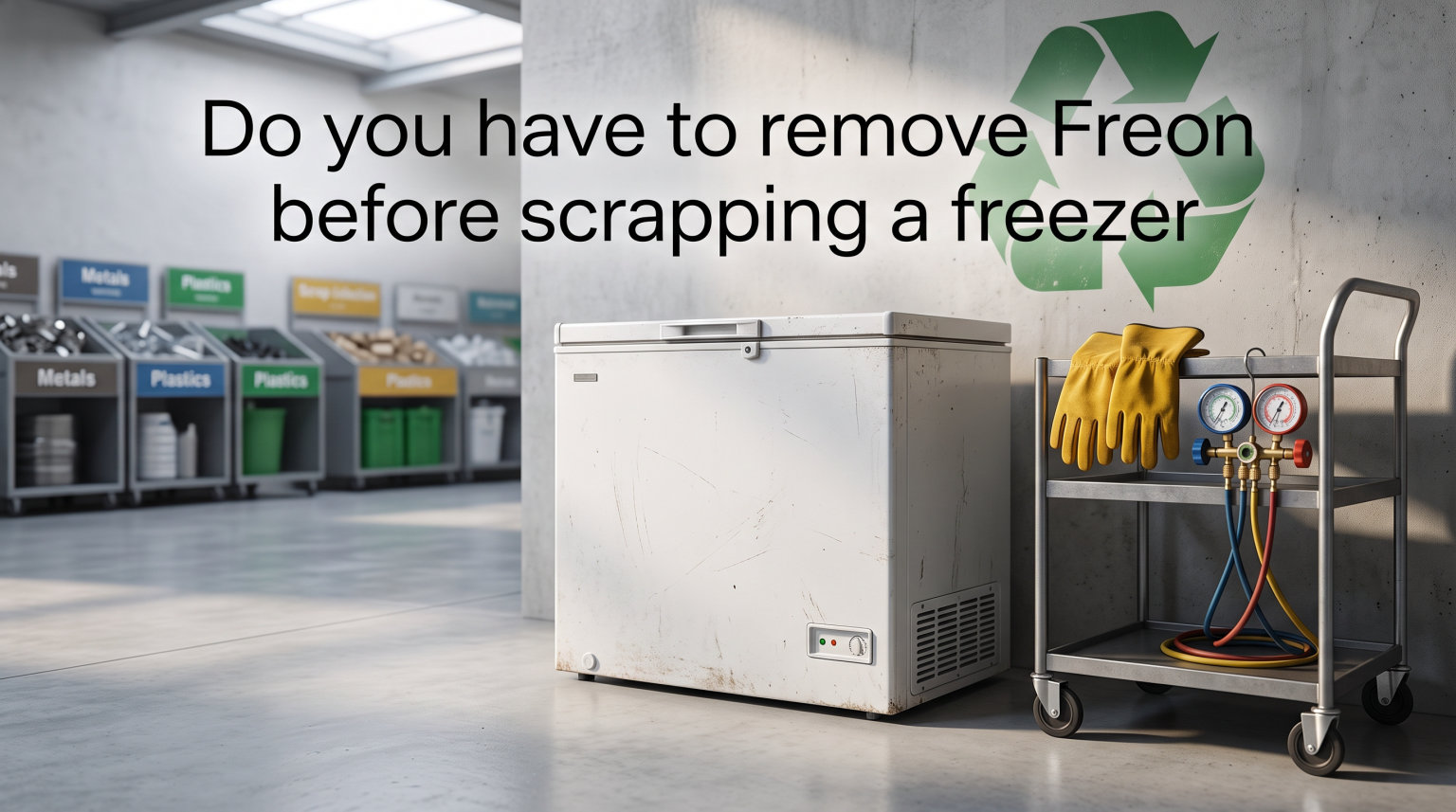
Yes, you have to remove Freon before scrapping a freezer. Federal law under Section 608 of the Clean Air Act requires a certified technician to recover refrigerant from any appliance before disposal, and the answer is the same whether you have an upright freezer, a chest freezer, or a refrigerator-freezer combo. Skipping this step can lead to fines up to $500,000 per violation, and it is one of the most common reasons homeowners get into legal trouble when scrapping large appliances.
I dug into the EPA regulations, talked through this with a few appliance recyclers, and pulled real experiences from scrap metal forums to put together this guide. By the end, you will know exactly what the law requires, what it costs, and how to scrap your freezer the right way.
Table of Contents
Freon Is the Refrigerant Chemical That Cools Your Freezer
Freon is a brand name for a family of refrigerants used to cool the inside of freezers, refrigerators, and air conditioners. Your freezer likely contains one of three types: CFC (R-12), HCFC (R-22), or HFC (R-134a or R-410A). Older freezers built before 1995 typically use R-12, while most units made after 2010 use HFC refrigerants.
Refrigerant is sealed inside copper coils running through the walls and compressor of your freezer. It cycles through compression and expansion to absorb heat from inside the unit. The problem is that this same chemical, when released into the air, damages the ozone layer and acts as a potent greenhouse gas.
A typical household freezer contains between 4 and 12 ounces of refrigerant. That small amount is enough to cause measurable environmental harm if vented, which is exactly why the EPA regulates it so tightly.
EPA Section 608 Makes Freon Removal a Legal Requirement
Under Section 608 of the Clean Air Act and the EPA’s implementing rules at 40 CFR Part 82 Subpart F, refrigerant must be recovered from any appliance before it enters the waste stream. This rule applies to freezers, refrigerators, window air conditioners, dehumidifiers, and any other equipment that contains refrigerant.
The law treats refrigerant recovery the same way it treats hazardous waste disposal. You cannot simply toss a freezer in a dumpster, cut the copper lines, or take it apart for scrap metal without first removing the refrigerant. Even if the appliance is being recycled for its steel and copper, the refrigerant still has to come out first.
There is one important exception. If a scrap metal recycler has on-site refrigerant recovery equipment operated by a certified technician, the appliance can enter their facility with the charge still intact. The EPA requires the technician to recover the refrigerant before any crushing, shredding, or scrap processing begins. The recycler must then provide you with a signed statement documenting the recovery.
Here is what that means in plain terms. Either you pay to have the Freon removed before drop-off, or the scrap yard does it on-site. Either way, the refrigerant must be recovered by a Section 608 certified technician.
Only EPA-Certified Technicians Can Remove Refrigerant Legally
Only EPA Section 608 certified technicians are legally allowed to remove refrigerant from appliances. Homeowners, DIYers, and even most general handymen cannot legally recover Freon, even if they understand how the cooling system works.
There are four types of Section 608 certifications:
- Type I for small appliances under 5 pounds of refrigerant (mini-fridges, window ACs)
- Type II for high-pressure appliances like residential freezers and refrigerators
- Type III for low-pressure appliances (large commercial chillers)
- Universal which covers all appliance types
For a household freezer, you need a technician with at least Type II certification. Most HVAC contractors, appliance repair companies, and scrap metal recyclers employ technicians with this credential. The certification requires passing an EPA-approved exam and is renewed through ongoing training.
The reason DIY removal is illegal comes down to equipment. Proper recovery requires a certified recovery cylinder, a recovery machine that pulls vacuum to specific levels, and weighing equipment to confirm all refrigerant has been extracted. Cutting a line with a hacksaw and letting the gas vent into your garage is a direct violation of federal law.
Scrapping a Freezer Legally Takes Four Steps From Start to Finish
Scrapping a freezer legally takes four steps from start to finish. Here is the process that works in every U.S. state.
Step 1: Check Local Disposal Regulations First
Before doing anything, call your city or county waste management department. Some municipalities require specific drop-off procedures, scheduled pickups, or proof of Freon removal before accepting large appliances. Your local utility may also offer rebates for proper appliance recycling through the EPA’s RAD (Responsible Appliance Disposal) program.
Step 2: Hire a Certified Refrigerant Recovery Technician
Contact an HVAC contractor, appliance repair company, or scrap metal recycler in your area. Ask specifically whether they employ Section 608 certified technicians and whether they can issue documentation of refrigerant removal. Most charge between $50 and $150 for residential freezer recovery, and some scrap yards include the service free when you bring the appliance in.
Step 3: Get Your Freon Removed by a Professional
The technician will connect a recovery machine to the service port on your freezer’s compressor, pull the refrigerant into a certified recovery cylinder, and verify removal by weighing the cylinder. The whole process usually takes 20 to 45 minutes. You will receive a signed statement showing the date, the technician’s certification number, the type of refrigerant recovered, and the quantity.
Step 4: Request Proper Freon Disposal Documentation
Keep the signed statement with your records. The EPA requires this documentation to trace the refrigerant through the disposal chain. If you sell the freezer to a scrap yard, that yard will provide its own documentation showing they received an empty appliance (or that they recovered the refrigerant themselves). Either way, the chain of custody must be intact.
Most Scrap Yards Require Refrigerant Removal Before Drop-Off
Most scrap yards will not accept a freezer with refrigerant still in the compressor. The yard I called in my area charges a $25 refrigerant recovery fee on top of the scrap payout, while a yard in the next county offers free recovery because they have on-site equipment and a full-time certified technician.
The practical reality, based on conversations with scrappers on Reddit and ScrapMetalForum, is that enforcement varies. Some smaller yards will accept a freezer with the lines intact and handle the recovery themselves. Others will turn you away. Federal law requires recovery in either case, but the enforcement gap at the local level is real.
Here is what to expect when you arrive at a scrap yard with a freezer:
- Most yards will inspect the unit before accepting it
- Yards with on-site recovery can take the appliance as-is
- Yards without recovery will require proof of prior removal
- You will receive a receipt documenting how the refrigerant was handled
- Scrap payout is typically $5 to $25 for a standard freezer based on steel weight
Call ahead before you load the freezer into your truck. Asking whether the yard handles refrigerant recovery saves you a wasted trip and keeps you on the right side of the law.
Professional Freon Removal Costs Between $50 and $150
Professional Freon removal from a freezer typically costs between $50 and $150, depending on your location, the technician’s travel requirements, and the type of refrigerant. HFC refrigerants like R-134a are the cheapest to recover because they are common and easier to handle. R-12 and R-22 are more expensive because they require additional certification and handling protocols.
Here is what affects the price you will pay:
- Travel fees: Some technicians charge $25 to $75 just to come to your location
- Refrigerant type: Older R-12 units cost more due to specialized handling
- Freezer size: Chest freezers with more refrigerant take longer to recover
- Free removal options: Many scrap yards and RAD partner utilities offer free recovery
- Documentation: Always included; do not pay extra for the signed statement
If you are scrapping the freezer, the cost of professional removal often eats into your scrap payout. A $100 recovery fee against a $15 scrap payout is a real calculation scrappers make. Forum users report that some homeowners decide to junk the freezer instead because the math does not work out. That is a fine choice as long as the appliance still goes to a facility that recovers the refrigerant properly.
Proper Freon Removal Protects the Ozone Layer and Climate
Freon and other refrigerants are controlled substances because they damage the ozone layer and contribute to climate change. CFC refrigerants like R-12 have an ozone depletion potential thousands of times higher than CO2. HFC refrigerants do not harm the ozone layer but still trap heat in the atmosphere at thousands of times the rate of carbon dioxide.
When refrigerant is vented, it rises into the stratosphere and breaks down ozone molecules that protect life on Earth from ultraviolet radiation. The Montreal Protocol of 1987 phased out CFCs globally for this reason, and the Kigali Amendment extended controls to HFCs. The EPA’s Section 608 rules are the U.S. enforcement mechanism for these international agreements.
Recovered refrigerant is either recycled, reclaimed, or destroyed. Recycled refrigerant is cleaned for reuse in similar equipment. Reclaimed refrigerant is reprocessed to meet new-product specifications. Destroyed refrigerant is incinerated at high temperatures. Each pathway keeps the chemical out of the atmosphere and, in many cases, puts it back into productive use.
You Have Four Legal Freezer Disposal Alternatives to the Scrap Yard
The scrap yard is not your only option for getting rid of an old freezer. Several alternatives may be cheaper, easier, and more environmentally responsible.
Municipal Bulk Pickup Is the Easiest Option
Most cities and counties offer scheduled bulk appliance pickup for free or for a small fee. The crews are typically required to recover refrigerant before disposal, so the legal responsibility shifts to them. Call your local waste department to schedule a pickup.
Retailer Take-Back Programs Handle Removal for You
Many appliance retailers will haul away your old freezer when delivering a new one. The retailer is responsible for proper refrigerant recovery and disposal under their EPA obligations. This option is often free with a new purchase.
RAD Partner Utilities Offer Free Pickup and Rebates
The EPA’s Responsible Appliance Disposal (RAD) program partners with utilities nationwide to offer rebates and free pickup for old refrigerators and freezers. RAD partners commit to proper refrigerant recovery, foam recycling, and metal recycling. Search the EPA’s RAD partner directory for programs in your state.
Working Freezers Are Better Donated Than Scrapped
If your freezer still works, donate it through Habitat for Humanity ReStores, local charities, or community sharing programs. Working freezers do not need refrigerant removal because the refrigerant stays sealed inside the working appliance.
Fines for Venting Refrigerant Start at $27,500 Per Day
Federal penalties for venting refrigerant start at $27,500 per day per violation under Section 608. Civil fines can reach $500,000 per violation, and criminal penalties for willful violations include up to five years in prison under the Clean Air Act.
The EPA has pursued enforcement actions against individuals, scrap yards, and HVAC companies for improper refrigerant venting. State agencies also enforce these rules, and some states impose additional penalties on top of federal fines.
The most common enforcement scenario involves:
- Scrap yards found venting refrigerant during shredding operations
- HVAC companies that skip recovery to save time
- Property owners who cut refrigerant lines during demolition
- Individuals who vent appliances to recover copper faster
The risk is not just theoretical. Forum users have shared stories of EPA sting operations targeting scrap yards, and several states run tip lines for reporting illegal venting. The fines are severe enough that the cost of professional removal is, in retrospect, a bargain.
Frequently Asked Questions
How much does it cost to have Freon removed from a freezer?
Professional Freon removal from a freezer typically costs between $50 and $150 depending on your location, the refrigerant type, and whether travel fees apply. Many scrap yards and utility RAD programs offer free refrigerant recovery if you bring the freezer to them or schedule a pickup.
Do you have to remove Freon from a refrigerator to scrap it?
Yes. EPA Section 608 regulations apply to all refrigerant-containing appliances, including refrigerators, freezers, window air conditioners, and dehumidifiers. The refrigerant must be recovered by a Section 608 certified technician before the appliance enters the waste stream, with very limited exceptions for scrap recyclers with on-site recovery equipment.
Are deep freezers worth scrapping?
Deep freezers typically yield $5 to $25 in scrap value based on the weight of their steel and copper components. After paying $50 to $150 for professional refrigerant removal, the net return is often negative. Many homeowners choose municipal pickup or retailer take-back instead. A working freezer is worth more donated than scrapped.
How much is a fridge freezer worth in scrap?
A standard fridge freezer is worth $5 to $25 in scrap metal, depending on weight and current steel and copper prices. Larger commercial units can fetch $30 to $75. The scrap value rarely covers the cost of professional refrigerant removal, which is why many people choose alternative disposal methods like utility rebates, municipal pickup, or retailer take-back programs.
Yes, You Must Remove Freon Before Scrapping a Freezer: Final Word
Yes, you have to remove Freon before scrapping a freezer, and the requirement applies to every type of refrigerant-containing appliance. Hire a Section 608 certified technician, get your documentation, and choose the disposal path that fits your situation. If the scrap math does not work, municipal pickup, retailer take-back, and RAD partner utilities are all legal and often free alternatives. The few minutes of planning protect you from fines and keep harmful refrigerants out of the atmosphere.