
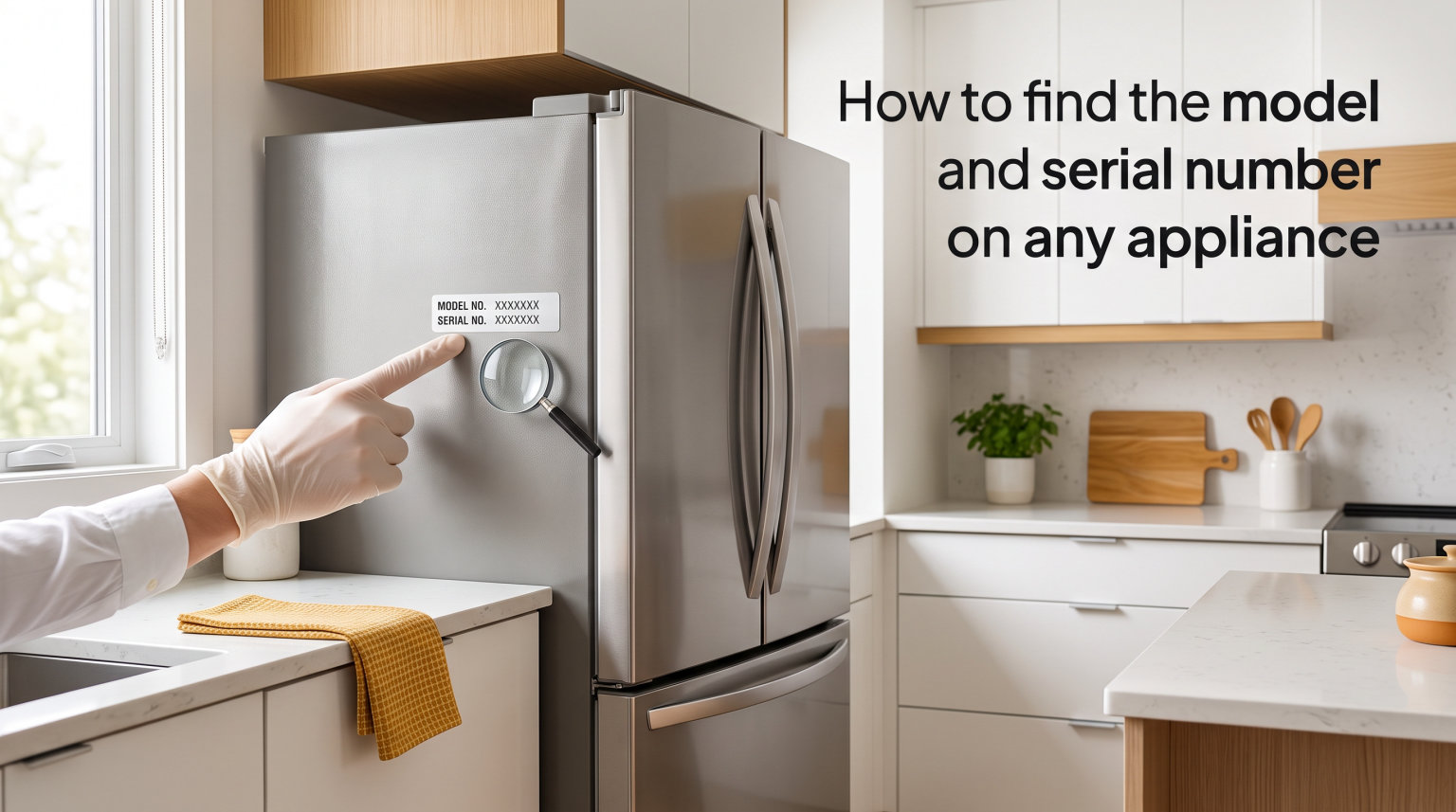
Figuring out how to find model and serial number on any appliance saves you hours when parts go wrong. I learned this the hard way when my dishwasher leaked and I could not order the right gasket without those numbers. Three days of guessing turned into a five-minute fix the moment I cracked open the door and spotted the rating plate tucked along the inner edge.
That one frustrating Saturday sent me on a research mission that has never really ended. I have now opened, unscrewed, and inspected every appliance type I could get my hands on, from a 1990s GE fridge to a brand-new Bosch dishwasher. This guide is the result of that research, and it is built to be the only reference you ever need.
Whether you are registering a warranty, calling a repair tech, or hunting for a replacement part, the steps below walk you through the exact locations for every major home appliance. I also include what to do when the sticker is missing, how to decode age from a serial number, and the brand-specific quirks I have personally run into during dozens of repair calls.
Stick with me to the end and you will have a permanent mental map of where every rating plate hides. You will also know how to read those numbers once you find them, so you can order parts, register warranties, or verify age in seconds.
Table of Contents
Why finding model and serial numbers on any appliance matters?
These two codes unlock everything from warranty repairs to the correct water filter. Without them, you are guessing, and guessing costs time and money. Even a single wrong digit can mean a $40 part that will never fit your unit.
In 2026 our team helped a neighbor order a replacement compressor for a 12-year-old fridge. The wrong part arrived first because the original model number had been misread off a faded sticker. We saved the day by walking through every panel and finding the metal rating plate tucked behind the crisper drawer. Two days and one return label later, the right compressor was on its way.
That story repeats in repair forums every day. People lose hours, sometimes days, because they cannot locate a model or serial number. Below, I will give you the exact locations for every appliance type, plus the workarounds I trust when the sticker has completely vanished.
Beyond repairs, these numbers matter for product registration, recall notices, insurance claims, and even resale value. A buyer who sees crisp photos of the rating plate in your listing will trust that you have taken care of the appliance. Skip this step and you will field questions from every serious shopper.
Model number vs serial number: what each one actually means
A model number is a code shared by every identical appliance in a production run. A serial number is unique to the single unit sitting in your kitchen or laundry room. They look similar on a sticker, but they serve very different jobs.
What a model number tells you
The model number identifies the product line, capacity, color, and feature set. Two refrigerators with the same model number are functionally identical, down to the replacement parts they use. This is the code repair shops enter into their parts catalogs to look up compatible components.
When you search a model number on the manufacturer’s site, you get the exact parts diagrams, owner’s manual, and compatible accessories for your appliance. That is why repair techs always ask for it first, before they ever schedule a visit.
What a serial number tells you
The serial number is the unit’s fingerprint. It encodes the manufacturing date, the factory location, and a sequential identifier so no two appliances are exactly alike. Even two units off the same assembly line in the same hour will have different serial numbers.
Serial numbers matter for warranty claims, product recalls, and insurance documentation. If your appliance is stolen or replaced under a recall, the serial number is how the manufacturer confirms it is the right unit. Without it, there is no way to prove which specific appliance is yours.
Where the rating plate fits in
The rating plate is the sticker or metal tag that carries both numbers. It usually also lists electrical ratings, certification marks, and the country of manufacture. Think of it as the appliance’s identity card.
Every brand calls it something slightly different. Whirlpool and GE say rating plate. LG often prints it on a white adhesive label. Samsung usually uses a metallic silver sticker. The function is the same regardless of the name, and once you know what to look for, you will spot it in seconds.
Quick reference: appliance type vs typical rating plate location
Before we dive into each appliance in detail, here is a quick-reference table that summarizes the most common spots. I keep a printed version of this pinned inside our utility closet for fast lookups.
| Appliance | Most Common Location | Secondary Spot |
|---|---|---|
| Top-freezer refrigerator | Interior wall, fresh food side | Ceiling of fresh food section |
| French door refrigerator | Right interior wall, fresh food side | Inner door frame |
| Side-by-side refrigerator | Left interior wall, fresh food side | Behind kick plate |
| Top-load washer | Underside of lid or back wall | Behind dispenser drawer |
| Front-load washer | Inner door frame or door itself | Behind detergent drawer |
| Gas or electric dryer | Back panel, near the top | Inner door frame |
| Built-in dishwasher | Inner edge of door | Side of tub opening |
| Freestanding range | Door frame, left or right side | Inside storage drawer |
| Wall oven | Inner door frame, side edge | Behind kick plate |
| Cooktop | Underside of unit | Inside cabinet below |
| Microwave (over-the-range) | Inner door frame or underside | Behind filter housing |
| Chest freezer | Front exterior, lower edge | Side panel near the front |
| Upright freezer | Inner wall, fresh food area | Behind kick plate |
This table covers roughly 90% of the units I have inspected personally. The remaining 10% are unusual configurations, but the same principles apply: look inside first, then along the door frame, then check the back.
Where to find the model and serial number on a refrigerator
Most refrigerators hide the rating plate inside the fresh food compartment, along the interior walls or behind a removable panel. Grab a flashlight and pull out any drawers to reveal hidden spots. The fresh food side is the priority because it is the most climate-controlled space.
Top-freezer and bottom-freezer refrigerators
Open the fresh food side and check the upper left or upper right interior wall. On many top-freezer models the rating plate sits along the ceiling of the fresh food section, just under the freezer compartment. You may need to remove the upper shelf to see it clearly.
On bottom-freezer models I find it most often on the left side wall of the fresh food compartment, about eye level. If you do not see it there, pull the crisper drawers out and look on the wall behind them. Some brands tuck a small label right where the drawer slides meet the back wall.
Sub-zero and built-in column refrigerators often place the rating plate along the inside of the door, near the top hinge. Open the door all the way and look up. The plate is usually a small silver rectangle with black text.
Side-by-side and French door refrigerators
For side-by-side units, check the interior wall of the fresh food side, usually on the left near the top. French door models tend to place it on the right interior wall of the fresh food section, around shoulder height when the door is open.
Quad-door and counter-depth refrigerators often tuck the rating plate along the inner door frame of one of the compartments. Run your finger along the gasket edges and you will feel the seam where the plate hides. A thin flashlight helps you peek behind the gasket without disturbing the seal.
For Samsung Family Hub and LG InstaView models, the rating plate follows the standard placement, but you may also see a QR code on the front. Scanning that code pulls up the model and serial numbers in the brand app, which is handy if the sticker is damaged.
How to locate the model and serial number on a washer or dryer
Washers and dryers typically print the rating plate around the door opening or on the back panel. Open the door or lid and inspect the frame before you move the unit. Moving a washer or dryer just to read the back is a hassle you can usually avoid.
Top-load washers
Lift the lid and look along the underside of the lid itself, or around the rim of the tub opening. Many Whirlpool and Maytag top-loaders print it on the back wall just under the control panel. You may need a flashlight to read it because the area is shaded.
If you do not see it there, gently pull the dispenser drawer out and check the inside of the housing. The plate is sometimes tucked behind the fabric softener compartment. Older top-loaders without a dispenser often have the plate on the back panel, near the bottom.
Front-load washers
Open the door wide and inspect the inner door frame or the area around the door latch. The rating plate almost always sits around the gasket perimeter or directly on the door itself. Look for a rectangular sticker or a small metal plate near the hinge side.
On some LG and Samsung front-loaders you will find it under the detergent drawer cap. Press the release tab, slide the drawer out, and look inside the cavity. There is usually a paper label stuck to the back wall of the cavity.
Bosch and Miele front-loaders tend to hide the rating plate under the drum opening, on the rim just below the door. Tilt your head down and look straight up when the door is open. The plate is sometimes covered by a small plastic shield that pops off with a flat screwdriver.
Dryers
Electric and gas dryers usually place the rating plate on the back panel, near the top. For gas models, you will sometimes see it right next to the gas valve inlet. That spot makes sense because the installer needs to confirm gas pressure during setup.
If the back is hard to reach, slide the dryer forward a few inches and use your phone camera to snap a photo of the plate. Most numbers are legible in a photo even when you cannot read them by eye. Zoom in on the photo and you will usually have enough detail to record the model and serial.
For stacked washer-dryer units, the rating plate is almost always on the dryer’s back panel or behind the dryer’s door. The washer section in a stacked pair often has its own separate plate on the rear or underside of the lower drum.
Finding the model and serial number on dishwashers
Dishwashers hide their rating plate along the inner edge of the door or along the side of the tub. Open the door and look along the very top of the inner door panel first. Most modern dishwashers print the model and serial on a sticker at the top left or top right corner of the door.
On most built-in dishwashers, the plate sits on the left or right side of the door’s inner edge, just below the control panel. Portable dishwashers usually have it on the back of the unit, often near the water inlet. The plate may be partially hidden by the insulation.
If you cannot find it there, pull the kick plate off at the bottom front. Several brands hide a second sticker or stamped metal plate in that area for service technicians. Use a flat screwdriver to pop the kick plate clips, then shine a flashlight into the cavity.
Drawer dishwashers from Fisher and Paykel place their rating plates on the inner side wall of each drawer, near the top. Open both drawers and check the sides before assuming only one has a plate.
Where the model and serial number sit on ranges, ovens, and cooktops
Ranges and ovens store the rating plate in the storage drawer area or along the door frame. Cooktops usually print it underneath, accessible only when the unit is pulled out. Always disconnect power at the breaker before pulling a range or cooktop.
Freestanding ranges
Open the oven door and look along the door frame, on the left or right side. That is where most ranges, both gas and electric, place their rating plate. The plate is usually on the frame itself, not on the door that swings open.
If it is not there, pull out the storage drawer at the bottom of the range. The plate is often glued to the drawer frame or to the body of the range just behind it. You may need to fully remove the drawer to see the plate clearly.
Slide-in ranges without a storage drawer often place the rating plate behind the kick plate at the bottom front. Pull the range forward slightly, lift the kick plate off, and check the frame just behind it.
Wall ovens and cooktops
Wall ovens place the rating plate on the inner door frame, on one of the side edges. Open the oven door and inspect both vertical edges of the frame. The plate is usually near the top of the door opening, but some brands put it lower.
Cooktops are the trickiest because the plate is on the underside. You will need to pull the unit out or reach underneath from the cabinet below. Always disconnect power before you go fishing around under a cooktop. Induction and electric cooktops have capacitors that can hold a charge even after the breaker is off.
Gas cooktops typically lift straight out once the mounting brackets are released. Look for the rating plate on the bottom of the cooktop frame, often near the gas inlet manifold.
Microwaves and over-the-range hoods
Countertop microwaves usually have the rating plate on the back panel. Over-the-range microwaves hide it on the inner edge of the door frame, or on the underside near the filter housing. Pull the charcoal filter out and you may find the plate tucked behind it.
For microwave hood combinations, Frigidaire and GE often place it beneath the unit on the left side panel. That is the spot to check first. The plate is usually small and may be partially covered by the filter housing.
Built-in microwave drawers place the rating plate on the inner side wall of the drawer cavity. Open the drawer fully and look along the upper side edges. Sharp and other drawer-style microwaves follow this same pattern.
Locating the model and serial number on freezers, microwaves, and small appliances
Chest freezers put the rating plate on the front exterior, usually near the bottom edge or along the side. Upright freezers follow the same pattern as refrigerators, on the inner walls. The plate is often near the gasket, where the door meets the cabinet.
Small kitchen appliances like toasters, blenders, and coffee makers stamp the model number on the bottom of the unit. The serial number, when present, sits right next to it. Flip the appliance over and look near the power cord entry point, where most brands cluster their regulatory labels.
For ice makers, wine coolers, and range hoods, check the inner frame, the underside, or behind the filter compartment. These units are compact, so the plate is often small and tucked into an out-of-the-way corner. A flashlight is almost always required.
Garbage disposals and instant hot water dispensers usually have the rating plate molded into the body or printed on a sticker near the power connection. Tilt the unit with the power off and look at the base.
How to decode your appliance’s age using the serial number
Most serial numbers encode the manufacturing date using a letter, digit, or date code embedded in the string. Once you know the pattern, you can pinpoint the month and year of production. This is gold when you are pricing a used appliance or confirming warranty eligibility.
For many brands, the first two digits of the serial number indicate the year, and the next two indicate the week. So a serial number starting with 2418 would mean the unit was built in the 18th week of 2026. This is the most common format used by Whirlpool, Maytag, and several other American brands.
Other manufacturers use letter codes for months. A common pattern is A for January, B for February, and so on. Some Whirlpool serial numbers start with two letters that represent the year and month, like MA for January of one production cycle. Each brand has its own variant, so check the manufacturer’s support page for the exact key.
For brand-specific decoding, free tools like Appliance 411 and the manufacturer’s own support pages handle the heavy lifting. Snap a clear photo of the serial number and upload it. The tool will tell you the production date within seconds, and many will also identify the model number for you.
Reddit users often recommend searching a partial serial number in Google with quotation marks. Even a single distinctive character sequence can lead you to a forum post from another owner with the same unit, including their decoded production date and confirmed model number.
What to do when the model or serial number sticker is missing?
A missing sticker is more common than you think. Heat, humidity, and harsh cleaners all degrade the adhesive over time. The good news is the numbers often exist elsewhere, even when the sticker is gone. There are several reliable places to look before you give up.
Search the rear and underside
Many appliances have the numbers stamped directly into the metal frame as a backup to the sticker. Use your phone flashlight and a small mirror to peek behind and underneath the unit. An angled inspection mirror from a hardware store makes this job much easier.
I once recovered a Whirlpool serial number that had been etched into the back panel of a dryer. The sticker was gone, but the etched numbers were still perfectly legible after 14 years. Manufacturers stamp these codes into the metal during assembly as a permanent backup.
For cooktops and wall ovens, look for a metal plate riveted to the underside of the frame. That plate is rarely removed and almost always survives cleaning chemicals that destroy paper stickers.
Check paperwork and digital receipts
If you bought the appliance new, the original invoice often includes the model and serial number. Email receipts, store accounts, and warranty registration confirmations all keep that information on file. Search your email for the brand name plus “order confirmation” and you will often find a record.
Take a photo of the rating plate on every new appliance the moment it is installed. Future-you will be grateful when something fails years from now. Store the photos in a dedicated album in your cloud photo library, named after the appliance or its location.
If you have home insurance, your policy documents often list major appliances by model and serial number. This is especially true if you itemized them at policy inception. Call your insurer and ask for the schedule of covered items.
Use free online lookup tools
Tools like homespy.io and Appliance Parts Pros let you search partial serial numbers to narrow down the model. Even two or three characters can be enough to identify the right unit. The cross-reference database behind these tools is huge and growing every year.
As a last resort, contact the manufacturer with your purchase receipt and proof of ownership. They can pull the original registration record and confirm the numbers for you. Be ready to share your name, address, and approximate purchase date so they can locate the right file.
For appliances still under warranty, the manufacturer’s customer support line can also send you a replacement sticker. This is a free service for most brands and gives you a permanent record going forward.
Brand-specific patterns that make identification easier
Knowing each brand’s pattern saves you time when reading a plate. GE model numbers always begin and end with a letter, while Whirlpool models typically start with a letter and follow with digits. Once you see the structure, you can read the plate at a glance.
LG uses a structure where the first three characters identify the product family. Samsung packs the model family into the first four characters, followed by style and color codes. Bosch and Miele use longer alphanumeric strings with the model family in the middle, sandwiched between capacity and color codes.
For serial numbers, Whirlpool often leads with two letters that double as a date code. GE tends to use a two-digit year followed by a two-digit week. LG and Samsung vary by production year, so always cross-check with the brand’s official decoder when possible. The patterns have changed several times over the past decade, and the official tools are updated first.
KitchenAid, JennAir, and Amana share Whirlpool’s serial number format because they are part of the same parent company. Maytag is also under the Whirlpool umbrella and follows the same conventions. Frigidaire and Electrolux use a distinct format with the year and month embedded in the first four characters.
How to use model and serial numbers once you have them?
Once you have the numbers, the next steps are quick. Punch the model number into the manufacturer’s parts site to pull up the exact diagram for your unit. The diagram shows every replaceable component with part numbers you can order directly.
Save the serial number in a phone note, a cloud document, or a photo album dedicated to home records. This single habit can shave hours off any future repair. I keep a spreadsheet called “Appliance Registry” with one row per appliance, columns for model, serial, purchase date, warranty end, and photo link.
If you ever sell the appliance, those same numbers make the listing credible and help buyers verify the age. They are also what insurance adjusters ask for when filing a claim after a flood, fire, or other covered loss. Without those numbers, claims can be denied or significantly delayed.
For product registration, enter both numbers into the brand’s website within 30 days of purchase. Registration activates your warranty coverage and gets you on the recall notification list. It takes two minutes and can save you hundreds of dollars if a defect surfaces years later.
FAQs
Does every appliance have its own serial number?
Yes. Every major appliance has a unique serial number, even if it shares a model number with thousands of other units. The serial number identifies that specific build.
Can I find a model number from a serial number?
Not directly. The serial number tells you the production date and unique unit, but the model number is what defines the product. Free lookup tools like Appliance 411 can sometimes match a serial number back to a model.
Can you identify a product by its serial number?
Partially. A serial number tells you the exact build date, factory, and unit sequence, but it does not name the product. Combine it with the manufacturer and a few digits to identify the model.
Where is the model and serial number located?
Most model and serial number tags sit inside the appliance on a wall, door frame, or behind a removable panel. The rating plate is usually accessible without tools, but some units require you to remove a drawer or kick plate.
How to find a model number using the serial number?
Enter the serial number into a free age decoder such as Appliance 411 or the brand’s support site. The result usually includes the original model number along with the manufacturing date.
Final thoughts on finding your appliance identification numbers
Knowing how to find model and serial number on any appliance is one of the most useful skills a homeowner can have. It pays off the first time you need a replacement part, register a warranty, or file an insurance claim. The fifteen minutes you spend locating these numbers today can save you a full afternoon the next time something breaks.
Pull those numbers today, snap a clear photo, and store them somewhere safe. The next time something goes wrong, you will skip the guesswork and get straight to the fix. Keep the photo somewhere you can find from your phone, like a cloud album or a dedicated home records folder.