
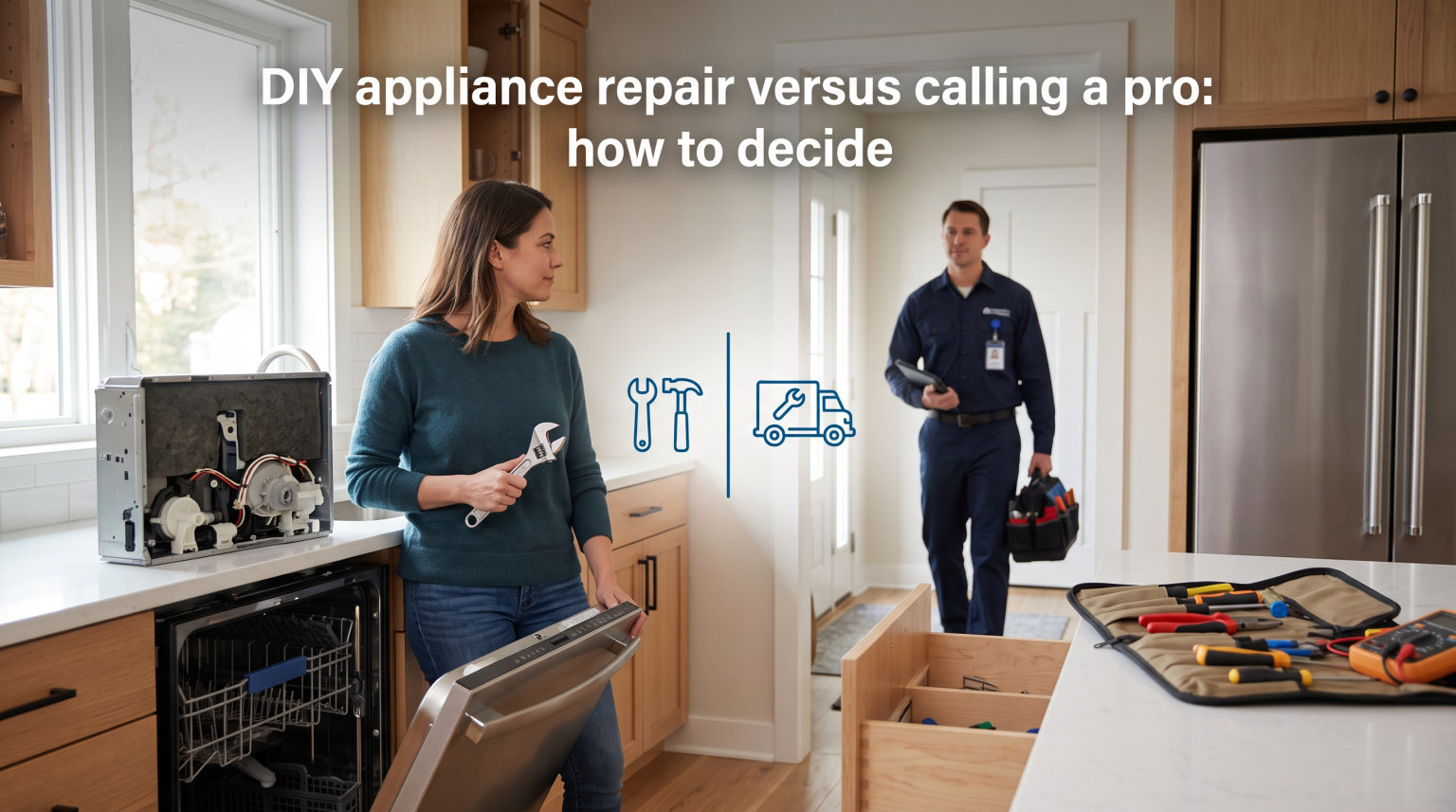
Your dishwasher stops mid-cycle. Your dryer tumbles but produces no heat. The fridge hums louder than usual, and your gut drops because you know a service call could run anywhere from a hundred to several hundred dollars. That is the moment every homeowner faces: should you attempt DIY appliance repair, or pick up the phone and call a pro?
I have spent more weekends than I can count with a multimeter in one hand and a parts diagram on my laptop. I have also called technicians for jobs I should never have touched. The decision between DIY appliance repair versus calling a pro comes down to a handful of clear factors, and I’m going to walk you through every one of them.
This guide gives you a working decision framework, a list of repairs you can safely handle yourself, a list of jobs that always belong with a licensed technician, and a clear answer to the question most readers ask first: when is it cheaper to replace the appliance entirely? By the end, you will know exactly which path to take for your specific situation.
Table of Contents
DIY appliance repair versus calling a pro: how to decide in 5 factors
The decision rarely comes down to a single number. It comes down to five factors working together, and skipping any one of them is how homeowners end up with bigger bills or, worse, injuries. Run your situation through these five checks before you crack open a panel or schedule a service call.
1. Your skill level and honest experience
Be honest about what you have actually done, not what you think you could figure out. Swapping a refrigerator water filter is a beginner task. Replacing a door gasket is intermediate. Swapping a control board is advanced. If you have never worked with electrical components before, a dishwasher control board is not the place to learn.
I keep a mental rule: if I cannot name the safety hazard involved and the tool that protects me from it, I am not ready for that repair yet. The good news is that YouTube tutorials have closed much of the gap. Most household appliances can be diagnosed and repaired by an average homeowner with patience and the right video. The bad news is that some repairs still require hands-on knowledge that no video can deliver.
2. The complexity of the actual problem
Some failures are obvious. A loose hose, a tripped breaker, a clogged drain trap, a burned-out bulb. These are simple. Others are vague: the refrigerator is warm, the washer leaks from somewhere, the oven heats unevenly. Vague problems often hide deeper issues in sealed systems, control boards, or refrigerant lines, and they tend to escalate when poked at without a clear diagnosis.
Start with the simplest explanation first. If the symptom matches a known pattern (a burning smell plus a dryer that does not heat usually points to a thermal fuse or heating element), that is a green light for DIY. If the symptom is silent (intermittent failure, random error codes with no clear pattern), I strongly recommend paying a technician for a diagnostic first. That diagnostic fee often gets credited toward the repair.
3. The safety risk
Safety is the only factor that should automatically disqualify DIY, no matter how confident you feel. Gas lines, refrigerant in sealed systems, and high-voltage capacitor work are the three categories where a small mistake can cause a house fire, a toxic leak, or a serious injury.
If the repair involves any of the following, call a professional licensed technician and do not attempt it yourself:
Gas connections on a stove, oven, or dryer
Refrigerant lines on a refrigerator, freezer, or AC unit
Capacitor discharge on a washing machine or microwave
Main control board replacement on a modern appliance
Anything involving the breaker panel beyond flipping a switch
4. The 50% rule for repair vs replacement
The 50% rule is the most useful shortcut for the cost question. If the repair estimate is more than 50% of the cost of a comparable new appliance, replace it instead. If the estimate is under 50% of replacement cost, repair generally makes sense.
Examples from real decisions I have watched neighbors make: a $350 control board replacement on a 7-year-old refrigerator that originally cost $1,800 is a repair (about 19%). A $900 sealed system repair on a 12-year-old fridge worth maybe $600 in scrap is a replacement. The math is simple, but people regularly ignore it because they have an emotional attachment to “their” appliance.
5. Warranty and insurance implications
Opening an appliance yourself can void the manufacturer’s warranty, especially if the unit is still under coverage. I learned this the hard way on a dishwasher where a bad seal would have been replaced for free. Before you unscrew anything, check the warranty terms and the age of the unit.
Insurance works the other direction. If a licensed technician causes a fire or water damage, their liability insurance covers the loss. If you cause the same damage during a DIY repair, your homeowner’s insurance may or may not cover it depending on the policy. That is not a gamble I recommend with kitchen ranges or gas dryers.
Repairs you can safely do yourself
Most homeowners can handle a meaningful chunk of common appliance repairs safely and cheaply. The key is staying inside the categories below, where the failure mode is straightforward, the parts are inexpensive, and the worst case (if you mess up) is calling a pro anyway.
Filter replacement and routine cleaning
Refrigerator water filters, dryer lint filters, dishwasher filters, and range hood filters are all designed for owner replacement. Most cost between $10 and $50 and take less than five minutes. Cleaning condenser coils on a fridge (usually once a year) is another DIY win that prevents the most common cause of refrigerator failure: an overworked compressor.
Unclogging drains, hoses, and pumps
Washer drain pumps, dishwasher drain hoses, and dryer vents clog constantly, and the fix is almost always a simple mechanical removal of hair, lint, or buildup. A wet/dry shop vac, a pair of pliers, and a bucket are usually sufficient. Total cost under $20, total time under an hour.
Resetting breakers and error codes
Many “broken” appliances are actually tripped GFCI breakers, blown fuses, or pending error codes that need a reset sequence. Check your breaker panel first. If the appliance is on a GFCI outlet, press the reset button. Many modern washers and ovens also have a hidden diagnostic reset that resolves intermittent glitches without any parts at all.
Door gaskets, belts, and bulbs
Refrigerator and oven door gaskets wear out and can be replaced by most homeowners with a screwdriver and a YouTube video. Dryer belts, washer belts, and interior bulbs are similarly accessible. These parts typically cost $15 to $60 and the labor is measured in minutes, not hours.
Ice maker and water line fixes
A frozen water line or a cracked supply hose is a beginner-friendly repair. Unplug the fridge, thaw the line with a hair dryer, replace the $8 saddle valve if it is leaking, and you are done. If the issue is the ice maker module itself, expect to spend $50 to $120 on the part for a 30-minute repair.
When to call a professional appliance repair technician?
Some repairs are not about skill level. They are about legal requirements, specialized tools, or safety risks that a homeowner cannot reasonably manage. The list below is conservative on purpose. When in doubt, call a pro.
Gas appliances and connections
Gas stoves, gas ovens, and gas dryers should only be serviced by a licensed technician in most jurisdictions. A faulty gas connection can leak carbon monoxide into your home, which is odorless and deadly. Even a small leak over hours can send a family to the hospital. The risk-to-reward calculation here is wildly lopsided in favor of calling a professional.
Refrigerant and sealed systems
Refrigerators, freezers, and air conditioners use refrigerants that are regulated by the EPA. Recovering and recharging refrigerant requires certification, specialized equipment, and is illegal to do yourself in most areas. If your fridge is low on refrigerant, a licensed HVAC or appliance technician has the tools and the certification to handle it. Trying to top it off yourself is both dangerous and a federal violation.
Control board diagnostics and replacement
Modern appliances have circuit boards that can be diagnosed with manufacturer-specific tools, error code readers, and experience. Replacing a board costs $150 to $500 in parts alone, and installing the wrong one can damage the entire appliance. This is the most common category where a bad DIY repair turns a $200 fix into a $1,200 replacement.
Compressor and motor replacements
Compressors, drive motors, and transmission assemblies are heavy, expensive, and often require pulling the appliance out and special tools. The parts alone often exceed the 50% rule, and labor is significant. For these repairs, the answer is almost always replace the appliance rather than repair the component.
How to verify a technician’s credentials
Not all repair techs are equally qualified. Before booking, ask for the business license, proof of insurance, and any manufacturer certifications. Check reviews on Google, Yelp, and the Better Business Bureau. A trustworthy technician will provide a written estimate, explain the diagnosis, and stand behind the work with a warranty on parts and labor.
Cost vs safety: how to balance the two
The cheapest path is not always the right one, and the safest path is not always the most expensive. The real decision is what trade-off you are willing to live with. Here is the framework I use when the math and the safety risk point in different directions.
Break down DIY parts cost vs professional labor
A DIY repair has three costs: the part, the tool (if you do not own it), and your time. A professional repair has two costs: the part and the labor. If the DIY part costs more than 50% of the professional total, the savings shrink fast. If the DIY part costs less than 30% of the professional total, the savings are real and meaningful.
For example, a dryer heating element that costs $35 and takes 45 minutes to replace has a DIY cost of $35 plus your time. The same repair through a technician typically runs $200 to $280. The savings are clear. But a dishwasher control board at $180 plus two hours of labor is a closer call, and the risk of misdiagnosis is real.
When saving money creates bigger bills
The failure mode everyone fears is the “while I am in there” repair. You open the panel to replace a $15 part, you bump a wire, you break a connector, and now you need a $200 part plus a $150 service call. The forum posts are full of these stories. A good rule: if the part you are replacing is hidden behind glued panels, snap clips, or hard-to-reach fasteners, the cost of a mistake is high enough that a pro is often the cheaper choice.
Red flags that demand immediate professional help
Stop what you are doing and call a professional if you encounter any of these signs during troubleshooting:
Burning smell from the appliance, especially a metallic or plastic smell
Visible scorch marks around outlets, plugs, or internal wiring
Water leaks that have pooled under or behind the unit
Gas smell from any appliance (leave the house and call your utility)
Loud grinding, squealing, or thumping from a motor or compressor
Repeated breaker trips when the appliance runs
Frequently asked questions
What is the 50 rule for appliance repair?
The 50% rule says that if the cost of a repair exceeds 50% of the price of a comparable new appliance, you should replace the appliance instead of repairing it. For example, if a $900 repair estimate is more than half the cost of a new unit, replacement is the smarter financial choice. This rule keeps repair decisions grounded in real numbers rather than emotion.
Is it safe to repair appliances myself?
It is safe for homeowners to handle repairs that involve routine maintenance, accessible parts, and no gas, refrigerant, or high-voltage capacitor work. Examples include filter replacement, drain unclogging, gasket swaps, and belt replacement. Repairs involving gas lines, sealed refrigerant systems, or control boards should always be handled by a licensed technician to avoid injury, fire, or warranty voiding.
Should I call a plumber or appliance repair?
Call a plumber for water supply line issues, drainage clogs in your home’s plumbing, or anything involving your home’s pipes. Call an appliance repair technician for problems inside the appliance itself, such as a washing machine drum bearing, a dishwasher pump, or a refrigerator compressor. If water is leaking from the appliance but you are not sure where the leak starts, start with an appliance tech who can diagnose whether the source is the unit or the plumbing.
Which appliance breaks down the most?
Refrigerators and washing machines tend to have the most repairs over their lifetime, mostly because they run continuously and have mechanical pumps, compressors, and motors that wear out. Dryers and dishwashers are in the middle of the pack. Ovens and microwaves generally have the fewest repairs, especially electric models with simple heating elements.
How do I know if I can fix an appliance myself?
You can probably fix it yourself if the problem has a clear, single cause, the part is easily accessible, the repair is well documented on YouTube, and you can name the safety hazard involved. If the problem is intermittent, the part is hidden behind glued panels, or the repair involves gas, refrigerant, or a control board, call a professional instead.
What voids an appliance warranty?
Most manufacturer warranties are voided if you open the appliance, replace parts yourself, or have work done by a non-authorized technician. Some warranties also have specific clauses about using only OEM parts. Always check your warranty terms before attempting a DIY repair, and keep your receipts and documentation in case you need to make a claim later.
Make the call with confidence
The decision between DIY appliance repair versus calling a pro is not a philosophical choice. It is a practical one that depends on your skill level, the complexity of the issue, the safety risk, the cost compared to replacement, and your warranty status. Get those five factors right and you will almost always make the right call.
For 2026, save this guide and run your next appliance failure through the framework. If the answer is DIY, YouTube and a $20 part will save you hundreds. If the answer is a professional, the cost of a service call is a small price to pay for safety, warranty protection, and the peace of mind that the repair will actually last.