
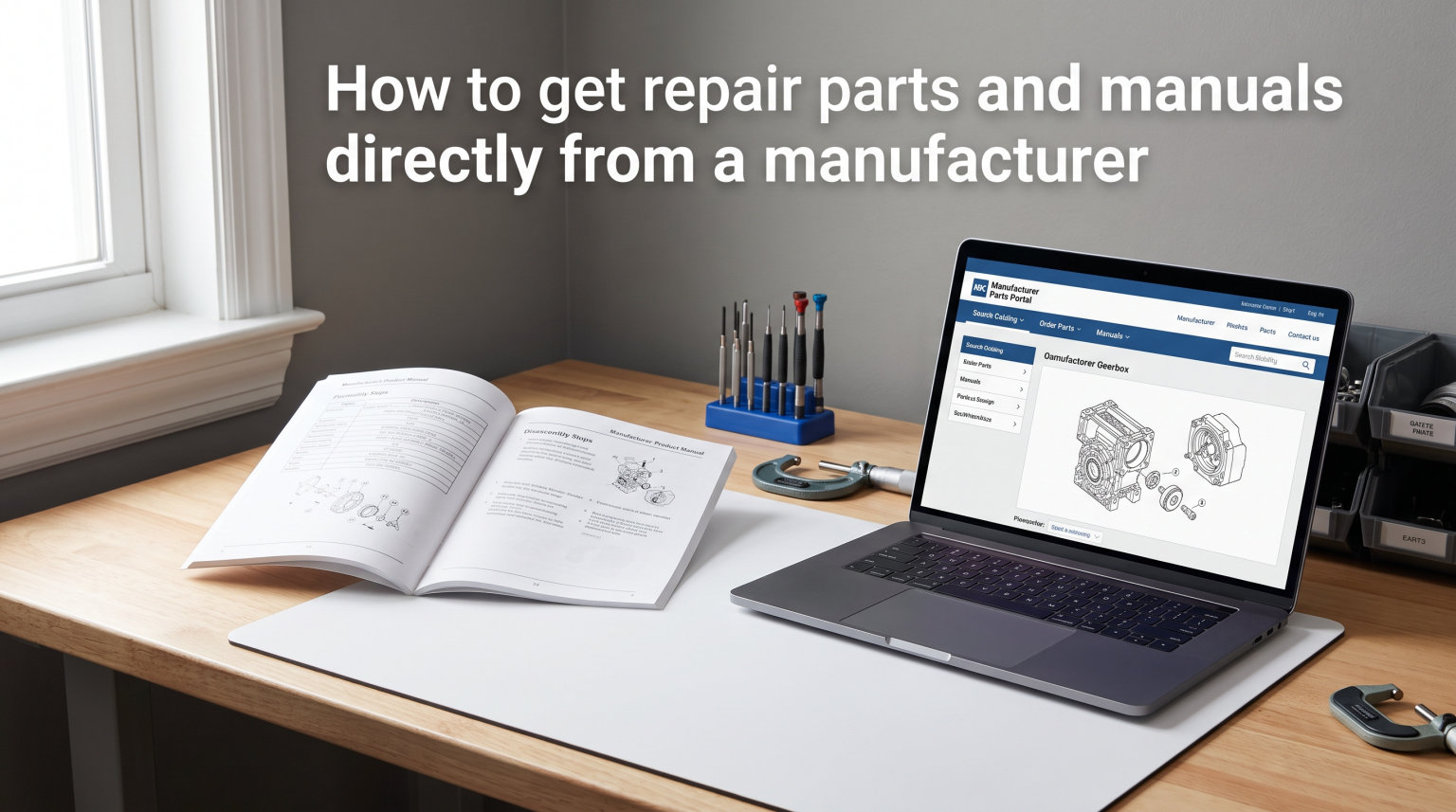
When something breaks, the fastest path to a correct fix usually runs straight back to the company that built it. Learning how to get repair parts and manuals directly from a manufacturer saves you money on markups, guarantees the part fits, and gives you the exact service documentation that factory-trained technicians use. Third-party sellers and generic guides help, but they rarely match the depth and accuracy of original equipment manufacturer (OEM) resources.
This guide walks you through the entire process, from identifying your exact model to contacting the right department, ordering genuine parts, and downloading factory service manuals. I have used this same approach on everything from a kitchen dishwasher to an older pickup truck, and the steps work across appliances, vehicles, power tools, and electronics. By the end, you will have a repeatable method you can use for any product, any brand, any time.
Table of Contents
Why Going Direct to the Manufacturer Matters?
Buying parts and documentation directly from the source removes most of the guesswork from a repair. You get the exact component designed for your model rather than a “compatible” part that may or may not fit. You also avoid the markup that retailers and resellers stack on top of wholesale pricing.
Documentation matters just as much as parts. A genuine service manual includes torque specs, wiring diagrams, diagnostic codes, and step-by-step procedures that aftermarket books like Haynes or Chilton often skip. Forum users frequently report that dealerships charge extreme prices for printed manuals, with some owners seeing quotes of around $1,500 for a single factory book. Going direct, when you know where to look, usually costs a fraction of that.
There is also a longer-term benefit. Manufacturers that hear directly from owners are more likely to keep manuals, parts lists, and troubleshooting guides available online. Every successful direct request reinforces that consumers want repairability built into the products they buy.
Types of Documentation Manufacturers Provide
Before you contact a manufacturer, it helps to know exactly what you can ask for. Most companies offer several categories of documentation, and asking for the right one by name gets you a faster answer.
Service Manuals
Service manuals, sometimes called workshop or factory manuals, are the most detailed resource available. They cover full teardown and reassembly procedures, diagnostic flowcharts, and exact specifications. For vehicles, these are the same books that dealership technicians use, and they typically run several hundred pages per model year.
Some brands sell them as printed books, others deliver them on a USB drive for roughly $150, and a growing number offer downloadable PDF versions. Always ask whether a digital version exists, because it is usually cheaper and arrives instantly.
Parts Catalogs
A parts catalog, also called a parts list or exploded view diagram, shows every component in an assembly along with its part number. These diagrams are essential for ordering the right piece, especially for older equipment where the model has been revised multiple times.
Many manufacturers publish interactive parts finders on their websites. You enter your model number, click the assembly you need, and the system displays every part with current pricing and availability.
Wiring Diagrams
Wiring diagrams map the electrical system, showing connections, fuses, sensors, and grounds. They are critical for diagnosing electrical faults on appliances, HVAC equipment, vehicles, and electronics. Genuine wiring diagrams are often bundled inside the service manual rather than sold separately.
Troubleshooting Guides and Bulletins
Manufacturers release troubleshooting guides, technical service bulletins (TSBs), and recall notices that document known problems and the official fix. Asking the manufacturer for any bulletins that apply to your model can save hours of diagnosis, because the issue may already have a documented solution.
How to Get Repair Parts and Manuals Directly From a Manufacturer
The process below works for almost any product category. Follow it in order, and keep a notebook or document open to record model numbers, part numbers, and the names of people you speak with.
Step 1: Identify Your Exact Model and Serial Number
The model number is the single most important piece of information you need. Manufacturers build dozens of variants under the same name, so “Model X100” is rarely enough. Locate the full model number and the serial number, usually printed on a rating plate, sticker, or stamped into the frame.
On appliances, check the door jamb, back panel, or inside a drawer. On vehicles, use the VIN. On power tools and electronics, look near the battery compartment or on the underside. Write both numbers down exactly as printed, including dashes and prefixes.
Step 2: Confirm Who Built It
The brand on the front is not always the actual manufacturer. Many appliances are built by one company and sold under several labels, and vehicles are sometimes assembled under partnership agreements. A quick search for your model number plus “who makes” or “OEM manufacturer” usually reveals the true source.
Knowing the real manufacturer matters because they hold the service manuals and parts inventory, even when the retail brand does not.
Step 3: Locate the Right Department
Most manufacturers split customer contact into several teams, and contacting the right one speeds up your request. Look for a parts department, service and technical support, or a documentation and literature team. For automotive brands, the parts and service division is often reachable through the dealer network or a dedicated owner portal.
Check the official manufacturer website first. Look for pages labeled “Parts and Service,” “Owner Support,” “Download Manuals,” or “Order Literature.” If those pages do not exist, the general customer service line can route you to the correct team.
Step 4: Submit a Clear Request
When you call or email, lead with the essentials: model number, serial number, year of manufacture if known, and the specific part or document you need. Ask directly for the factory service manual, the parts catalog, or the exact replacement part number. Vague requests get vague responses.
If you are writing an email, keep it short and structured. One paragraph with the model details, one paragraph with your request, and one sentence with your contact information. Manufacturers respond faster to clean, complete messages.
Step 5: Place the Order or Download
Many manufacturers now offer direct online ordering through a parts portal. You enter the model number, select the part from an exploded diagram, and check out. For manuals, look for a “Download” option before requesting a printed copy, since digital versions are cheaper and immediate.
For brands that do not sell direct, ask whether they can refer you to an authorized parts distributor. Authorized distributors carry genuine OEM parts and often ship faster than the manufacturer itself.
Where to Find Manufacturer Contact Information
The official manufacturer website is almost always the best starting point. Most brands maintain a “Contact Us,” “Support,” or “Owner Resources” page with phone numbers, email forms, and live chat. Bookmark the page once you find it, because deep links are easy to lose.
If the website does not list a direct parts line, try the owner’s manual that came with the product. The back cover or last page usually contains a phone number and mailing address for parts and service. For older products, the contact information may have changed, so verify the number online before calling.
For vehicles, the manufacturer’s owner portal is the most reliable source. Brands like Ford, GM, Toyota, and others maintain online accounts where owners can enter their VIN and access manuals, service history, and recall information. Independent forums and the National Highway Traffic Safety Administration database are useful for cross-referencing recalls and bulletins.
For appliances and electronics, third-party parts retailers like the major online parts houses often list the manufacturer’s support number on their product pages. This is a shortcut when the official site is hard to navigate, but always confirm the number against the manufacturer’s own website.
OEM vs Aftermarket Parts: What You Should Know
OEM parts are made by, or to the exact specification of, the original manufacturer. They carry the brand’s part number and are guaranteed to fit and function like the original component. Aftermarket parts are produced by third-party companies and may be identical, similar, or noticeably different in quality.
The main advantage of OEM parts is certainty. You know the part fits, you know it meets factory tolerances, and you usually get a warranty backed by the manufacturer. The trade-off is price, which is often higher than an aftermarket alternative.
Aftermarket parts make sense when the OEM version is discontinued, back-ordered, or priced well above the value of the product. They are also useful for routine maintenance items where tolerances are not critical. For safety-related components, like brakes, electrical, or structural parts, OEM is generally the safer choice.
One important note on warranty: under the Magnuson-Moss Warranty Act in the United States, a manufacturer cannot void your warranty simply because you used an aftermarket part. They can only deny coverage for a specific failure that the aftermarket part caused. Keep your receipts and document the work either way.
Right to Repair and Your Legal Protections
The Right to Repair movement has pushed manufacturers to make parts, manuals, and diagnostic tools available to independent shops and consumers. Several states have passed laws requiring manufacturers to provide documentation and parts at fair terms, and the Federal Trade Commission has issued warnings against warranty terms that block independent repair.
Before assuming a manufacturer will not help you, check whether your product is covered by a Right to Repair law in your state. Some categories, like automotive and appliances, already have strong protections. Others, like smartphones and medical equipment, are still being negotiated.
End User License Agreements (EULAs) sometimes try to restrict repair or require you to use authorized service centers. Read the EULA, but know that certain restrictions are not enforceable, particularly when they conflict with state law or federal warranty rules. If a manufacturer refuses to sell you a manual or part, a written request that cites your Right to Repair protections often changes the answer.
Tips for Getting a Fast, Helpful Response
Be specific in every contact. Provide the model number, serial number, and exact part or document name up front. Customer service teams handle hundreds of requests, and a complete first message prevents back-and-forth delays.
Call during business hours in the manufacturer’s home time zone, and avoid Mondays when possible. Mondays are the busiest day for support lines, and wait times often double. Mid-week calls in the morning tend to reach knowledgeable staff faster.
Ask for a reference or case number at the start of every conversation. If you need to call back, that number connects you to your existing request instead of starting over. It also creates a paper trail if you need to escalate.
Request digital delivery whenever it is an option. Downloadable PDFs arrive the same day, cost less than printed books, and let you search the text. Save a backup copy in cloud storage so you never lose the documentation.
If the first representative cannot help, ask politely to be transferred to a technical specialist or the parts department. Front-line agents handle general questions, while technical teams handle documentation and special orders. A transfer takes a few extra minutes and often solves the problem.
Common Challenges and How to Overcome Them
The most common obstacle is a manufacturer that claims parts or manuals are not available to consumers. This is sometimes accurate, but more often it means the agent does not know the process. Ask for the parts or literature department directly, and put the request in writing so there is a record.
Discontinued products are another frequent problem. When a part is out of production, ask the manufacturer for a substitute part number or a referral to an authorized distributor that may still have stock. Many brands maintain a “last time buy” list of remaining inventory.
High dealer pricing on manuals frustrates many owners, and forum posts confirm quotes in the hundreds or even thousands of dollars for a single book. Before paying dealer prices, check the manufacturer’s online owner portal, which often offers the same manual as a download at a fraction of the cost.
For free options, your local public library is an underrated resource. Many library systems provide free online access to professional repair databases that include OEM procedures, wiring diagrams, and bulletins. All you need is a library card, and you can often log in from home.
EULA and software locks are increasingly used to block independent repair, especially on electronics. If you encounter a lock, document it and check whether your state’s Right to Repair laws apply. Manufacturers are required in many cases to provide the tools and documentation needed to service what they sell.
Finally, persistence pays off. A second call, a different representative, or a written request often produces a completely different result. Treat the first “no” as a starting point, not a final answer.
FAQs
Where can I find repair manuals?
You can find repair manuals through the manufacturer’s official website or owner portal, by contacting their parts or literature department directly, through authorized dealers, or via subscription services like ALLDATAdiy and eautorepair.net. Public libraries also frequently offer free online access to professional OEM repair databases.
How do mechanics get OEM parts?
Mechanics get OEM parts by ordering through the manufacturer’s authorized dealer network, using wholesale parts accounts, or purchasing directly from the manufacturer’s parts portal. Independent shops typically establish accounts with local dealerships or authorized distributors, which gives them access to genuine factory parts at trade pricing.
Is ALLDATAdiy better than a repair manual?
ALLDATAdiy is generally more comprehensive than a single repair manual because it is sourced directly from OEM data and updated regularly. It includes the full factory service procedures, wiring diagrams, technical service bulletins, and recall information for a specific vehicle, whereas a printed book like Haynes condenses and simplifies that information and may omit some procedures.
Who makes car repair manuals?
Car repair manuals are produced by three main sources. The original equipment manufacturer produces the factory service manual. Aftermarket publishers like Haynes and Chilton produce condensed consumer-friendly manuals based on teardowns. Subscription services like ALLDATAdiy and Mitchell 1 compile licensed OEM data into online platforms used by both professionals and DIYers.
Conclusion
Knowing how to get repair parts and manuals directly from a manufacturer puts you in control of every repair you take on. Identify your exact model, contact the right department, ask for the specific document or part by name, and request digital delivery whenever possible. Use your Right to Repair protections and free resources like public libraries when a manufacturer is reluctant to help. Once you have run through this process once, it becomes a routine you can repeat for any product, in 2026 and beyond.