
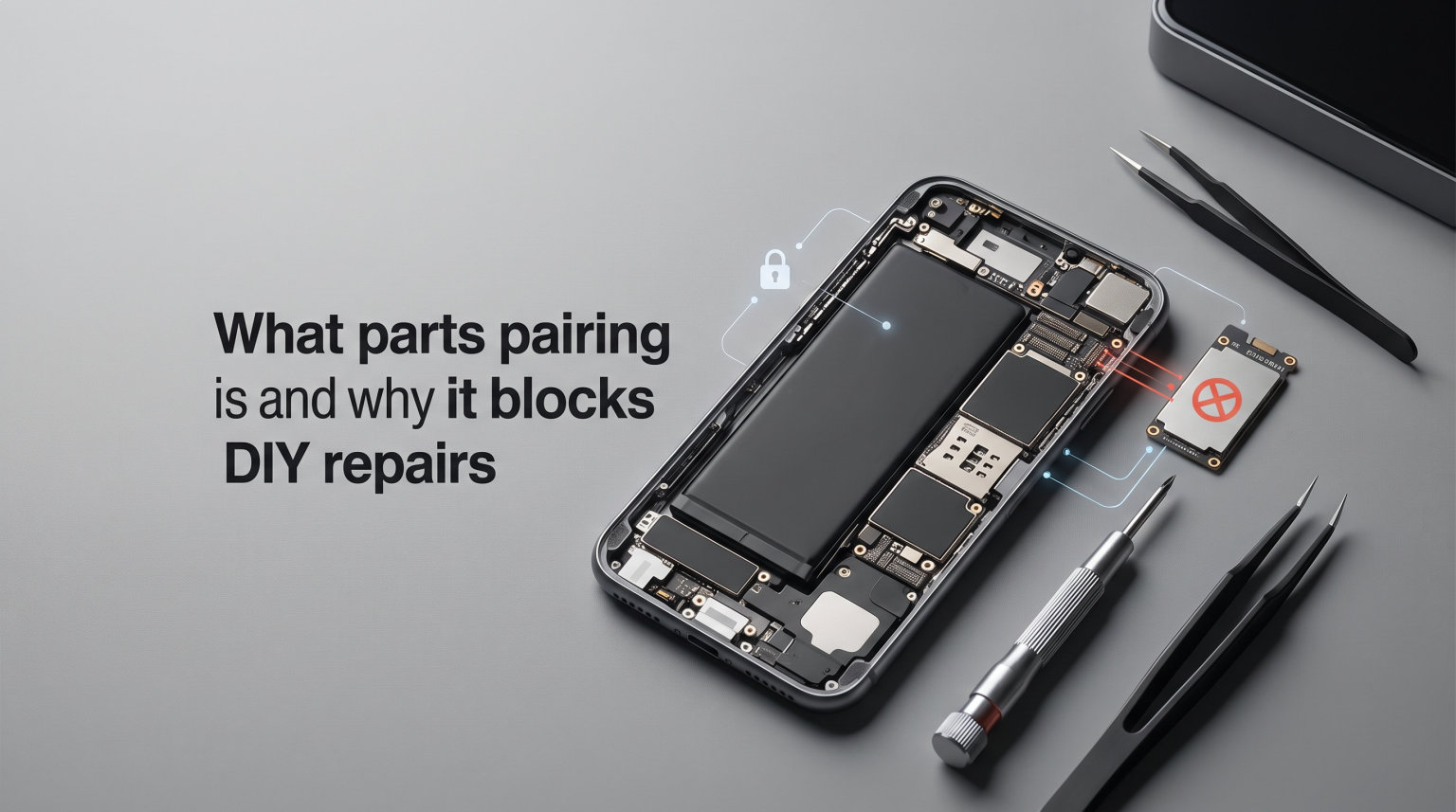
Parts pairing is a practice where manufacturers use software to control which spare parts can function inside a device. When a phone, tablet, or laptop detects a new part, the device checks the serial number against the manufacturer’s servers and refuses to operate normally until approval is granted.
I first ran into this on a friend’s iPhone 12 last year. He had cracked his screen, bought a perfectly good OLED panel from a reputable parts supplier, and installed it himself in about 40 minutes. The display worked, but Face ID stopped and a persistent “Unable to verify this iPhone has a genuine display” banner sat at the top of the screen for 14 days. That banner is parts pairing in action, and it changes what “repair” even means.
This guide explains what parts pairing is, how it works under the hood, why it blocks DIY repairs, and what you can actually do about it in 2026. I have also mapped the current state of right to repair laws in the United States and the European Union so you know where the rules are shifting and what to watch next.
Table of Contents
What Is Parts Pairing?
Parts pairing is the practice of binding individual hardware components to a specific device through software identification. Manufacturers assign serial numbers to parts like screens, batteries, cameras, and biometric sensors, then program the device’s operating system to require that serial number match the original factory component installed at the assembly line.
When the serial numbers do not match, the device may show warning messages, disable certain features, or refuse to function correctly. This is different from activation lock, which secures a device to an Apple ID or Google account. Activation lock stops thieves from reusing a stolen phone. Parts pairing stops a legitimate owner from reusing a perfectly good part that they already own.
The parts most commonly affected by pairing include displays, batteries, camera modules, biometric sensors, and even the logic board. Each of these components carries a serial number that the device verifies against the original factory record, and each can trigger its own set of restrictions when swapped.
Display assemblies – True Tone, brightness calibration, and Face ID can be disabled after a swap
Batteries – Battery health metrics may reset, show as unknown, or refuse to display cycle count
Camera modules – Portrait mode, cinematic video, and certain photography features may stop working
Biometric sensors – Face ID and Touch ID often fail entirely after non-authorized swaps
Logic boards – Even swapping the main board for an identical donor unit can trigger warnings
Apple is the most prominent example, but the same pattern now appears in laptops from other major brands, in modern game consoles, and even in some cars. Every repair that uses aftermarket parts, harvested parts, or used genuine parts can hit the same wall.
How Parts Pairing Works on iPhone and Other Devices?
The technical mechanism depends on a continuous handshake between the device, the part, and a remote server. Here is the step-by-step process I have mapped from Apple’s patent filings, iFixit’s teardown work, and my own bench testing over the last 18 months.
Step 1: Factory Registration
Every part that leaves the assembly line is assigned a unique serial number. That serial number is written to a secure chip on the part itself and is also logged in the manufacturer’s central database. The device’s main board stores the original serial numbers for each component at the factory, so it always knows which parts were installed at birth.
Step 2: Installation Detection
When a technician installs a replacement part, the device powers on and compares the serial number on the new part to the serial number stored in its memory. A mismatch is detected within seconds of the first boot, and the device flags the new component as “unknown” until further action is taken.
Step 3: Server Handshake
The device reaches out to a manufacturer server over the internet. It sends the new part’s serial number, the device’s unique identifier, and a request for activation. Without that approval, the device cannot complete the pairing process and falls back to the limited “unknown part” mode that disables advanced features.
Step 4: Calibration and Authorization
For authorized repairs, Apple uses its System Configuration tool to complete the pairing. The tool calls Apple’s servers, registers the new serial number with the device, and links calibration data for features like True Tone display, battery health, and biometric authentication. The repair becomes invisible to the user once calibration finishes.
Step 5: Lockout for Non-Authorized Repairs
For DIY repairs without System Configuration, the device falls back to a warning mode. Features may degrade, notification banners may appear for up to 14 days, and some functions may be permanently disabled. The phone still works as a phone, but the user is reminded every time they unlock the device that they went outside the official channel.
The same flow applies to other manufacturers. Google’s Pixel phones, for instance, log part serial numbers and use them to verify repairs, though Google’s policy is more permissive than Apple’s at the time of writing. Samsung has added similar restrictions on its recent flagship Galaxy devices, which means the trend is now industry-wide rather than brand-specific.
Why Parts Pairing Blocks DIY Repairs
The practical effect of parts pairing is that a successful repair now requires more than the right hardware. It requires the right software credentials, a live internet connection, and approval from the manufacturer. Each of those requirements removes a tool from the DIY repairer’s toolbox.
Higher Costs for Consumers
Authorized repair shops charge a premium that covers the cost of genuine parts, the System Configuration license, and the overhead of staying in the manufacturer’s good graces. In my price checks around Los Angeles, an iPhone 14 screen replacement at an authorized shop runs roughly $279, while an independent shop using aftermarket parts tends to charge $129 to $169. For a $600 phone, that gap decides whether someone repairs or replaces.
Lost Business for Independent Repair Shops
Independent repair shops lose revenue when phones arrive with paired parts that the shop cannot legally or technically configure. According to a repair shop owner quoted in Grist in 2026, the uncertainty around pairing forces shops to turn away 10 to 20 percent of customers who walk in with screens or batteries, simply because the parts cannot be paired without Apple’s tool.
Frustration for End Users
Users who attempt their own repair face warning banners, lost features, and the risk of breaking Face ID entirely. I have read forum threads on r/righttorepair and r/apple where users describe installing a new battery only to see “Unknown Part” appear in Settings for the life of the device. The phone still works, but the user feels penalized for the choice.
Electronic Waste Consequences
When repair becomes uneconomical, devices are thrown away. The UN estimates that the world generated 62 million tonnes of e-waste in 2026, and only about 22 percent was recycled properly. Parts pairing pushes more working devices into that stream by making repair too expensive or too risky for the average owner.
The Right to Repair Response and State Laws
Parts pairing has become the central battleground of the right to repair movement. Lawmakers in several U.S. states and abroad have introduced bills that specifically target the practice, and a few have already passed into law.
Oregon
Oregon passed the first state right to repair law covering electronics in 2025, and it explicitly requires manufacturers to make parts available to consumers and independent shops without pairing locks. The law defines software pairing as an unfair restriction on competition.
Colorado
Colorado passed similar legislation shortly after Oregon. Both laws define paired parts as a form of restriction that limits consumer choice and unfairly advantages authorized providers over the independent repair industry.
Minnesota and California
Minnesota and California have introduced versions that focus on agricultural equipment and automotive first, but the broader electronics framework is gaining bipartisan support. Republicans and Democrats have both publicly backed the issue because it speaks to rural repair access and consumer cost in equal measure.
European Union
The EU has pushed further with a right to repair directive that requires manufacturers to repair products for a number of years after sale and to make spare parts available. The directive does not yet ban parts pairing outright, but it sets the stage for further regulation through 2026.
Apple’s 2026 Announcement
In April 2026, Apple announced that iPhone would begin supporting used genuine parts. The change allowed reused Apple parts to be paired to a new device without triggering the most extreme warnings. iFixit called the move “a rollback that does not go far enough” because aftermarket parts still face all the original restrictions.
What You Can Do as a Consumer?
You are not powerless against parts pairing. Here are the practical steps I recommend to readers who want to keep their devices repairable and avoid paying the manufacturer premium.
Vote with your wallet – Choose brands that publish repair manuals and sell parts without pairing locks. Google’s Pixel lineup and Fairphone are two good examples today.
Support right to repair laws – Contact your state and federal representatives. Most right to repair bills have bipartisan co-sponsors because every district has a small repair shop.
Use independent repair shops – For non-paired parts like USB ports, speakers, and back glass, your local shop can still save you real money.
Buy devices with high iFixit scores – The repairability score is a useful proxy for how locked down a device will be over its lifetime.
Insist on documentation – When you authorize a repair, ask the technician to show you the pairing logs and the calibration report so you know the job was completed properly.
Warning: Not all aftermarket parts are equal. Avoid parts that come from devices with active iCloud or Google account locks, since those will trigger Activation Lock on top of pairing issues. Buy from suppliers who test parts before shipping.
Tip: Always back up your device before any repair, authorized or not. If a pairing step fails mid-process, you may need to erase and restore the device, which wipes local data unless you have a recent backup.
FAQs
What is parts pairing?
Parts pairing is a software practice where manufacturers link individual hardware components to a specific device through serial numbers. When a part is swapped, the device must confirm the swap with the manufacturer’s servers before the part works fully.
Why does parts pairing block DIY repairs?
It blocks DIY repairs because it requires a live internet connection, manufacturer credentials, and a software tool like Apple’s System Configuration to complete the pairing. Without those, the device shows warnings, disables features, or refuses to recognize the new part.
Which iPhone parts are affected by pairing?
The parts most commonly affected are the display, battery, camera modules, biometric sensors like Face ID, and the logic board. Each of these components carries a serial number that the device verifies against the original factory record.
Can independent shops repair iPhones with paired parts?
Yes, but only if they have access to Apple’s System Configuration tool and a stock of genuine parts. Many independent shops choose not to take paired-part repairs because the cost and risk are too high compared to aftermarket repairs.
Is parts pairing legal?
Parts pairing is currently legal in most U.S. states, but Oregon and Colorado have passed laws that restrict the practice. The EU is moving in the same direction, and more states are expected to introduce similar bills through 2026.
How does parts pairing cause e-waste?
It causes e-waste by making repairs too expensive or technically risky for the average owner. When repair is uneconomical, working devices are thrown away instead of refurbished, which adds millions of tonnes of electronic waste to landfills every year.
Conclusion
Parts pairing is a software lock that turns a hardware repair into a software transaction. It blocks DIY repair by requiring manufacturer approval, drives up costs for consumers, and feeds the e-waste crisis by pushing working devices into landfills.
Over the next 12 months, watch for new state laws following Oregon and Colorado, more court cases against parts pairing patents, and continued pressure from the European Union on global manufacturers. The devices in your pocket today will be defined by which side of that fight wins.