
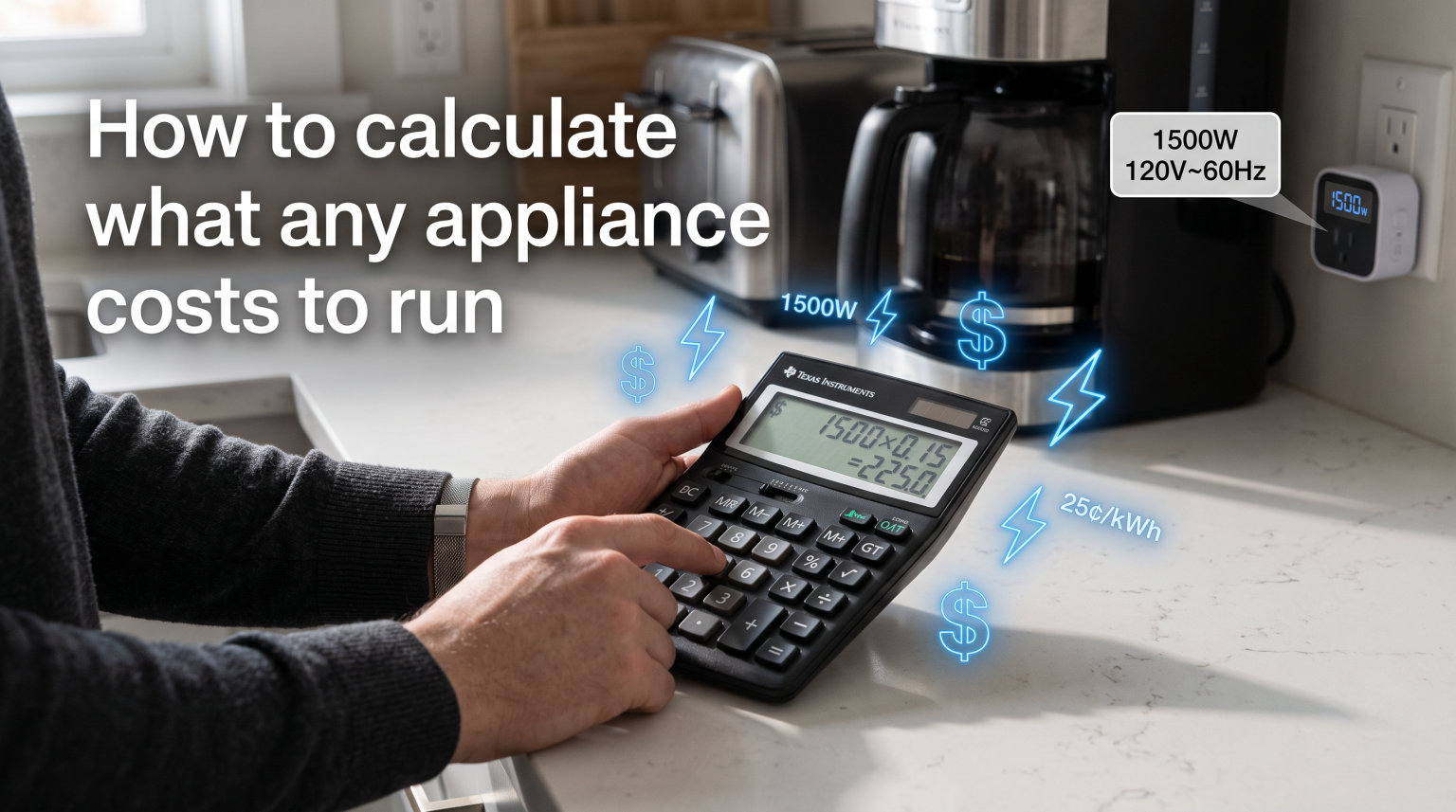
I remember staring at my electricity bill and feeling completely lost. The number on the page made no sense because I had no idea what each appliance was contributing to it. That moment pushed me to learn exactly how to calculate what any appliance costs to run, and once I understood the formula, my whole approach to energy use changed.
If you want a clear, no-jargon way to figure out how much electricity every device in your home burns, this guide is for you. I will walk you through the exact formula I use, show you where to find the numbers you need, and give you real examples using common household appliances. By the end, you will be able to estimate any appliance’s running cost in your head, on a napkin, or with a basic calculator.
Table of Contents
What Is a Kilowatt Hour (kWh) and Why It Matters?
A kilowatt hour, written as kWh, is simply the unit your electricity supplier uses to bill you. One kilowatt hour equals using 1,000 watts of power for one full hour. If you run a 1,000-watt space heater for an hour, you have used exactly 1 kWh of electricity.
Think of it like this. A watt is the rate at which an appliance uses power at any moment. A kilowatt hour is the total amount of energy used over time. Your bill is charged in kilowatt hours, not watts, which is why understanding this conversion is the first step toward figuring out what anything in your home costs to run.
Here is the quick mental model I keep in my head:
1,000 watts running for 1 hour = 1 kWh
100 watts running for 10 hours = 1 kWh
50 watts running for 20 hours = 1 kWh
Once you can picture this, the actual calculation becomes almost trivial.
The Basic Formula to Calculate Appliance Running Costs
Here is the exact formula I use to calculate what any appliance costs to run. I have written it out in plain text so it is easy to copy:
Cost = (Wattage ÷ 1,000) × Hours Used × Electricity Rate per kWh
Each piece of that formula matters. The wattage tells you how much power the appliance pulls at any moment. Dividing by 1,000 converts watts into kilowatts, which matches the kWh unit on your bill. Multiplying by hours used gives you the total energy consumed. Multiplying by your electricity rate turns that energy into a dollar amount.
For example, if you have a 500W appliance that runs for 4 hours and your rate is $0.15 per kWh, the calculation looks like this:
(500 ÷ 1,000) × 4 × $0.15 = 0.5 × 4 × $0.15 = 2 × $0.15 = $0.30
That appliance costs you 30 cents for those 4 hours. It is honestly that simple once you break the formula into pieces.
How to Calculate What Any Appliance Costs to Run: Step-by-Step
Let me walk you through the exact steps I follow whenever I want to estimate a new appliance. I have used this process on everything from my coffee maker to my workshop table saw, and the numbers always come out close to what I actually pay.
Step 1: Find the appliance wattage. Look for a label, sticker, or plate on the back, bottom, or side of the appliance. Most devices list wattage directly. If you only see amps and volts, multiply them together to get watts.
Step 2: Estimate how many hours you actually use it. Be honest here. A dishwasher might only run for one hour per cycle, but you might run it every day. Multiply hours per day by 30 for monthly costs, or by 365 for yearly costs.
Step 3: Find your electricity rate. Check your latest bill or your supplier’s website. The rate is usually listed in cents per kWh or dollars per kWh. Look for terms like “unit rate” or “energy charge.”
Step 4: Plug everything into the formula. Use the formula above. Multiply wattage by hours used, divide by 1,000, then multiply by your rate.
Step 5: Convert to daily, monthly, or yearly totals. Multiply the single-use cost by how often you actually use the appliance. This is where the real money shows up.
Where to Find the Wattage of Your Appliance
Finding the wattage is usually the trickiest part for beginners. I have spent too many minutes hunting for the right label on older appliances. Here are the spots I always check first.
Look for a sticker on the back, bottom, or inside the door. Most appliances manufactured after the year 2000 list wattage somewhere visible. You might see it labeled as “W,” “Watts,” or “Power.”
Check the manual or original box. If you still have it, the spec sheet will list wattage. If not, search the brand and model number online. Manufacturers almost always post a spec sheet on their product page.
Use a plug-in wattage meter if you want real precision. These inexpensive devices sit between the wall outlet and your appliance and display the actual wattage being drawn. They are perfect for appliances that cycle on and off, like refrigerators.
If you only see amps (A) and volts (V), multiply them. Watts = Amps × Volts. A 5A appliance on a 120V circuit pulls 600W. A 10A appliance on a 240V circuit pulls 2,400W.
Practical Examples: Calculating Real Appliance Costs
Let me show you what these calculations look like with real appliances I have measured or looked up. I am using a rate of $0.15 per kWh, which is close to the average U.S. residential rate.
Example 1: A 500W appliance for 4 hours. (500 ÷ 1,000) × 4 × $0.15 = $0.30. If you use it every day for a month, that becomes $9. Per year, it adds up to $109.50.
Example 2: A refrigerator using 150W average, running 24 hours a day. (150 ÷ 1,000) × 24 × $0.15 × 365 = $197.10 per year. Refrigerators are sneaky because they cycle on and off, but their constant draw makes them one of the biggest energy users in most homes.
Example 3: A 1,500W space heater for 8 hours a day in winter. (1,500 ÷ 1,000) × 8 × $0.15 × 30 = $54 per month. That is why heating is expensive.
Example 4: A 1,200W microwave for 15 minutes per day. (1,200 ÷ 1,000) × 0.25 × $0.15 × 30 = $1.35 per month. Small, frequent use adds up less than people think.
Here is a quick reference of common appliance wattages I have compiled from manufacturer specs and my own measurements. Use these as a starting point if you cannot find the exact number for your device.
LED light bulb: 9 to 12W
Laptop: 30 to 65W
Desktop computer: 100 to 300W
Refrigerator: 100 to 400W average
Washing machine: 400 to 1,300W
Electric oven: 2,000 to 5,000W
Dishwasher: 1,200 to 1,800W
Air conditioner (window): 500 to 1,500W
Hair dryer: 1,000 to 1,875W
Electric vehicle charger: 1,400 to 11,500W
Factors That Affect Your Electricity Rate
The wattage of your appliance is only one side of the equation. Your electricity rate plays an equally large role, and that rate is not always as simple as a single number. I have been surprised more than once to find that the rate I assumed was different from what was actually on my bill.
Unit rate versus standing charge. Most electricity bills have two main parts. The unit rate is the per-kWh price you pay for the energy you actually use. The standing charge is a fixed daily fee that covers supply, transmission, and maintenance. Some suppliers charge very low unit rates but high standing charges, or the reverse. Make sure you use the unit rate when running the formula.
Time-of-use tariffs. Some suppliers charge different rates at different times of day. Power used during peak hours (usually late afternoon and early evening) costs more than power used overnight. If you have this kind of plan, your real cost per appliance depends on when you run it.
Regional variation. Rates vary by state, country, and supplier. In the United States, the average residential rate in 2026 sits around 15 to 17 cents per kWh, but I have seen rates from under 10 cents to over 30 cents depending on the region. Always use your own rate, not a national average.
Why my calculation does not match my bill. This is a common frustration I have seen in forums and experienced myself. The biggest reasons for discrepancies are standby power, seasonal usage changes, and the fact that many appliances do not pull their full rated wattage continuously. Add about 5 to 10 percent to your calculated total to get closer to your real bill.
Standby Power: The Hidden Cost of Vampire Energy
One thing that surprised me when I first started measuring my appliances was standby power, sometimes called vampire power. Many electronics keep drawing a small amount of electricity even when you think they are off. TVs, game consoles, computers, microwaves, and coffee makers all sip power when idle.
The draw per device is small, usually between 1W and 10W. But when you add up a dozen devices around your home, the total can reach 50 to 100W running 24 hours a day. At $0.15 per kWh, that is between $65 and $130 per year of pure waste.
The fix is straightforward. Use power strips with switches for entertainment centers and computer setups. Unplug chargers when they are not in use. Look for appliances with low standby draw when you replace old ones. I cut my own standby load by about 70 percent just by adding three power strips and unplugging my office gear at night.
Tips to Reduce Appliance Running Costs
Once you know how to calculate what any appliance costs to run, you can start finding real savings. Here are the strategies that have worked best for me over the years.
Run high-wattage appliances during off-peak hours if your tariff supports it. Dishwashers, washing machines, and dryers can often wait until evening or early morning when rates are lower.
Replace old appliances with efficient models when they fail. A new Energy Star refrigerator uses about 40 to 50 percent less electricity than a 15-year-old one. The savings often pay back the purchase price within five to seven years.
Use the right size appliance for the job. A 1,500W space heater in a small bedroom wastes energy. A smaller 750W unit will keep you comfortable at half the cost.
Maintain your appliances regularly. A refrigerator with dusty coils or a dryer with a clogged vent works harder and uses more electricity. Cleaning coils and vents once a year can cut consumption by 10 to 25 percent.
Track your usage with a home energy monitor. Devices like Sense, Emporia, or simple plug-in meters show you exactly which appliances are costing you the most. Once you see the numbers, you cannot unsee them.
Frequently Asked Questions
How do I calculate how much an appliance costs to run?
Multiply the appliance wattage by the hours you use it, divide by 1,000 to convert to kilowatt hours, then multiply by your electricity rate per kWh. The formula is: (Watts ÷ 1000) × Hours × Rate = Cost.
What household appliance costs the most to run?
Electric space heaters, central air conditioners, water heaters, and electric ovens typically cost the most because of their high wattage and long run times. Heating and cooling systems usually account for the largest share of a home electricity bill.
How much does it cost to run a 500W appliance?
A 500W appliance running for one hour uses 0.5 kWh. At $0.15 per kWh, that is $0.075 per hour, or about 7.5 cents. For 4 hours of use, the cost is $0.30. For 8 hours, the cost is $0.60.
How do I calculate running cost?
Use this step-by-step process: 1) Find the wattage on the appliance label. 2) Estimate hours of use. 3) Find your electricity rate per kWh on your bill. 4) Apply the formula (Wattage ÷ 1000) × Hours × Rate. 5) Multiply by days or weeks for monthly and yearly totals.
Final Thoughts on Calculating Appliance Costs
Learning how to calculate what any appliance costs to run is one of the most useful small skills a homeowner or renter can pick up. Once you understand the formula and know where to find your numbers, you can estimate the cost of any device in your home in under a minute.
Start with the appliances you use most, especially the ones that stay on for hours at a time. Measure or look up their wattage, plug it into the formula, and see what surprises you. Most people I have worked through this with discover at least one appliance that costs far more than they expected. Knowing that gives you the power to make real changes.
If you want to take this further, invest in a simple plug-in wattage meter or a whole-home energy monitor. Seeing the actual numbers as they happen turns this from a guessing game into a real strategy for cutting your electricity bill in 2026 and beyond.