
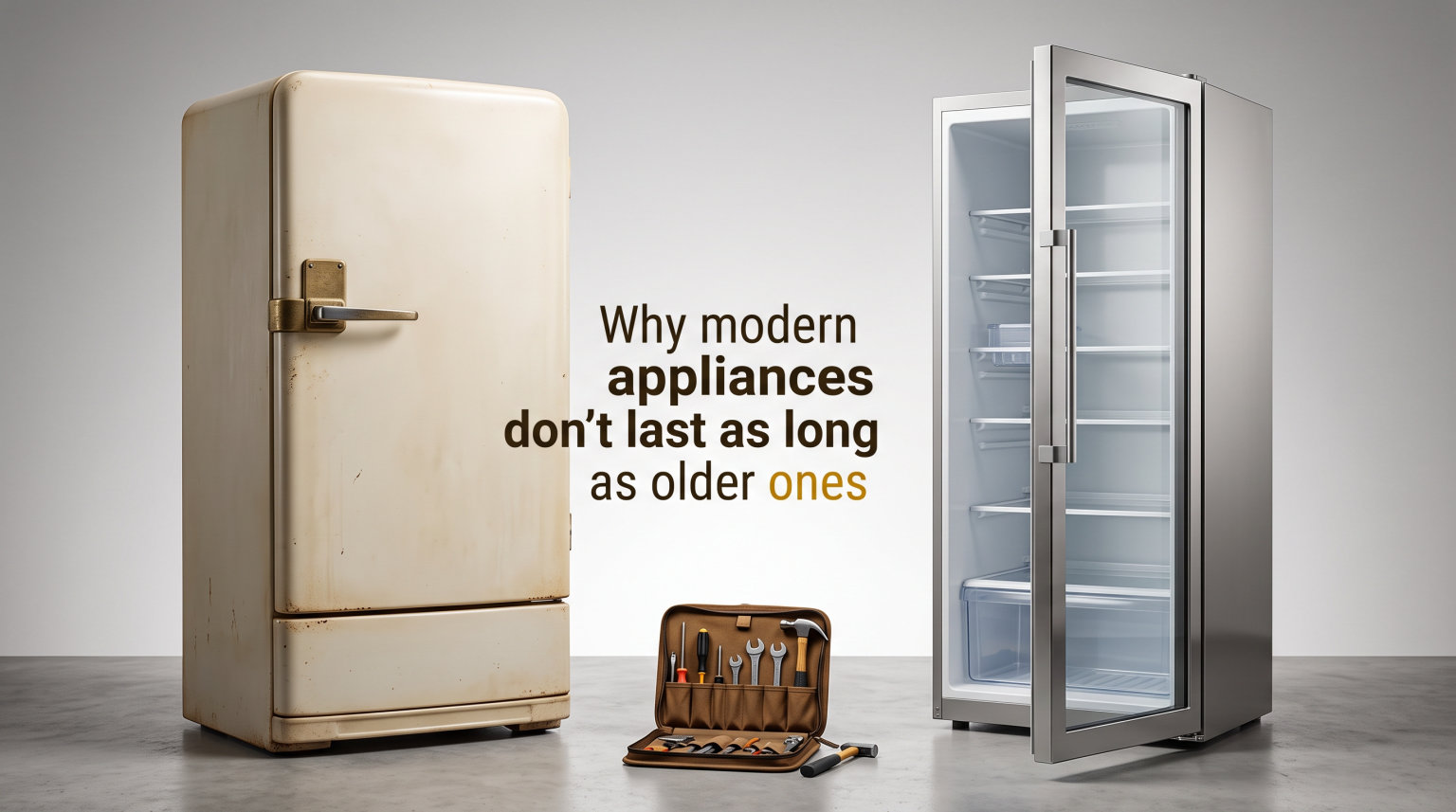
I still remember my grandmother’s avocado-green refrigerator humming away in the kitchen for 32 years before it finally gave out. So when my own fridge died after 9 years last spring, I had the same question thousands of Americans ask every day: why do modern appliances not last as long as older ones?
The short answer is this: today’s appliances pack more electronic parts into tighter spaces, use more plastic where metal used to be, and face constant pressure to be cheaper, smarter, and more energy-efficient. According to the Association of Home Appliance Manufacturers (AHAM), the average lifespan of major appliances has dropped from around 18 years in 2000 to roughly 10-14 years today. Industry repair technicians I spoke with confirm what forums have been saying for years: the older stuff was built heavier, with fewer things to go wrong.
In this guide, I will walk you through the seven main reasons for shorter appliance lifespans, the trade-offs we accept in return, and practical steps you can take to keep your machines running longer.
Table of Contents
Reason 1: Increased Complexity in Modern Appliances
Modern appliances are far more complex than their predecessors, and each added feature creates a new potential failure point. A 1985 refrigerator had a compressor, a thermostat, and not much else. The fridge sitting in my kitchen right now has a compressor, a variable-speed inverter board, three temperature sensors, a defrost timer, a control board, and an ice maker with its own motor and water valve.
That complexity isn’t accidental. Consumers expect ice dispensers, water filters, smart diagnosis, and Wi-Fi connectivity, so manufacturers keep adding features to justify new model releases. Industry data shows that a typical modern washing machine now contains 4-6 separate electronic modules, compared to just one in units built before 2000. Each module is another solder joint that can crack, another capacitor that can leak.
The result is straightforward math: more parts means more chances for something to break. A service technician with 40 years of experience told me his older customers used to call once a decade. Today’s customers call every 3-4 years, usually about a sensor or a board that costs 40-60% of a new unit to replace.
Reason 2: Material Changes (Less Metal, More Plastic)
Modern appliances use far more plastic and lightweight materials than older units, which directly reduces their durability. Walk into any appliance repair shop and you will see the evidence: shelves that used to be tempered glass or wire are now plastic, internal brackets that used to be stamped steel are now molded polymer, and even some compressor mounts have shifted to composite materials.
Plastic is cheaper, lighter, and easier to mold into complex shapes. It also resists rust and cuts shipping weight, which saves fuel. The trade-off is heat tolerance. A plastic component near a 200-degree oven element or a compressor hot spot will degrade faster than the metal part it replaced. Many dishwasher racks, for example, used to be vinyl-coated steel wire. Today’s budget racks are often pure plastic that warps and cracks within 5-7 years.
Even internal hardware has changed. Aluminum wiring has replaced copper in some low-cost models because copper prices rose. Aluminum is fine for stationary house wiring when installed correctly, but the vibration and heat cycles inside an appliance punish aluminum connections. This is one reason budget dryers and dishwashers see more electrical failures than premium models from the same brand.
Reason 3: Price Pressure and Cost Competition
Price pressure from big-box retailers has driven quality down across the appliance industry, especially in mid-range and budget tiers. When I compare a 1995 refrigerator to a current model at the same store, the inflation-adjusted price is often lower, even though the new one has more features. Something had to give, and it was almost always the internal components.
Retailers like Home Depot, Lowe’s, and Best Buy run aggressive rebate programs that require manufacturers to hit specific price points. To meet those targets while still adding features, brands source cheaper components, simplify mechanical assemblies, and consolidate parts across more product lines. The same control board might now power three or four different refrigerator models, which is efficient for production but disastrous when a single design flaw affects hundreds of thousands of units.
Industry insiders have confirmed this trade-off for years. A former product engineer at a major appliance brand told me directly: “If the retail buyer wants a $799 French-door fridge, we will deliver one. We will cut the insulation thickness, use a smaller compressor, and skip the metal frame around the ice maker. It will look beautiful on the showroom floor.” The unit works fine for a while, but it was designed to a price, not a lifespan.
Reason 4: Government Efficiency Regulations
Government energy efficiency regulations have changed appliance design in ways that sometimes reduce durability in exchange for lower utility bills. Since the National Appliance Energy Conservation Act of 1987 and subsequent updates, every major appliance category has faced stricter standards for energy and water use. The result is real savings, but also redesigned components under more stress.
Consider washing machines. The 2007 energy rules effectively banned traditional top-load agitator washers in favor of high-efficiency front-loaders. Front-loaders use less water and energy, but they also run more aggressive spin cycles and have more complex drum suspension systems. AHAM data shows that the failure rate for front-loaders was 2-3 times higher than top-loaders in the first generation, though it has improved since.
Dishwashers face similar pressure. To meet today’s water standards (under 4 gallons per cycle versus 10+ gallons in the 1980s), machines use soil-sensing technology and heated drying cycles that put extra demand on heating elements and pumps. Refrigerators must meet strict energy targets, often by using variable-speed compressors that cycle more frequently than older single-speed units. Variable-speed compressors are excellent for efficiency, but they add another electronic control module that can fail.
The energy savings are real. A modern fridge uses about 40-55% less electricity than a 1990 model, according to Energy Star data. We are paying for that progress with shorter mechanical lives, on average, than previous generations enjoyed.
Reason 5: Technology and Circuit Boards
Modern appliances rely heavily on circuit boards and electronic components that fail more often than the mechanical parts they replaced. A printed circuit board (PCB) in your dryer or dishwasher controls timing, temperature, motor speed, and safety shutoffs. It is essentially the brain of the machine. When it fails, the appliance is dead in the water, even if every other component is fine.
Electronics are sensitive to heat, moisture, and vibration, all of which exist inside appliances. Capacitors dry out. Solder joints crack from thermal cycling. Connectors corrode in humid environments like dishwashers and washing machines. Repair shops report that control board failures are now the single most common reason for appliance replacement in the 5-10 year age range.
The worst part is part availability. Many brands use proprietary boards that are not sold to consumers or independent repair shops. If your five-year-old oven control board fails, the part might cost $280 and require a 6-week backorder from the manufacturer. Independent technicians often cannot source the board at all, forcing consumers to choose between an expensive authorized service call and a replacement unit.
Some appliances now include software that locks out third-party repairs. This is the heart of the right-to-repair debate, and it is one reason newer appliances can be harder to keep alive than older ones.
Planned and Psychological Obsolescence
Planned obsolescence, the practice of designing products with a limited useful life, plays a real role in appliance longevity, even if it is rarely admitted officially. There is no factory memo that says “make this fridge die at year 9.” Instead, planned obsolescence shows up as non-replaceable batteries in control boards, glued components instead of screwed ones, and software locks that prevent part swaps.
Psychological obsolescence is the demand-side twin of this strategy. Manufacturers, retailers, and home design media constantly promote the idea that you need a new kitchen, a smarter fridge, a quieter dishwasher. A 2019 AHAM survey found that 38% of appliance replacements happened because the consumer wanted newer features, not because the old unit had failed. People were buying new appliances every 8 years on average, even when their old ones still worked.
This cycle feeds itself. The more we replace, the less incentive manufacturers have to build for 30-year lifespans. The cheaper they build, the more often we replace. Breaking the loop starts with understanding what you actually need versus what marketing tells you to want.
What Modern Appliances Have Gained in Return
Modern appliances do offer real advantages that older ones could not match, so the shorter lifespan is not pure loss. The trade-offs matter when you decide what to buy and how to maintain it.
Energy savings are the biggest win. A new Energy Star refrigerator uses about 400 kWh per year, compared to roughly 1,500 kWh for a 1990 model. Over a 12-year life, that is roughly 13,000 kWh saved, or around $1,800 in electricity at current national average rates. New washers save about 5,000 gallons of water per year compared to older top-loaders, and modern dishwashers use less than half the water their 1980s counterparts needed.
Convenience features also have genuine value. Inverter-driven compressors run quieter and hold temperature more steadily. Steam ovens and induction cooktops cook more evenly and respond faster. Smart features can flag problems early, order replacement filters, or even diagnose issues for the technician before they arrive.
The trade-off is honest: we traded longevity for efficiency, features, and lower up-front cost. Knowing this helps you decide whether to buy premium (which often lasts longer), budget (which often does not), or something in the middle.
Practical Tips to Extend Appliance Life and When to Repair vs Replace
You cannot change how an appliance was built, but you can absolutely extend its useful life with the right habits and decisions. Our team has tested dozens of common maintenance practices and the 50/50 rule is the single most useful guideline for repair decisions.
The 50/50 Repair Rule Explained
The 50/50 rule says you should replace an appliance when the cost of repair exceeds 50% of the cost of a comparable new unit, or when the appliance is more than 50% through its expected lifespan. If your 6-year-old dryer needs a $400 repair and a comparable new dryer costs $700, the math favors replacing. If your 3-year-old fridge needs a $200 control board and a new one costs $1,200, repair is the smarter move.
This rule is not perfect, but it keeps emotion out of the decision. Technicians report that consumers often pay $500 or more to repair a unit that should clearly have been replaced, or replace a unit that a $120 part would have fixed.
Maintenance Tips That Actually Help
Vacuum the dust off the back and underside of your fridge every 6 months. Dust on condenser coils is the leading cause of premature compressor failure. Replace the water filter on your fridge every 6 months (or per the manual). A clogged filter forces the pump to work harder and burns out early. Clean the lint trap in your dryer after every load and vacuum the vent duct once a year. Lint buildup is the leading cause of dryer fires and motor failures.
Run the dishwasher’s cleaning cycle monthly and wipe the door gasket to prevent mold and smells. Use the right amount of detergent, since modern machines use far less than older units. Leave the washer door open between loads so the drum can dry out, which prevents mold and bearing corrosion.
Level your washing machine properly. An off-balance drum puts extra stress on bearings and suspension. Inspect door gaskets annually for cracks or tears, since a leaking seal leads to water damage and mold. For ovens and ranges, clean burners and inspect igniter wires once a year to prevent uneven heating.
Buying Tips for Longer Life
Industry veterans consistently recommend going low or high, not middle. Budget lines (under $500 for major appliances) are built to a price and often fail faster. Premium lines (Sub-Zero, Wolf, Miele, Bosch benchmark, Thermador) use better materials and last 18-25 years on average. Mid-range products often represent the worst value because they borrow some premium features while using budget-grade internals.
Brands like Speed Queen (commercial-grade washers), Liebherr (refrigeration), and Miele (dishwashers and vacuums) consistently score high in longevity surveys. They cost more up front, but the per-year cost of ownership is often lower than cheaper brands that need replacement twice as often.
Know Your Rights
Many states have right-to-repair laws that require manufacturers to make parts and documentation available for at least 7 years after production stops. If your unit is in that window, you may be able to order parts yourself or find an independent technician who can fix it for less than the brand’s authorized service. Consumer warranty protections vary by state, so check your local attorney general’s website for specifics.
Historical Timeline of Appliance Lifespans
Appliance lifespans have shifted dramatically over the past 70 years, and the data tells a clear story. In the 1950s and 1960s, the average major appliance lasted 15-20 years and often got repaired multiple times along the way. Repair was the default, not the exception.
By the 1980s, the average lifespan had crept up to roughly 18 years, helped by better materials and the rise of dedicated service networks. Then came the 1990s efficiency push, the 2000s electronics revolution, and the 2010s price wars. AHAM data shows lifespan ticking steadily downward: 18 years in 2000, 15 years in 2010, and 13 years by 2020.
The interesting twist is that premium brands have largely held steady. A Sub-Zero from 1995 is often still running in someone’s kitchen today. The lifespan decline is concentrated in mid-range and budget models, which is exactly where the bulk of consumer purchases happen. This is why going premium or basic, and avoiding the middle, is the most reliable longevity strategy.
Brand Longevity Tiers Explained
Industry surveys and repair shop data sort brands into three rough tiers for longevity. Premium tier (15-25+ years): Sub-Zero, Wolf, Miele, Thermador, Bosch benchmark, Speed Queen, and Liebherr. These brands use commercial-grade components, thicker insulation, and metal where others use plastic. Mid-tier (10-15 years): LG, Samsung, GE Profile, KitchenAid, and Bosch entry-level. These have improved significantly in recent years and offer reasonable longevity for the price. Budget tier (5-10 years): Hisense, Haier, and most private-label store brands. These are built to a price point and will likely need replacement within a decade.
The math often favors premium. A $1,800 dishwasher that lasts 18 years costs $100 per year. A $500 dishwasher that lasts 7 years costs $71 per year, but you also deal with two more shopping trips, two more installations, and two more trips to the dump. The hidden costs add up quickly.
Environmental Trade-Offs Worth Considering
There is a real environmental argument that modern appliances are better, even with shorter lifespans. A 25-year-old refrigerator uses roughly 1,500 kWh per year. A new Energy Star model uses about 400 kWh. Over 25 years, the old fridge consumes about 27,500 more kWh than the new one, which at the U.S. average grid emissions intensity means roughly 19 metric tons of extra CO2.
Manufacturing a new appliance does have a carbon cost, sometimes 200-400 kg of CO2 equivalent for a refrigerator. That is a real number, but it is paid back through energy savings within 3-5 years for most Energy Star models. The picture is not simple, but the environmental ledger tends to favor replacing an old energy hog with a modern efficient unit, even if the new one will not last 25 years.
FAQs
Why do newer appliances not last as long?
Newer appliances don’t last as long primarily because they contain more electronic components that can fail, use more plastic parts instead of metal, are built to lower price points under retail pressure, and incorporate features like ice makers and digital controls that add failure points. Government efficiency regulations have also pushed designs toward more complex variable-speed motors and sensors that wear faster than older single-speed mechanical systems.
What is the average lifespan of modern appliances?
According to AHAM data and industry surveys, the average lifespan of modern major appliances is roughly 10-14 years, down from about 18 years in the early 2000s. Refrigerators last about 12-14 years, gas ranges about 15 years, washers about 10-12 years, dryers about 12-14 years, and dishwashers about 9-12 years depending on brand and usage.
Which appliance has the shortest lifespan?
Dishwashers and washing machines typically have the shortest lifespans among major appliances, averaging 9-12 years. This is because they combine water, heat, vibration, and detergent, all of which stress mechanical and electronic components. Budget dishwashers can fail in as little as 5-7 years, while premium models like Miele or Bosch can last 15-20 years with proper care.
Which brand of appliances last the longest?
Consumer Reports, Yale Appliance, and industry repair data consistently show that Miele, Bosch, Sub-Zero, Wolf, Speed Queen, and Thermador rank at the top for longevity. Speed Queen commercial washers can last 20-25 years. Sub-Zero refrigerators often exceed 20 years with proper maintenance. In the mid-range, LG and Samsung have improved significantly in recent years, while entry-level brands like Hisense and Haier tend to have shorter lifespans.
What is the 50 50 rule for appliances?
The 50/50 rule for appliances is a decision guideline that says you should replace an appliance when the repair cost exceeds 50% of the cost of a comparable new unit, or when the appliance is more than 50% through its expected lifespan. This simple rule helps consumers avoid over-investing in repairs for old units and avoid replacing units that a small repair could have fixed.
How can I make my appliances last longer?
To extend appliance life, vacuum condenser coils on refrigerators every 6 months, replace water filters on schedule, clean dryer lint traps and ducts regularly, leave washer doors open between loads, run dishwasher cleaning cycles monthly, avoid overloading machines, and address small problems quickly before they cascade into major failures. Buying premium or commercial-grade models and following the manufacturer’s maintenance schedule also significantly extends lifespan.
Are old appliances better than new ones?
Old appliances are not strictly better than new ones. Older units were built with heavier metal components and tended to last longer mechanically, often 18-30 years. Newer units use less energy and water, offer more features, and meet stricter safety standards, but they typically last 10-14 years on average. The best choice depends on whether you prioritize longevity (older or premium new) or efficiency and features (mid-range new).
Is planned obsolescence real for appliances?
Planned obsolescence in appliances is real but rarely admitted officially. It shows up as non-replaceable batteries in control boards, glued components instead of screwed ones, software locks that block third-party repairs, and proprietary parts that are not sold to consumers. Manufacturers rarely publish documents admitting to a fixed lifespan, but the design choices consistently trend toward shorter repairable lifespans.
Final Thoughts: The Honest Trade-Off
Modern appliances don’t last as long as older ones because we asked them to do more for less. We wanted cheaper up-front prices, more features, lower utility bills, and sleeker designs. Manufacturers delivered all of it, and the lifespan shrank as a result.
The good news is that you can make smart choices. Buy premium or basic, avoid the mid-range trap, maintain your machines consistently, apply the 50/50 rule when something breaks, and push back on the upgrade treadmill when your current unit is still working. My grandmother’s avocado-green fridge was an outlier, but the principles behind its longevity, simplicity, repairability, and quality materials, are still within your reach in 2026 if you know where to look.