
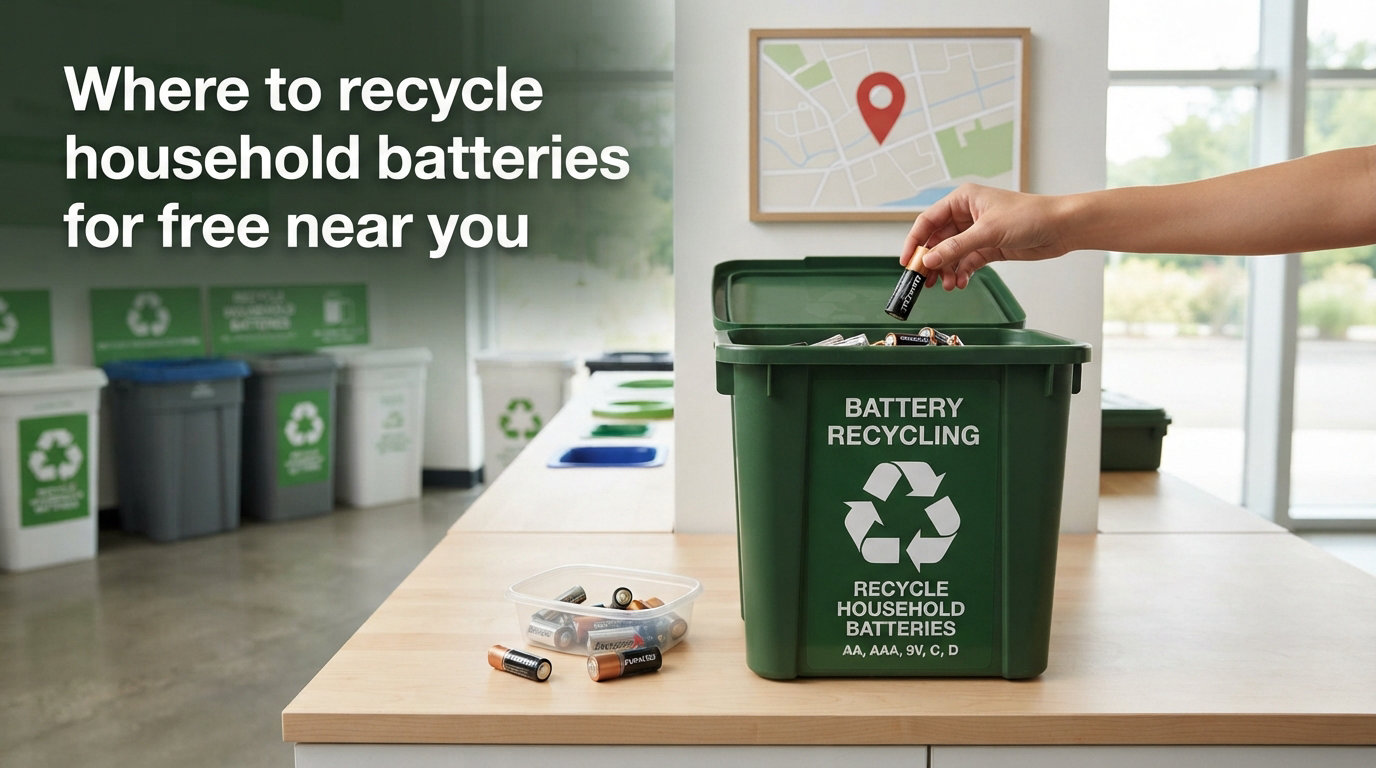
You can recycle household batteries for free at major retailers like Home Depot, Lowe’s, and Batteries Plus through the Call2Recycle program. Most of these drop-off locations accept rechargeable batteries at no charge, and many also take single-use alkaline batteries depending on your state.
If you have a drawer full of dead AA, AAA, 9-volt, or lithium-ion batteries, you are not alone. Millions of households accumulate used batteries every year, and throwing them in the trash is illegal in several states and dangerous everywhere. The good news is that free recycling is closer than you think.
In this guide, our team breaks down exactly where to recycle household batteries for free near you, which retailers accept which battery types, and how to prepare your batteries safely before drop-off. We pulled together information from the EPA, Call2Recycle, retailer policies, and real community experiences to give you a clear, practical answer.
Table of Contents
Quick Answer: Where to Recycle Household Batteries for Free Near You
The fastest way to recycle household batteries for free is to bring them to a participating retailer with a Call2Recycle collection bin. These are the most common free drop-off spots across the country:
Home Depot — free rechargeable battery recycling through Call2Recycle bins at most stores
Lowe’s — free rechargeable battery drop-off at the customer service or returns area
Staples — accepts rechargeable batteries for free (single-use battery policies vary by location)
Best Buy — free recycling for rechargeable batteries and battery-powered electronics
Batteries Plus — accepts the widest range of battery types, including automotive
Ace Hardware and local hardware stores — many independent locations offer free community recycling
You can find the closest participating location by using the Call2Recycle ZIP code locator at call2recycle.org/locator or the Earth911 search tool at search.earth911.com.
Major Retailers That Recycle Batteries for Free
Not every retailer handles every battery type, and some charge fees for certain categories. Here is a detailed breakdown of the biggest free battery recycling options so you know exactly where to go.
Home Depot
Home Depot partners with Call2Recycle to offer free rechargeable battery recycling at nearly all of its U.S. locations. You will typically find the collection bin near the front entrance or customer service desk. The program accepts nickel-cadmium (Ni-Cd), nickel-metal hydride (Ni-MH), lithium-ion, and small sealed lead-acid batteries up to 11 pounds.
Home Depot does not accept single-use alkaline batteries in its Call2Recycle bins. If you have standard AA or AAA alkaline batteries, you will need a different drop-off spot for those.
Lowe’s
Lowe’s also hosts Call2Recycle collection bins and accepts rechargeable batteries for free at most stores. Look for the bins near the customer service counter or the returns area. Lowe’s takes the same rechargeable chemistries as Home Depot: Ni-Cd, Ni-MH, lithium-ion, and small sealed lead-acid.
Some Lowe’s locations go a step further and accept used plastic bags and compact fluorescent bulbs alongside batteries, making it a convenient multi-item recycling stop.
Staples
Staples offers free recycling for rechargeable batteries at participating stores through Call2Recycle. The bins are usually located near the front of the store. Rechargeable AA, AAA, laptop batteries, and power tool battery packs are all accepted at no cost.
For single-use alkaline batteries, Staples policies vary widely. Some forum users report that certain locations charge around $3 per battery for alkaline recycling, while others do not accept them at all. Always call ahead if alkaline batteries are what you need to recycle.
Best Buy
Best Buy provides free recycling for rechargeable batteries and electronics at all U.S. stores. You can drop off lithium-ion batteries, rechargeable household batteries, and batteries still inside old devices like laptops, phones, and tablets.
Best Buy limits customers to three items per day for free electronics recycling. If you are bringing in several devices with embedded batteries, plan your trip accordingly. Single-use alkaline batteries are generally not part of the free program.
Batteries Plus
Batteries Plus has the broadest acceptance list of any major retailer. Most locations accept rechargeable batteries for free and will also take single-use alkaline batteries, button cells, and even automotive and marine batteries.
Some Batteries Plus stores charge a small fee for certain battery types or for large quantities. The advantage is convenience: if you have a mixed bag of battery types, Batteries Plus is your best one-stop option.
Ace Hardware and Local Hardware Stores
Community forums consistently highlight Ace Hardware and independent hardware stores as excellent free battery recycling resources. Many Ace locations keep a recycling bucket near the register and accept both single-use and rechargeable batteries at no charge.
Locally owned hardware stores like Cole Hardware in San Francisco are frequently recommended by residents for their free battery recycling buckets. These smaller stores often fill the gap that big-box retailers leave when it comes to single-use alkaline batteries.
The Call2Recycle Program Explained
Call2Recycle is the nonprofit battery stewardship program that powers most free drop-off bins you see at Home Depot, Lowe’s, Staples, and other retailers. Founded in 1994, it is the first and largest consumer battery recycling program in North America.
The program is funded by battery manufacturers, so the cost is built into the products you buy rather than charged at the drop-off counter. That is why rechargeable battery recycling is free at participating locations. Call2Recycle collects the batteries from retailers, sorts them by chemistry, and sends them to certified processors for material recovery.
To date, Call2Recycle has diverted more than 160 million pounds of batteries from landfills. The program focuses primarily on rechargeable batteries, but it has expanded in recent years to include single-use battery collection in certain regions and states.
How to Find Free Battery Recycling Using a ZIP Code Locator?
Finding the closest free battery recycling drop-off takes less than a minute with the right tools. Here are the two best ZIP code locators our team recommends:
1. Call2Recycle Locator — Visit call2recycle.org/locator, enter your ZIP code, and the tool displays every participating retailer within your chosen radius. Each result shows the store address, accepted battery types, and hours.
2. Earth911 Search — Go to search.earth911.com, type in your ZIP code and the specific battery type (such as “alkaline batteries” or “lithium-ion batteries”), and Earth911 returns a list of nearby recycling options including retailers, municipal facilities, and mail-in programs.
We recommend checking both tools because their databases do not always overlap. A local option that shows up on Earth911 may not appear on Call2Recycle, and vice versa.
What Types of Batteries Can You Recycle for Free?
The battery type determines where you can recycle it for free. Matching the right battery to the right drop-off location saves you a wasted trip. Here is a breakdown of common household battery categories and their recycling options.
Single-Use (Alkaline) Batteries
Standard alkaline AA, AAA, C, D, and 9-volt batteries are the trickiest to recycle for free. In most states, alkaline batteries manufactured after 1996 contain very low levels of mercury and are technically safe for landfill disposal. However, many communities still prefer recycling.
Free alkaline recycling is most commonly found at Ace Hardware, local hardware stores, Batteries Plus, and municipal household hazardous waste facilities. Call2Recycle bins at big-box retailers typically do not accept alkaline batteries.
Rechargeable Batteries (Ni-Cd and Ni-MH)
Nickel-cadmium and nickel-metal hydride rechargeable batteries are accepted for free at virtually every Call2Recycle location. This includes Home Depot, Lowe’s, Staples, and Best Buy. These chemistries contain toxic metals like cadmium, so proper recycling is important.
Bring your used rechargeable AA and AAA batteries, along with rechargeable battery packs from older electronics, to any of these retailers at no cost.
Lithium-Ion Batteries
Lithium-ion batteries power laptops, smartphones, power tools, and many modern household devices. These are accepted for free at Call2Recycle locations, Best Buy, and Batteries Plus. Because lithium-ion batteries can catch fire if damaged, most drop-off locations require you to tape the terminals before recycling.
Never throw lithium-ion batteries in the trash or curbside recycling bin. They are a leading cause of fires at waste facilities and recycling plants.
Button Cell and Specialty Batteries
Button cell batteries, found in watches, hearing aids, and key fobs, contain silver and mercury in older models. These are accepted at Batteries Plus, many jewelry stores, and hearing aid clinics. Some Ace Hardware locations also take them.
For 9-volt batteries, the terminals must be taped before drop-off because both terminals are on the same side and can short-circuit if they touch metal.
How to Prepare Batteries for Safe Drop-Off?
Preparing your batteries correctly protects workers, prevents fires, and ensures your batteries actually get recycled rather than rejected. Follow these steps before heading to any drop-off location.
Step 1: Identify battery types. Sort your batteries into rechargeable and single-use piles. Mixing them up makes it harder for the drop-off location to process them and could lead to safety issues.
Step 2: Tape the terminals. Place a piece of clear tape over both the positive and negative terminals of every lithium-ion, 9-volt, and button cell battery. This prevents the terminals from touching each other and sparking.
Step 3: Bag lithium batteries separately. Put each lithium-ion battery in its own clear plastic bag, or place clear tape over the contacts. Many Call2Recycle bins now require this step explicitly.
Step 4: Do not remove embedded batteries. If a battery is permanently installed inside a device, bring the whole device to a retailer like Best Buy rather than trying to pry the battery out yourself.
Step 5: Store safely during transport. Keep prepared batteries in a non-conductive container like a cardboard box or plastic bin. Never carry loose batteries loose in a pocket or bag where they can shift and short-circuit.
Local Alternatives: Libraries, Community Centers, and Hazardous Waste Facilities
Retailers are not your only option. Several community-based alternatives offer free battery recycling, and they often accept battery types that big-box stores will not take.
Public libraries in many areas, especially in California and other environmentally proactive states, maintain free battery recycling collection bins. Check with your local branch to see if they participate.
Household hazardous waste facilities run by city or county governments accept all battery types for free. These facilities typically hold regular collection events or maintain permanent drop-off sites. Some require an appointment, so call ahead.
Community collection events pop up periodically, often around Earth Day or during local sustainability fairs. These events usually accept every battery type and may also take paint, electronics, and other hard-to-recycle items.
State-Specific Battery Recycling Rules to Know
Battery disposal laws vary significantly by state, and ignoring them can result in fines. Knowing your local rules helps you stay compliant and find the right recycling channel.
California is the strictest state. It is illegal to throw any battery, including standard alkaline, in the trash. California residents must take all batteries to a designated recycling location. Many California cities offer curbside battery collection in special zip-top bags.
Other states with notable battery disposal restrictions include New York, Vermont, Maine, and Washington. These states generally require rechargeable battery recycling and may ban certain chemistries from landfills.
Even in states where tossing alkaline batteries is legal, recycling remains the better choice. Batteries contain steel, zinc, and manganese that can be recovered and reused, reducing the need for virgin mining.
What Happens to Batteries After You Recycle Them
When you drop off a battery, it begins a journey of material recovery. Certified processors sort batteries by chemistry, then break them down through smelting or mechanical separation.
Rechargeable batteries yield valuable metals like cobalt, nickel, and lithium. These recovered materials go back into manufacturing new batteries, electronics, and stainless steel. Single-use alkaline batteries yield zinc, manganese, and steel.
The EPA highlights battery recycling as a key strategy for recovering critical minerals and reducing reliance on imported raw materials. Every battery you recycle keeps hazardous metals out of soil and water while conserving resources.
FAQs
Does Home Depot recycle batteries for free?
Yes, Home Depot recycles rechargeable batteries for free at nearly all U.S. stores through the Call2Recycle program. Look for the collection bin near the front entrance or customer service desk. Home Depot accepts Ni-Cd, Ni-MH, lithium-ion, and small sealed lead-acid batteries, but it does not accept single-use alkaline batteries in its Call2Recycle bins.
What do you do with a dead AA battery?
To dispose of a dead AA battery, first determine whether it is single-use alkaline or rechargeable. For rechargeable AA batteries, take them to Home Depot, Lowe’s, Staples, or Best Buy for free recycling. For single-use alkaline AA batteries, check your local hardware store, Batteries Plus, or a household hazardous waste facility. In California, you cannot throw any AA battery in the trash and must recycle it.
Can I dispose of old batteries at Walmart?
Walmart does not have a nationwide free household battery recycling program. Some individual Walmart locations with automotive service centers accept car batteries for recycling, and certain stores partner with local programs for occasional collection events. For reliable free household battery recycling, Home Depot, Lowe’s, and Staples are better options.
Does Best Buy recycle household batteries for free?
Yes, Best Buy recycles rechargeable household batteries for free at all U.S. stores. You can drop off lithium-ion batteries, rechargeable AA and AAA batteries, and batteries still inside old electronics. Best Buy limits free electronics recycling to three items per day. Single-use alkaline batteries are generally not accepted.
Can I throw household batteries in the regular trash?
In most states, single-use alkaline batteries can legally go in the trash, but rechargeable and lithium-ion batteries cannot. California bans all batteries from the trash, including alkaline. New York, Vermont, and several other states prohibit rechargeable battery disposal in landfills. Regardless of local law, recycling every battery is the safest and most environmentally responsible choice.
How should I prepare batteries before dropping them off for recycling?
Sort batteries by type, then tape the terminals of all lithium-ion, 9-volt, and button cell batteries with clear tape to prevent short-circuiting. Place each lithium-ion battery in its own plastic bag. Never try to remove batteries permanently sealed inside devices. Store prepared batteries in a non-conductive container like a cardboard box for safe transport.
Wrapping Up: Recycle Household Batteries for Free Near You
Free household battery recycling is widely available if you know where to look. Home Depot, Lowe’s, Staples, Best Buy, and Batteries Plus all offer free drop-off for rechargeable batteries through the Call2Recycle program, while local hardware stores and hazardous waste facilities fill the gap for single-use alkaline batteries.
Now that you know where to recycle household batteries for free near you, the next step is simple. Sort your batteries, tape the terminals, plug your ZIP code into the Call2Recycle locator, and make the trip. Every battery you recycle keeps hazardous metals out of the environment and valuable materials in circulation.