
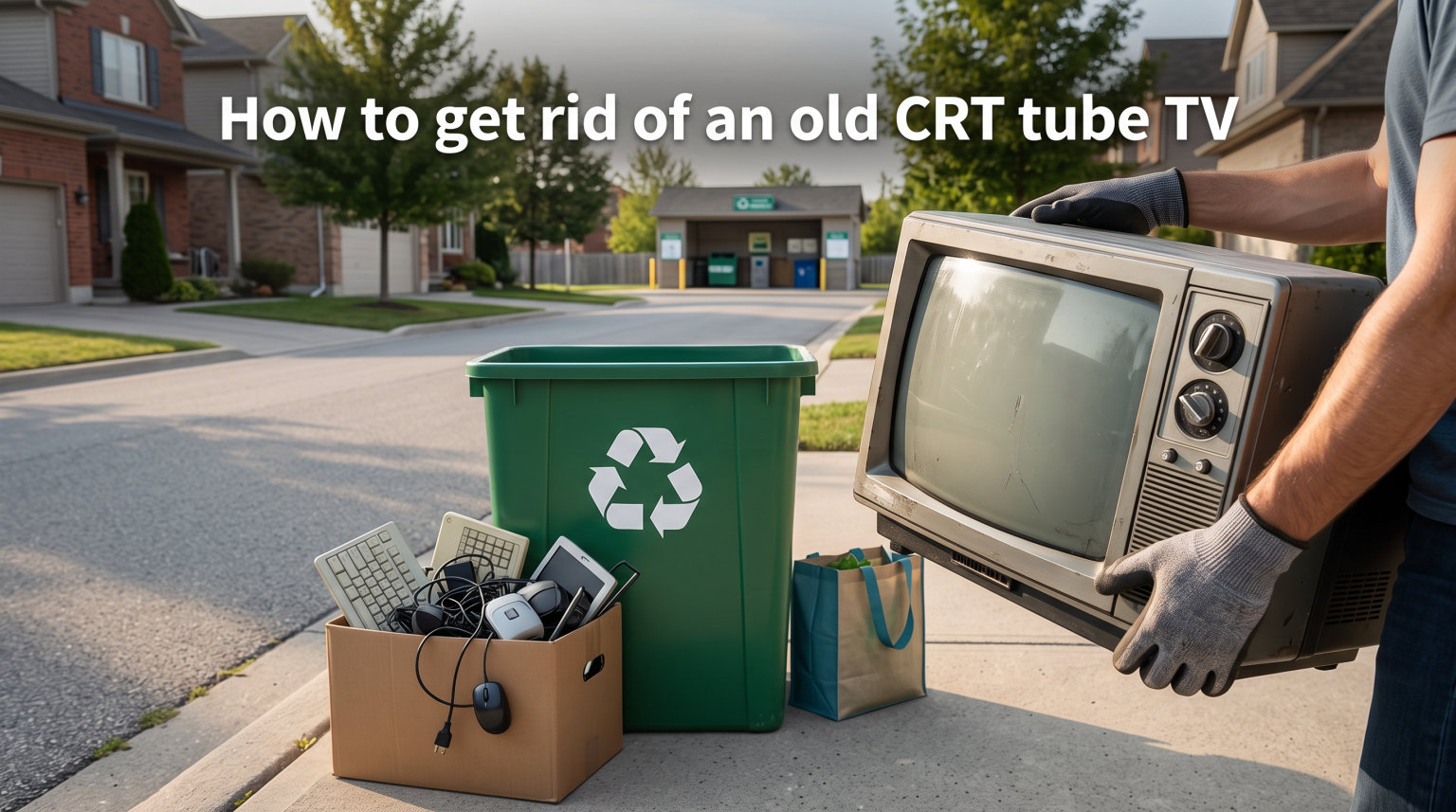
If you’re trying to figure out how to get rid of an old CRT tube TV, the short answer is: don’t put it in the regular trash. CRT (cathode ray tube) televisions contain roughly 6 pounds of lead, traces of mercury, cadmium, and phosphor coatings, and they are classified as hazardous waste in most U.S. states. That means they need to go through a certified e-waste recycler, a manufacturer take-back program, a donation channel, or a junk removal service.
Our team put together this guide after comparing three top-ranking articles, reading hundreds of forum posts on r/crtgaming and r/StLouis, and reviewing EPA e-waste guidelines. We break down every working option, with safety steps, costs, and the exact programs that will actually accept your old TV.
Table of Contents
What Is a CRT Tube TV?
A CRT tube TV is an older-style television that uses a cathode ray tube to display images. Inside the tube, an electron gun fires beams at a phosphorescent screen coated with leaded glass, which produces the picture you see.
CRT TVs were the standard for decades until flat-panel LCD and plasma displays took over around 2007-2010. Sets from the 1990s and early 2000s can weigh anywhere from 60 to over 200 pounds depending on screen size, and a 36-inch console can easily pass the 200-pound mark.
Three things make a CRT different from a modern flat-panel TV for disposal purposes:
- The funnel glass is leaded (often 20-25% lead by weight) to shield users from X-ray radiation.
- The tube holds a high-voltage capacitor that can store a dangerous electrical charge even when unplugged.
- The phosphor coating on the inside of the screen may contain cadmium, mercury, or other heavy metals.
Those are the features that make your old set hazardous if it ends up in a regular landfill, and why your local trash hauler will usually refuse curbside pickup.
Why CRT TVs Are Hazardous (and Why You Can’t Toss Them)
CRT TVs are hazardous because they contain 4 to 8 pounds of lead per set, along with smaller amounts of mercury, cadmium, beryllium, and flame retardants. When a CRT is crushed in a garbage truck or breaks down in a landfill, that lead can leach into soil and groundwater.
The EPA classifies CRTs as “universal waste” under federal rules, and most states have additional laws. In California, New York, New Jersey, and several other states, it’s outright illegal to throw a CRT in the regular trash. Penalties range from fines to civil liability for cleanup costs if the leachate contaminates a water source.
Here are the real risks, drawn from EPA and university extension materials:
- Lead exposure – Children are especially vulnerable to lead, which damages the nervous system even at low levels.
- Mercury vapor – Released when the tube is broken or heated, mercury vapor damages the brain and kidneys.
- Cadmium dust – The phosphor coating contains cadmium, a known carcinogen if inhaled.
- Implosion risk – The vacuum tube can implode violently if punctured, sending glass shards outward.
Bottom line: this is not a “set it on the curb” item. It needs a proper destination.
Where to Recycle a CRT TV Near You
The most reliable way to get rid of an old CRT tube TV is through a certified e-waste recycler. Here’s a numbered list of the options that actually work in 2026, based on what the three top-ranking articles recommend and what real users report.
- Best Buy TV recycling – Most Best Buy stores accept old tube TVs for a fee (typically around $25-30 per unit). They accept CRTs of any size at participating locations. Call ahead because not every store handles them.
- Staples – Some Staples locations accept CRTs through their free tech recycling program, though availability varies. Check your local store before loading up your car.
- Manufacturer take-back programs – Sony, Samsung, LG, Panasonic, and Toshiba have all run mail-back or drop-off programs at various times. Search “[manufacturer name] CRT take-back program” to see what’s currently active in 2026.
- R2v3 or e-Stewards certified recyclers – These are the gold-standard certifications for responsible e-waste handling. Use the Earth911 recycler locator (earth911.com) to find R2v3-certified facilities within 25 miles of your zip code.
- Municipal hazardous waste drop-off – Most counties run free or low-cost household hazardous waste collection days, often 2-4 times per year. CRTs are usually accepted at no charge.
- Retail trade-in events – Stores like Costco, Walmart, and Target occasionally partner with recyclers for in-store electronics take-back days.
For our team, the fastest path is usually Best Buy (one trip, immediate pickup) followed by the municipal hazardous waste roundup if you want to do it for free.
How to Donate a Working CRT TV
Donating a working CRT TV is the best option if your set still turns on and shows a clear picture. Reuse beats recycling every time because it keeps the embedded lead and energy out of the waste stream entirely.
Here are the donation channels that actually accept working CRTs in 2026:
- Local schools and daycares – Younger classrooms sometimes still use CRT TVs for VHS playback or older gaming consoles. Call the front office first.
- Thrift stores (selectively) – Goodwill, Salvation Army, and Habitat ReStores usually won’t accept CRTs because they’re hard to sell. Smaller church-run thrift stores are more flexible.
- Retro gaming communities – This is where the demand lives. r/crtgaming on Reddit, the Facebook CRT collector groups, and sites like Craigslist still have active buyers for working CRTs, especially Trinitrons and PVMs.
- Community theaters and church AV teams – Many still rely on CRT projectors or older tube monitors for live setups.
- Local Buy Nothing groups – A quick post on a Buy Nothing Facebook group often finds a taker within hours. People restoring vintage consoles or building retro arcade cabinets are constantly hunting for working CRTs.
If your TV doesn’t power on, scratch that idea and move to recycling. No donation organization will accept a non-working CRT.
Junk Removal Services for Heavy CRT TVs
Junk removal services are the right call when the TV is non-working, you can’t transport it yourself, or you want it gone in one appointment. They’ll come to your home, carry it out, and route it to a certified recycler for you.
The main national services that handle CRT TVs are:
- 1-800-GOT-JUNK – Booked online or by phone. Typical cost for a single CRT TV runs $150-300 depending on your zip code and whether they need to climb stairs. They sort and route e-waste to certified recyclers.
- LoadUp – Generally cheaper than 1-800-GOT-JUNK, with up-front pricing before booking. CRTs typically fall in the $75-200 range.
- Local junk haulers – Search “junk removal near me” plus your city. Local operators often quote $50-150 for a single CRT pickup.
From our team’s research, the going rate for a single CRT pickup in most U.S. metro areas is $75-200. Two-person minimum is standard because of the weight.
One warning from r/StLouis and similar forums: always confirm in writing that your junk hauler will route CRTs to a certified recycler, not the landfill. A reputable company will state this without being asked.
Safety Precautions When Moving a CRT TV
Moving a CRT TV safely means treating it like a fragile, heavy, electrically charged object all at the same time. The number one rule is: never grab the screen. Always support the TV by its base or its rear corners.
Step 1: Unplug and Wait
Unplug the TV at least 24 hours before you move it. The high-voltage capacitor inside the CRT can hold a charge for hours, sometimes days, after the set is unplugged. Don’t open the back panel unless you know how to discharge it safely.
Step 2: Remove Stands and Cables
Detach the base or stand and any cables. Tape the power cord to the back of the unit so it doesn’t snag during the move. Wrap the screen with a soft blanket or moving pad – never bubble wrap directly on the glass, because it can leave marks and increase suction against the tube.
Step 3: Two-Person Lift for Anything Over 27 Inches
Our team found that any CRT over 27 inches needs two people to carry safely. A 32-inch CRT can weigh 100-130 pounds; a 36-inch console can hit 200 pounds. Use a furniture dolly whenever possible. Lift with your legs, not your back.
Step 4: Transport Upright
Always transport a CRT upright if you can. Laying it flat increases the risk of tube stress and can crack the neck of the CRT, which is the most fragile part. If you have to lay it down, support it under the screen edge and the rear.
Step 5: Don’t Break the Tube Yourself
Some forum users suggest “smashing the tube” before disposal to neutralize the vacuum. We strongly disagree. Breaking a CRT releases lead dust, phosphor (which may contain cadmium), and risks severe cuts from imploding glass. Leave it intact and let a certified recycler handle it.
Cost Considerations: Free vs Paid Disposal
Disposing of a CRT TV can cost anywhere from $0 to $300, depending on the method. Here’s a realistic cost breakdown based on what people are paying in 2026.
- Free options: Municipal household hazardous waste collection days (typically held 2-4 times a year), some manufacturer mail-back programs, and a handful of retail partnerships during Earth Month (April).
- Low-cost ($20-50): Best Buy TV recycling fees at participating stores, small local recyclers that charge by the pound, and occasional curbside e-waste pickup events.
- Mid-range ($75-200): Junk removal services like LoadUp or local haulers who come to your home.
- Higher-end ($150-300): 1-800-GOT-JUNK and similar national services, especially if stairs or long carry distances are involved.
If you’re working on a tight budget, the municipal hazardous waste day is the best deal in almost every U.S. county. Check your county’s solid waste department website for the schedule.
Frequently Asked Questions
How do you dispose of an old CRT TV?
You can dispose of an old CRT TV through a certified e-waste recycler (Best Buy, municipal drop-off, or R2v3-certified facility), a manufacturer take-back program, a junk removal service, or by donating it if it still works. Regular trash pickup is illegal in most U.S. states because of the lead and mercury inside.
Are old CRT TVs worth anything?
Working CRT TVs can sell for $50-500 on eBay or Craigslist, depending on the model. Trinitrons and broadcast PVMs in good condition command the highest prices from retro gaming collectors. Non-working CRTs have essentially no resale value and cost money to dispose of properly.
Can you put a CRT TV in the trash?
In most U.S. states, no. CRTs are classified as hazardous waste because they contain 4-8 pounds of lead, plus mercury and cadmium. Tossing one in the regular trash can result in fines, and many waste haulers will refuse curbside pickup for CRTs altogether.
Will Best Buy take an old tube TV?
Most Best Buy stores accept CRT TVs for a fee, typically $25-30 per unit, regardless of size. Call your local store before bringing it in, because not every location processes CRTs and some have weight limits. They will route the set to a certified recycler.
The Best Way to Get Rid of Your Old CRT Tube TV
So the cleanest answer to how to get rid of an old CRT tube TV: if it works, donate it or sell it to a retro gaming buyer. If it doesn’t work, take it to a Best Buy TV recycling drop-off, your county’s household hazardous waste day, or an R2v3-certified recycler near you.
Skip the curb, skip the dumpster, and skip breaking the tube yourself. The lead, mercury, and vacuum inside a CRT make it one of the few household items that genuinely needs a professional handoff. Pick one of the four paths above and you’ll be done in a single afternoon.