
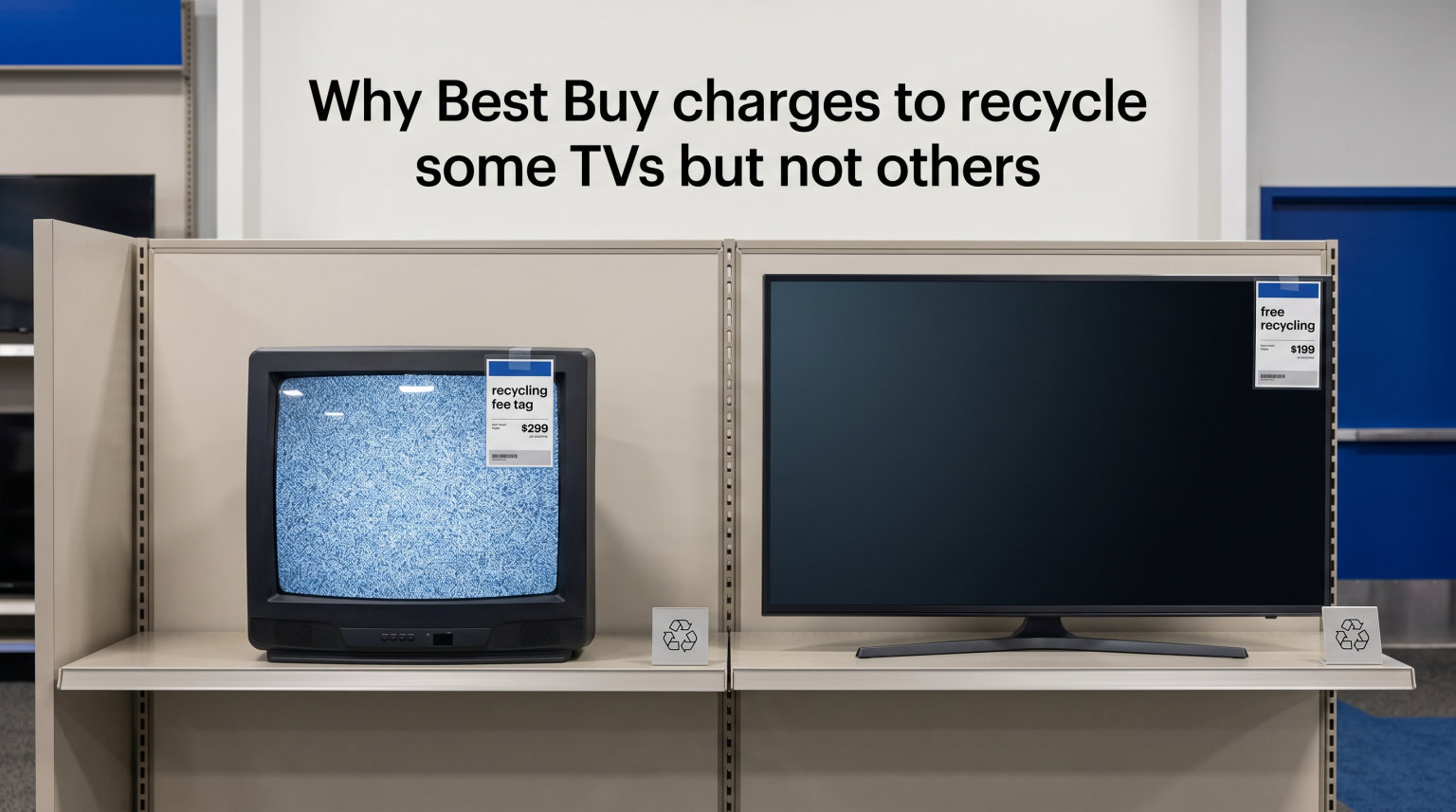
I was standing at a Best Buy customer service desk last spring holding a 42-inch Vizio, and the associate told me it would cost $29.99 to leave it there. The woman in front of me rolled in an Insignia TV and walked out without paying a cent. Same store, same recycling bin, two completely different outcomes. That moment is exactly why so many people search for why Best Buy charges to recycle some TVs but not others.
The short answer is this: Best Buy charges a $29.99 recycling fee for most TVs because older and non-store-branded screens contain hazardous materials like lead and mercury that require specialized handling. TVs made by Best Buy’s house brands (Insignia and Dynex) are accepted for free, and residents in California, Connecticut, and Hawaii pay nothing regardless of brand. The rest of this guide breaks down every line of that policy so you know exactly what you’ll pay before you load the truck.
Table of Contents
Why Best Buy Charges to Recycle Some TVs but Not Others?
The recycling fee exists because most TVs are not safe to crush, shred, or melt down with regular scrap. Each set contains a small cocktail of materials that require licensed processors, certified ventilation, and government-approved disposal routes. Best Buy absorbs some of that cost, but for non-store-branded TVs they pass a portion of it to the customer as a $29.99 per-unit fee.
Hazardous Materials Hidden Inside Your TV
That flat-panel in your living room is not just glass and plastic. It contains leaded solder on the circuit boards, mercury traces in early LCD backlights, and brominated flame retardants in the plastic housing. Older CRT televisions (the boxy ones from the 90s) carry even more lead, often between 2 and 4 pounds per tube, sealed behind the glass face. If those TVs go to a regular landfill, the lead can leach into groundwater over time.
Best Buy’s official recycling FAQ acknowledges that the program exists specifically to keep these toxic components out of landfills. Recycling partners must be EPA-approved and capable of separating the heavy metals from the recyclable glass, plastic, and aluminum. That specialized labor costs money, and the fee helps cover it.
Why Best Buy-Branded TVs Are Accepted for Free
Insignia and Dynex are Best Buy’s private-label brands. When you recycle one of those TVs, Best Buy is essentially taking back a product it sold and profited from. The company recoups some of the recycling cost through that original margin, and it builds goodwill by handling its own products without charging the customer again. From a logistics standpoint, the process is identical, but the accounting is different.
Which TVs Are Free to Recycle at Best Buy
Best Buy accepts three categories of TVs for free at its customer service desks. Knowing what falls into each group is the fastest way to avoid an unexpected charge at the register.
Insignia TVs (any size) – Best Buy’s house brand, free regardless of screen size or technology.
Dynex TVs (any size) – Discontinued house brand, still accepted for free at most locations.
TVs in exempt states – California, Connecticut, and Hawaii residents pay nothing regardless of brand.
Best Buy Magnolia or Visions-branded displays – Occasionally accepted free at flagship stores.
Anything outside that list generally falls under the $29.99 fee structure. That includes Samsung, LG, Sony, TCL, Hisense, Vizio, Panasonic, Sharp, Toshiba, and most other manufacturers.
Other Items Best Buy Recycles for Free
Best Buy accepts a much wider list of smaller electronics for free at every store. Batteries, cables, ink cartridges, cell phones, tablets, and small appliances all fall under the free program. The fee applies almost exclusively to TVs and computer monitors because of the size, weight, and concentrated hazardous materials in those units.
Best Buy TV Recycling Fee: Size and Type Limits
There is a hard ceiling on what Best Buy will accept, even if you are willing to pay. The size limits differ by TV type, and going over them means you will need a different disposal option.
31-Inch Limit for Tube TVs (CRT)
For old tube televisions (CRT, rear-projection, or early flat-panel rear-projection units), the maximum diagonal screen size is 31 inches. Anything larger is too heavy and contains too much leaded glass for in-store handling. You will need to call ahead and confirm at your specific store, since some locations will not accept CRTs at all due to local regulations.
49-Inch Limit for Flat-Panel TVs
For modern flat-panel TVs (LCD, LED, OLED, or plasma), the cutoff is 49 inches measured diagonally. A 50-inch screen is too large for in-store drop-off, even with the fee. Best Buy’s haul-away service is the only option for larger units, and that costs significantly more.
Daily Household Limits
Best Buy limits each household to two TVs or computer monitors per day, regardless of whether you pay the fee. This is enforced to prevent commercial waste haulers from dumping inventory at retail locations. If you have more than two TVs to recycle, you can return on a different day or contact a dedicated e-waste hauler.
States Where Best Buy TV Recycling Is Free
State electronics recycling laws directly change what Best Buy charges. Because Best Buy must comply with state-level e-waste legislation, the fee structure shifts based on your shipping address at the point of sale.
Free Recycling States (CA, CT, HI)
California, Connecticut, and Hawaii have some of the strongest e-waste laws in the country. Manufacturers in those states must fund take-back programs, which means consumers pay nothing at the Best Buy register. If you live in one of these three states, the $29.99 fee is waived automatically, regardless of brand or TV size up to the standard limits.
Gift Card Incentive States (PA, WI, MI, and select others)
Pennsylvania, Wisconsin, Michigan, and a handful of other states run Extended Producer Responsibility programs that effectively make recycling free after a rebate. Best Buy gives you a $30 gift card at drop-off, which cancels out the $29.99 fee. The gift card is store credit, not cash, so you have to plan to use it on a future purchase.
Why State Laws Matter
State e-waste laws shift the cost from the consumer to the manufacturer. When a state requires producers to fund recycling, Best Buy’s cost is reimbursed through that system. In states without such laws, Best Buy pays the recycler directly and recovers part of that cost through the customer fee. The fee is not a profit center; it is a cost-recovery mechanism.
Best Buy Haul-Away Service and Costs
If your TV is too big to transport, or if you simply do not want to load it in your vehicle, Best Buy offers a haul-away service. The standard charge is $199.99 per visit, and a technician comes to your home to remove the old TV when delivering a new one or as a standalone service.
This is not the same as recycling through a municipal pickup. The technician takes the TV back to a Best Buy distribution center, where it enters the same recycling pipeline as in-store drop-offs. The price jump from $29.99 to $199.99 reflects the labor, truck, and scheduling logistics of the home visit, not any difference in how the TV is processed.
When Haul-Away Makes Sense
I would only recommend haul-away if you are already buying a replacement TV and the haul-away is bundled into the delivery service. Paying $199.99 standalone for recycling is hard to justify when a local e-waste pickup often costs $0 to $50. The math changes if you are scheduling a Geek Squad delivery anyway, since the incremental cost is much lower.
Does a Best Buy Membership Waive the Recycling Fee
No. Neither My Best Buy Plus, My Best Buy Total, nor TotalTech membership waives the $29.99 recycling fee. This is one of the most common misconceptions I see on forums and Reddit threads. Membership perks cover shipping, exclusive pricing, and Geek Squad support, but recycling fees fall outside those benefits.
I checked the official Best Buy membership terms page, and recycling is explicitly excluded from membership benefits. The only ways to avoid the fee are state exemptions, brand exemptions, or the gift card incentive programs.
How to Recycle a TV at Best Buy: Step-by-Step
Recycling a TV at Best Buy takes about 10 minutes if you come prepared. Here is the process I recommend after going through it twice.
Call your local store first. Confirm they accept TVs in your size range and check current hours for customer service.
Bring a photo ID. Some stores require proof of residence to confirm the state exemption applies.
Transport the TV safely. Flat-panels should be upright; CRTs can be on their side. Use a blanket or padding to protect the screen.
Go to the customer service desk. Do not go through the regular checkout line. Recycling is handled at the dedicated service counter.
Pay the fee if applicable. Have $29.99 ready, or check whether your state qualifies for the gift card incentive.
Get a receipt. Keep the receipt for your records, especially if you paid for the haul-away service.
No appointment is required for in-store recycling. Walk-ins are accepted during regular customer service hours. The whole process is faster than standing in the checkout line at most grocery stores.
Best Buy Recycling vs Alternatives
Best Buy is not your only option for TV recycling. Here is how the alternatives stack up.
Manufacturer take-back programs. Samsung, LG, and Sony all offer mail-back recycling for their own products, often free of charge.
Municipal e-waste days. Most cities host quarterly or annual e-waste collection events at no cost. Check your county’s website for the schedule.
Donation. If the TV still works, Goodwill and Habitat for Humanity ReStores accept working TVs and may even pick up from your home.
Specialized e-waste haulers. Companies like 1-800-GOT-JUNK and Republic Services handle TVs for $50 to $150 depending on your location.
Retailer trade-in programs. Target and Staples occasionally run electronics trade-in events that include free recycling for old TVs.
For most people, the deciding factor is convenience. If a Best Buy is on your regular route, the $29.99 fee is reasonable compared to scheduling a home pickup. If you have multiple TVs, the daily limit makes Best Buy impractical, and a municipal e-waste day is the better choice.
Frequently Asked Questions
How much does Best Buy charge to recycle an old TV?
Best Buy charges a $29.99 recycling fee per TV or computer monitor for most brands. The fee is waived for Insignia and Dynex TVs, and for residents of California, Connecticut, and Hawaii. Haul-away service from your home costs $199.99 per visit.
Does Best Buy charge a fee to recycle TVs?
Yes, Best Buy charges $29.99 per TV for non-Best Buy brands. The fee covers the cost of sending the unit to an EPA-approved recycling partner that handles hazardous materials like lead and mercury. Free recycling is limited to house brands and specific states.
Why are TVs so expensive to recycle?
TVs contain lead, mercury, cadmium, and brominated flame retardants that require specialized handling. Recycling facilities must safely extract these materials, which costs more than processing standard scrap. The $29.99 fee helps offset these specialized processing costs that regular recyclers cannot handle.
What states have free TV recycling at Best Buy?
California, Connecticut, and Hawaii residents pay no fee for TV recycling at Best Buy, regardless of brand. Pennsylvania, Wisconsin, and Michigan residents receive a $30 gift card that effectively cancels the fee. These exemptions are tied to state e-waste laws that require manufacturers to fund recycling.
Does a Best Buy membership waive the recycling fee?
No. My Best Buy Plus, My Best Buy Total, and TotalTech memberships do not waive the $29.99 TV recycling fee. Recycling fees are excluded from membership benefits. The only ways to avoid the fee are brand exemptions, state exemptions, or gift card incentive programs.
What size TV can I recycle at Best Buy?
Best Buy accepts tube TVs up to 31 inches and flat-panel TVs up to 49 inches. Anything larger must be handled through the haul-away service for $199.99 or through a different recycling provider. Each household is limited to two TVs or monitors per day.
What does Best Buy not take for recycling?
Best Buy does not accept TVs larger than 49 inches (flat-panel) or 31 inches (tube), appliances containing refrigerants, or commercial quantities of electronics. Household hazardous waste like paint, chemicals, and batteries over a certain size are also excluded. Call your local store to confirm before loading up your vehicle.
Final Thoughts on Best Buy TV Recycling Fee
The Best Buy TV recycling fee comes down to three variables: brand, size, and state. Insignia and Dynex TVs are always free. Non-Best Buy brands cost $29.99 unless you live in California, Connecticut, Hawaii, or one of the gift card incentive states. TVs over 49 inches flat-panel or 31 inches tube need the haul-away service or a different disposal route.
For most people, $29.99 is a fair price for the convenience of dropping off an old TV at a retail location with no appointment needed. If you have multiple large TVs to recycle, look up your next municipal e-waste day and skip the fees entirely. The fee is not a profit grab; it reflects the real cost of processing hazardous electronics, and Best Buy’s program is one of the more accessible options in the country.