
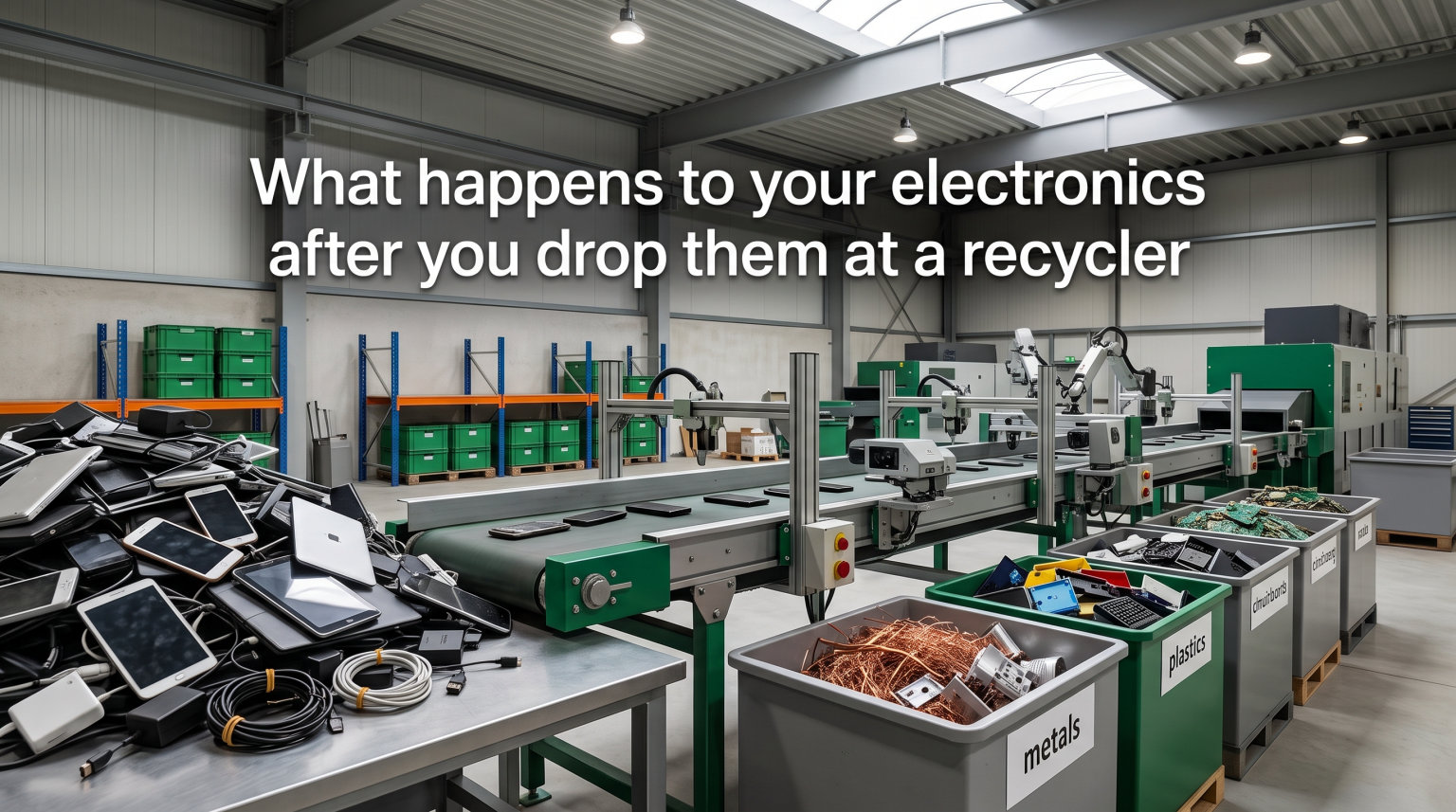
Every year, the world generates more than 60 million metric tons of electronic waste. That number grows by roughly 2 million tons annually as people upgrade phones, replace laptops, and retire old televisions. When you drop off that cracked tablet or sluggish desktop at a recycling center, you probably wonder where it actually goes.
Understanding what happens to your electronics after you drop them at a recycler matters for two big reasons. First, your personal data sits inside those devices. Second, the environmental impact of improper disposal is severe, with toxic materials like lead and mercury leaching into soil and groundwater.
I spent months researching e-waste recycling facilities, interviewing industry professionals, and tracing the path that old electronics take from drop-off bin to raw commodity. What I found was a sophisticated, multi-stage industrial process that most people never see.
Our team visited certified recycling facilities and traced the complete chain from collection to final material distribution. We examined how data destruction works, what materials actually get recovered, and why choosing the right recycler can mean the difference between responsible recovery and environmental harm.
Here is exactly what happens to your electronics after you drop them at a recycler, explained step by step.
In short: After you drop off electronics at a recycler, they are collected, inspected, and sorted by type. Any data storage devices undergo certified data destruction through shredding or wiping. Workers manually dismantle the devices to remove components like batteries, circuit boards, and screens.
The remaining materials are mechanically shredded, then separated using magnets, eddy currents, water density separation, and optical sorting to recover metals, plastics, and glass. These raw commodities are then sold to manufacturers who use them to build new products.
Table of Contents
What Happens to Your Electronics After You Drop Them at a Recycler: The Complete Process
The e-waste recycling process is not a single event. It is a chain of specialized operations, each handled by trained professionals and increasingly by automated systems. Here is every stage your old devices pass through.
Step 1: Collection and Intake
The process begins the moment you hand over your device. Certified recyclers log every item that arrives, whether it comes from an individual dropping off a single phone or a business decommissioning hundreds of servers.
At this stage, the recycler creates an initial record. For business clients, this includes a chain of custody document that tracks each asset from pickup through final processing. This documentation is important for companies that need proof of compliant disposal for regulatory or audit purposes.
Facilities typically sort incoming items into broad categories right at intake. Computers go in one area, televisions in another, small appliances in a third. This pre-sorting speeds up the downstream process and keeps items on the correct handling path.
Some items require special intake protocols. Devices with intact lithium-ion batteries, for example, may be placed in fire-resistant containers immediately. CRT televisions and monitors are separated because their leaded glass demands a completely different processing approach.
Step 2: Initial Inspection and Sorting
Once items enter the facility, technicians inspect each one to determine the best processing path. Not everything gets shredded. Many devices are evaluated for potential reuse or refurbishment first.
A working laptop might be only two years old and perfectly suitable for resale or donation. A smartphone with a cracked screen but functional internals could have individual components harvested for repairs. This inspection step is where recyclers decide whether a device gets a second life or heads to material recovery.
Devices flagged for material recovery are then sorted by type and construction. Phones, tablets, desktop computers, servers, printers, and televisions each have different material compositions and require different dismantling strategies.
Hazardous items are identified during this inspection. Devices containing mercury switches, PCB-containing capacitors, or refrigerants are routed to specialized handlers who are trained and licensed to deal with those specific materials.
Step 3: Secure Data Destruction
This is the step that concerns most people, and rightly so. Your hard drives, solid state drives, phones, and tablets contain personal photos, financial data, passwords, and browsing history.
Certified recyclers offer multiple data destruction methods depending on the device type and client requirements. For hard drives, physical shredding reduces the drive to small metal fragments. The pieces are too small to recover any data, and this process is typically witnessed and documented.
Software-based wiping follows standards like NIST 800-88, which specifies how many overwrite passes are needed to make data unrecoverable. This method is preferred when the drive itself will be reused or resold, as it preserves the hardware while permanently destroying the data.
For solid state drives and flash memory, physical destruction is often the recommended approach. SSDs distribute data across many memory chips, making thorough software wiping less reliable than it is on traditional spinning hard drives.
Magnetic media like tapes are destroyed using degaussing. A powerful electromagnetic field scrambles the magnetic domains on the tape, rendering any stored data permanently unreadable.
After destruction, the recycler issues a Certificate of Destruction. This document lists the serial numbers of all destroyed devices, the method used, and the date. Businesses rely on these certificates to demonstrate compliance with data protection regulations.
Step 4: Manual Dismantling and Component Recovery
After data destruction, workers manually disassemble the devices. This is skilled labor. Technicians use specialized tools to open cases, remove circuit boards, extract batteries, and separate different material streams.
Circuit boards are one of the most valuable components in any electronic device. They contain concentrated amounts of gold, silver, palladium, and copper. Workers remove these boards and send them to specialized refiners who extract the precious metals.
Batteries are removed and segregated by chemistry type. Lithium-ion batteries go to one processor, lead-acid batteries to another. This separation matters because mixing battery types during processing can cause fires and chemical reactions.
Screens and displays require careful handling. LCD panels contain liquid crystal materials and often mercury in their backlighting. CRT monitors and televisions contain significant amounts of lead in their glass funnel and faceplate.
These components are sent to specialized processors equipped to handle the hazardous materials safely. During manual dismantling, workers also recover reusable components like power supplies, fans, cables, and memory modules that are still functional.
These working parts can be tested and resold. This component-level recovery extends the useful life of parts before the materials themselves are recovered.
Step 5: Mechanical Shredding and Size Reduction
Once valuable components and hazardous materials have been manually removed, the remaining device shells and mixed materials move to mechanical shredding. Large industrial shredders tear through metal casings, plastic housings, and mixed-component assemblies.
The shredding happens in stages. A primary shredder breaks large items into fist-sized pieces. Secondary and sometimes tertiary shredders reduce the material further, creating a consistent particle size that makes downstream separation efficient.
This is one of the most physically demanding steps in the process. Shredders are massive machines capable of processing tons of material per hour. Dust collection systems capture particles released during shredding to protect worker health and prevent environmental contamination.
The output of the shredding stage is a mixed stream of small fragments. These fragments contain a jumble of metals, plastics, glass, and other materials all mixed together. The next steps focus on separating this mixture into pure commodity streams.
Step 6: Material Separation Technologies
This is where the process gets technically fascinating. Modern recycling facilities use a combination of physical and electromagnetic technologies to separate mixed shredded material into clean commodity streams.
Strong magnets pull ferrous metals out of the stream. Steel and iron fragments stick to the magnets while everything else passes by. This is the first and simplest separation step.
Eddy current separators handle the non-ferrous metals like aluminum and copper. These machines create a rapidly changing magnetic field that induces an electrical current in conductive metal fragments. That current generates its own magnetic field that repels the metal, literally throwing it out of the stream while non-metallic materials continue falling.
Density separation uses water or air to separate materials by weight. Heavier materials sink while lighter ones float. This technique effectively separates heavier metals from lighter plastics.
Optical sorting systems use cameras and near-infrared sensors to identify materials by their visual and spectral signatures. When the system detects a specific type of plastic or metal, a precisely timed burst of compressed air shoots it into the correct collection bin. This technology can distinguish between different types of plastics that look identical to the human eye.
Electrostatic separation handles fine materials that are too small for other methods. Charged particles stick to differently charged surfaces, allowing fine metal particles to be separated from fine plastic particles.
Step 7: Precious Metal Recovery and Refining
Circuit boards removed during manual dismantling contain gold, silver, palladium, and platinum. These boards are sent to specialized smelting and refining facilities that focus specifically on extracting precious metals.
The refining process typically involves smelting the boards at extremely high temperatures. The metals melt and separate from the non-metallic board material. Different metals settle at different levels based on density and chemical properties.
Chemical refining then purifies the recovered metals to industry-grade quality. A single metric ton of circuit boards can yield several hundred grams of gold. Compare that to mining, where a ton of gold ore might produce just a few grams.
Copper recovery is particularly efficient. The copper recovered from electronics is often higher purity than newly mined copper, making it especially valuable to manufacturers.
Rare earth elements like neodymium, dysprosium, and praseodymium are found in magnets, speakers, and display components. While recycling of these materials is still developing, research and pilot programs are making progress toward commercially viable recovery processes.
Step 8: Battery and Hazardous Material Handling
Batteries deserve their own processing stream because of the unique hazards and valuable materials they contain. Lithium-ion batteries power everything from phones to electric vehicles, and their recycling is a rapidly growing field.
Battery recycling facilities discharge the cells first to eliminate fire risk. Then the batteries are shredded in controlled environments, often under inert atmospheres to prevent thermal runaway. The recovered materials include lithium, cobalt, nickel, and manganese, all of which are in high demand for new battery production.
Lead-acid batteries from UPS systems and older electronics are one of the most successfully recycled products on the planet. The recycling rate for lead-acid batteries exceeds 99 percent in many regions. The lead is recovered and reused, and the plastic cases are processed into new battery housings.
Other hazardous materials are handled by licensed specialists. Mercury from old switches and relays is captured and contained. Toner cartridges are processed separately to recover their plastic and residual toner. Refrigerants from appliances are captured rather than vented to the atmosphere.
Step 9: Refurbishment and Reuse Opportunities
Not every device that arrives at a recycling facility gets destroyed. Many items are tested, repaired, and given a second life. This reuse path is actually the highest form of recycling because it preserves the energy and materials originally invested in manufacturing.
Refurbishable laptops and desktops are tested, repaired, cleaned, and loaded with fresh operating systems. These devices often end up in schools, nonprofits, or budget-conscious buyers’ homes. A laptop that gets three more years of use saves far more resources than one that gets shredded immediately.
Phones follow a similar path. Refurbished smartphones represent a significant and growing market. Many people prefer them over new devices because of the cost savings and reduced environmental footprint.
Component-level reuse is another option. Processors, memory modules, graphics cards, and power supplies that still work are tested and sold to repair shops or hobbyists. This keeps functional parts in circulation and extends the service life of devices still in use.
Step 10: Final Commodity Distribution
The recovered materials do not sit in the recycling facility. They become commodities that enter global supply chains. Recovered copper goes to wire manufacturers. Steel goes to construction and automotive industries.
Aluminum returns to product casings and structural components. Recovered plastics are pelletized and sold to manufacturers who use recycled content in new products. Glass from screens and CRTs goes to specialized glass recyclers or finds use in construction materials.
The precious metals extracted from circuit boards enter the same refining streams as mined metals. Once refined, there is no difference between an ounce of recycled gold and an ounce of mined gold. They are chemically identical.
This final distribution closes the loop. The materials from your old phone might end up in new electronics, automotive wiring, jewelry, or medical equipment. The circular economy transforms yesterday’s waste into tomorrow’s raw materials.
What Materials Are Recovered from Your Old Electronics
Understanding what comes out of the recycling process helps explain why it is worth the effort. Electronics are surprisingly rich in valuable and recoverable materials.
A typical smartphone contains gold, silver, copper, palladium, aluminum, cobalt, rare earth elements, and multiple types of engineering plastics. The material concentration in electronics is often far higher than in naturally occurring ores, which is why urban mining is economically viable.
Urban mining simply means recovering metals from discarded electronics rather than extracting them from the earth. Here is what different device types yield during processing:
Smartphones and tablets: Gold contacts, silver in solder, copper wiring, cobalt and lithium from batteries, rare earth elements from speakers and vibration motors, aluminum casings, and glass screens.
Laptops and desktops: Steel chassis, aluminum housings, copper from wiring and heat sinks, gold from circuit boards and connectors, silicon from processors, and various plastics.
Televisions and monitors: Large amounts of glass, aluminum and steel frames, copper from internal wiring, circuit board metals, and plastics from housings.
Servers and networking equipment: High concentrations of gold and copper due to the large number of circuit boards, steel rack components, aluminum heat sinks, and substantial copper wiring.
Small appliances: Steel and aluminum housings, copper motor windings, small circuit boards, and various plastics.
The economic value of recovered materials is substantial. The raw materials in global e-waste are estimated to be worth tens of billions of dollars annually. Much of that value is in gold, copper, and palladium concentrated in circuit boards and connectors.
Beyond precious metals, the volume of recovered steel, aluminum, and copper is enormous. These industrial metals reduce the demand for energy-intensive primary production and keep recyclable materials out of landfills.
Certified vs Non-Certified Recyclers: Why It Matters
Not all recyclers operate to the same standards. The difference between a certified recycler and an uncertified one can be the difference between responsible processing and environmental damage.
The two major certifications in the electronics recycling industry are R2 (Responsible Recycling) and e-Stewards. Both set rigorous standards for environmental protection, worker safety, and downstream accountability.
R2 certification, currently in its R2v3 version, is managed by SERI. It requires recyclers to demonstrate responsible handling of devices throughout the processing chain. R2v3 emphasizes a performance-based approach, meaning facilities must prove their processes actually achieve the stated outcomes rather than simply following prescribed steps.
e-Stewards certification is managed by the Basel Action Network. It is generally considered the stricter of the two certifications. e-Stewards explicitly prohibits the export of hazardous e-waste to developing countries and requires recyclers to meet ISO 14001 environmental management standards.
Uncertified recyclers pose serious risks. Some operators collect electronics and then export them to countries with weak environmental regulations. In these destinations, workers, including children in some documented cases, dismantle electronics using crude methods like open burning and acid baths.
These practices release toxic fumes and contaminate local water supplies. Before choosing a recycler, ask whether they hold R2 or e-Stewards certification. Reputable recyclers display their certifications prominently.
You can verify certifications through the SERI and e-Stewards online directories. For businesses, the stakes are even higher. An uncertified recycler that improperly handles data-containing devices could expose your company to data breach liability.
Choosing a certified recycler with documented chain of custody protects both the environment and your organization. The small effort of verification pays off in security and peace of mind.
How to Prepare Your Electronics Before Recycling?
Taking a few steps before dropping off your devices makes the recycling process smoother and protects your personal information.
Back up any data you want to keep. Transfer photos, documents, and files to a new device, external drive, or cloud storage. Once the device leaves your hands, recovering data becomes impossible.
Perform a factory reset on phones, tablets, and computers. This wipes your personal data and restores the device to its original state. While certified recyclers will perform their own data destruction, doing your own reset adds a layer of protection and peace of mind.
Remove accessories that are not part of the device itself. Cases, cables, chargers, and memory cards should be separated. Some recyclers accept accessories, but others only process the main device.
Remove batteries if the device allows it. Removable batteries may need to be recycled separately. Built-in batteries will be handled by the recycler, but noting their presence helps during intake.
Choose a certified recycler. Look for R2 or e-Stewards certification. If you are a business disposing of multiple devices, request a chain of custody document and a Certificate of Destruction.
What Happens When E-Waste Is Not Recycled Properly
The consequences of improper e-waste disposal are severe and far-reaching. When electronics end up in landfills, the results affect the environment and human health.
Electronics contain hazardous materials that leach into soil and groundwater when buried. Lead from solder and CRT glass, mercury from switches and backlights, cadmium from batteries, and brominated flame retardants from plastics all pose serious health risks. These toxins can persist in the environment for decades.
The export of e-waste to developing nations creates environmental and human tragedies. Informal recycling operations in these regions use open burning to recover metals, releasing toxic dioxins and furans into the air. Acid baths used to dissolve circuit boards contaminate water supplies.
The economic waste is equally significant. Every device thrown into a landfill represents lost valuable materials. The gold, copper, silver, and rare earth elements locked in discarded electronics could have been recovered and reused, reducing the need for environmentally destructive mining.
Proper recycling avoids all of these outcomes. By choosing a certified recycler, you can trust that hazardous materials are handled safely, valuable resources are recovered, and your personal data is destroyed before the device is processed.
FAQs
Should I destroy my computer before recycling?
You do not need to physically destroy your computer before recycling. Certified recyclers handle data destruction professionally using methods like hard drive shredding, NIST 800-88 software wiping, and degaussing. Simply perform a factory reset for peace of mind, then bring the device to a certified recycler who will provide a Certificate of Destruction. If you are especially concerned about data security, ask the recycler about their specific destruction methods.
What happens to electronics after they are recycled?
After recycling, electronics are dismantled and separated into raw materials. Metals like copper, gold, silver, and aluminum are recovered through shredding and electromagnetic separation. Plastics are sorted by type and pelletized. Glass is processed for reuse. These recovered commodities are then sold to manufacturers and used to create new products, closing the recycling loop.
Does Best Buy wipe computers before recycling?
Best Buy partners with certified recyclers for their electronics recycling program, but the company recommends that customers remove all personal data before dropping off devices. Best Buy does not guarantee data destruction for items dropped off at stores. You should perform your own factory reset or hard drive wipe before recycling any device through a retail program.
What is the best way to get rid of old electronics?
The best way to dispose of old electronics is through a certified e-waste recycler holding R2 or e-Stewards certification. For working devices, consider donation to schools or nonprofits. Retailers like Best Buy and Staples offer recycling programs. Many municipalities also host community e-waste collection events. Always back up and wipe your data before handing over any device.
Is my data safe when I recycle my computer?
Your data is safe when you use a certified recycler that offers documented data destruction. These recyclers use physical shredding, NIST 800-88 compliant software wiping, and degaussing to permanently destroy data. They also provide a Certificate of Destruction listing serial numbers and destruction methods. Avoid uncertified recyclers who cannot provide documentation of their data destruction processes.
What materials are recovered from old electronics?
Recycling recovers gold, silver, copper, aluminum, palladium, steel, and various plastics from old electronics. Circuit boards are especially valuable, yielding high concentrations of precious metals. Lithium-ion batteries provide lithium, cobalt, and nickel. Rare earth elements like neodymium are found in magnets and speakers. These recovered materials return to manufacturing supply chains for use in new products.
The Bottom Line on Electronics Recycling
When you drop off your old electronics at a certified recycler, you set in motion a remarkable process. Your devices are collected, inspected, and evaluated for reuse. Data storage is securely destroyed through shredding, wiping, or degaussing.
Components are manually dismantled and sorted by material type. The remaining materials are mechanically shredded and separated using magnets, eddy currents, density separation, and optical sorting. Recovered metals, plastics, and glass become raw commodities that re-enter manufacturing supply chains.
Precious metals from circuit boards get refined to the same purity as newly mined materials. Understanding what happens to your electronics after you drop them at a recycler empowers you to make better choices.
Choose certified recyclers. Back up and wipe your data before drop-off. Support the circular economy that turns yesterday’s devices into tomorrow’s raw materials.
The next time you upgrade your phone or retire an old laptop, you will know exactly where it goes and what it becomes. That knowledge is the first step toward more responsible e-waste management for everyone.