
Last year, our team watched a small business owner hand over 40 old laptops to a “free recycling” service. The pickup crew looked professional. They had a logo and even a printed certificate taped to the truck door. Three months later, the business owner got a call from her bank. Customer credit card numbers had been pulled off a server that was supposed to be destroyed.
The recycler she used was not certified. That is the kind of risk you avoid when you choose a certified e-waste recycler verified by an independent third party. In 2026, the EPA and several nonprofit groups have made it easier than ever to check on a recycler’s credentials, but most people still do not know where to look.
I have spent the last few months talking to IT managers, homeowners, and certified recyclers across the country. This guide pulls together everything I have learned so you can find a certified e-waste recycler you can actually trust. We will cover what certification really means, the difference between the two main programs, and a step-by-step verification checklist you can use today.
Table of Contents
What Is a Certified E-Waste Recycler?
A certified e-waste recycler is an electronics recycling facility that has passed an independent audit by an accredited third-party certification body. The auditor checks that the recycler meets strict standards for environmental protection, worker health and safety, data security, and downstream vendor management.
The word “certified” is not regulated on its own. Anyone can print a fancy badge. The trust comes from the certifying body. In North America, the two most recognized programs are R2 (Responsible Recycling) and e-Stewards. Both require annual on-site audits by accredited auditors. Both publish searchable directories of certified companies.
If a recycler claims to be “certified” but cannot point to one of these programs, treat that as a warning sign. Real certification shows up in public databases that you can search yourself.
Why Certification Matters: The Hidden Risks of Uncertified Recycling
Electronics contain lead, mercury, cadmium, and brominated flame retardants. When processed responsibly, these materials are captured and recycled. When handled carelessly, they end up in soil, water, and the lungs of workers.
Uncertified recyclers often cut costs by shipping old equipment overseas to developing countries. Workers in those regions, many of them children, dismantle devices in open-air workshops. They breathe toxic fumes and absorb heavy metals through their skin. The Basel Action Network has documented this practice for over two decades.
There is also the data angle. A certified e-waste recycler must follow documented procedures for data destruction. Uncertified operators have no obligation to wipe your drives before resale. I have seen used hard drives from “destroyed” laptops show up for sale on online marketplaces, complete with old tax records and medical files.
The Real Cost of Cutting Corners
Improper e-waste disposal costs real money. The United Nations estimated in 2026 that the global value of recoverable raw materials in discarded electronics exceeds $90 billion. When a recycler sends those materials to a landfill or dumps them overseas, your company loses recoverable value. Worse, you inherit the reputational risk when customers find out their data was leaked.
Understanding R2 Certification (R2v3 Standard)
R2 certification is the most widely adopted electronics recycling standard in the United States. The R2 Standard is maintained by Sustainable Electronics Recycling International (SERI) and is currently in its third major revision, known as R2v3.
To become R2 certified, a recycler must pass an audit performed by an ANAB-accredited certification body. The audit covers 14 process areas, including data sanitization, material recovery, downstream due diligence, and worker safety. After certification, recyclers are re-audited annually to keep their status active.
R2v3 added stronger requirements for data destruction and a more rigorous focus on reuse before recycling. If a recycler only shreds material without attempting refurbishment, they cannot earn the highest R2v3 rating.
How to Confirm R2 Status
SERI maintains a public directory at sustainableselectronics.org. You can search by company name or location. Each listing shows the recycler’s certification status, scope, and expiration date. If a recycler claims R2v3 but does not appear in that directory, they are not certified. It is that simple.
Understanding e-Stewards Certification
e-Stewards certification is run by the Basel Action Network (BAN). It was launched in 2010 as a response to concerns about toxic waste exports from wealthy nations to poorer ones.
The e-Stewards Standard is similar to R2 in many ways. It covers data security, environmental compliance, and worker protections. The major difference is a strict prohibition on exporting hazardous e-waste to developing countries. e-Stewards recyclers must process materials domestically or send them only to OECD countries with robust environmental laws.
e-Stewards also requires NAID AAA certification for any data destruction activities performed on-site. That means hard drive wiping, shredding, and degaussing must follow a separate set of audited standards.
How to Confirm e-Stewards Status
The e-Stewards Foundation publishes a directory at e-stewards.org. Search results include the recycler’s address, services, and current certification status. Each certified company carries a unique ID that you can verify directly with the foundation if you have any doubt.
R2 vs e-Stewards: Which Certification Matters More?
Neither certification is automatically “better” than the other. Both programs enforce strong standards and require annual audits. The right choice depends on your priorities.
Choose R2 if you want the widest selection of certified recyclers. R2 has more certified facilities in the United States than any other program. It is also the standard most enterprise IT asset disposition (ITAD) vendors support.
Choose e-Stewards if you want the strongest possible guarantee against overseas exports. e-Stewards recyclers are prohibited from shipping hazardous waste to non-OECD countries under any circumstances. This is a hard line that R2 does not draw.
Quick Comparison
Certifying body: R2 is run by SERI; e-Stewards is run by the Basel Action Network.
Audit standard: Both use ANAB-accredited auditors and require annual re-audits.
Data destruction: R2 covers data security; e-Stewards requires separate NAID AAA certification.
Export policy: R2 allows exports to OECD countries; e-Stewards prohibits most exports entirely.
Market reach: R2 has more certified facilities; e-Stewards has stricter ethical rules.
Many recyclers carry both certifications. If you find one, that is usually a sign of strong commitment to responsible recycling.
How to Verify a Recycler Is Certified: A Step-by-Step Checklist
Following a clear verification process is the single best way to find a certified e-waste recycler you can trust. I use this checklist with every new vendor our team considers.
Step 1: Ask for the certification name and ID number. A legitimate recycler will hand you this information in seconds. Hesitation is a red flag.
Step 2: Search the official directory. Look up the company on the SERI R2 directory or the e-Stewards directory. Confirm the certification is currently active, not expired or suspended.
Step 3: Confirm the scope matches your needs. Some recyclers are certified only for specific equipment, like consumer electronics or data center hardware. Make sure their scope covers your devices.
Step 4: Check the downstream vendor list. Ask who handles the material after the recycler. A certified recycler must vet downstream partners. You have the right to see that list.
Step 5: Request a sample certificate of destruction. After pickup, you should receive a serialized certificate that documents each device processed and the data destruction method used. Keep this for your records.
Step 6: Confirm insurance and liability coverage. A reputable recycler carries pollution liability insurance and offers financial protection if data is breached.
Any recycler who pushes back on these steps is not the right partner. Move on.
Red Flags: How to Spot E-Waste Recycling Scams
E-waste scams fall into predictable patterns. After reviewing dozens of consumer complaints, our team noticed the same warning signs keep appearing.
“Free” pickup with vague details. Legitimate recyclers either charge a fee for some items or pay you for valuable materials. Truly free service with no explanation of how the recycler makes money often signals resale of working equipment with intact data.
No physical address. Every certified recycler I have researched has a real, verifiable facility. If a company only lists a P.O. box or a residential address, be skeptical.
Expired or copied certifications. Some companies display logos for certifications they held years ago. Always check the active status in the official directory.
Refusal to discuss downstream vendors. If a recycler will not tell you where your equipment ends up, assume the worst.
Pressure tactics. Scammers often push for same-day pickup or claim an offer expires soon. Legitimate recyclers will give you time to verify their credentials.
Questions to Ask Before Choosing a Certified E-Waste Recycler
Once you have a shortlist of certified recyclers, the next step is a quick conversation. These are the questions I always ask before signing anything.
1. What is your current certification status, and can I see proof today?
2. How do you destroy data, and what documentation will I receive?
3. Do you refurbish equipment for resale, and if so, how do you wipe the drives?
4. Where do the materials end up after you finish processing?
5. Can I tour your facility before committing?
6. What insurance do you carry, and what liability do you assume if data leaks?
7. Do you offer on-site data destruction if I cannot transport the equipment?
8. How do you handle items that cannot be refurbished, like broken screens or damaged batteries?
A recycler who answers these clearly and confidently is worth your business. One who dodges or hand-waves is not.
Finding Certified E-Waste Recyclers Near You
The fastest way to locate a certified e-waste recycler near you is the official directory. The SERI R2 directory lets you filter by country, state, and ZIP code. The e-Stewards directory offers a similar search tool on its website.
For households, many certified recyclers partner with retailers like Best Buy and Staples. Some municipalities host annual electronics collection events staffed by certified vendors. Call your city or county waste authority to find upcoming dates.
For businesses, enterprise ITAD companies often have nationwide pickup networks that route equipment to certified processing facilities. Ask whether the actual processor is certified, not just the ITAD company itself. Many ITADs outsource to subcontractors, and that subcontractor is where your data risk lives.
What Happens to Your Recycled Electronics?
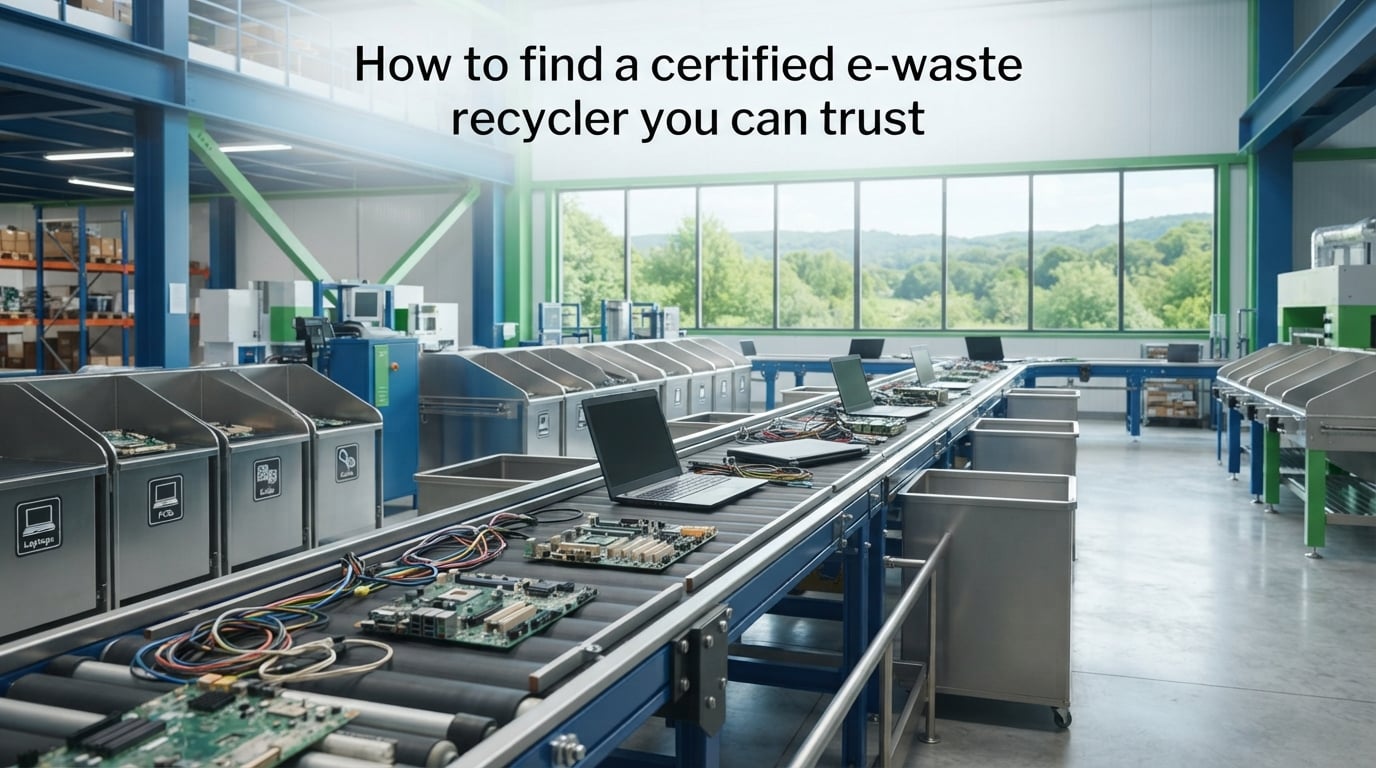
Once your equipment arrives at a certified facility, it is sorted and tested. Working devices are wiped to NIST 800-88 standards and refurbished for resale. Broken devices are dismantled into component streams. Circuit boards are smelted to recover gold, silver, copper, and palladium. Plastics are shredded and pelletized for new products. Hazardous fractions like leaded glass and mercury lamps are sent to specialized hazardous waste handlers.
About 95 to 98 percent of a typical device can be recovered or reused. That is why certified recycling is a valuable part of the circular economy. Every laptop that gets refurbished keeps a new one out of the supply chain.
Data Security Best Practices Before You Recycle
Even with a certified recycler, you should take basic precautions. Back up any data you still need. Encrypt sensitive files at rest before transfer. Note the serial numbers of devices you are releasing. Ask for a signed certificate of destruction within 30 days of pickup. Store that certificate for at least three years for compliance audits.
For high-security environments, consider on-site hard drive shredding. Several certified recyclers will bring an industrial shredder to your office and destroy drives in front of your staff. You keep the shredded fragments as evidence.
FAQs
What is an R2 certified facility?
An R2 certified facility is an electronics recycler that has passed an independent audit by an ANAB-accredited certification body and meets the R2v3 Standard for Responsible Recycling. The audit covers data security, environmental protection, worker safety, and downstream vendor management. Certification must be renewed annually.
What is the difference between R2 and e-Stewards?
R2 and e-Stewards are both accredited electronics recycling standards, but they differ on export policy. R2 allows exports of working equipment to OECD countries. e-Stewards prohibits most exports of hazardous e-waste to non-OECD countries. e-Stewards also requires separate NAID AAA certification for data destruction.
How can I verify a recycler’s certification?
Search the official R2 directory at sustainableselectronics.org or the e-Stewards directory at e-stewards.org. Confirm the certification is active, the scope matches your equipment, and the certification ID matches what the recycler gave you. Always ask for a sample certificate of destruction before pickup.
Is it hard to get R2 certified?
R2 certification requires a thorough audit of 14 process areas, including data destruction, environmental compliance, and downstream due diligence. The process typically takes several months and requires significant investment in policies, training, and record-keeping. The annual re-audits keep the standard rigorous.
Why is recycling e-waste so difficult?
Electronics contain a complex mix of valuable and hazardous materials, including lead, mercury, gold, and rare earth elements. Separating these materials safely requires specialized equipment and trained workers. Without proper oversight, recyclers often cut corners by exporting hazardous waste to developing countries or reselling devices with intact data.
Final Thoughts: Choosing a Certified E-Waste Recycler You Can Trust
Finding a certified e-waste recycler you can trust comes down to three habits. Verify the certification in the official directory. Ask for proof of data destruction practices. Demand transparency about where your equipment ends up.
In 2026, the bar for responsible electronics recycling is higher than it has ever been, and the tools to verify recyclers are free. Use them. Whether you are clearing out a closet of old phones or decommissioning a data center, taking an hour to confirm certification can save you from years of regret. If you want help building a sustainable electronics disposal program, our team is always happy to share what we have learned.