
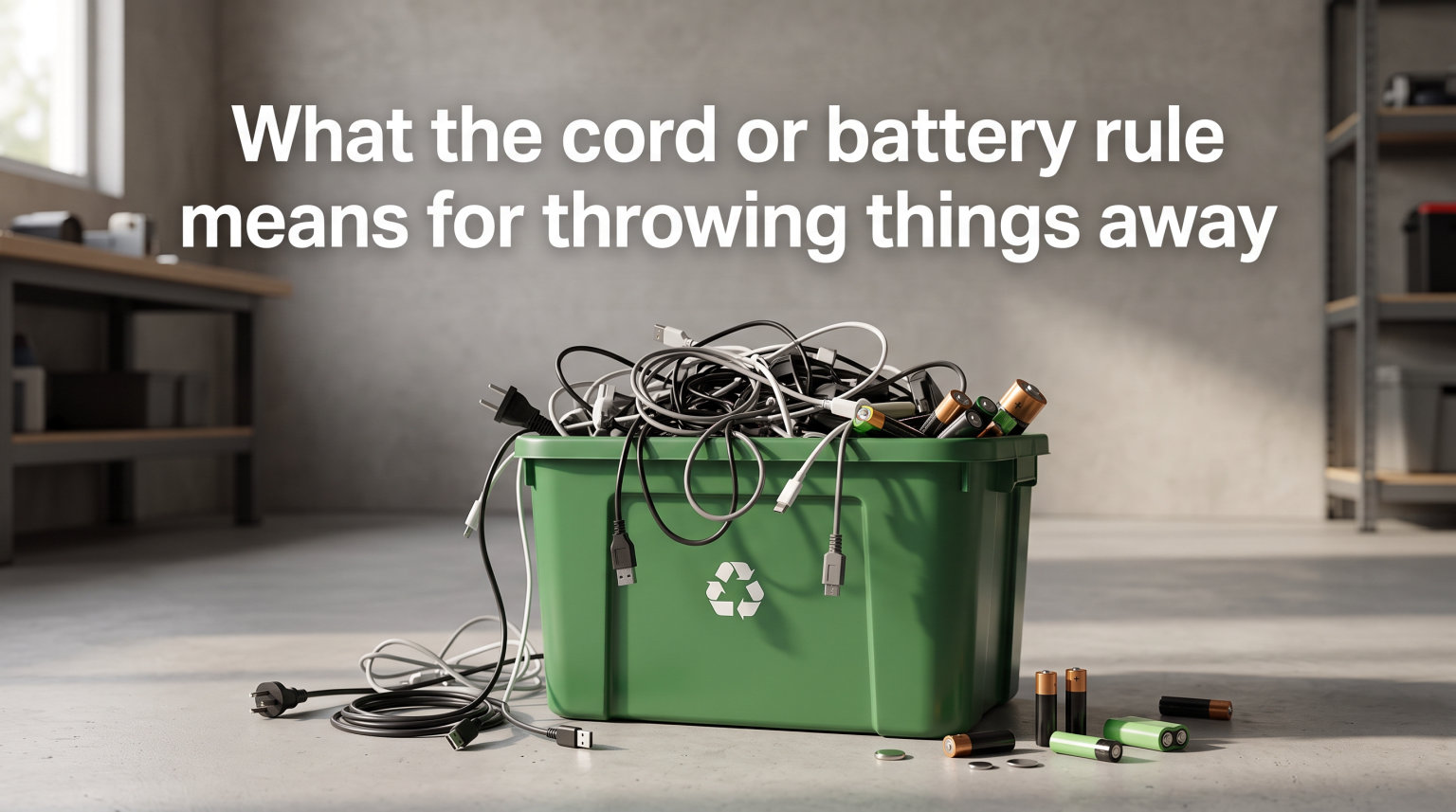
When I moved into my first apartment, I tossed a dead hair dryer, a box of old cables, and three cracked phone chargers into the kitchen trash. A neighbor stopped me at the dumpster and asked one question that changed how I think about throwing things away: “Do any of those have a cord?” That moment is exactly what the cord or battery rule is designed for. In this guide, I will walk you through what the cord or battery rule means for throwing things away, why it exists, which items it covers, and how to dispose of electronics the right way.
Table of Contents
What Is the Cord or Battery Rule?
The cord or battery rule is a consumer-friendly way of describing the electronics disposal laws already on the books in more than 25 U.S. states. The rule is simple: any item that has a power cord, plug, or internal battery cannot go in your regular trash or curbside recycling bin. It has to be taken to a certified e-waste recycler, a retailer take-back program, or a municipal collection event instead.
The phrase itself isn’t a single federal statute. It’s a shorthand name that combines the language used in several state laws, including New York’s Consumer Electronics Recycling Act, California’s Covered Electronic Waste Payment System, and Washington State’s E-Cycle program. I started using it myself after seeing how often the same question comes up in recycling forums: “Can I just throw this in the garbage?” The answer, almost always, is no if it has a cord or a battery.
Two key triggers put an item under the rule:
It needs a power cord to operate or charge.
It runs on any type of battery, including AA, AAA, rechargeable lithium-ion, or a built-in cell.
If either condition applies, the item is classified as e-waste, and the rule applies.
Why the Rule Exists: Environmental and Health Concerns
I think the easiest way to understand why this rule matters is to picture what happens when a laptop ends up in a landfill. The casing eventually breaks down, and the heavy metals inside start to move. Lead from solder, mercury from older screens, cadmium from batteries, and brominated flame retardants from plastic housings can all leach into the soil. From there, they make their way into groundwater and, eventually, into the food chain.
Beyond toxic materials, lithium-ion batteries pose a separate and more immediate danger. A punctured or swollen battery can cause thermal runaway, which is a chain reaction where the battery catches fire. Sanitation workers have been seriously burned when regular garbage trucks compacted batteries hidden inside other devices. That is a big reason why the cord or battery rule treats every battery, even a single AA, as e-waste rather than household trash.
The rule also keeps valuable materials in circulation. A single metric ton of circuit boards can contain more gold than a metric ton of ore mined from the ground. Recycling electronics recovers copper, aluminum, rare earth elements, and plastics. When these items go into the trash instead, that value is lost forever, and the environmental cost of mining new raw materials goes up.
What Items Are Covered by the Rule
The cord or battery rule covers a wider range of items than most people realize. I keep a running checklist on my fridge, and it has saved me from making the wrong call more than once. Below are the categories that fall under the rule, based on the eight categories named in the Consumer Electronics Recycling Act and the lists used by state agencies like the New York DEC and California DTSC.
Small electronics and accessories
Cell phones, smartphones, and chargers
Tablets, e-readers, and portable game devices
Headphones, earbuds, and Bluetooth speakers
Cables, cords, power strips, and extension cords
Remote controls and wireless mice or keyboards
Small kitchen gadgets like electric kettles, toasters, and hand mixers
Computers and home office equipment
Laptops, desktops, and tablets
Computer monitors, including older CRT screens
Printers, scanners, and fax machines
Modems, routers, and networking equipment
External hard drives and USB flash drives
TVs and home entertainment
Flat-screen TVs and older tube TVs
DVD, Blu-ray, and VCR players
Streaming devices, cable boxes, and satellite receivers
Video game consoles and accessories
Sound bars and home theater systems
Household appliances
Microwaves and toaster ovens
Vacuums and carpet cleaners
Electric fans and space heaters
Hair dryers, curling irons, and electric toothbrushes
Batteries of every kind
AA, AAA, C, D, and 9-volt disposable batteries
Rechargeable lithium-ion, NiMH, and NiCd battery packs
Car batteries and other lead-acid batteries
Button cell batteries from watches and small devices
Power banks and portable chargers
The simplest test is the one I use every time. Ask yourself: does this item need a plug or a battery to work? If yes, it falls under the cord or battery rule.
How to Properly Dispose of Electronics?
Once you know an item is covered, the disposal process is straightforward. I follow these five steps whenever I clear out a drawer, closet, or garage.
Step 1: Separate by category
Sort items into three piles: working electronics you can donate, broken electronics that need recycling, and loose batteries. Keeping these groups apart makes drop-off faster and safer.
Step 2: Remove batteries when possible
If a device has a removable battery, take it out. Loose batteries are recycled separately from the device itself. For built-in batteries, leave them inside and recycle the whole unit together.
Step 3: Erase personal data
For computers, phones, and tablets, sign out of accounts, perform a factory reset, and remove or wipe any storage drives. This step protects your identity before the device leaves your hands.
Step 4: Choose a drop-off option
Pick whichever channel fits the item and your location:
Retailer take-back: Best Buy, Staples, and Home Depot accept a wide range of electronics for free in most states.
Municipal collection events: Cities and counties hold periodic drop-off days for e-waste and household hazardous waste.
Manufacturer mail-back: Many brands offer prepaid shipping labels for their own products.
Call2Recycle and Earth911: National locators help you find certified battery and electronics recyclers near you.
Step 5: Handle damaged or swollen batteries with care
If a battery looks puffy, leaks, or smells unusual, place it in a non-conductive container like a plastic bucket with sand or kitty litter. Take it directly to a hazardous waste facility. Do not put it in your regular recycling bin and never mix it with other batteries.
State-by-State Regulation Overview
Electronics disposal laws vary across the country. Some states have strict bans with real penalties, while others only restrict certain items. Here is a snapshot of how the cord or battery rule is enforced in several key states.
California: The Covered Electronic Waste Act bans CRT devices, LCDs, and most consumer electronics from the trash. Retailers collect recycling fees at point of sale.
New York: The Consumer Electronics Recycling Act bans computers, TVs, and small electronics from landfill disposal. Manufacturers fund free take-back programs.
Texas: The state Computer Equipment Recycling Program covers computers and monitors, and the TCEQ recommends recycling all other electronics.
Washington: E-Cycle Washington covers TVs, computers, and laptops, with free manufacturer-funded recycling.
Illinois: The Consumer Electronics Recycling Act covers specific categories, and statewide landfill bans exist for certain devices.
If you live outside these states, check with your local solid waste district. Many cities enforce local ordinances that follow the same cord or battery rule principles even when state law does not.
Common Mistakes to Avoid
Even people who care about recycling make errors that put items in the wrong stream. These are the most common ones I see when I volunteer at community drop-off events.
Tossing electronics in the regular trash. A dead toaster or old phone charger still belongs in e-waste, even if it is broken.
Hiding batteries inside devices. Recycling centers want batteries out whenever possible. Taping the ends of loose batteries with clear tape is even better.
Putting electronics in curbside recycling bins. The wires and metals jam sorting equipment and force entire loads to be thrown away.
Ignoring damaged batteries. A swollen phone battery is a fire hazard and must go to a hazardous waste facility, not a regular drop-off.
Forgetting cables and cords. Power cords, HDMI cables, and extension cords count. They contain copper that should be recycled, not buried.
Frequently Asked Questions About the Cord or Battery Rule
Can you throw away things with cords?
No. Items with power cords, plugs, or built-in batteries are classified as e-waste and cannot go in regular trash or curbside recycling. They must be taken to a certified recycler, retailer take-back program, or municipal collection event.
What electronics should never be thrown away?
You should never throw away cell phones, laptops, tablets, TVs, monitors, printers, small kitchen appliances, hair tools, batteries of any kind, cables, power strips, remote controls, or video game consoles. If it has a cord or a battery, treat it as e-waste.
How do I safely dispose of a swollen or damaged battery?
Place the damaged battery in a non-conductive container such as a plastic bucket filled with sand or kitty litter. Do not put it in your regular trash or recycling bin. Take it directly to a household hazardous waste facility or a retailer that accepts damaged batteries.
Is it illegal to throw away electronics in the trash?
In more than 25 U.S. states, including California, New York, Washington, Illinois, and Texas, it is illegal to dispose of certain electronics in the regular trash. Penalties vary by state but can include fines for repeat offenders.
Where can I recycle electronics for free near me?
Best Buy and Staples accept most consumer electronics for free in all U.S. states. Home Depot accepts rechargeable batteries and some small devices. Use the Earth911 locator or Call2Recycle search tool to find certified e-waste drop-off sites in your zip code.
Do I need to remove batteries before recycling electronics?
Yes, when possible. Take out any removable batteries and recycle them separately at a battery drop-off location. If the battery is built into the device and cannot be removed, recycle the entire device together at an e-waste facility.
Final Thoughts on the Cord or Battery Rule for Throwing Things Away
Understanding the cord or battery rule removes most of the confusion around throwing things away. Once you know the simple test (does it have a cord or a battery?), every disposal decision becomes easier. Electronics with cords or batteries belong in e-waste streams, not in curbside bins. With retailer take-back programs, municipal collection events, and free mail-back options widely available, doing the right thing is rarely more than a short drive away.
Take ten minutes this week to check the drawers and closets in your home. Pull out anything that fits the cord or battery rule, and set it aside for the next drop-off day in your area. You will keep toxic materials out of the landfill, recover valuable metals for reuse, and protect sanitation workers from hidden battery fires. Small choices like this, multiplied across millions of households, are how the cord or battery rule actually does its job.