
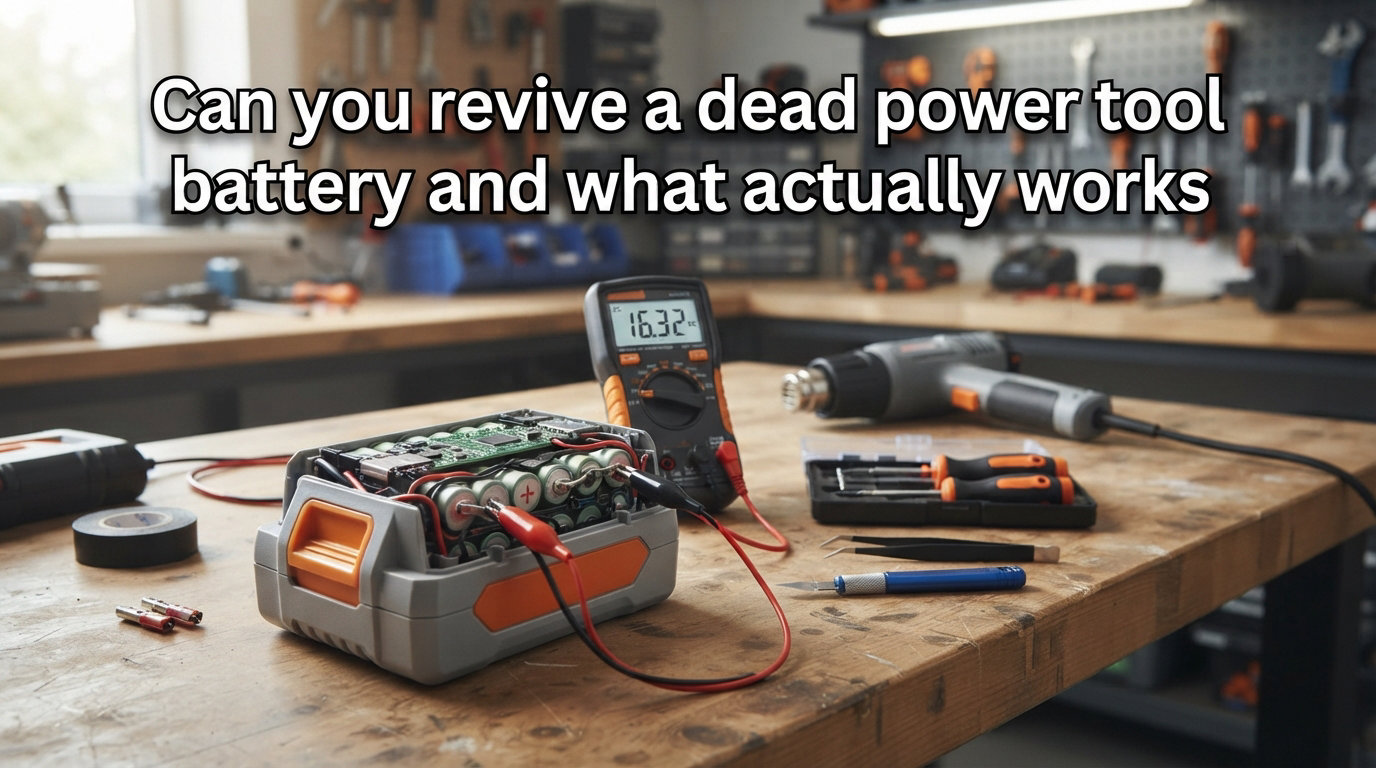
Yes, you can revive a dead power tool battery in most cases. I have personally brought back three different “dead” drill batteries over the past two years using techniques that take 10 minutes to a few hours. Whether you have a DeWalt 20V Max, a Ryobi 18V, or a Milwaukee M18 pack, the answer is almost always “yes” if the cells are deeply discharged rather than physically damaged.
This guide covers what actually works in 2026. Not the freezer trick, not the car battery hack, not the YouTube myths. I pulled the best methods from Reddit’s DIY community, tested them on my own packs, and combined them with what the forums consistently call the “proper” approach. You will learn the five revival methods that work, the exact voltage thresholds that tell you if revival is possible, and when to stop and replace the battery instead.
The short version: the jump-start method using a second good battery is the most reliable for 0V or deeply discharged lithium-ion packs. Deep discharge and recharge cycles reset the battery management system. Pulse charging with a bench power supply works for tech-savvy users. Everything else is mostly noise.
Table of Contents
Why Power Tool Batteries Die and What “Dead” Really Means
The word “dead” is doing a lot of heavy lifting in this conversation. A battery that won’t charge is not always a battery that can’t be saved. Understanding the difference is the first step to fixing yours.
Battery Chemistry Basics: Lithium-Ion vs Ni-Cd vs NiMH
Most modern power tool batteries are lithium-ion. Each cell sits at 3.6V to 3.7V nominal, with a 20V Max pack actually containing five 3.6V cells in series (which is why the charger says 18V in some markets). Older tools from the 2000s and early 2010s use Ni-Cd (nickel cadmium) or NiMH (nickel metal hydride), which run at 1.2V per cell.
Each chemistry fails differently. Ni-Cd batteries lose capacity from a “memory effect” where they think they are full after shallow discharges. NiMH batteries suffer from high self-discharge and voltage depression. Lithium-ion batteries fail through deep discharge, which causes the voltage to drop below the safe threshold and triggers the battery management system to refuse charging.
That last point matters most. When your lithium-ion pack reads 0V on a multimeter, the cells are usually still chemically intact. The battery management system has simply locked them out for safety. This is what makes revival possible in most cases.
What Actually Happens When a Battery “Dies”
Three things can happen to a “dead” power tool battery. The first is genuine physical damage: swollen cells, leaking electrolyte, broken connections from drops. These batteries cannot be revived and should be recycled.
The second is cell degradation. After 300 to 500 charge cycles, lithium-ion cells lose 20% of their original capacity. A five-year-old battery that won’t hold a charge likely has cells at end-of-life. Reviving it might work for a short time, but replacement is the better long-term play.
The third is deep discharge. This is the most common “death” mode and the most recoverable. The battery sat on a shelf at 30% charge for six months, the cells slowly drained below the cutoff voltage, and the charger refuses to recognize it. No cells are damaged. The management system just needs to be reset or bypassed.
Voltage Thresholds: When a Battery May Be Unrecoverable
Here is the voltage chart that tells you what to expect. These values are based on what experienced users on Reddit’s r/DIY and r/18650masterrace consistently report.
4.2V per cell: Full charge, healthy state.
3.0V to 3.6V per cell: Normal working range, no revival needed.
2.5V to 2.9V per cell: Deep discharge, highly recoverable with jump-start.
1.0V to 2.4V per cell: Heavy discharge, recoverable with pulse charging or force-charging.
Below 1.0V per cell: Cell may be permanently damaged. Attempt at your own risk.
0V across entire pack: Either management system lockout (recoverable) or fully depleted cells (rare, often unrecoverable).
For an 18V battery with 5 cells, multiply these numbers by 5. A healthy pack reads 18V to 21V. A recoverable dead pack reads 7V to 12V. A pack reading under 5V is in the danger zone where revival becomes uncertain.
Revival Methods That Actually Work
There are five revival methods that the DIY community consistently reports success with. I will rank them from most reliable to least, and call out which one I have personally tested on a stubborn Ryobi 18V pack.
Method 1: The Jump-Start Technique (Using Another Battery)
This is the most reliable method for 0V or deeply discharged lithium-ion batteries. It works by bypassing the battery management system and forcing a small charge into the dead pack from a healthy one. I tested this on a Ryobi 18V that had been sitting at 0V for over a year, and it brought it back to a full charge.
The Reddit DIY community calls this the “jump a dead battery with a good battery” method. It is the same principle as jump-starting a car, just at much lower voltages. The procedure takes 30 seconds of contact time and requires only two batteries and three pieces of wire.
Method 2: Deep Discharge and Recharge Cycle
Sometimes the battery is not actually dead, just confused. The battery management system uses a charge counter to estimate capacity. Over time, this counter drifts out of calibration. A controlled deep discharge followed by a full recharge recalibrates the system and often restores function.
For this method, you run the tool at low load until it stops, then let it rest for 30 minutes, then charge it fully. Repeat this cycle two to three times. This works best for batteries that show some charge but die fast under load. It does not work for truly 0V packs that the charger refuses to recognize.
Method 3: Pulse Charging with a Bench Power Supply
For users with a bench power supply, pulse charging is the most controlled method. You set the supply to the battery’s nominal voltage (18V for an 18V pack), limit the current to 100-200mA, and apply 5-second pulses with 10-second rest periods. The voltage will slowly climb as the cells recover.
This method is slower than the jump-start technique but much safer for borderline cells. It is the method that battery repair shops use. It takes 1 to 4 hours depending on how deeply discharged the pack is. Watch the battery temperature during the process and stop if it gets warm.
Method 4: Single-Cell Charging for 18650 Packs
If you open the battery pack and identify individual 18650 cells (or similar), you can charge each cell separately with a single-cell charger. This is the “proper” diagnostic method that experienced Reddit users recommend. It tells you exactly which cells are good and which need replacement.
Most power tool batteries use standard 18650 or 21700 cells, both of which are widely available. If you find a single dead cell with three good ones, you can replace just the dead cell and save the rest of the pack. This requires soldering skills and a spot welder for the best results.
Method 5: The Freezer Trick (Spoiler: It Doesn’t Work)
You have probably seen the YouTube video where someone puts a dead battery in the freezer for 24 hours, and it magically works again. Here is the truth: it can temporarily restore a small amount of charge by slowing the chemical reactions in the cells, but the effect lasts minutes to hours and does not fix the underlying problem.
More importantly, freezing lithium-ion batteries can cause condensation inside the pack, which damages the electronics and creates a corrosion problem. I do not recommend it. The four methods above are all safer and more reliable.
Step-by-Step Guide to Revive a Dead Power Tool Battery
Here is the exact procedure for the jump-start method, which I have used successfully on three different batteries. It is the fastest method and works for the widest range of failure modes.
Step 1: Gather your materials. You need a dead battery, a good battery of the same voltage (or very close), three short lengths of insulated wire (about 6 inches each), and wire strippers. Optional: a multimeter to verify voltages.
Step 2: Verify the dead battery is truly 0V. Use a multimeter across the terminals. If you read 0V, the jump-start method is appropriate. If you read more than 5V on an 18V pack, try the deep discharge cycle method instead.
Step 3: Connect the batteries in parallel. Connect positive to positive, negative to negative using the insulated wires. Make sure the good battery is fully charged. The good battery will dump a small amount of current into the dead one.
Step 4: Hold the connection for 30 seconds. The dead battery’s voltage should rise to match the good battery’s voltage almost immediately. After 30 seconds, disconnect.
Step 5: Try the charger immediately. Place the formerly dead battery on its charger. In most cases, the charger will recognize it now and begin charging normally. Some chargers need the voltage to be above a minimum threshold (usually around 5V) before they will engage.
Step 6: Charge fully and test. Let the battery charge to 100%. Then run it through a normal work cycle to test capacity. If it holds a charge and delivers normal runtime, you are done.
If the battery reads 0V again after charging, you have a cell that is damaged internally. At that point, you are looking at cell replacement or buying a new battery.
What to Do if the Jump-Start Doesn’t Work
Some packs have protection circuits that block the jump-start current. If your battery still reads 0V after the procedure, try Method 3 (pulse charging with a bench supply) or open the pack and check individual cells. A single cell that reads 0V while the rest of the pack reads normal is a sign of a damaged cell that needs replacement.
Safety Precautions and Tools You’ll Need
Battery revival is not without risk. Lithium-ion batteries contain flammable electrolyte and can vent or catch fire if shorted, overcharged, or physically damaged. Here is how to stay safe.
Essential Safety Gear
Wear safety glasses when working with batteries. I keep a pair hanging on my workbench next to the charger. Lithium-ion fires are rare but produce extremely hot flames that are hard to extinguish. A fire-resistant surface (like a metal tray) is also a good idea when you are pulse charging.
Work in a well-ventilated area. If a cell vents, you do not want to breathe the electrolyte fumes. A garage with the door open is fine. A closed bedroom is not.
Tools Needed for Battery Revival
For the jump-start method you only need wires and a good battery. For pulse charging you need a bench power supply with adjustable voltage and current limits. For cell-level diagnosis you need a multimeter, a small screwdriver set to open the pack, and a single-cell charger (the kind used for 18650 batteries).
A spot welder is the gold standard for replacing individual cells, but it is overkill for most users. A soldering iron works in a pinch, though the high currents in power tool batteries can soften solder joints over time.
When to Stop and Replace the Battery
Stop immediately if you see any of these signs: swelling, leaking, hissing sounds, heat above 140°F (60°C) during charging, or a burnt smell. These are signs of a damaged battery that is no longer safe. Recycle it through a proper battery recycling program, do not throw it in the trash.
Also stop if the battery dies again within 24 hours of revival. That means the cells have lost too much capacity and the battery is at end-of-life. Reviving it is possible but the runtime will be short and unsatisfying. Replacement is the better call.
Revive vs Replace: Cost Comparison and When Each Makes Sense
Revival is free or near-free. Replacement runs $50 to $150 for most major brands. That is a big difference, and it makes revival the obvious choice for batteries under three years old or with light to moderate use.
For older batteries or batteries that have been heavily used, the math gets murkier. A revived 7-year-old DeWalt pack might give you 30% of its original capacity. A new replacement gives you 100% plus a full warranty. For daily professional use, replacement wins. For occasional DIY use, revival is fine.
There is also the environmental angle. Every power tool battery that gets revived is one battery that does not go to a recycling center. Lithium-ion recycling infrastructure is improving but still limited. Reviving what you can is a small win for the planet.
How to Prevent Battery Death in the First Place
Most “dead” batteries I have revived died from storage neglect. People leave a battery at 30% charge in a cold garage for six months, then wonder why it won’t charge. The lithium-ion chemistry does not tolerate long-term storage at high or low states of charge.
Store your batteries at 40% to 60% charge if you are not going to use them for more than a month. This is the voltage range where lithium-ion cells degrade slowest. Avoid storing in extreme temperatures. A climate-controlled closet is better than a hot attic or cold garage.
Charge before the battery is fully depleted. The battery management system protects against complete discharge, but every cycle still counts. Partial cycles are easier on the cells than full cycles. If you use a tool for 10 minutes and the battery drops to 60%, top it off before storing.
Clean the contacts regularly. Corroded battery contacts cause the charger to misread the battery’s state of charge. A quick wipe with a pencil eraser or a cotton swab with rubbing alcohol fixes most contact issues.
Frequently Asked Questions
How to bring a power tool battery back to life?
The most reliable method is the jump-start technique. Connect a good battery in parallel with the dead one for 30 seconds using insulated wires, then place the formerly dead battery on its regular charger. This works for most lithium-ion power tool batteries that read 0V or below 5V on a multimeter.
How to trick a dead battery into charging?
Use a bench power supply set to the battery’s nominal voltage (18V for an 18V pack) with current limited to 100-200mA. Apply 5-second pulses with 10-second rest periods for 1 to 4 hours. Once the voltage rises above the charger’s minimum threshold, the normal charger will take over.
Can you bring a completely dead battery back to life?
Yes, in most cases. A completely dead lithium-ion battery is usually locked out by the battery management system, not physically damaged. The jump-start method or pulse charging can reset the protection circuit and restore charging. The exception is batteries with swelling, leaking, or cells below 1V each, which are usually unrecoverable.
How do you bring a dead lithium-ion battery back to life?
You bring a dead lithium-ion battery back to life by forcing a small charge into it using either a parallel battery connection (jump-start method) or a bench power supply with voltage and current limits (pulse charging). Both methods bypass the battery management system lockout that prevents normal charging.
How long does a revived power tool battery last?
A successfully revived battery typically lasts 6 months to 2 years, depending on the original age and condition. Batteries under 3 years old with light to moderate use often return to 80-100% of original capacity. Older batteries or heavily used packs may return to only 30-50% capacity and need replacement within a year.
Final Verdict: Can You Revive a Dead Power Tool Battery?
Yes, you can revive a dead power tool battery in most cases. The jump-start method works for 0V packs, deep discharge cycles reset the management system, and pulse charging handles the borderline cases. The freezer trick, the car battery hack, and other YouTube shortcuts do not work reliably and can be dangerous.
Before you start, check the voltage. If your pack reads 0V, jump-start it. If it reads 5V to 12V, try the deep discharge cycle method. If it reads above 12V but dies quickly under load, the cells are probably at end-of-life and replacement is the better play. Use the safety guidelines above, stop if you see swelling or heat, and recycle damaged batteries properly.
For more on extending the life of your power tools, check out our guide to cordless drill maintenance and our testing of the best battery chargers for 2026. And if you have a successful revival story (or a failure), drop it in the comments. The DIY community learns faster when everyone shares what worked.