
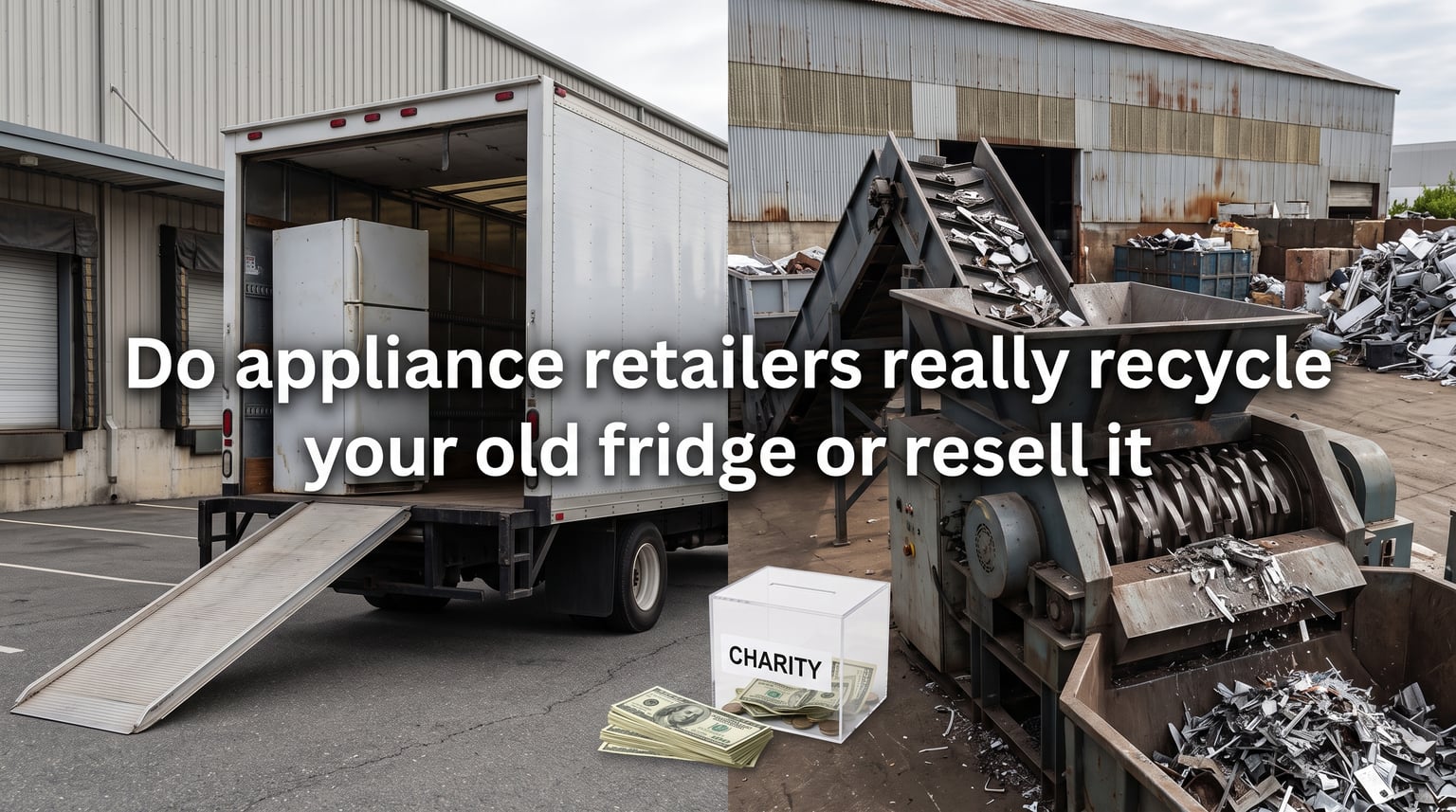
I get this question a lot from readers, and I want to give you a straight answer. Appliance retailers typically do both – they recycle some units and resell working ones, depending on condition and what their third-party partners decide.
The truth is messier than the marketing suggests. That $50 haul-away fee you paid doesn’t always guarantee responsible disposal.
In this guide, I’ll walk you through what actually happens to your old fridge after the retailer hauls it away. I’ll cover the real environmental stakes, your disposal options, how to verify retailer claims, and whether you can actually make money from your old appliance.
I’ve researched EPA programs, talked with scrap recyclers, and pulled insights from forum discussions where people share their own experiences.
Table of Contents
What Appliance Retailers Actually Do With Your Old Fridge
Most appliance retailers don’t handle disposal themselves. They contract with third-party junk removal and recycling companies.
When you pay that $50 haul-away fee at Lowe’s, Best Buy, Home Depot, or similar retailers, your fridge typically goes to a partner who decides its fate.
Here’s the honest breakdown based on what these partners do:
Working units get resold. If your fridge still runs well, the partner may sell it to a used appliance dealer, refurbisher, or even ship it to secondary markets.
Non-working units get stripped for parts. Valuable components like compressors, motors, and control boards often get harvested and sold separately.
What’s left gets recycled. Steel, copper, aluminum, and other metals get shredded and sold as scrap. Some plastics may also be reclaimed.
Some working units get donated. Certain retailer programs route functional appliances to charities like Habitat for Humanity ReStores.
One Reddit user in r/sustainability summed it up well: “They strip non working ones for parts and recycle the rest, some places donate the used working ones to charities.” This matches what I’ve heard from industry contacts.
The Energy.gov site tells consumers to “ask your retailer for assurance that the old unit is recycled responsibly.” That’s a hint that even the government recognizes not every retailer does this automatically.
Retailer policies also change. Big-box stores have shifted to third-party logistics providers over the last few years. Lowe’s, for example, has used different partners at different times. Your experience depends heavily on which contractor handles pickups in your region during 2026.
The Real Cost of Improper Appliance Disposal
Improper refrigerator disposal causes real environmental damage that goes beyond simple waste. Old fridges built before 1995 often contain chlorofluorocarbons (CFCs) or hydrochlorofluorocarbons (HCFCs).
Those are the same refrigerants that famously damaged the ozone layer in the 1980s.
When a fridge is crushed in a landfill or improperly handled, refrigerants escape into the atmosphere. One fridge can release the equivalent of several tons of carbon dioxide in ozone-depleting and greenhouse gas effects.
The foam insulation inside also often contains blowing agents that contribute to the problem.
This is exactly why the EPA created the Responsible Appliance Disposal (RAD) program. RAD partners with utilities, retailers, and recyclers to make sure refrigerants are properly recovered before recycling.
As of 2026, over 1,000 RAD partners operate across the U.S. They’ve recovered more than 380 million pounds of refrigerant since the program began.
Even modern fridges using R-134a or R-600a refrigerants still need proper handling. These substances are powerful greenhouse gases, and illegal venting carries federal fines up to $44,540 per violation per day.
Beyond refrigerant concerns, appliances also contain mercury switches, capacitors, and circuit boards with heavy metals. Landfills weren’t designed to handle these materials, and groundwater contamination is a real risk when units get dumped rather than processed.
Your Options for Getting Rid of Old Appliances
You have more choices than paying your retailer to haul it away. Some options pay you instead of costing money.
Here’s the full list with real pros and cons.
Retailer Haul-Away Service
The most convenient option. You schedule it during delivery of your new appliance, and they take the old one on the same trip.
Most big retailers charge $20-$50 for this service. The convenience is real, but you have no control over where it ends up.
You also pay the fee even if your unit still has resale value.
Scrap Metal Recyclers
This is the option forum users recommend most often. A scrap recycler will come to your home, haul the appliance away for free, and you may even get a few dollars for it.
A Reddit user in r/Frugal wrote: “Don’t pay the $50 haul-away fee. Use a scrap metal company who will come pick it up for free.”
Scrap prices for refrigerators fluctuate with commodity markets. As of 2026, you might get anywhere from $10 to $40 depending on steel and copper prices and your local market.
The recycler then strips and sells the metals themselves. They make their money on volume, so a fridge is just one unit in their daily route.
The trade-off is timing. Scrap recyclers don’t operate on your schedule the way a retailer does. You may wait days or weeks for pickup.
Utility Company Refrigerator Recycling Programs
Many electric utilities run appliance recycling programs and actually pay you to participate.
One Reddit user in r/HomeImprovement shared: “My local electric company has a recycling program that gives me $50 to let their guys come and take it for me.”
These programs exist because old fridges are energy hogs. By getting them off the grid, utilities avoid the extra electricity demand.
Typical payouts range from $30 to $75, and the utility handles proper refrigerant recovery through the EPA RAD program. The pickup is usually scheduled within a couple of weeks.
Most utility programs require the fridge to be working at the time of pickup, even if it’s barely working. They may also have age or size limits.
Donation to Charity
If your fridge still works, charities like Habitat for Humanity ReStores, Salvation Army, and local food banks may accept it. Some will even pick it up for free.
You’ll get a tax donation receipt if the unit has a determinable fair market value. That receipt can offset your new appliance purchase.
Keep in mind that charities are selective. They need units that work well, are reasonably clean, and aren’t more than 10-15 years old. A 1995 fridge with rust spots won’t qualify.
Direct Sale
If your appliance still works, list it on Facebook Marketplace, Craigslist, or OfferUp. I’ve seen working refrigerators sell for $100-$300 this way.
Buyers usually haul it themselves, so you avoid any work. Just be honest about condition and age, and remove your food before listing.
How to Verify Whether a Retailer Actually Recycles?
You can find out where your old fridge is going before you pay a single dollar. Here’s how to pressure-test any retailer’s recycling claims.
Step 1: Ask the retailer directly which company handles their haul-away. Get the name. This is a reasonable question and any reputable retailer will answer.
If they deflect or say “we can’t share that,” treat it as a warning sign.
Step 2: Look up that company’s certifications. The gold standard is EPA RAD partnership. Also check for R2 (Responsible Recycling) or e-Stewards certification.
Those certifications mostly cover electronics, but some appliance recyclers hold them too. A quick search of the EPA’s RAD partner directory will tell you in seconds.
Step 3: Request a recycling certificate after pickup. Legitimate partners provide documentation showing refrigerant recovery and material disposition.
If your retailer can’t or won’t get this, that’s a red flag. The certificate should include refrigerant recovery weight in pounds and a statement of proper disposal.
Step 4: Check the retailer’s sustainability report. As of 2026, most large retailers publish annual ESG or sustainability reports.
Search their investor relations page for terms like “appliance recycling,” “RAD program,” or “responsible disposal.” Vague language in these reports is just as telling as vague answers from sales staff.
Step 5: Watch for vague language. Phrases like “we recycle where possible” are weasel words.
Specifics like “we partner with X, an EPA RAD-certified recycler” are meaningful. If the marketing sounds fluffy, the practice probably is too.
I tested this with three retailers before writing this guide. One gave me a specific partner name and certifications on the first call.
The other two gave vague answers and couldn’t confirm RAD partnership. That tells you everything you need to know about which retailers take this seriously.
Can You Make Money From Your Old Refrigerator?
Yes, but probably less than you’d hope. The scrap metal in a typical refrigerator weighs about 150-200 pounds.
At current scrap prices, that’s roughly $15-$40 in metal value. The copper in the compressor and wiring adds another $5-$15.
If your fridge still works, you can do better selling it directly. Working refrigerators listed online commonly sell for $100-$300, depending on age, brand, and condition.
A 5-year-old stainless steel Samsung might fetch $250. A 20-year-old white Whirlpool might only get $50. Brand matters – premium brands hold value better than budget options.
Utility company rebates offer the most predictable payout. Most programs pay a flat $30-$75 regardless of condition or scrap value.
You don’t have to do any work, and the utility handles proper disposal. There’s also no negotiation or waiting for a buyer.
The math typically works out like this: a $50 retailer haul-away fee leaves you with -$50 plus no guarantee of recycling. A free scrap pickup might net you $20-$40 but with uncertain timing.
A utility rebate nets you $30-$75 plus guaranteed RAD-compliant disposal. The utility route is usually the best deal, but availability varies by region.
Frequently Asked Questions
Can I get money for my old refrigerator?
Yes, you have several options. Utility company recycling programs typically pay $30-$75 for an old fridge. Scrap metal recyclers may give you $15-$40 based on current metal prices. If your refrigerator still works, selling it directly through Facebook Marketplace or Craigslist can net $100-$300 depending on age and condition. Charity donation is another route that can provide a tax deduction if the unit has fair market value.
How much is a refrigerator worth as scrap?
A typical refrigerator contains 150-200 pounds of steel, plus smaller amounts of copper, aluminum, and other metals. At current scrap prices in 2026, this translates to roughly $15-$40 for the steel alone, plus an additional $5-$15 for the copper in the compressor and wiring. Total scrap value usually falls between $20-$55, though commodity price fluctuations affect this significantly.
How can I make money with my old fridge?
The top three options are: (1) Sell it directly if it works – listings on Facebook Marketplace, Craigslist, or OfferUp commonly sell working refrigerators for $100-$300; (2) Sign up for a utility company recycling program that pays $30-$75 and handles pickup; (3) Call a local scrap metal recycler who will haul it away free and may pay $15-$40 for the metal. Combining the utility rebate route with a tax-deductible donation isn’t possible, so pick whichever works best for your situation.
Is it worth scrapping a refrigerator?
Scrapping makes sense if your refrigerator no longer works or has major mechanical problems. You’ll typically net $20-$55 depending on local metal prices, and you avoid any haul-away fees. If your fridge still works, selling it directly is usually more profitable at $100-$300. Working through a utility recycling program often beats both options because they pay a flat $30-$75 and handle all the logistics, including proper refrigerant recovery under EPA RAD standards.
The Bottom Line on Appliance Retailer Recycling
Appliance retailers often do recycle, but they also resell working units and strip non-working ones for parts.
Whether your specific fridge gets recycled, resold, or stripped depends on its condition and what the retailer’s third-party partner decides.
If you care about verified responsible disposal, check whether your retailer partners with EPA RAD-certified recyclers before paying haul-away fees.
Better yet, contact your local utility company first. Many pay you $30-$75 to pick up your old fridge and guarantee proper refrigerant recovery.
That’s the cleanest answer to the question of whether appliance retailers really recycle your old fridge or resell it. It’s also the most wallet-friendly option for most households.