
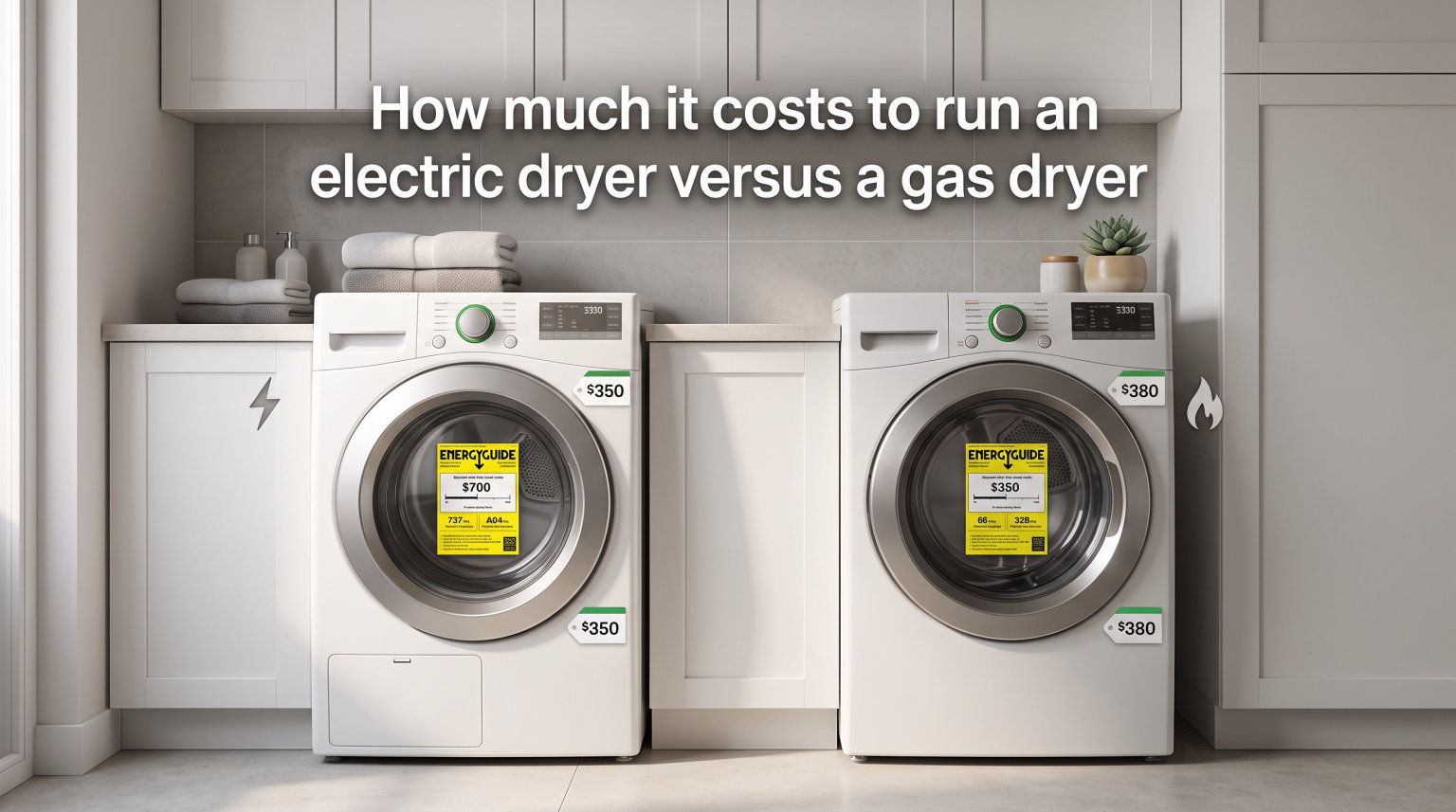
When I moved into my first home, I assumed the dryer already in the laundry room was the cheapest option to run. After 18 months of high utility bills, I learned that picking the right dryer type can save you $35 to $85 a year on energy, and sometimes much more depending on local rates. The electric dryer vs gas dryer cost question matters more than most homeowners realize, especially if you do six or more loads per week.
In this guide, I break down real operating numbers using current U.S. average utility rates, share what our team found after analyzing dozens of homeowner forums, and give you a formula to calculate your own personal dryer cost based on your local energy prices.
Table of Contents
Quick Answer: Which Dryer Costs Less to Run?
A gas dryer typically costs less to run than an electric dryer, saving about $35 to $85 per year for the average household. According to industry data, an energy-efficient electric dryer costs around $120 to $130 per year to operate, while a comparable gas dryer runs about $85 per year. That works out to roughly $0.15 to $0.35 savings per load with gas, based on feedback shared by users on Reddit’s r/Appliances community.
However, the operating cost advantage is only part of the picture. Gas dryers cost $50 to $150 more upfront, and if your home does not already have a gas line, installation can add $1,800 or more. Electric dryers are simpler to install but tend to run longer per cycle, which can shrink some of the gas savings in high-electricity regions.
Annual Operating Cost Breakdown
The annual operating cost of a dryer comes down to three numbers: how much energy it uses per cycle, how many loads you run per year, and your local utility rate. Here is what our team found using current averages.
Electric Dryer Monthly and Annual Costs
A standard electric dryer uses roughly 2 to 5 kWh per load, depending on the cycle and load size. Pensacola Energy reports that a typical electric dryer consumes around 80 kWh per month. At the current U.S. average residential electricity rate of about $0.17 per kWh, that adds up to roughly $13.60 per month or $163 per year.
Energy-efficient electric dryers with moisture sensors and eco modes drop the figure closer to $120 to $130 per year. Premium heat pump dryers can cut that even further, but they carry a much higher purchase price.
Gas Dryer Monthly and Annual Costs
A gas dryer uses about 15,000 to 22,000 BTUs of natural gas per cycle, plus a small amount of electricity to run the drum and controls. According to Mr. Sparky’s analysis, a comparable gas dryer costs about $85 per year to operate at average U.S. natural gas prices of around $1.20 per therm. The Omni Calculator estimates put the annual cost at roughly $31.20 in regions with very low gas rates, but $85 is a more realistic national figure.
In regions where natural gas is cheap and electricity is expensive, the savings can stretch well above $100 per year. In regions where electricity is subsidized or gas is expensive, the gap shrinks considerably.
Cost Per Load Comparison
Per load, an electric dryer runs about $0.40 to $0.55 in energy costs, while a gas dryer runs about $0.20 to $0.35. That $0.15 to $0.35 per-load difference is the figure that gets cited most often in homeowner forums. If you run eight loads a week, that adds up to $60 to $145 in yearly savings.
| Metric | Electric Dryer | Gas Dryer |
|---|---|---|
| Average cost per load | $0.40 to $0.55 | $0.20 to $0.35 |
| Monthly energy cost | $10 to $14 | $6 to $9 |
| Annual energy cost | $120 to $165 | $70 to $110 |
| Drying time per load | 45 to 60 minutes | 30 to 45 minutes |
| Average lifespan | 13 to 14 years | 12 to 13 years |
How to Calculate Your Personal Dryer Cost
The national averages are useful, but your real cost depends on local utility rates. Here is the formula our team uses when we want a personalized estimate.
For electric dryers: Multiply kWh per load by your electricity rate (per kWh) by the number of loads per year. A dryer using 3 kWh per load at $0.17 per kWh for 400 loads per year equals $204 per year.
For gas dryers: Multiply therms per load by your gas rate (per therm) by the number of loads per year, then add the small electricity cost for controls. A dryer using 0.15 therms per load at $1.20 per therm for 400 loads equals $72, plus roughly $10 for the electricity used by the drum motor and controls.
If you do not know your local rates, your utility bill lists them as “price per kWh” and “price per therm” or “per Ccf.” Plug those numbers into the formula above to get an estimate closer to your real cost.
Gas Dryer Pros and Cons
Gas dryers heat up faster than electric models, which means shorter dry cycles. Most homeowners we spoke with said gas dryers finish a normal load in 30 to 40 minutes, compared to 50 to 60 minutes for a standard electric. That faster drying is part of why gas dryers tend to use less total energy per load.
The main downside of gas dryers is the installation. They require a dedicated gas line shutoff valve within a few feet of the dryer and proper venting to the outside. If your laundry room does not already have a gas stub-out, hiring a licensed plumber to run one can cost anywhere from $500 for a short, easy run to $1,800 or more for longer distances or homes with no existing gas service.
Maintenance is another consideration. Gas dryers have a burner assembly, igniter, and gas valve that occasionally need service. Repairs tend to cost slightly more than equivalent electric dryer repairs, but the gap is smaller than most homeowners expect.
Here is a quick summary of the gas dryer trade-offs:
Pros: Lower operating cost, faster drying, gentler on fabrics due to shorter heat exposure
Pros: Higher BTU output handles large loads and bulky items like comforters more efficiently
Cons: Higher upfront cost ($50 to $150 more than comparable electric models)
Cons: Requires gas line hookup; installation adds $500 to $1,800 if no line exists
Cons: Slightly more complex maintenance due to burner components
Electric Dryer Pros and Cons
Electric dryers are simpler in design, which makes them easier and cheaper to install. If your laundry room has a 240-volt outlet, you can plug in an electric dryer and start using it the same day. Most U.S. homes are already wired for electric dryers, and about 75 percent of households use one.
The trade-off is energy use. Electric dryers use resistance heating coils that take longer to reach full temperature, which is why a typical cycle runs 50 to 60 minutes. In regions where electricity is expensive, that extra runtime shows up clearly on the monthly bill.
One emerging option is the heat pump dryer, which uses refrigerant and a compressor to dry clothes at lower temperatures. Heat pump dryers use about half the electricity of a standard electric dryer and can pay back their higher purchase price within five to seven years in high-electricity regions.
Here is the electric dryer breakdown:
Pros: Lower upfront cost ($100 to $300 less than gas on average)
Pros: Easier installation; only requires a 240-volt outlet
Pros: Simpler maintenance with fewer components to service
Pros: Heat pump models offer significant energy savings over time
Cons: Higher operating cost in most U.S. regions
Cons: Longer dry cycles increase wear on some fabrics
Cons: Higher energy use contributes to larger carbon footprint in regions reliant on fossil-fuel electricity
Installation Requirements and Upfront Costs
Before choosing between gas and electric, it is worth checking what your home already supports. Electric dryers need a dedicated 240-volt circuit with a four-prong outlet in most homes built after 2000. Older homes with three-prong outlets can still use electric dryers but may need a receptacle upgrade.
Gas dryers need two things: a 120-volt standard outlet for the controls and a gas supply line with a shutoff valve. The gas line must be properly sized for the dryer’s BTU load and installed to local code.
Installation costs vary widely:
Gas line installation (no existing line): $500 to $1,800 depending on distance and complexity
Gas dryer conversion kit (propane to natural gas or vice versa): $20 to $50
Electric dryer installation (existing outlet): Usually free, or $100 to $200 if a new 240V circuit is needed
Venting installation: $100 to $300 if no existing exterior vent
One detail many homeowners overlook: a gas dryer cannot be installed in a location where gasoline or other flammable vapors are present, and many building codes restrict gas dryers in bedrooms or sleeping areas. Electric dryers do not have these restrictions.
How to Tell If Your Dryer Is Gas or Electric?
If you are staring at a dryer and not sure what type it is, there are a few quick ways to tell. Gas and electric dryers look nearly identical from the front, but the back panel and connections are different.
Here is a simple three-step check:
Look at the connections at the back. Electric dryers have one large 240-volt cord with a big three or four-prong plug. Gas dryers have a smaller standard 120-volt plug plus a flexible gas line with a shutoff valve.
Check the data plate. Open the door or check the panel behind the door. Gas dryers are labeled “Natural Gas” or “LP” (liquefied petroleum), and the BTU rating will be listed. Electric dryers list voltage (240V) and wattage instead.
Listen to the startup. Gas dryers make a brief clicking or whooshing sound as the igniter lights the burner. Electric dryers start almost silently, with only the drum motor humming.
If your home only has a standard 120-volt outlet in the laundry area, you have an electric dryer. Gas dryers always need a dedicated gas line nearby.
Heat Pump Dryers: A Modern Electric Alternative
Heat pump dryers are the most significant change in clothes drying in decades. Instead of generating heat, they recirculate warm air through a refrigerant system, much like a window air conditioner running in reverse. The result is a dryer that uses roughly 50 percent less electricity than a standard electric model.
The catch is upfront cost. Heat pump dryers run $1,200 to $2,500, which is significantly more than a $600 to $900 standard electric dryer. They also run longer per cycle (60 to 90 minutes for a normal load), but the operating cost is so low that the higher purchase price pays back over time in regions where electricity costs more than $0.15 per kWh.
For households that do not have access to natural gas and want to lower their electric dryer operating cost, a heat pump model is worth considering. Major brands including LG, Samsung, Bosch, and Miele all offer heat pump dryers in the U.S. market as of 2026.
Which Dryer Is Right for You?
The right choice depends on three things: whether your home already has a gas line, your local utility rates, and how much laundry you do each week. Here is a simple decision framework our team uses.
Pick a gas dryer if: Your home already has a gas line stub-out in the laundry room, your local gas rate is below $1.50 per therm, and you run six or more loads per week. The operating savings will typically cover the higher purchase price within three to five years.
Pick a standard electric dryer if: Your home has no gas service and you do not want to pay for a new gas line, your local electricity rate is below $0.12 per kWh, or you only do three to four loads per week. The operating cost difference is small enough that installation simplicity wins.
Pick a heat pump dryer if: Your home has no gas service, your local electricity rate is above $0.17 per kWh, and you plan to keep the dryer for eight or more years. The energy savings will offset the higher purchase price in most cases.
Regional availability matters too. According to the U.S. Energy Information Administration, only about 31 to 69 percent of U.S. homes have access to natural gas hookups, depending on the region. In the Northeast and parts of the Southeast, natural gas is much less common, which effectively limits your choice to electric or heat pump models.
Frequently Asked Questions
Is it cheaper to dry clothes with a gas or electric dryer?
Yes. A gas dryer costs about $85 per year to operate, while a comparable electric dryer runs $120 to $165 per year at average U.S. utility rates. The savings come from cheaper natural gas prices and faster drying times, which reduce total energy per load.
How much does it cost to run a gas dryer for 1 hour?
Running a gas dryer for one hour costs about $0.30 to $0.55 in combined natural gas and electricity costs at average U.S. utility rates. Natural gas accounts for roughly $0.20 to $0.40, and the small electric draw for the drum and controls adds another $0.05 to $0.15.
What lasts longer, an electric or gas dryer?
Both types last about 12 to 14 years with normal use, and neither has a clear lifespan advantage. Electric dryers have fewer mechanical parts, but gas dryers produce less cumulative heat stress on components. The biggest factor in dryer lifespan is regular vent cleaning and avoiding overloading.
Are gas dryers being phased out?
No, gas dryers are not being phased out at the federal level as of 2026. Some California municipalities have restricted natural gas appliances in new construction, but gas dryers remain widely available and manufactured across the rest of the U.S. The market is shifting toward heat pump dryers in regions pushing for electrification.
Is it worth switching from electric to gas dryer?
It is worth switching only if your home already has a gas line and you do six or more loads per week. Without an existing gas hookup, the $500 to $1,800 installation cost can take five to ten years to recover through energy savings. If your home has no gas service, a heat pump electric dryer offers better long-term value.
Final Verdict on Electric Dryer vs Gas Dryer Cost
For most households with existing gas service, a gas dryer wins on operating cost. The annual savings of $35 to $85 are real, the faster drying is a quality-of-life bonus, and the higher upfront price pays itself back in three to five years. For households without a gas line, the math depends on how much you value lower operating cost over simpler installation. A standard electric dryer is the path of least resistance, while a heat pump model offers meaningful long-term savings if you plan to keep the appliance for a decade or more.
The best dryer for your home is the one that matches your utility rates, your laundry volume, and the infrastructure already in place. Use the formulas in this guide to calculate your personal cost and you will have a clear answer within minutes.