
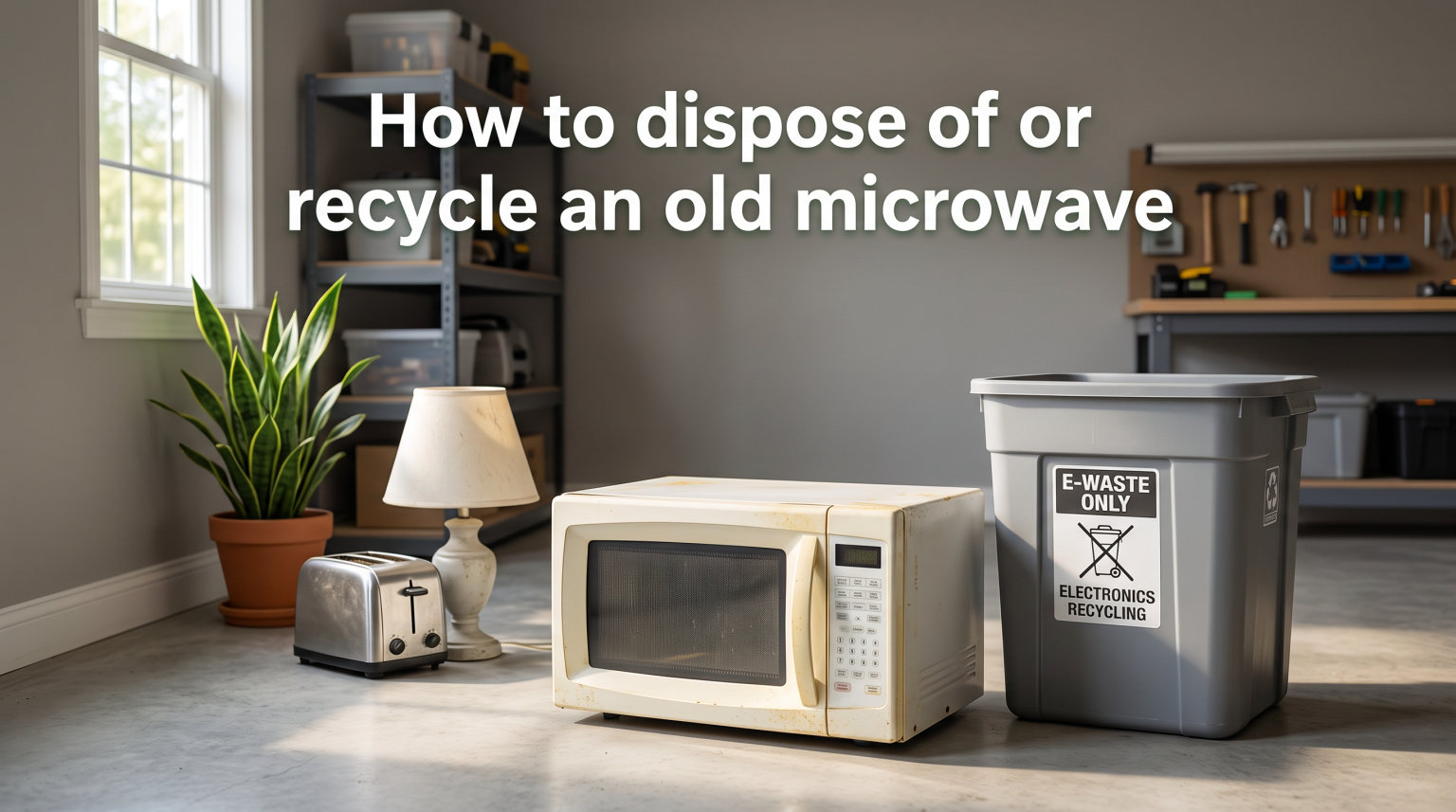
Every year, millions of Americans upgrade their kitchen appliances and face the same question: what do I do with the old one? If you are wondering how to dispose of or recycle an old microwave, you are not alone. The answer is more complicated than simply wheeling it to the curb.
Microwaves are classified as electronic waste, or e-waste, which means they contain materials that demand special handling. Tossing one in your regular trash bin can be illegal depending on where you live. It can also release hazardous substances into the environment.
In this guide, I walk you through every viable option for getting rid of an old microwave the right way. You will learn about certified recycling, retailer take-back programs, donation routes, selling, and even repair. I also cover safety steps, state-specific regulations, and how to verify a recycler is actually doing the job properly.
Table of Contents
Why You Can’t Just Throw a Microwave in the Trash?
Microwaves are not ordinary household waste. They contain a mix of metals, plastics, electronic components, and potentially hazardous materials that standard landfills are not equipped to process.
The biggest concern is the magnetron, the component that generates the microwaves. It contains heavy metals and can store a dangerous electrical charge long after the unit is unplugged. Microwaves also contain circuit boards, wiring, and capacitors that fall under electronic waste regulations.
The E-Waste Classification
In most jurisdictions, a microwave is classified as e-waste or household hazardous waste rather than bulky household waste. This classification exists because microwaves contain recoverable materials like steel, copper, and aluminum, alongside components that can leach toxins if buried in a landfill.
Because of this classification, many states have passed laws that specifically prohibit putting microwaves in regular curbside trash or standard landfill drops.
State and Local Laws You Should Know
Disposal laws vary significantly by state. California, for example, classifies microwaves as “universal waste” under its Electronic Waste Recycling Act, making it illegal to dispose of them in regular trash anywhere in the state. New York, Illinois, Pennsylvania, and several other states have similar e-waste bans that cover microwaves.
Other states leave regulation to individual counties and municipalities. This means the rules can differ from one town to the next, even within the same state.
I always recommend checking your local county or city government website before making any disposal decision. Search for “household hazardous waste” plus your city name to find the official rules that apply to you.
Environmental Impact of Improper Disposal
When a microwave ends up in a landfill, the recoverable steel, copper, and aluminum are wasted. Those are finite resources that recyclers can reclaim and return to the manufacturing supply chain.
More importantly, the electronic components can degrade over time and release harmful substances into soil and groundwater. Responsible e-waste disposal keeps these materials out of the environment and reduces the need for virgin mining.
How to Dispose of or Recycle an Old Microwave: Your Main Options
When it comes to how to dispose of or recycle an old microwave, you have five solid options. The best choice depends on whether your microwave still works, your budget, and what services are available in your area.
I have ranked these from most environmentally responsible to most convenient. In general, you want to keep a working appliance in use for as long as possible before sending it to recycling.
Option 1: Recycle at a Certified E-Waste Facility
Recycling is the go-to option for microwaves that no longer work. A certified e-waste recycler will break the unit down, separate the materials, and process each component appropriately.
To find a facility, search “microwave recycling near me” or use the EPA’s searchable database of certified electronics recyclers. Many county recycling centers also have dedicated electronics drop-off sections.
Some facilities charge a small fee, typically between $5 and $20, to process a microwave. This covers the labor and specialized handling the unit requires. A few municipal programs offer free drop-off events, so it is worth checking your local waste management calendar.
Option 2: Retailer Take-Back Programs
Several major retailers run electronics recycling programs that accept old microwaves. Best Buy is one of the most accessible, offering in-store drop-off at most locations. They typically accept microwaves and other small appliances at no charge, though some restrictions apply based on size and condition.
Home Depot and Lowe’s recycle some electronics, but their microwave policies vary by store. I recommend calling your local store before making the trip to confirm they will accept your unit.
When you purchase a new microwave, ask the retailer if they offer haul-away or take-back for the old one. Many appliance sellers include this service, sometimes free with delivery and sometimes for a small fee.
Option 3: Donate a Working Microwave
If your microwave still heats food properly, donating it is the best outcome. Keeping a functional appliance in use is always better than recycling it, because it extends the product’s lifespan and helps someone who needs it.
Habitat for Humanity ReStore locations frequently accept working microwaves. Goodwill and Salvation Army thrift stores also take small appliances in some regions, though policies vary.
Local shelters, community centers, and refugee resettlement programs often need working microwaves. Posting in a neighborhood Facebook group or on Freecycle can connect you directly with someone who will put it to use.
Before donating, clean the microwave thoroughly and test it one more time. Most charities will not accept appliances that are dirty, damaged, or non-functional.
Option 4: Sell or Freecycle Your Microwave
A working microwave can fetch anywhere from $20 to $50 on platforms like Facebook Marketplace, Craigslist, or eBay local pickup. Higher-end models or units in excellent condition can go for more.
Be honest about the age and condition in your listing. Include clear photos and mention any cosmetic wear. Buyers appreciate transparency and it saves everyone time.
If selling feels like too much effort, Freecycle and the “free” section of Craigslist are excellent options. You would be surprised how quickly a working microwave disappears when listed for free. Someone who needs one will usually pick it up the same day.
Option 5: Repair Instead of Replace
Before getting rid of a microwave, consider whether it actually needs to be replaced. Many common microwave problems are fixable, and repairing extends the appliance’s life while saving you money.
If your microwave runs but does not heat, the problem is often a blown fuse or a faulty diode, both of which are inexpensive parts. Turntable issues are usually a worn motor or a broken coupler. Sparking inside the cavity might just mean a damaged waveguide cover that costs a few dollars to replace.
Search for “repair microwave” plus your issue to find troubleshooting guides. Community repair resources like iFixit and local repair cafes can help you identify whether a fix is worthwhile.
One important warning: never attempt to open a microwave’s internal housing unless you know how to safely discharge the capacitor. The high-voltage capacitor can deliver a serious shock even after the unit has been unplugged for days.
Step-by-Step Guide to Preparing Your Microwave for Disposal
Once you have chosen your disposal method, a few preparation steps make the process safer and smoother. Follow these in order.
Step 1: Unplug and let it rest. Disconnect the microwave from power and let it sit unused for at least 24 hours. This gives the internal capacitor time to dissipate stored charge, reducing shock risk.
Step 2: Remove all accessories. Take out the glass turntable, the roller ring, and any removable racks. These are standard glass and plastic items that you can recycle separately or keep for a future microwave.
Step 3: Clean the interior. Wipe down the inside with a damp cloth and mild soap. This matters most if you are donating or selling, but it is also courteous for the recycling staff who will handle the unit.
Step 4: Check the door latch. Tape the door shut if the latch is broken. This prevents the door from swinging open during transport and keeps the interior components contained.
Step 5: Choose and confirm your disposal route. Call ahead to confirm hours, fees, and acceptance policies before you drive anywhere. Nothing is more frustrating than arriving at a recycling center only to find they do not accept microwaves on that day.
Step 6: Transport safely. Secure the microwave in your vehicle so it does not slide or tip over. If you are using a pickup service, leave the unit in an accessible location and follow any instructions the hauler provides.
How to Verify a Certified Recycler
Not all recyclers operate to the same standard. Some unverified operations ship electronics overseas where they are processed unsafely. To make sure your microwave is handled responsibly, look for two key certifications.
The first is e-Stewards certification, an internationally recognized standard that prohibits the export of toxic e-waste to developing countries. The second is R2 certification, a standard managed by SERI that covers environmental, worker safety, and data security practices.
You can verify a recycler’s certification status directly on the e-Stewards and R2 official websites. Both maintain searchable directories of certified facilities. If a recycler cannot show either certification, ask pointed questions about where your microwave will end up before handing it over.
What Happens to Your Microwave During Recycling
Understanding the recycling process can give you confidence that your old microwave is being handled properly. At a certified facility, the process is thorough and methodical.
The microwave is first inspected to determine if it can be refurbished. Working units may be cleaned, tested, and resold. Non-working units move on to the dismantling stage.
During dismantling, technicians or automated systems separate the unit into distinct material streams. The outer steel casing is recovered as scrap metal. The circuit boards are processed for their copper, gold, and other metals. The magnetron is removed and handled separately due to its specialized components.
Plastics are sorted by type and sent to plastic recyclers. Glass from the turntable and door is separated and recycled. Even the wiring is stripped for its copper content.
In the end, a large percentage of a microwave’s weight is recoverable material. Steel alone accounts for a significant portion, and reclaiming it requires far less energy than producing new steel from raw ore.
Cost Comparison of Disposal Methods
Cost is a common concern, and disposal expenses can range from free to around $25 depending on the method you choose.
Donation and freecycling are always free. Selling actually puts money in your pocket. Retailer take-back programs like Best Buy are typically free for in-store drop-off. Municipal household hazardous waste events are often free for residents.
Certified e-waste recyclers usually charge a modest fee between $5 and $20. Curbside bulk pickup from your city or waste hauler may be free or carry a small charge, depending on your local program. Private junk removal services are the most expensive option, often starting around $50 to $100 for appliance haul-away.
If cost is a barrier, start with free options. Your county website is the best place to find free local electronics recycling events and drop-off points.
FAQs
How do I discard an old microwave?
You can discard an old microwave by recycling it at a certified e-waste facility, dropping it off at a retailer like Best Buy, donating it if it still works, or scheduling a bulk pickup through your city. Never put a microwave in regular household trash, as it is classified as e-waste in most jurisdictions.
Can I put a microwave in general waste?
No, you should not put a microwave in general waste or regular trash. Microwaves are classified as electronic waste and contain hazardous components that can harm the environment. Many states, including California and New York, legally prohibit disposing of microwaves in regular trash.
What do you do with old microwaves that don’t work?
Broken microwaves should be taken to a certified e-waste recycler or a retailer take-back program like Best Buy. You can also check with your county’s household hazardous waste program for free drop-off events. Some scrapyards accept microwaves for their metal content, but certified recyclers handle the hazardous components more safely.
Will Home Depot take my old microwave?
Home Depot’s recycling acceptance varies by location. Some stores accept small electronics through their recycling programs, while others do not take microwaves at all. Call your local store to confirm before bringing in your unit. Best Buy is generally more reliable for microwave drop-off.
Wrapping Up: Dispose of Your Microwave the Right Way
Figuring out how to dispose of or recycle an old microwave does not have to be stressful. If the unit still works, donation or selling keeps it in use and is the most environmentally responsible choice. If it is broken, a certified e-waste recycler or retailer take-back program will handle it properly.
The key steps are simple. Check your local regulations, choose the best option for your situation, prepare the unit safely, and verify your recycler holds e-Stewards or R2 certification. Avoid the trash bin at all costs, both for the environment and because it may be illegal where you live.
Take five minutes today to search your county website or a retailer near you. Your old microwave has recoverable materials inside it, and proper disposal ensures those resources find a second life instead of a landfill.