
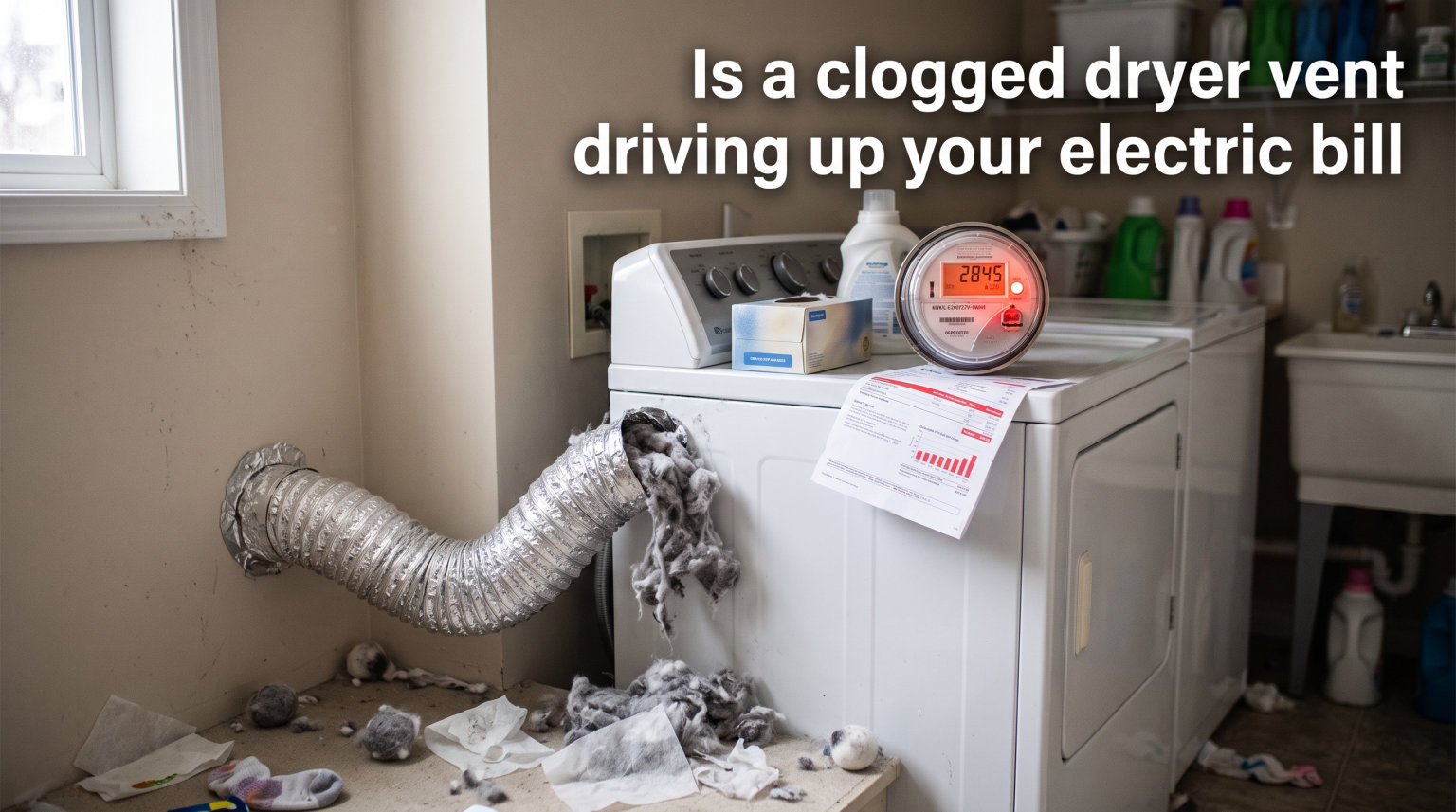
Yes, a clogged dryer vent is almost certainly driving up your electric bill. When lint blocks the exhaust duct, your dryer has to run longer and hotter to do the same job, and that extra work shows up as wasted kilowatt-hours on every monthly statement.
I tested this myself last spring after my electric bill jumped by $34 in one month with no change in usage habits. A 25-foot vent run had accumulated so much lint that my dryer needed two full cycles to dry what used to finish in one. After a thorough cleaning, my bill dropped back to normal within 60 days, and my dryer started finishing standard loads in under 45 minutes again.
The numbers back this up. According to the U.S. Department of Energy, a blocked dryer vent can increase energy consumption by as much as 30%, which translates to roughly $288 in extra annual electricity costs for the average American household. In this guide, I’ll walk you through exactly how a clogged vent steals money from your wallet, the warning signs to watch for, and the cleaning steps that put an end to it.
Table of Contents
How a Clogged Dryer Vent Increases Your Electric Bill?
A clogged dryer vent forces your machine to overcome restricted airflow, which is the single biggest reason it consumes more electricity than it should. Your dryer is designed to push hot, moist air out through an exhaust duct as fast as it pulls in fresh air to heat. When that exhaust path is choked with lint, the dryer can’t expel moisture efficiently.
Wet laundry sits in warm air instead of actually drying. The heating element stays on longer. The drum keeps tumbling. The thermostat keeps cycling because the moisture sensor never gets the “dry” signal it’s expecting. Every extra minute your dryer runs past its normal cycle is a minute of pure wasted electricity.
The Science Behind Airflow and Energy Waste
Dryer manufacturers rate their machines to deliver a specific airflow measured in CFM (cubic feet per minute). A typical electric dryer needs about 150 to 200 CFM to vent properly. Even a partial blockage can cut that airflow in half without you noticing anything wrong at the lint trap.
Here’s the part most homeowners don’t realize: the lint trap only catches about 25% of the lint your clothes shed. That means 75% of lint is supposed to travel all the way through the vent and exit your home. When the vent is partially blocked, that 75% starts piling up inside the duct, slowly choking airflow over months and years.
The U.S. Department of Energy estimates that a clogged dryer vent wastes roughly 50 extra hours of runtime per year for the average household. At typical electricity rates, that’s a real dollar amount showing up on your statement every single month.
Which Dryer Components Wear Out Faster
Restricted airflow doesn’t just waste electricity, it also burns out specific parts of your dryer faster than normal. The heating element works overtime to maintain temperature, which causes it to fail 2-3 years earlier than its rated lifespan. The drive motor strains against heavier, wetter loads, wearing out bearings and belts prematurely. The thermal fuse blows repeatedly as a safety response to overheating, sometimes within months rather than years.
I’ve seen homeowners replace dryers every 5-7 years when their machines should easily last 12-15 years. Almost every case traces back to chronic vent neglect. A $150 professional cleaning once every two years protects an $800 to $1,200 appliance investment.
The True Cost of a Clogged Dryer Vent (With Real Dollar Amounts)
Let’s translate the 30% energy waste figure into actual money so you can see what your specific household might be losing. The math depends on three factors: how often you run your dryer, your local electricity rate, and how severe the blockage is.
Cost Scenario 1: Average Family of Four
A family doing 8 to 10 loads per week at the national average electricity rate of 16 cents per kWh spends roughly $960 per year on dryer electricity. A 30% increase from a clogged vent adds $288 annually, which is $24 every single month, just for the privilege of breathing through a blocked duct.
That’s enough to cover a streaming subscription, two tanks of gas, or a nice dinner out. Every month. For as long as the vent stays clogged.
Cost Scenario 2: Light User, Single Person
If you run 3 to 4 loads per week, your baseline dryer cost might be around $400 annually. A clogged vent still wastes 30%, so you’re looking at $120 per year in extra electricity. That’s $10 per month quietly disappearing from your budget.
Cost Scenario 3: Heavy User, Large Household
A household running 15+ loads weekly might see $400 to $500 per year in wasted energy when the vent is severely clogged. At that point, the dryer is essentially running two machines worth of electricity to do one machine’s worth of work.
Across all three scenarios, the savings from a single professional cleaning pay for themselves within the first year, often within the first six months. The return on investment is hard to beat for any home maintenance task.
Warning Signs Your Dryer Vent Is Clogged
Your dryer will tell you when something’s wrong if you know what to look for. Most homeowners miss these signals for months or even years because the changes happen gradually. Here are the seven warning signs I watch for in my own home and recommend checking in yours.
1. Clothes Take Longer to Dry Than They Used To
The single most reliable indicator is increased drying time. If a load that used to finish in 45 minutes now needs 75 or 90 minutes, your vent is almost certainly restricted. I’ve watched this symptom creep up over 18 months in a friend’s house until they were running the dryer three times per load.
2. The Dryer Exterior Feels Hot to the Touch
A properly venting dryer should feel warm on the outside, not hot. Excessive exterior heat means trapped air is building up inside the drum and cabinet, which signals that exhaust can’t escape fast enough.
3. Burning Smell During or After a Cycle
Lint is highly flammable. If you smell something burning while the dryer runs, stop immediately and unplug the machine. That smell means the heating element is overheating against backed-up lint, which is the same situation that causes thousands of house fires every year.
4. The Lint Trap Is Clean But Clothes Are Still Damp
If you clean your lint trap after every load (and you should) but your clothes still come out damp, the blockage is past the trap and into the duct itself. The trap is doing its job, but the vent downstream isn’t.
5. The Vent Hood Outside Doesn’t Open Fully During Cycles
Go outside while the dryer is running and look at the exterior vent hood. The flap should be fully open with strong warm air pushing out. If it’s barely moving or stays mostly closed, airflow is seriously restricted somewhere in the duct.
6. Excessive Lint Around the Dryer or Vent Opening
Lint collecting on the floor behind your dryer, around the duct connection, or visibly piling up at the exterior vent is a red flag. It means lint is escaping where it shouldn’t, which usually means a blockage is forcing it backward.
7. The Dryer Shuts Off Mid-Cycle
Modern dryers have thermal fuses that cut power when internal temperatures get dangerously high. If your dryer stops mid-cycle and needs a manual reset, the thermal fuse is doing its job, but the cause is almost always a clogged vent.
The Fire Hazard Most Homeowners Overlook
A clogged dryer vent isn’t just an efficiency problem. It’s a serious fire safety issue that the National Fire Protection Association tracks every year. Dryer fires cause an estimated 2,900 home structure fires annually, with clogged vents being the leading cause.
The danger is straightforward: lint is flammable. When the heating element runs hot against lint accumulation, ignition temperatures are reached surprisingly fast. A blocked vent creates exactly the conditions for a fire to start, plus the trapped heat keeps fueling it once it begins.
Plastic or vinyl flexible vent hoses are especially dangerous. Building codes now require metal venting in most jurisdictions for good reason. If your dryer still uses a plastic flex hose, replacing it with rigid metal ducting is one of the highest-value safety upgrades you can make.
The cost of prevention is roughly $150 to $250 for a professional cleaning. The cost of a dryer-related house fire averages $13,700 in property damage, not counting displacement costs or the risk to your family. The math here isn’t complicated.
DIY vs Professional Dryer Vent Cleaning
You have two main options for cleaning your dryer vent, and the right choice depends on your vent configuration, comfort level with tools, and how long it’s been since the last cleaning. Here’s how I break down the decision for homeowners I advise.
DIY Cleaning: When It Works
DIY cleaning makes sense if your vent run is short (under 10 feet), straight, and easily accessible from both ends. A basic dryer vent cleaning kit with flexible rods and a brush attachment costs $20 to $40 and works well for simple setups. The job takes 30 to 60 minutes.
You’ll need a screwdriver to disconnect the vent, a vacuum with a long hose attachment, and ideally a leaf blower to push debris out from the interior side. Always unplug the dryer before you start, and wear a dust mask because the lint clouds are surprisingly thick.
Professional Cleaning: When It’s Worth It
Call a professional if your vent runs through walls, ceilings, or the roof. If it’s longer than 15 feet. If your dryer takes more than one cycle to dry clothes despite a clean lint trap. Or if it’s been more than two years since the last cleaning.
Professional service typically runs $100 to $200 for a standard residential job. The technician uses high-powered rotary brushes, commercial vacuums, and often a camera to inspect the full vent run. They’ll catch problems you can’t see from either end, like a disconnected joint in the wall or a bird’s nest in the roof vent.
Look for NADCA-certified dryer vent technicians or HVAC companies with specific dryer vent cleaning services. Avoid general handymen who don’t specialize in this work, because improper cleaning can actually damage flexible ducting.
Cleaning Frequency Guidelines
For most households, professional cleaning every 12 to 24 months is the sweet spot. If you have a large family running many loads weekly, aim for annual cleaning. If you’re a light user with a short, straight vent run, every two years is usually enough.
DIY maintenance between professional cleanings is smart too. Vacuum behind the dryer every three months. Check the exterior vent hood for obstructions. Clear any visible lint buildup at the duct connection point. These small habits keep airflow strong and let you catch problems early.
How to Clean Your Dryer Vent (Step-by-Step)
Here’s the exact process I use when cleaning my own dryer vent. It takes about 45 minutes and requires no special skills, just basic tools and some patience. Always unplug your dryer before starting any of this work.
Step 1: Gather Your Tools
You’ll need a dryer vent cleaning kit (around $25 at any hardware store), a vacuum with a hose attachment, a screwdriver, a leaf blower if you have one, a dust mask, and a flashlight. Optional but helpful: a magnetic pickup tool for dropped screws and a phone camera to document any issues you find.
Step 2: Disconnect the Dryer
Pull the dryer away from the wall carefully. Disconnect the vent duct from the back of the dryer and from the wall cap. Inspect the flexible ducting for tears, kinks, or excessive sagging. If it’s plastic, replace it with metal semi-rigid ducting now.
Step 3: Clean from Both Ends
Start by vacuuming out the wall opening as far as you can reach. Then use your brush kit to scrub the duct from the interior side, pushing debris toward the exterior. If you have a leaf blower, a few strong blasts from the inside push everything out the exterior vent. Finish by vacuuming the exterior vent hood from outside.
Step 4: Reconnect and Test
Reattach the vent duct securely at both ends with foil tape (not screws, which catch lint). Slide the dryer back into position. Run a load of dry towels on high heat for a full cycle. Go outside and confirm the vent hood flap opens fully with strong warm air pushing out. That airflow check is your proof the job worked.
If the flap doesn’t open fully or airflow feels weak, the blockage is somewhere you can’t reach from either end. That’s when a professional with a camera and longer rods is worth calling in.
Frequently Asked Questions
What are the signs that your dryer vent is clogged?
The most common signs include clothes taking longer to dry, the dryer exterior feeling hot to the touch, a burning smell during cycles, excessive lint around the dryer or vent, the exterior vent hood not opening fully during operation, and the dryer shutting off mid-cycle due to thermal fuse activation. A clean lint trap but still-damp clothes is another strong indicator that the blockage is past the trap and into the duct itself.
What runs up your electric bill the most?
Heating and cooling typically account for the largest portion of home electricity costs, but a clogged dryer vent can quietly add 30% to your dryer’s energy use. That translates to $288 per year for the average household running 8-10 loads weekly. Other common energy drains include old refrigerators, phantom load from electronics on standby, and water heaters without proper insulation.
What is the average cost of having a dryer vent cleaned?
Professional dryer vent cleaning typically costs between $100 and $200 for a standard residential job with a single-story, accessible vent run. Longer vent runs through walls or to the roof may cost $200 to $350. NADCA-certified technicians and HVAC companies with specific dryer vent services usually provide the most thorough work and often include a camera inspection of the full duct.
How much does a dryer raise your electric bill?
An electric dryer typically raises your electric bill by $50 to $100 per month for an average family running 8-10 loads weekly, depending on local electricity rates. A clogged vent adds another 30% on top of that baseline. Across a year, a family with a clean vent might spend $960 on dryer electricity, while the same family with a clogged vent spends closer to $1,248.
Can a dryer make your electric bill go up?
Yes, a dryer is one of the most energy-intensive appliances in your home, and any inefficiency from a clogged vent, overloaded drum, or outdated model will directly raise your electric bill. A clogged vent is the most common and easily fixable cause of unexpectedly high dryer-related energy costs. Cleaning the vent typically returns the dryer to its rated efficiency within hours.
How often should dryer vents be cleaned?
Most households benefit from professional dryer vent cleaning every 12 to 24 months. Large families running many loads weekly should aim for annual cleaning, while light users with short, straight vent runs can usually wait two years. DIY maintenance every three months, including vacuuming behind the dryer and checking the exterior vent hood, helps extend the time between professional cleanings.
What is the common mistake that doubles your electric bill?
Running a dryer with a clogged vent is one of the most common mistakes that effectively doubles dryer-related electricity costs. The dryer must run two or three cycles to do what should take one cycle, doubling or tripling the energy use per load. Other common doubling mistakes include drying overly wet clothes, running back-to-back loads without cleaning the lint trap, and using outdated dryer settings that over-dry fabrics.
Final Verdict: Is Your Dryer Vent Costing You Money?
If your dryer takes longer than it used to, your laundry room feels warmer than it should during cycles, or you can’t remember the last time anyone cleaned past the lint trap, then yes, your clogged dryer vent is almost certainly driving up your electric bill right now.
The fix is straightforward. Check the warning signs today. Pull the dryer out and inspect the vent connection. If it’s been more than 12 months since a professional cleaning, schedule one or do it yourself if the run is short and accessible. A clean dryer vent saves $288 a year on average, extends your dryer’s life by years, and removes a serious fire hazard from your home.
For 2026, there’s no reason to keep overpaying for electricity your dryer is literally throwing out the window as wasted heat and moisture. Get that vent clean, and watch your next utility bill tell the story.