
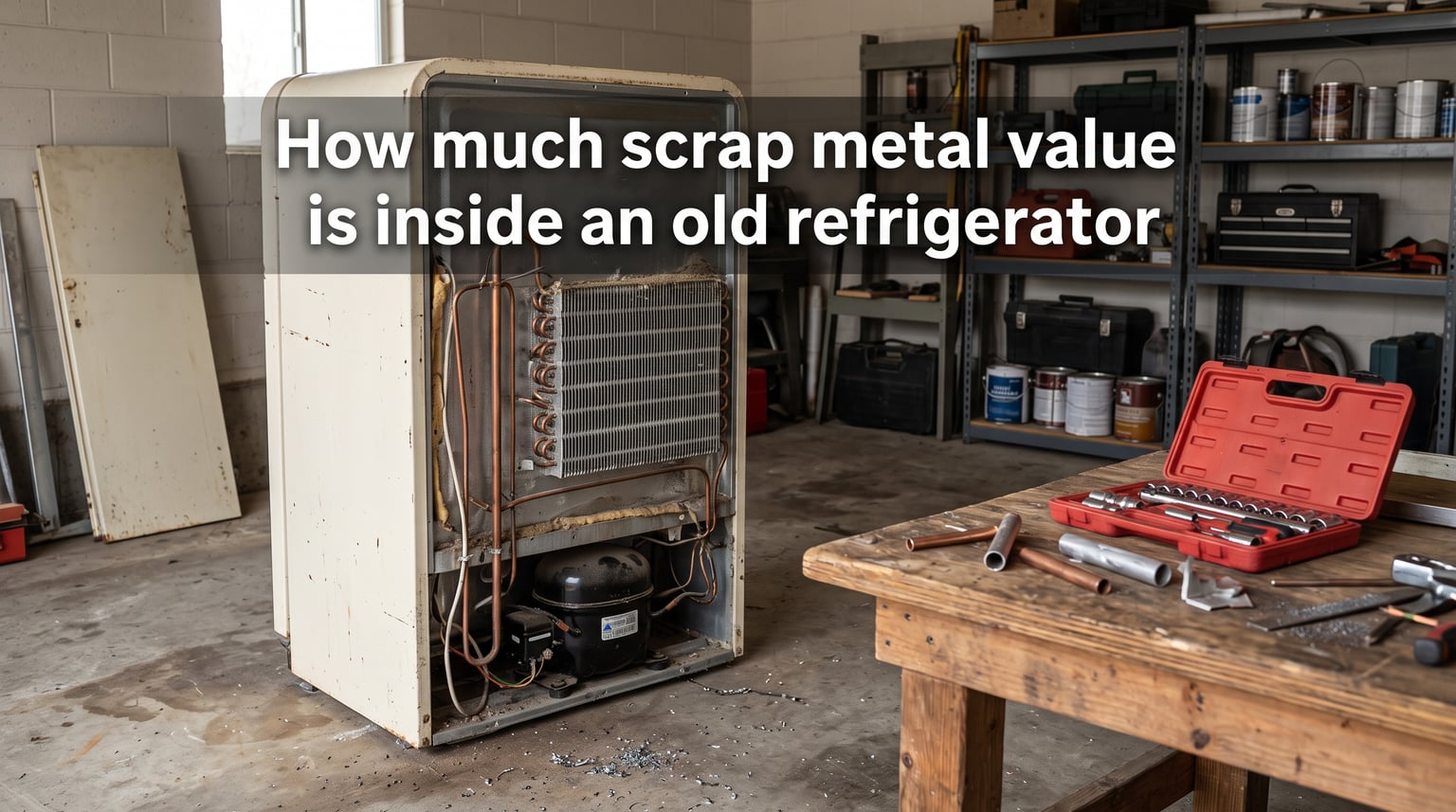
An old refrigerator typically contains between $15 and $35 worth of scrap metal. That value comes from roughly 140 to 200 pounds of steel, 3 to 5 pounds of copper, 5 to 8 pounds of aluminum, and 1 to 2 pounds of brass spread across the body, compressor, tubing, and condenser coils.
I’ve spent the last few months helping friends and family dismantle old refrigerators, and the numbers don’t lie. Even a beat-up 1990s fridge sitting in a garage can put $25 to $30 in your pocket if you know where the valuable metals hide. The trick is knowing what to look for, what’s safe to remove yourself, and what requires a certified technician.
In this guide, I’ll walk you through every metal inside a refrigerator, current per-pound prices, a step-by-step disassembly process, and the EPA rules around refrigerant removal. By the end, you’ll know exactly how much scrap metal value is inside an old refrigerator and how to get the most out of it.
Table of Contents
What Is the Scrap Metal Value of an Old Refrigerator?
An old refrigerator is worth $15 to $35 at a scrap yard when sold as a whole unit. If you separate the metals first, you can push that value to $35 to $55 or more, depending on current commodity prices in your region.
A standard refrigerator weighs between 150 and 300 pounds, with most home models landing around 200 to 250 pounds. The bulk of that weight is steel, which makes up the outer cabinet, inner liner, shelves, and door panels. But the real money sits in the smaller components: the copper motor windings inside the compressor, the thin copper refrigerant lines, and the aluminum coils on the back.
Reddit user Ok_Quality_2207 reported getting $28 for a complete fridge at a local yard, then saw the same fridge’s metal sell for $65 once separated. That gap is why professional scrappers always pull the compressor first. Homeowners who don’t separate are leaving $10 to $30 on the table, and they don’t even know it.
Quick Answer: Old Refrigerator Scrap Value 2026
- Total value range: $15 to $35 whole, $35 to $55 separated
- Average weight: 200 to 250 lbs
- Most valuable metal: Copper (motor windings and tubing)
- Least valuable metal: Steel (high weight, low price per pound)
- Legal requirement: Refrigerant must be removed by EPA Section 608 certified technician
Materials Breakdown: What’s Inside an Old Refrigerator
Every refrigerator contains four main scrap metals: steel, copper, aluminum, and brass. Each one has a different value per pound and a different location inside the unit. Here’s the full breakdown based on what I see when I strip these units down.
Steel: 140 to 200 lbs Worth $8 to $20
Steel makes up 70 to 80 percent of a refrigerator’s total weight. You’ll find it in the outer cabinet, door panels, inner liner, adjustable shelves, and the structural frame. Steel scrap prices hover around $0.05 to $0.10 per pound as of 2026, so even a 200 lb fridge only generates $10 to $20 from steel alone.
The steel in refrigerators is generally low-grade cold-rolled steel, which scrap yards classify as “light iron” or “shreddable steel.” It’s not the cleanest scrap, but it’s accepted everywhere. Magnetic separation makes steel easy to identify, and most yards will pay the same flat rate regardless of grade.
One scrap yard owner told me his biggest headache is when people bring refrigerators covered in plastic, foam insulation, and wiring. The contamination drops the price fast. If you want top dollar for steel, strip the panels clean before you haul them in.
Copper: 3 to 5 lbs Worth $3 to $8
A standard refrigerator contains 3 to 5 pounds of copper, but that number varies wildly by model. The copper hides in three places: the compressor motor windings, the thin refrigerant lines running through the back, and the wiring harness.
Copper scrap prices have been swinging between $3.00 and $4.50 per pound in 2026, depending on grade. Bare bright copper (clean, uncoated wire) commands the highest price. Copper tubing with solder joints or insulation falls into a lower grade. The compressor copper is technically copper windings, and most yards classify it as #2 copper or “insulated copper wire.”
Here’s where the real value comes from. If you fully strip the compressor, pull the motor windings, and clean the copper tubing, you’re looking at $10 to $25 in copper value from a single fridge. That’s why scrappers focus on the compressor first.
Aluminum: 5 to 8 lbs Worth $2 to $5
Aluminum shows up in the condenser coils on the back of the refrigerator and sometimes in the evaporator coils inside the freezer. Most refrigerators have 5 to 8 pounds of aluminum, though older models can have less if the coils were made of copper decades ago.
Aluminum scrap prices are around $0.40 to $0.80 per pound in 2026. That puts the value of a refrigerator’s aluminum at $2 to $5. It’s not a fortune, but it’s worth separating because mixed loads always pay less.
The condenser coils are also called “radiator coils” or “fin-and-tube” condensers. They look like a mesh of thin metal fins with copper tubing running through them. The fins are aluminum, the tubing is copper. A scrap yard usually pays one combined price for the whole assembly, but if you separate them, you can double your return.
Brass: 1 to 2 lbs Worth $1 to $3
Brass shows up in small fittings, valve connections, and the refrigerant service valves. Most refrigerators only have 1 to 2 pounds of brass, but brass commands $1.50 to $2.50 per pound, so even a small amount adds up.
Brass is easy to miss because it’s often covered in patina or paint. Look for the yellowish-gold metal near the compressor inlet and outlet. Pull the fittings off with a wrench and toss them in a separate bucket. Most scrap yards will pay a premium for clean brass over mixed metal.
Other Materials Inside a Refrigerator
Beyond the four main metals, refrigerators contain plastic shelving, foam insulation, glass shelves, PC boards, and refrigerant. The plastic and insulation are usually worthless at the scrap yard. Refrigerant must be recovered by a certified technician and cannot be vented into the atmosphere. Glass shelves have no scrap value but can be reused or recycled separately.
How to Scrap an Old Refrigerator: Step-by-Step Disassembly Guide
Scraping a refrigerator takes 30 to 90 minutes depending on your tools and experience. I’ve broken the process into nine steps. Skip steps 1 and 2 if you have a certified technician handle the refrigerant recovery.
Tools You’ll Need
- Socket wrench set (10mm, 12mm, 14mm)
- Wire cutters and lineman’s pliers
- Reciprocating saw or angle grinder with metal blade
- Flathead and Phillips screwdrivers
- Safety glasses, cut-resistant gloves, and hearing protection
- Refrigerant recovery machine (only if EPA certified)
- Separate containers for steel, copper, aluminum, and brass
Step 1: Remove the Refrigerant
This is the legal first step. Old refrigerators contain R-12, R-134a, or R-410A refrigerant. EPA Section 608 of the Clean Air Act requires that only certified technicians recover refrigerant. Most scrap yards will not accept a fridge with refrigerant still in the lines.
Call your local scrap yard or junk removal service. Many offer free pickup if they can recover and sell the refrigerant, copper, and steel. If you want to recover it yourself, you need an EPA 608 certification and a recovery machine. The certification costs $200 to $500 for the test, and equipment runs $500 to $2,000.
Step 2: Disconnect and Unplug the Refrigerator
Unplug the unit from the wall outlet. Wait at least 30 minutes before removing any panels. Capacitors inside the compressor can hold a charge even after the unit is unplugged, and that charge can deliver a serious shock. Discharge any capacitors before you touch the wiring.
Step 3: Remove the Doors and shelving
Pull off the door shelves and drawers. Unscrew the door hinges from the main body. Most hinges use 10mm or 12mm bolts. Removing the doors makes the fridge much easier to handle and reduces the weight by 20 to 30 pounds.
Step 4: Pull the Compressor
The compressor sits at the bottom rear of the refrigerator. Disconnect the relay, overload protector, and the copper refrigerant lines. Use a tubing cutter or a small reciprocating saw to cut the lines near the compressor. The compressor shell itself is steel, but the copper motor windings inside are where the value lives.
Some scrappers sell the whole compressor as “sealed unit” for $5 to $15. Others crack it open with a hammer or cut-off wheel to extract the copper windings. Crack it open if you can. The copper is worth more than the sealed compressor.
Step 5: Strip the Condenser Coils
The condenser coils mount on the back of the refrigerator. Remove the screws holding the coil panel and pull it off. Use a flathead screwdriver to separate the aluminum fins from the copper tubing. The aluminum and copper are sold separately, and you’ll get a better price for both.
If the coils are dirty or covered in dust, rinse them off first. Clean metal pays better than dirty metal. Some yards dock $0.05 to $0.10 per pound for contaminated material.
Step 6: Pull the Copper Tubing
Inside the fridge, copper refrigerant lines connect the compressor to the evaporator coils. Cut these lines with a tubing cutter and pull them out. Strip any insulation or rubber coating to upgrade the copper from #2 to bare bright. Bare bright copper pays an extra $0.50 to $1.00 per pound.
Step 7: Remove the Wiring Harness
The wiring harness runs through the back panel. Cut it out with wire cutters. Strip the copper wire from the insulation using a utility knife or wire stripper. Insulated copper wire pays less than bare bright, but it’s still worth $2.00 to $3.00 per pound in 2026.
Step 8: Separate the Steel Panels
Once the valuable metals are out, the remaining steel cabinet is ready for the scrap yard. Strip any plastic, foam, or insulation off the steel panels. The cleaner the steel, the better the price. Most yards accept light iron appliances at $0.05 to $0.10 per pound.
Step 9: Sort and Haul
Sort your scrap into four buckets: steel, copper, aluminum, and brass. Take everything to a scrap yard that accepts appliances. Many yards will weigh each metal separately and pay you on the spot. Call ahead to confirm hours, pricing, and minimum loads.
EPA Section 608 and Refrigerant Removal Requirements
The EPA Section 608 regulation under the Clean Air Act prohibits venting refrigerant into the atmosphere. Violations can result in fines up to $44,539 per day per violation, and criminal penalties if intentional. This isn’t a gray area. You need certification or you need to hire someone who has it.
What Refrigerants Are in Old Refrigerators?
Refrigerators built before 1995 typically contain R-12 (Freon), which is a chlorofluorocarbon (CFC) that depletes the ozone layer. Refrigerators built between 1995 and 2020 use R-134a, a hydrofluorocarbon (HFC) that doesn’t harm the ozone layer but is a potent greenhouse gas. Newer models use R-410A or R-600a (isobutane).
None of these refrigerants should be released into the air. Even small amounts contribute to climate change and ozone depletion. EPA Section 608 requires certified technicians to recover refrigerant using approved equipment.
Who Needs EPA 608 Certification?
Anyone who recovers refrigerant from appliances, including refrigerators, air conditioners, and freezers, must hold an EPA Section 608 certification. There are four types of certification, but Type II (High-Pressure Refrigerant) covers most household appliances. The test is administered by an EPA-approved organization, and you must pass a proctored exam to receive your certificate.
How to Dispose of a Refrigerator with Freon
You have three legal options: hire a certified HVAC technician to recover the refrigerant, take the fridge to a scrap yard that handles refrigerant recovery, or contact your local utility or municipality for a free appliance recycling pickup. Most utility companies offer free pickup for old refrigerators and even pay you $30 to $50 for the unit, after they recover the refrigerant and sell the metal.
Safety Precautions When Scrapping a Refrigerator
Scrapping a refrigerator can be dangerous if you skip safety basics. I learned this the hard way after a capacitor shocked me through a pair of leather gloves. Here are the precautions I follow now.
Personal Protective Equipment
Always wear safety glasses, cut-resistant gloves, and steel-toed boots. Refrigerator panels have sharp edges that slice through thin gloves. I use a pair of Kevlar-lined work gloves whenever I’m pulling panels apart. Hearing protection matters when you’re cutting metal with a reciprocating saw or angle grinder.
Capacitor Safety
The compressor contains a start capacitor that can hold a 240-volt charge even after the fridge is unplugged. Touch the two terminals with an insulated screwdriver to discharge the capacitor before you cut any wires. Without this step, you can get a shock that throws you across the garage.
Refrigerant Exposure
If you cut the refrigerant lines before the refrigerant is recovered, liquid refrigerant will spray out. It can cause frostbite on contact and asphyxiation in enclosed spaces. This is another reason to leave recovery to certified technicians. The risk isn’t worth it.
Sharp Edges and Cutting Tools
Sheet metal edges are razor sharp. When you cut panels apart, the edges can slice your hands or forearms. Use a file or sandpaper to deburr every cut before you handle the pieces. I keep a roll of duct tape in my kit to wrap especially sharp edges during transport.
Heavy Lifting
A refrigerator weighs 150 to 300 pounds. Don’t try to move one alone. Use a hand truck or appliance dolly, and recruit a helper. Back injuries from moving appliances are common, and they’re completely preventable.
Where to Sell Your Refrigerator Scrap for the Best Price
The scrap yard you choose makes a big difference in what you get paid. Some yards specialize in appliances and pay premium prices. Others treat refrigerators as low-grade scrap and offer the minimum. Here’s how to find the right buyer.
Local Scrap Yards vs Certified Recyclers
Local scrap yards vary widely in pricing. Call three or four yards in your area and ask for their current price per pound on steel, copper, aluminum, and brass. There’s often a $0.05 to $0.20 per pound difference between yards, and that adds up fast on a 200-pound fridge.
Certified recyclers are a different option. These facilities specialize in appliance recycling and are typically EPA Section 608 certified. They’ll recover the refrigerant, scrap the metal, and pay you a bundled price for the whole unit. Expect $30 to $50 for a complete fridge at a certified recycler.
Regional Price Variations
Scrap prices are local. Coastal areas and major metropolitan regions usually pay higher prices because of stronger demand from metal refineries. Rural areas pay less because of transportation costs. Check the iScrapApp website or call your local yard to see current pricing in your zip code.
Whole vs Separated Pricing
Most scrap yards accept refrigerators as whole units and pay a flat price based on weight. The advantage is convenience. The disadvantage is low payout. A separated fridge typically pays 50 to 100 percent more than a whole unit, but the separation work takes 30 to 90 minutes.
For most homeowners, the whole-unit option is the right call. Your time is worth more than the extra $20 to $30 you’d earn by separating. For scrappers doing this regularly, separation makes sense because the labor scales across multiple units.
Tips for Getting the Best Price
- Call multiple yards and compare prices before you haul
- Separate metals if you have the time and tools
- Clean dirty metal before dropping it off
- Ask about volume bonuses for large loads
- Avoid yards that deduct for “contamination” without explaining what they mean
Refrigerator vs Other Appliances: Scrap Value Comparison
Refrigerators are among the most valuable household appliances for scrap because of their weight and metal content. But they’re not the highest-paying appliance across the board. Here’s how refrigerators compare to other common appliances in 2026.
Scrap Value Comparison Table
- Refrigerator: 150 to 300 lbs, $15 to $35 whole, $35 to $55 separated
- Window AC unit: 50 to 100 lbs, $8 to $20 whole, $20 to $40 separated
- Washing machine: 150 to 250 lbs, $12 to $25 whole, $25 to $45 separated
- Dryer: 100 to 150 lbs, $8 to $15 whole, $15 to $25 separated
- Dishwasher: 50 to 100 lbs, $5 to $12 whole, $12 to $25 separated
- Stove/oven: 100 to 200 lbs, $8 to $18 whole, $18 to $30 separated
Refrigerators rank near the top because of the compressor copper and the overall weight. Window AC units actually have a higher copper-to-weight ratio, so they pay better per pound. Washing machines are close behind refrigerators in total value because of their motor windings.
What Appliance Has the Most Copper?
Window AC units and refrigerators have the most copper per pound of appliance. A typical window AC unit contains 5 to 10 pounds of copper, and a refrigerator contains 3 to 5 pounds. Larger appliances like central AC systems and old water heaters can have 10 to 30 pounds of copper, but those are less common in residential scrapping.
Tips to Maximize Your Refrigerator Scrap Value
After scrapping dozens of refrigerators, I’ve learned a few tricks that consistently boost the payout. None of these are complicated, but they all add up.
Pull the Compressor First
The compressor is the single most valuable component in a refrigerator. Removing it before dropping the unit off at the yard can add $15 to $25 to your total payout. Some yards pay a “sealed unit” premium for intact compressors with refrigerant already recovered.
Separate Copper Grades
Copper comes in different grades, and the price difference is significant. Bare bright copper (clean, uncoated wire) pays $3.50 to $4.50 per pound. #2 copper (solder joints, oxidized metal) pays $2.50 to $3.50 per pound. Stripping insulation and removing solder joints can boost your total by $5 to $10 per fridge.
Time the Market
Scrap metal prices fluctuate seasonally. Copper tends to be higher in spring and summer when construction and manufacturing demand peaks. Steel prices track construction cycles too. Check commodity prices on iScrapApp or MetalMiner before you haul. If prices are down, store the separated metal until they recover.
Build Relationships with Yards
Regular customers get better service and sometimes better prices. Yards prioritize repeat customers because they bring consistent volume. If you plan to scrap appliances regularly, pick one yard and stick with it. The relationship pays off over time.
Frequently Asked Questions
How much is an old refrigerator worth at a scrapyard?
An old refrigerator is worth $15 to $35 at most scrap yards when sold as a whole unit. If you separate the steel, copper, aluminum, and brass before hauling, you can earn $35 to $55 or more. The exact value depends on current commodity prices and your local scrap yard.
Is it worth scrapping a refrigerator?
Scrapping a refrigerator is worth it if you have the time to separate the metals or you can find a yard that pays premium prices. The whole unit pays $15 to $35, but separated metal pays $35 to $55. For homeowners, the convenience of whole-unit pickup often justifies the lower payout. For regular scrappers, separation doubles the return.
What appliance has the most copper in it?
Window AC units and central AC systems have the most copper per pound of appliance, with 5 to 30 pounds depending on size. Among common household appliances, refrigerators and washing machines rank next, with 3 to 5 pounds of copper each. Old water heaters also have substantial copper content.
Do you have to remove Freon from a refrigerator to scrap it?
Yes, you must remove Freon (refrigerant) from a refrigerator before scrapping it. EPA Section 608 of the Clean Air Act prohibits venting refrigerant into the atmosphere. Only EPA 608 certified technicians can legally recover refrigerant. Most scrap yards will not accept a fridge with refrigerant still in the lines.
How to dispose of a refrigerator with Freon?
To dispose of a refrigerator with Freon legally, contact an EPA 608 certified technician, take the unit to a scrap yard that handles refrigerant recovery, or schedule a free pickup with your local utility or municipal recycling program. Most utilities offer free pickup and even pay you $30 to $50 for the whole unit after they recover the refrigerant and sell the metal.
Final Thoughts on Refrigerator Scrap Value
An old refrigerator holds $15 to $35 in scrap metal value when sold whole, and $35 to $55 when disassembled. The biggest value comes from copper in the compressor and refrigerant lines, while steel makes up the bulk of the weight.
If you’re scrapping a refrigerator in 2026, start with refrigerant recovery. The EPA Section 608 requirements are not optional, and the fines for improper disposal are steep. From there, decide whether to separate the metal yourself or sell the whole unit. Separation pays more, but only if your time is flexible.
Finally, prioritize safety. Capacitors, sharp edges, and refrigerant exposure are real hazards. Wear protective gear, discharge capacitors before cutting wires, and never vent refrigerant. A few minutes of caution saves a trip to the emergency room.