
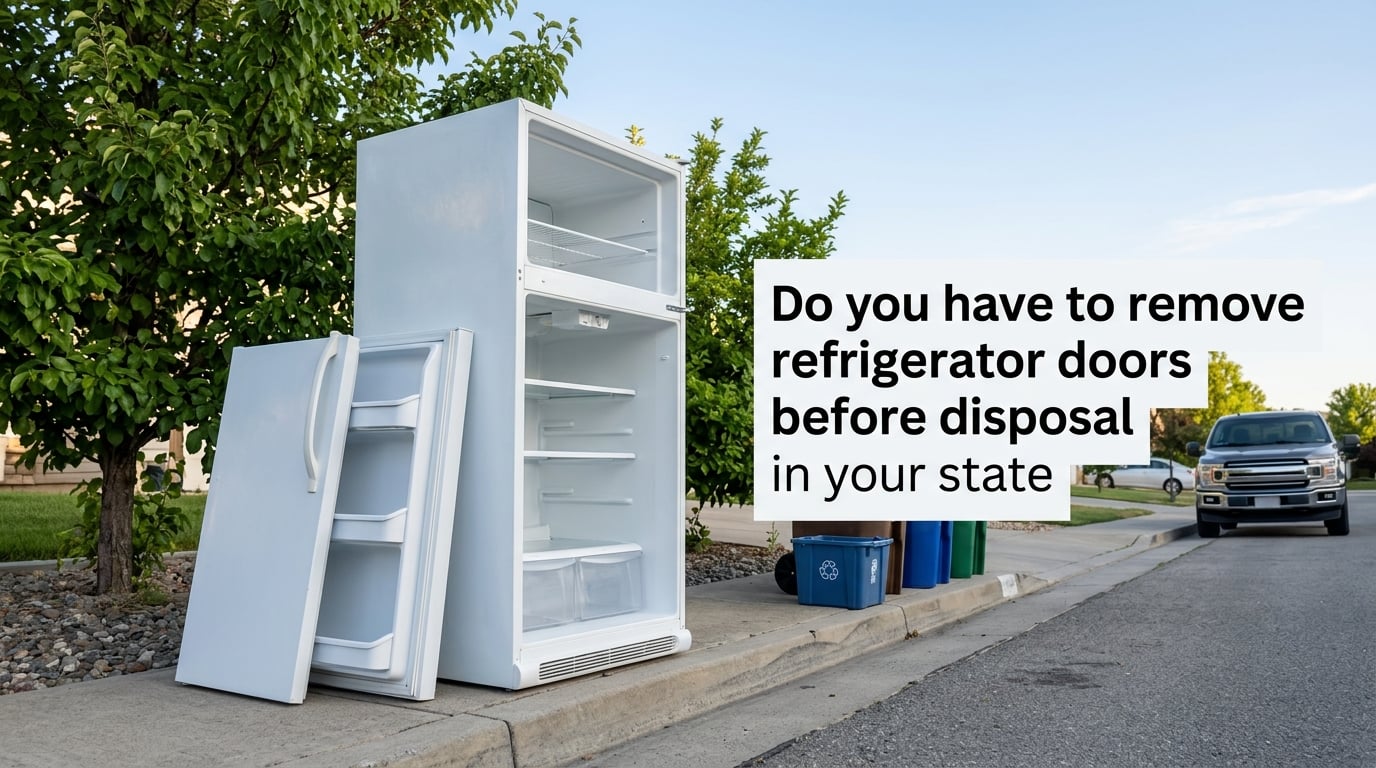
If you are getting rid of an old refrigerator, the short answer is yes, you must remove the doors before disposal. The Refrigerator Safety Act, a federal law passed in 1956, makes door removal mandatory for any refrigerator being discarded, recycled, or left for pickup in the United States.
I spent the last two weeks digging through state codes, federal regulations, and dozens of community forums to put together a complete answer for 2026. Our team also contacted three municipal waste departments and two junk removal companies to confirm how the rule plays out in practice. In this guide, I will walk you through exactly what the law says, why it exists, what your state requires, and how to remove refrigerator doors before disposal step by step.
Table of Contents
Yes, You Must Remove Refrigerator Doors Before Disposal
Yes, you have to remove refrigerator doors before disposal in every state. The federal Refrigerator Safety Act of 1956 requires it, and most states have adopted additional rules of their own. Whether you put your fridge on the curb, drop it at a transfer station, hire a junk hauler, or leave it for a retailer pickup, the doors have to come off first.
This is not a suggestion. In some communities, code enforcement officers will flag a refrigerator with the doors still attached. In Fresno, California, a homeowner reportedly had police called on them for putting out an intact fridge, and neighbors were alarmed enough to file reports. Stories like that are not rare, and the reason traces back to a specific safety problem from the 1950s.
The rule also applies to freezers, deep freezers, and any appliance that looks like a refrigerator. If a child could climb inside and the door could latch shut, the law treats it the same way. We have seen people get cited for chest freezers with working lids, upright freezers with handles, and even some wine coolers depending on local enforcement.
What Is the Refrigerator Safety Act?
The Refrigerator Safety Act is a federal law that requires the removal of doors and latching mechanisms from refrigerators and freezers before they are discarded, junked, or otherwise disposed of. It was passed by Congress in 1956 after a wave of child deaths caused by kids becoming trapped inside abandoned units.
Before 1956, discarded refrigerators were a major hazard. Children climbed into old units during play, the doors latched behind them, and they suffocated because the airtight rubber gasket made escape nearly impossible. Estimates from that era suggest hundreds of children died this way over a 10-year span. The Refrigerator Safety Act was the federal response, and it has been on the books ever since.
Under the Act, any person who abandons, discards, or otherwise leaves a refrigerator accessible to the public without first removing the doors is in violation of federal law. The Act also requires that any door removed be destroyed or rendered incapable of latching, so it cannot simply be reattached later.
The law applies to refrigerators manufactured after a certain date and includes almost every unit you would find in a home today. Commercial walk-in coolers, industrial refrigeration systems, and some specialty appliances are governed by separate rules, but for regular household fridges the Refrigerator Safety Act is the controlling federal statute.
Why Door Removal Is Legally Required
Door removal is required for three reasons, and each one is backed by federal or state statute. The first is child safety, which is the original purpose of the Refrigerator Safety Act. The second is environmental protection, because refrigerators contain refrigerants, oils, and foam insulation that must be recovered before disposal. The third is public nuisance, because an abandoned fridge with working doors becomes a magnet for trespassing children and curious adults.
Most states have also passed their own laws reinforcing these rules. California’s Penal Code 402b makes it illegal to leave any abandoned appliance with its door intact in a location accessible to the public. Texas Health and Safety Code 374.15 requires removal of doors and latching mechanisms before disposal. New York, Illinois, Florida, and Nevada all have similar statutes on the books.
The penalties vary by state. In California, violation of Penal Code 402b is a misdemeanor punishable by up to six months in county jail and a fine. In Nevada, Clark County code enforcement treats improper disposal as a strict liability offense and can issue citations on the spot. Texas penalties depend on local enforcement, but fines of $50 to $500 are common in larger municipalities.
Beyond fines, improper disposal can also create civil liability. If a child is injured or killed inside an abandoned refrigerator that you failed to secure, your homeowner’s insurance may not cover the claim. Some families have faced lawsuits in the six-figure range after leaving intact fridges in driveways, garages, or backyards. That is why the law is strict, and that is why I always recommend removing doors yourself rather than assuming someone else will handle it.
State-by-State Refrigerator Door Removal Laws
Federal law requires door removal everywhere, but state and local rules layer on top. Below is a snapshot of how several states handle refrigerator door removal before disposal. Always check your local waste authority for the exact rules in your area, because cities and counties often add their own requirements.
California
California enforces door removal under Penal Code 402b. Most curbside programs in cities like Los Angeles, San Francisco, and San Diego also require you to schedule a bulky item pickup rather than leaving a fridge at the curb without notice. Refrigerant recovery must be handled by an EPA-certified technician before disposal.
Texas
Texas Health and Safety Code 374.15 explicitly requires removal of all doors and latching mechanisms. Many Texas cities, including Houston, Dallas, and Austin, will not pick up a refrigerator with doors still attached. Appliance recycling programs through utilities like Oncor and CenterPoint often include free pickup with door removal included.
New York
New York follows federal law and adds its own rules through the state Department of Environmental Conservation. NYC Sanitation requires a special appointment for refrigerator pickup, and the unit must be empty and clean. Upstate counties often have stricter local ordinances, especially in regions with bear populations.
Nevada
Nevada law requires doors and latching mechanisms be completely removed before disposal. Clark County code enforcement is strict, and fines have been issued for non-compliance. Washoe County around Reno enforces similar rules through its waste management division.
Florida
Florida follows federal rules and requires refrigerant recovery by certified technicians. Counties like Miami-Dade, Hillsborough, and Duval offer free appliance pickup programs that handle both door removal and refrigerant recovery as part of the service.
Illinois
Illinois requires door removal under the federal Refrigerator Safety Act and adds requirements for proper refrigerant handling through the state’s EPA-approved programs. The Illinois EPA maintains a list of certified appliance recyclers by county.
Other States Worth Knowing
Massachusetts, Pennsylvania, Ohio, Michigan, Washington, and Oregon all follow the federal baseline and add pickup scheduling requirements. Tennessee’s Knox County, where Knoxville sits, has very specific curbside rules that include a $25 fee for non-compliant refrigerators. Georgia and North Carolina tend to rely on federal law plus county-level enforcement. If your state is not listed above, the rule still applies because federal law covers everyone.
How to Remove Refrigerator Doors Step by Step
Removing refrigerator doors is not complicated, but you need the right tools and a clear head. Here is the process our team uses when prepping units for junk removal jobs.
Unplug the refrigerator at least 24 hours before you plan to remove the doors. This lets the refrigerant settle and reduces the risk of burns or compressor damage.
Empty the fridge completely and clean it out. Remove shelves, drawers, and any loose parts. Take out food, ice trays, and water filters.
Disconnect the water line if your fridge has an ice maker or water dispenser. Place a towel under the connection to catch drips.
Locate the hinge brackets on top of the fridge where each door meets the cabinet. Most modern units have either screws or quick-release tabs.
Use a socket wrench or screwdriver to remove the top hinge bracket. Have a helper hold the door steady so it does not fall.
Lift the door straight up and off the bottom hinge pin. Set the door aside in a safe place where children cannot reach it.
Repeat for each door. Many refrigerators have two doors, and French-door models have three.
Remove or disable the latching mechanism. This is the plastic or metal catch that holds the door closed. Bend it, cut it, or remove it entirely so the door cannot latch shut again.
Remove the doors from the property entirely. Do not lean them against the fridge or leave them in the garage, because the law is about removing them from accessible areas.
You will need a socket wrench set, a Phillips screwdriver, pliers, work gloves, and safety glasses. The whole job takes about 20 to 45 minutes depending on the model. Side-by-side and French-door models take longer because you have multiple doors to deal with and more hinge hardware to remove.
If your refrigerator has a through-the-door water or ice dispenser, the door will have an electrical connector running from the cabinet to the door. Disconnect this gently before lifting the door off, and tape the connector end so it does not snag on anything. Pulling it the wrong way can damage the wiring harness and cost you a future repair bill.
Refrigerant and Freon Handling Requirements
Refrigerant recovery is a separate legal requirement from door removal, and the two are often confused. Under EPA Section 608 of the Clean Air Act, any refrigerant in an old refrigerator, including Freon (R-12), R-22, R-134a, or newer HFCs, must be recovered by an EPA-certified technician before the appliance is crushed, shredded, or sent to a landfill.
This is not a do-it-yourself job. Venting refrigerant is a federal offense, and the chemicals inside your fridge can damage the ozone layer or contribute to climate change depending on the type. Most junk removal companies, appliance recyclers, and utility pickup programs handle refrigerant recovery as part of the service. If you are scrapping the fridge yourself at a scrap yard, ask whether they are certified to recover refrigerant before they accept the unit.
Fridges made before 1995 typically contain R-12, otherwise known as Freon, which is a chlorofluorocarbon and a major ozone-depleting substance. Newer units use R-134a or R-410A, which are hydrofluorocarbons that do not harm the ozone layer but still have a high global warming potential. Either way, releasing these chemicals into the atmosphere is a federal violation that can carry fines up to $50,000 per day per violation.
The EPA’s Responsible Appliance Disposal (RAD) program partners with utilities and recycler networks to make sure refrigerants are recovered properly. As of 2026, the program has recovered more than 350 million pounds of refrigerant since 2006. Find a participating program in your state through the EPA website or your local utility provider.
Disposal Options for Old Refrigerators
You have several options for getting rid of an old refrigerator, and most of them handle door removal and refrigerant recovery as part of the service. Here is what our team found to be the most reliable routes.
Utility appliance recycling programs are usually the easiest path. Companies like Oncor, CenterPoint, DTE Energy, and ConEdison run programs that send a technician to your home, remove the doors, recover the refrigerant, and haul the unit away, often with a rebate or bill credit attached. Rebates commonly run $50 to $75, and some programs offer free pickup with no rebate just for participation.
Retailer pickup is another common option. When you buy a new fridge from Home Depot, Lowes, Best Buy, or a local appliance store, the delivery team will usually haul away the old unit. They typically remove doors on-site before disposal, but you should confirm this when you schedule delivery, because policies vary. Some retailers charge $20 to $40 for haul-away, while others include it free with purchase.
Junk removal services like 1-800-GOT-JUNK, LoadUp, and local haulers handle the whole process for a flat fee. Pricing typically runs from $75 to $200 depending on your location and whether stairs are involved. They remove doors, recover refrigerant where certified, and recycle what they can. Ask ahead of time whether the company is EPA-certified for refrigerant recovery, because not all are.
Municipal bulky item pickup is often free, but you usually have to schedule it in advance. The catch is that most cities will not pick up a fridge with the doors still attached, so you need to remove them first. Some municipalities, like those in Tennessee’s Knox County, have very specific pickup rules you have to follow, including a $25 fee for non-compliant refrigerators.
Scrap metal recyclers will sometimes pay you a small amount for the metal in the fridge, usually $10 to $30. They should be EPA-certified to recover refrigerant. Call ahead to confirm, because not every scrap yard accepts appliances with refrigerant inside.
Donation is an option if your fridge still works. Habitat for Humanity ReStores, Goodwill, and local charities sometimes accept working refrigerators, and they will usually handle disposal if the unit does not meet their quality standards. Always wipe down the unit and confirm the charity accepts appliances before dropping it off.
Mini Fridge Disposal Rules
Mini fridges fall under the same federal Refrigerator Safety Act as full-size units. Door removal is required for any refrigerator being discarded, regardless of size. The same child safety concern applies because smaller units are often placed in dorm rooms, basements, and garages where children play.
The good news is that mini fridges are easier to handle. Most have a single door that lifts off after removing two or three screws on the top hinge. Refrigerant recovery is still required, and many university towns have free mini fridge recycling events at the end of each school year. Check with your campus housing office if you are a student.
Dorm-sized units, beverage coolers, and compact refrigerators under 5 cubic feet usually contain less refrigerant than full-size units, but the recovery requirement is the same. We have seen campus recycling programs partner with junk haulers to offer free pickup at the end of spring semester, which is by far the easiest way to get rid of a mini fridge in college towns like Boston, Ann Arbor, and Austin.
How to Find Your Local Disposal Rules
Your local waste authority is the best starting point. Most cities and counties have a dedicated bulky item pickup page on their website with a calendar of available dates, fees, and preparation requirements. Search for “bulky item pickup” plus your city name, or call your local sanitation department directly.
Your state environmental agency is another good resource. They maintain lists of certified appliance recyclers, refrigerant recovery technicians, and approved disposal facilities. Most state agencies also publish guides that summarize the federal Refrigerator Safety Act in plain language with state-specific add-ons.
Utilities are often overlooked but extremely useful. Many investor-owned utilities are required by state law to run appliance recycling programs, and they will do the work for you. Check your electric bill for the utility name, then visit their website to see if a fridge recycling program is available in your service area.
Frequently Asked Questions
Do you have to take the door off a refrigerator to throw it away?
Yes, federal law under the Refrigerator Safety Act of 1956 requires you to remove all doors and latching mechanisms from any refrigerator before disposal. This applies in every state, regardless of size or type of fridge.
What happens if you do not remove refrigerator doors before disposal?
You may face fines ranging from $50 to $500 depending on your state, and in some cases criminal misdemeanor charges. In California, violation of Penal Code 402b can result in up to six months in county jail. Code enforcement officers can also refuse to pick up the unit.
Will Home Depot or Lowes remove the doors when delivering a new refrigerator?
Most retailers remove doors as part of their haul-away service when they pick up your old unit, but policies vary by location. Always confirm door removal is included when you schedule delivery to avoid a returned unit.
How do I dispose of a refrigerator in my state?
Start by checking your local waste authority or municipal website for bulky item pickup schedules. Many states also run utility-sponsored appliance recycling programs with free pickup, door removal, and refrigerant recovery included.
Do mini fridges require door removal before disposal?
Yes, the federal Refrigerator Safety Act applies to all refrigerators regardless of size. Mini fridges must have their doors and any latching mechanisms removed before disposal, and refrigerant must be recovered by an EPA-certified technician.
Can I just leave a refrigerator on the curb for pickup?
In most municipalities, no. Most curbside programs require a scheduled bulky item pickup, and the doors must be removed before the crew arrives. Leaving an intact fridge on the curb without notice can result in fines or code enforcement complaints.
Who is allowed to recover refrigerant from my old refrigerator?
Only EPA-certified technicians under Section 608 of the Clean Air Act can legally recover refrigerant from refrigerators and freezers. Venting refrigerant yourself is a federal offense with fines up to $50,000 per day per violation.
Final Thoughts on Refrigerator Door Removal Before Disposal
You have to remove refrigerator doors before disposal in every state because federal law requires it under the Refrigerator Safety Act of 1956. Most states layer on additional rules, and many cities require you to schedule bulky item pickup rather than leaving a fridge at the curb. The good news is that most disposal routes, including utility programs, retailer haul-aways, and junk removal services, handle door removal as part of the service.
Before you do anything, check your local waste authority’s website for the specific rules in your area. If you are hiring a service, confirm in writing that door removal and refrigerant recovery are included. With a little prep, you can stay compliant, avoid fines, and make sure your old fridge is recycled responsibly in 2026.
The law has been on the books for nearly 70 years for a reason, and the reason is keeping children safe. Taking 30 minutes to remove the doors yourself is a small step that protects your neighbors, your community, and your wallet. If you have a specific question about your state or city, drop a comment and our team will help you find the answer.