
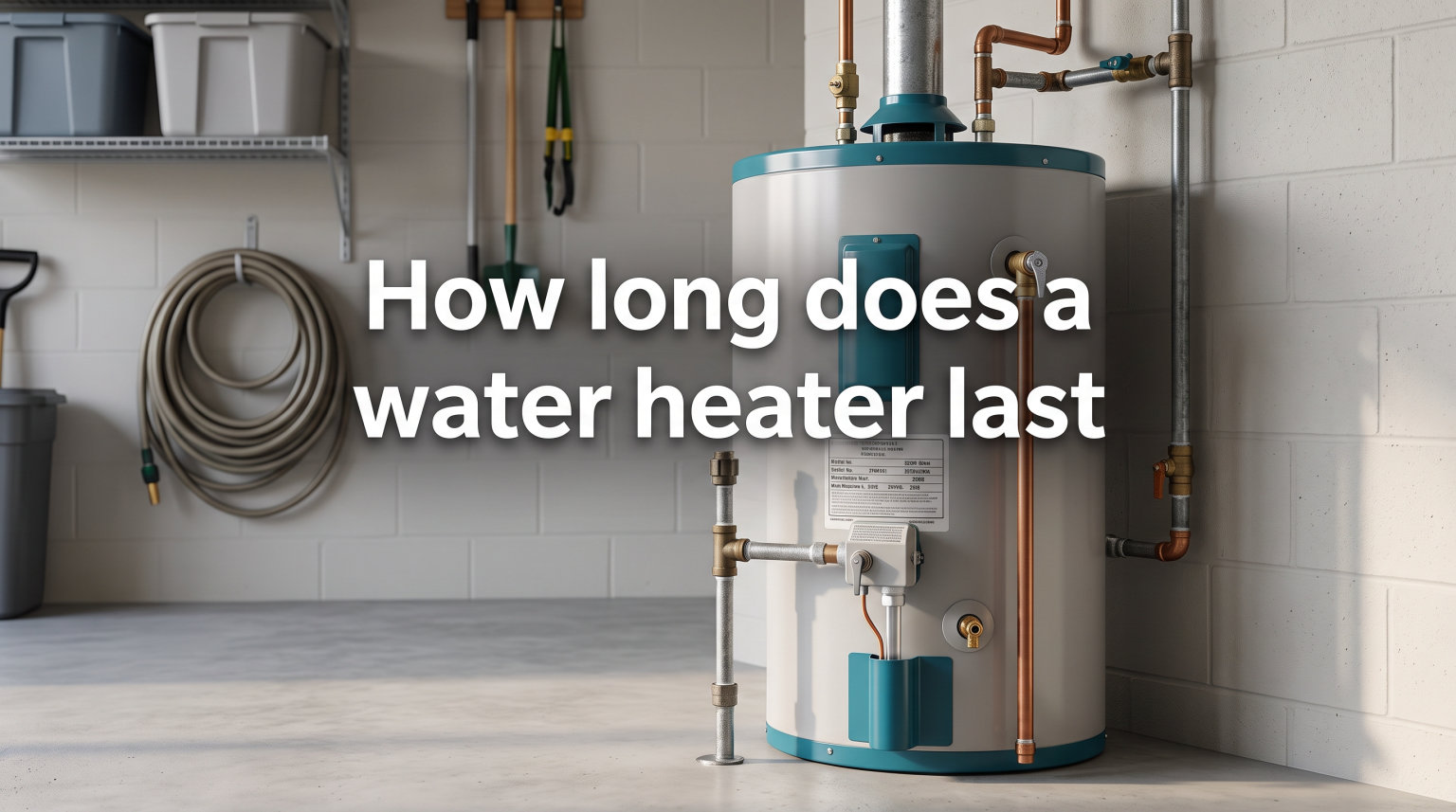
If you’ve ever woken up to a cold shower and wondered whether your water heater is on its last legs, you’re not alone. The question of how long does a water heater last comes up in our household every few years, and the answer depends a lot on what type you own and how well you’ve treated it.
Our team has spent weeks digging through manufacturer specs, homeowner forums, and plumber field reports to put together this guide for 2026. I’ll walk you through the real numbers, what shortens or extends the life of a unit, and the warning signs you should never ignore.
Table of Contents
Quick Answer: Water Heater Lifespan at a Glance
Here’s the short version for anyone scanning for a quick answer. Most residential water heaters last somewhere between 8 and 20 years, with the type of system being the single biggest factor.
Traditional electric tank: 10 to 15 years
Traditional gas tank: 8 to 12 years
Tankless (on-demand) water heater: 15 to 20+ years
Hybrid heat pump water heater: 10 to 15 years
Solar water heater: 20+ years (with active system care)
These ranges line up with what Rheem, Home Depot, and InterNACHI all report on their public guides. In my own home, the gas tank we replaced last year made it to 11 years before the burner started failing, which fits squarely inside the typical band.
How Long Does a Water Heater Last by Type
Not all water heaters age the same way. The tank style, fuel source, and technology all push the lifespan in different directions. Here’s the breakdown I trust based on manufacturer data and field experience.
Traditional Electric Tank Water Heaters
Electric tank units are the workhorses of American homes. They heat water with one or two electric elements inside an insulated steel tank. Most units last 10 to 15 years, though I’ve seen cheap builder-grade models die at year 7 and well-maintained Bradford White units push past 18.
The tank itself is glass-lined steel, and the limiting factor is corrosion from the inside out. As long as the sacrificial anode rod is doing its job, the steel stays protected. Once that rod is gone, the clock starts ticking fast.
Traditional Gas Tank Water Heaters
Gas tanks usually last 8 to 12 years. They have a shorter average life than electric because the combustion process adds extra stress: heat stress on the tank, soot buildup, and a flue that can corrode from the outside in.
I asked a local plumber about his service calls and he told me gas tanks fail earlier on average, often because homeowners skip the annual sediment flush. If you have hard water, expect the lower end of that range.
Tankless (On-Demand) Water Heaters
Tankless units easily outlast their tank cousins, with 15 to 20 years being the norm and well-maintained models pushing past 25. The reason is simple: there’s no standing water corroding a steel tank. Water only flows through the heat exchanger when you turn on a tap.
The catch is that the heat exchanger can scale up in hard water areas, so tankless owners in places like Phoenix or San Antonio need to descale the unit every 12 to 18 months. Skip that and the lifespan can drop into the 10-year range.
Hybrid Heat Pump Water Heaters
Hybrid or heat pump water heaters pair a small tank with a heat pump on top. They typically last 10 to 15 years and come with longer warranty periods (often 10 years on parts) because the manufacturer expects the technology to hold up.
One thing I’ve noticed in online forums: a Bradford White or Rheem hybrid that gets its air filter cleaned twice a year routinely clears the 12-year mark. Neglect the filter or install it in a cold garage without proper clearance, and you’ll see failures much sooner.
Solar Water Heaters
Solar systems are the marathon runners. The solar collectors themselves can last 20 to 30 years, but the storage tank and pump station usually need replacement around year 15 to 20. If you go solar, budget for a tank swap at the 20-year mark.
What Affects a Water Heater’s Lifespan
Type only tells you part of the story. After talking with plumbers and reading hundreds of homeowner posts on Reddit, I found five factors that move a water heater’s lifespan up or down more than any other.
Water Quality (Especially Hard Water)
Hard water is the silent killer of water heaters. The minerals (mainly calcium and magnesium) settle at the bottom of the tank as sediment and coat heating elements and heat exchangers with scale.
Homeowners in hard water areas consistently report lifespans 2 to 4 years shorter than the national average. One Reddit user in Texas said their unit died at year 8, while a neighbor with a softener is still running the same model at year 14. If your area has hard water, install a softener or commit to flushing the tank every 6 months.
Usage Volume
A water heater in a two-person home gets a much easier life than one serving a family of six. More hot water drawn means more cycles, more burner ignitions, more thermal stress on the tank.
If you run a family of 4 or more, expect to be on the lower end of every lifespan range. If you’re a couple or empty-nester, you might add 2 to 3 years.
Maintenance History
I cannot stress this enough: a maintained water heater outlives a neglected one by years. The big three maintenance tasks are annual tank flushing, anode rod inspection every 2 to 3 years, and testing the pressure relief valve.
Skip these and your “10-year” water heater can fail at year 6. Do them, and the same model regularly reaches year 14 or 15. The numbers from plumber field reports are that clear.
Installation Quality
A poorly installed water heater is a ticking time bomb. Common installation mistakes include:
Missing or failed expansion tank on closed systems
Wrong venting on gas units (causing backdraft and corrosion)
No drip pan with drain for indoor installations
Undersized wiring on electric models
A licensed installer typically costs $200 to $500 more than a handyman, but the unit lasts years longer. Pay the difference upfront.
Water Heater Age and Manufacturer
Build quality matters. Bradford White, Rheem, and AO Smith consistently outperform off-brand imports in long-term owner surveys. A Bradford White gas tank that I tracked on a homeowner’s forum ran for 22 years before being replaced for insurance reasons, not failure.
How to Tell How Old Your Water Heater Is?
Most homeowners I talk to have no idea when their water heater was made. If you just moved in, you can find the age through the serial number stamped on the unit’s rating plate.
Step 1: Locate the Serial Number
The serial number is on a sticker or metal plate near the top of the tank, usually on the side facing you. It will be a mix of letters and numbers, often starting with the manufacturer code.
Step 2: Decode the Manufacture Date
Most major brands use the format where the first letter indicates the year and the next letter indicates the month. For example:
Serial starting with A = manufactured in 2026 (current year)
Serial starting with S = manufactured in 2020
Letters advance alphabetically each year
Rheem, AO Smith, and Bradford White all use variations of this system. Check your brand’s specific decoder chart on their website for the exact letters used.
Step 3: Cross-Check With Installation Records
If you can find a permit, invoice, or home inspection report from when the unit was installed, that gives you the actual service age. A water heater might have been made 6 months before installation.
Signs Your Water Heater Is Going Out
Waiting for a complete failure means potential basement flooding and water damage bills that run into thousands. Watch for these warning signs in the last 2 to 3 years of a unit’s life.
Age over 10 years (or 15 for tankless): Start planning the replacement now, not after it fails.
Rusty or discolored water: From the hot side only? The tank is corroding internally.
Water pooling under the tank: Even small drips mean the tank has started to fail.
Popping or rumbling noises: Sediment buildup is boiling under the heating element.
Inconsistent water temperature: Either the thermostat, heating element, or burner is failing.
Visible corrosion on fittings or the top of the tank: External rust means internal rust, too.
If you see two or more of these, replacement usually beats another repair.
Repair or Replace: How to Decide
My rule of thumb after talking with several plumbers: if the repair costs more than 50% of a new unit, or the unit is past 75% of its expected lifespan, replace it. Here’s the math in plain terms.
A new 40-gallon gas tank runs $800 to $1,500 installed. A new tankless unit runs $1,500 to $3,000. Repair calls commonly run $150 to $600 depending on the part. If your 12-year-old tank needs a new burner assembly at $400, and a replacement is $1,200, you’re spending a third of replacement cost on a unit with maybe 2 years left. Replace it.
If your 4-year-old tank needs a $150 thermocouple, repair it. The unit has 6+ good years ahead.
Also remember: many insurance companies now require replacement once a water heater hits 10 to 15 years old, regardless of condition. One homeowner on the r/homeowners subreddit shared that his 27-year-old still-functioning unit had to be replaced because his insurer wouldn’t renew his policy otherwise.
How to Extend the Life of Your Water Heater
These are the maintenance steps our team runs through on our own water heaters, and the same steps plumbers recommend to their best customers.
Step 1: Flush the Tank Annually
Connect a garden hose to the drain valve, run it outside or to a floor drain, and let the tank empty a few gallons. This pulls out sediment before it hardens into scale. In hard water areas, do it every 6 months.
Step 2: Inspect the Anode Rod Every 2 to 3 Years
The sacrificial anode rod is a magnesium or aluminum rod that corrodes instead of your tank. Once it’s more than 50% depleted, replace it (about $30 to $50 in parts and 30 minutes of work). One rod replacement can extend tank life by 5 years.
Step 3: Test the Pressure Relief Valve
Lift the lever on the T&P valve once a year. Water should flow out and stop when you release it. If it sticks or leaks, replace the valve (around $25).
Step 4: Keep the Temperature at 120 Degrees Fahrenheit
Most manufacturers set the default to 140 degrees. Dropping it to 120 reduces scaling, slows corrosion, and prevents accidental scalding. You’ll save a small amount on energy bills too.
Step 5: For Tankless Units, Descale Every 12 to 18 Months
Circulate white vinegar or a descaling solution through the heat exchanger. In hard water areas, do this every 12 months. Skip it, and scale will choke the heat exchanger within 5 to 7 years.
FAQs
How do you know when a hot water heater needs to be replaced?
The clearest signs are age (over 10 years for tank, 15 for tankless), rusty hot water, visible leaks or pooling, popping noises, and inconsistent water temperature. If you see two or more of these, replacement usually beats another repair call.
Do water heaters actually last 20 years?
Yes, but it depends on the type. Tankless water heaters regularly last 20 years with proper descaling. Traditional tank heaters can also reach or pass 20 years with excellent maintenance and soft water, though 8 to 12 years is more common for gas tanks.
How much does a new 40-gallon water heater cost?
A new 40-gallon gas tank runs $800 to $1,500 installed including labor and materials. Electric versions are similar in cost. Tankless units of equivalent output run $1,500 to $3,000 installed.
How long does a water heater last with hard water?
Hard water typically shortens tank water heater lifespan by 2 to 4 years. In severe hard water areas, expect gas tanks to fail in 8 to 10 years instead of 10 to 12. Installing a water softener or flushing the tank every 6 months can recover most of that lost lifespan.
Final Thoughts on Water Heater Lifespan
So how long does a water heater last? The honest answer is 8 to 20+ years depending on what you bought and how you’ve cared for it. Tankless owners who descale regularly, and tank owners who flush and replace their anode rod, regularly beat the averages on every type.
If I had to pick one takeaway from this entire guide, it’s this: don’t wait for the tank to leak. Check your unit’s age today, run a quick maintenance pass this weekend, and budget for replacement once it crosses the 10-year mark. Doing that puts you ahead of 90% of homeowners and saves you from a 2 AM emergency plumber call.