
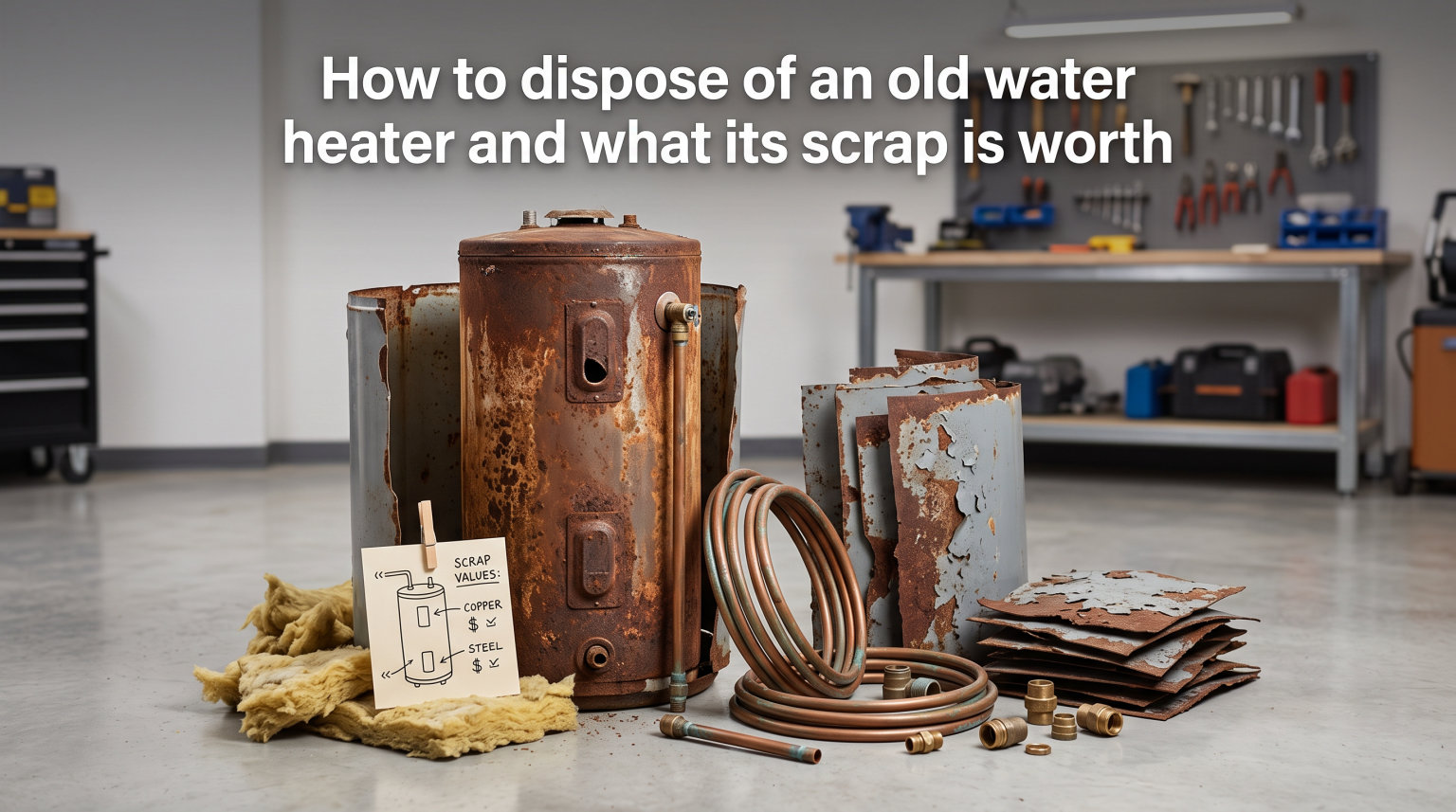
Replacing a water heater usually leaves you staring at a 100- to 150-pound metal tank in your basement or garage, wondering what to do with it. I went through this last spring after my 12-year-old 50-gallon tank finally gave up, and I learned more about scrap metal prices in a weekend than I had in my entire life.
This guide covers everything you need to know about how to dispose of old water heater scrap value, from draining the tank safely to weighing your options at the scrap yard. Whether you want to make a few bucks or just get rid of the thing for free, I’ll walk you through the process our team has tested multiple times.
Table of Contents
How Much Is an Old Water Heater Worth for Scrap?
A standard residential water heater typically pays between $7 and $30 at the scrap yard, depending on size, metal composition, and current market prices. A 40-gallon unit usually lands on the lower end, while a 50-gallon gas model with copper heat exchanger components can push past $20.
The reason for this wide range comes down to what scrap yards call “light-steel shred” versus sorted metals. When you drop off a whole water heater, most yards will weigh it as mixed steel at roughly 4 to 8 cents per pound. A 50-gallon tank weighs around 100-110 pounds empty, so at the low end you’re looking at $4 to $9 just for the steel shell.
Here’s where it gets interesting: that same tank contains roughly 5 to 15 pounds of copper and another 2 to 5 pounds of brass fittings. If you separate those metals before hauling it in, your scrap check can climb into the $25 to $40 range. I’ve personally seen the difference between selling whole and selling stripped, and it often doubles or even triples the payout.
What Materials Make Up a Water Heater (And What They’re Worth)
Understanding the composition helps you decide whether the extra effort to strip a tank is worth your time. Here’s what you’re working with inside a typical 50-gallon residential unit:
Steel shell: 95-105 pounds of sheet steel forming the outer tank and inner liner. At current scrap rates of 4-8 cents per pound, this alone is worth $4 to $8.
Copper components: A gas water heater has 5-15 pounds of copper in the heat exchanger, pilot tubing, and dip tube. Copper sells for $3.50-$4.50 per pound right now, so this is the money material.
Brass fittings: The water inlet/outlet connections, valve bodies, and gas regulator contain 2-5 pounds of brass. Brass currently fetches $2.50-$3.50 per pound.
Aluminum: Some models include aluminum anode rod holders or burner components, adding another 1-2 pounds of recyclable material at around 70 cents per pound.
Anode rod: A magnesium or aluminum sacrificial rod (3-5 pounds) that protects the tank from corrosion. Most scrap yards accept these as magnesium or aluminum.
The copper is where the real value hides, and it’s why serious scrappers take the time to strip tanks down. Even if you only recover the heat exchanger and a few feet of copper tubing, that $15-$25 in copper often exceeds what you’d get for the entire whole unit sold as steel.
Tankless vs Tank Water Heater Scrap Value
Tankless units tell a different story. They weigh only 25-40 pounds but contain a much higher concentration of copper in their heat exchangers. A tankless model can yield 8-20 pounds of copper with very little steel, meaning the scrap value ratio is far better per pound even though the total weight is lower.
If you have a tankless unit, stripping is almost always worth it because there’s almost no steel to offset the value. Traditional tanks require more judgment since you’re investing 30-60 minutes of labor for the extra payout.
How to Prepare a Water Heater for Disposal or Scrap
Before you haul that tank anywhere, you need to drain it, disconnect it, and make sure it’s safe to move. Water heaters hold 40-80 gallons of water, and a full tank weighs 300-650 pounds. Skipping the prep step has sent plenty of people to the ER with back injuries.
Step 1: Shut Off the Utilities
For electric units, flip the breaker at your electrical panel. For gas models, turn the gas valve to the “off” position, usually a quarter-turn. Wait at least 30 minutes for the unit to cool down before draining. I’ve seen scald injuries happen because someone didn’t let the tank cool.
Step 2: Turn Off the Cold Water Supply
Locate the cold water inlet valve above the heater and close it. This stops new water from entering the tank during draining. If your valve is stuck or corroded (common on older units), you may need to shut off water to the entire house.
Step 3: Drain the Tank
Attach a garden hose to the drain valve at the bottom of the tank and run the hose to a floor drain, outside, or into buckets. Open the drain valve and open a hot water faucet somewhere in your house to break the vacuum. The tank takes 20-45 minutes to drain completely.
Safety warning: Even cooled water can harbor bacteria like Legionella. Don’t run it through indoor drains if you can avoid it, and never spray it on vegetation you want to keep alive.
Step 4: Disconnect Water and Gas Lines
Once drained, disconnect the cold and hot water lines using a pipe wrench. For gas units, disconnect the gas line with a proper gas-rated wrench and cap the pipe immediately with a threaded cap. If you’re not comfortable with gas lines, this is the point to call a plumber.
Step 5: Remove Venting and Prepare for Transport
Gas water heaters have exhaust venting that needs to come off. For electric units, disconnect the wiring after verifying the breaker is off with a voltage tester. Tape over any open electrical boxes.
Your tank is now ready for scrap or disposal. If you’re hauling it yourself, bring moving straps and a dolly. A drained 50-gallon tank weighs 100-150 pounds depending on insulation type.
Should You Strip the Water Heater Before Scrapping?
Stripping means cutting the tank open with a reciprocating saw to remove the copper heat exchanger, brass valves, and any accessible copper piping before hauling it to the scrap yard. The question is whether the extra 30-60 minutes of work pays off.
Based on what our team and other scrappers report on forums, stripping increases payout by roughly 30-50% for traditional tanks. The math looks like this:
Whole tank sale (50-gallon): $7-$12 typically
Stripped tank sale: $18-$35 depending on copper recovery and market price
Time investment: 30-60 minutes plus a few dollars for a new saw blade
Stripping makes sense if you already own basic tools, you’re physically able to handle the work, and current copper prices are above $3.50 per pound. If scrap prices are low, gas is expensive, or you’d have to buy tools to do it, selling whole is the smarter move.
One more consideration: some scrap yards offer higher prices if you separate your metals. Call ahead and ask if they pay more for sorted loads. A few yards in my area pay 30% more for sorted copper versus mixed loads, which makes sorting worth the effort even if you don’t fully strip the tank.
Disposal Method Comparison: Scrap Yard, Pickup, and Other Options
Selling for scrap isn’t your only choice, and sometimes it’s not even the best one. Here’s how the main disposal methods stack up:
Scrap Yard Drop-Off
Pros: You make $7-$35 per unit. Many yards accept whole tanks, so you don’t have to strip. Same-day transaction.
Cons: You need a truck or trailer to haul it. Some yards charge small fees for non-metallic components. Hours are limited.
Municipal Bulk Waste Pickup
Pros: Free or low-cost (typically $30-$50 per pickup in most cities). They come to you and do the heavy lifting. Scheduled in advance.
Cons: You get no scrap value. May take 2-4 weeks to schedule. Some municipalities don’t accept water heaters or have size restrictions.
Junk Removal Service
Pros: Same-day or next-day pickup available. They handle all the heavy lifting. No tools or vehicle required.
Cons: Costs $100-$250 for a single water heater. They keep the scrap value. Most expensive option.
Retailer or Utility Trade-In
Pros: When you buy a new water heater, many retailers and utility companies will haul away the old one for free as part of installation. Convenient if you’re already replacing the unit.
Cons: Free only with a new purchase. You receive nothing for the old unit. Scheduling depends on installer availability.
Donation
Pros: Habitat for Humanity ReStores and similar organizations may accept working older units. Tax deduction potential. Helps someone in need.
Cons: Unit must work or be easily repairable. Very old tanks rarely qualify. You must transport it yourself.
The cheapest disposal route if your unit has no scrap value is municipal pickup or retailer trade-in. If your scrap yard is within driving distance and you have a truck, the scrap sale usually beats any paid disposal option.
Why You Shouldn’t Dump It in a Landfill
Old water heaters can contain sediment, bacteria, and in gas models, small amounts of residual combustion byproducts. Landfill dumping risks groundwater contamination, and many states have fines for improper disposal of large appliances. Recycling through proper channels keeps 95% of the metal out of landfills and back into manufacturing.
FAQs
How much money can I get for scrapping a water heater?
A standard residential water heater pays between $7 and $30 at most scrap yards. Whole units typically yield $7-$12 as steel shred, while stripped tanks with separated copper and brass can reach $20-$40 depending on current metal prices and your tank size.
How much copper is in a 50 gallon water heater?
A 50-gallon gas water heater contains 5-15 pounds of copper, mostly in the heat exchanger, dip tube, and pilot tubing. Electric models typically have less copper (1-3 pounds) since they lack a heat exchanger. The copper is the most valuable material in the unit.
Is it worth it to scrap a hot water tank?
Scrapping makes sense if you have a truck to haul it, a scrap yard within 20 miles, and current steel prices above 5 cents per pound. If you’d have to pay for disposal or transportation, the $7-$15 payout from a whole-tank sale may not justify the effort.
Will the scrap yard take a hot water heater?
Most scrap yards accept drained water heaters, especially those made primarily of metal. Some require you to remove non-metal components like plastic drain valves first. Call ahead to confirm hours, fees, and whether they accept whole units or require stripping.
Do gas and electric water heaters pay differently?
Gas models usually pay more because they contain more copper in the heat exchanger and gas lines. Electric units have less copper overall, so they typically fall on the lower end of the scrap value range. The steel shell value is similar across both types.
Can you make money scrapping a water heater?
Yes, but the profit is modest. Most people net $7-$15 selling whole and $20-$35 selling stripped. The real value is avoiding disposal fees ($30-$100) and keeping metal out of landfills. Contractors scrapping multiple units at once can see better returns through volume.
Final Thoughts on Water Heater Disposal and Scrap Value
Knowing how to dispose of old water heater scrap value comes down to weighing your time, transportation costs, and current metal prices. For most homeowners, the easiest path is arranging retailer haul-away during installation or scheduling municipal bulk pickup. If you have the truck and a nearby scrap yard, dropping off the whole tank puts $7-$15 in your pocket. Stripping for copper makes sense when prices are high and you have basic tools.
Our team has handled water heater disposal for over a dozen replacements across our homes and rental properties. The consistent finding: the scrap value rarely justifies a special trip, but it does justify adding a water heater to your next scrap run. Plan ahead, drain safely, and you’ll handle the job in an afternoon without injury or hassle.