
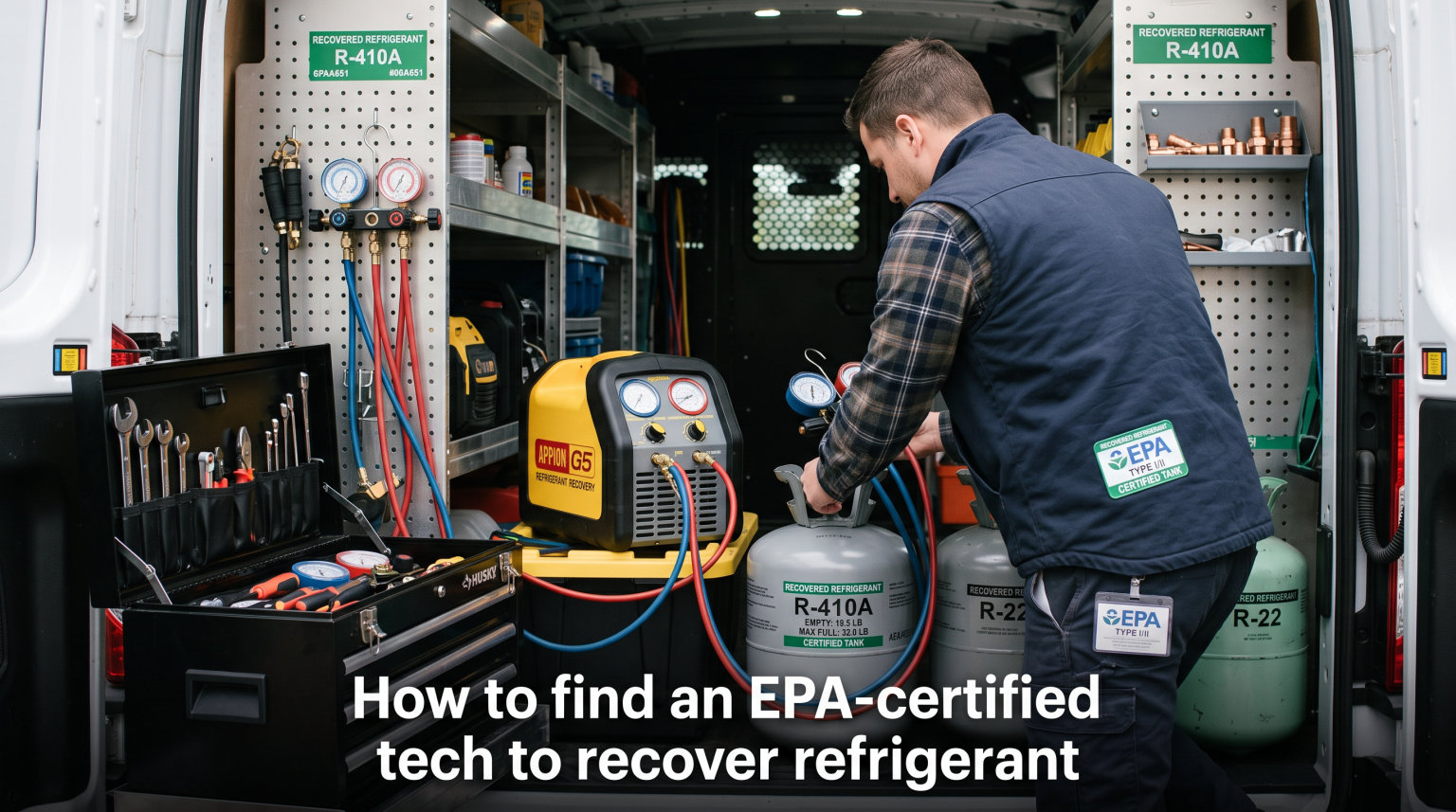
Finding an EPA-certified tech to recover refrigerant is one of those tasks that feels small until you realize the wrong hire can land you with a federal fine. I learned this the hard way when a handyman told me he could “vent the line” in my garage freezer for cash. He wasn’t joking, and he wasn’t certified. That kind of venting is a violation of the Clean Air Act, and it can trigger penalties up to $44,539 per day per violation.
I went through the full process after that, calling contractors, checking databases, and verifying cards. This guide is everything I wish I had before that first phone call. In the next ten minutes you’ll learn what EPA Section 608 certification actually means, where to find real certified technicians, how to confirm their paperwork, and how to spot the scams that try to look legitimate.
Table of Contents
What an EPA Section 608 Certified Tech Actually Does?
An EPA Section 608 certified technician is someone who passed a federal proctored exam under the Clean Air Act. The certification allows them to handle refrigerants safely, recover them from old equipment, and dispose of them without venting the gas into the atmosphere.
If you need refrigerant recovered from a residential AC, a commercial cooler, a walk-in freezer, or any appliance you are scrapping, federal law (40 CFR Part 82) requires that work be done by someone holding one of four certifications:
Type I: for small appliances that contain less than 5 pounds of refrigerant. Think window units, mini-fridges, dehumidifiers.
Type II: for high-pressure systems like residential and commercial AC, heat pumps, and most rooftop units.
Type III: for low-pressure systems, mostly large chillers that use HCFC-123 or similar refrigerants.
Universal: covers all three types above. This is the most common one HVAC contractors hold, and it costs only slightly more than a single-type exam.
For a typical homeowner job (recovering refrigerant from a central AC before a compressor swap), you need a Type II or Universal technician. For clearing out a fridge or freezer before disposal, Type I is enough. For commercial chillers, Type III or Universal is required.
Why certification matters for refrigerant recovery
Recovery is the controlled removal of refrigerant from a system into a DOT-approved cylinder. The cylinder must be labeled, the technician must log the transaction, and the gas must eventually go to an EPA-listed reclaimer. None of that is optional. When a non-certified person “tops off” or “vents” a system, the refrigerant escapes into the air and adds to ozone-depleting or high-GWP greenhouse gas emissions. That is the exact behavior the Clean Air Act was written to stop.
How to Find an EPA-Certified Tech to Recover Refrigerant
There are five reliable ways I use to find an EPA-certified tech to recover refrigerant, and I run through them in order from most to least reliable.
1. Search the EPA608.com technician verification database
The official lookup tool at EPA608.com lets you search by technician name, certifying organization, and certificate number. It is run by one of the section 608 certifying organizations, and it captures every technician who tested through their channel. If you already have a contractor’s name and certificate number, this is the fastest confirmation.
To use it, open epa608.com/technician-verification.html, fill in the technician’s last name, pick the certifying organization from the dropdown, and submit. The result either shows their name, certification type, and expiration date, or it says no record found. A “no record found” result does not always mean the tech is fake (some testing organizations use different databases), but it does mean you need to dig deeper.
2. Ask your local HVAC company for their certification card
Every reputable HVAC company has at least one Universal certified technician on staff. When you call, ask the dispatcher directly: “Do you have a tech with Universal EPA 608, and can I see their card before the visit?” A good company will say yes and email a photo of the card before the appointment.
This is the most common path for homeowners because HVAC companies also handle refrigerant recovery as part of larger repair jobs. If you need a compressor replaced, a line set flushed, or a coil swap, the recovery is built into the service.
3. Use trade group directories
ACCA (Air Conditioning Contractors of America) and ASHRAE both maintain membership directories. Members tend to employ certified technicians because association membership requires it. ACCA’s directory at acca.org lets you search by ZIP code and filter by certification level. For commercial refrigeration, the refrigerating industry group RETA (Refrigerating Engineers and Technicians Association) keeps a parallel list.
4. Check manufacturer pro networks
Major compressor and refrigerant brands like Carrier, Trane, Lennox, and Copeland run factory-authorized dealer networks. Their authorized dealers must employ EPA certified technicians. If you find a Trane dealer in your area, you can be confident the service tech arriving in the truck has at least a Universal certification because Trane requires it.
5. Local HVAC apprenticeship programs and union halls
Local sheet metal workers unions, UA (United Association of plumbers and pipefitters) locals, and community college HVAC programs graduate certified technicians every year. Their placement offices often connect new graduates with homeowners who need smaller recovery jobs. This is also a good way to get a fair price if you have flexibility on timing.
How to Verify a Technician’s EPA 608 Certification
Once you have a name, run the verification process I describe below. It takes about five minutes per technician.
Step 1: Get the certification card
A legitimate EPA 608 certification card is the size of a credit card, hard plastic or laminated, and includes the technician’s name, certification type (Type I, II, III, or Universal), certifying organization, certificate number, and issue date. Home-printed certificates are not recognized. AI-proctored online exams without a real human verifying your identity are not recognized. The certifier must be one of the 28 organizations approved by EPA.
Step 2: Match the card to a person
Ask the technician to hold the card while you take a photo. The photo on the card should match the person standing in front of you. This is the single most overlooked check. Many techs work for companies that have one valid card on file and rotate it through the team. Illegitimate outfits do this all the time.
Step 3: Cross-check the certifying organization
Every approval organization is listed on EPA’s website at epa.gov/section608. If the organization on the card is not on that list, the certificate is not legitimate. Period.
Step 4: Ask the right follow-up questions
Use this checklist when you call or meet the tech:
What is your certification type (I, II, III, or Universal)?
Which certifying organization issued the card?
How long have you held EPA 608?
Do you have a recovery cylinder and proper recovery equipment on the truck today?
After recovery, where does the refrigerant go, and how is it documented?
A certified technician answers these questions without hesitation. Hesitation, vague answers, or defensiveness are strong signals to look elsewhere.
Red Flags: How to Spot Fake or Worthless EPA Certifications
After reading hundreds of Reddit threads in r/HVAC and r/hvacadvice, I found that the same handful of red flags show up over and over when people describe bad experiences. Here is the short list.
“I took it online, no proctor needed.” Real EPA 608 exams require an in-person proctor. If the certification was issued without one, it is not recognized by EPA.
A PDF certificate instead of a plastic card. The card format is part of the standard. A PDF or home-printed certificate is not a valid credential.
No certificate number or “pending” lookup. Real certifications are searchable. If the tech cannot give you a number, you cannot verify anything.
Claiming experience matters more than certification. Experience is valuable, but Section 608 is a federal mandate. There is no apprenticeship exemption.
Quoting a price that is half of what others charge. Cheap refrigerant recovery usually means shortcuts. Those shortcuts include venting, which is the precise behavior the law is designed to prevent.
One more thing: in 2026, I still see unauthorized “EPA 608 prep” sites offering 30-minute courses that promise a certificate at the end. These are not affiliated with any approved certifying organization. The approved list is short and public. If the course provider is not on it, walk away.
How Much Does It Cost to Hire an EPA-Certified Refrigerant Tech?
For a residential service call where refrigerant recovery is part of an AC repair, most homeowners in the U.S. pay between $150 and $450 for the visit. Recovery alone, when it is the only job (such as clearing a system before a remodel), typically runs $200 to $600 depending on refrigerant type and quantity.
Commercial jobs scale up. Refrigerant recovery from a rooftop unit before replacement can run $500 to $2,000. Chiller recovery often costs more because the equipment is larger and the gas blend is more complex. Always ask for a written estimate that breaks out the recovery step separately from the rest of the work.
Questions to ask before you sign anything
Ask whether the estimate includes documentation of the recovery, EPA disposal paperwork, and a copy of the recovery receipt. These are required by 40 CFR 82.166 and they prove the gas was handled legally. If the contractor cannot provide them, you do not have proof of compliance either.
Frequently Asked Questions
How do I get certified to recover freon?
To get certified to recover freon, you must pass an EPA Section 608 proctored exam at one of the 28 approved certifying organizations. Choose Type I, II, III, or Universal based on the equipment you plan to service. After passing, you receive a credit card-sized certification card that you must carry on every job where you handle refrigerant.
Who can perform refrigerant recovery?
Only EPA Section 608 certified technicians can legally perform refrigerant recovery in the United States. Homeowners can recover refrigerant from their own equipment in some states, but the federal recordkeeping and reclaim requirements still apply, and most homeowners still hire a certified technician for safety and compliance reasons.
How much does EPA 608 certification cost?
EPA 608 certification typically costs between $100 and $250 per technician exam, depending on the certifying organization. Universal certification costs slightly more than a single-type exam. Materials and prep courses add another $50 to $300 in most cases. The certification itself does not expire, but many employers require periodic recertification reviews.
What EPA certification do I need to buy refrigerant?
To buy refrigerant, you need at least an EPA Section 608 Type II certification (for residential and commercial AC) or the certification type that matches the equipment you service. Section 608 Type I covers small appliances. Section 608 Universal covers all refrigerant types and is the most flexible option for HVAC contractors.
Final Thoughts on Finding an EPA-Certified Tech to Recover Refrigerant
The shortest path to a compliant refrigerant recovery job is to start with the EPA608.com lookup, then verify the card in person, then ask the five follow-up questions I listed above. If any of those steps fail, move on to the next candidate.
Take five minutes now to save thousands later. Spending an extra hour verifying a technician’s EPA 608 certification is far cheaper than a federal penalty, and it guarantees the refrigerant is recovered, not vented. The right EPA-certified tech to recover refrigerant will answer every question openly, hand over the card without hesitation, and leave you with the documentation you need for your records.