
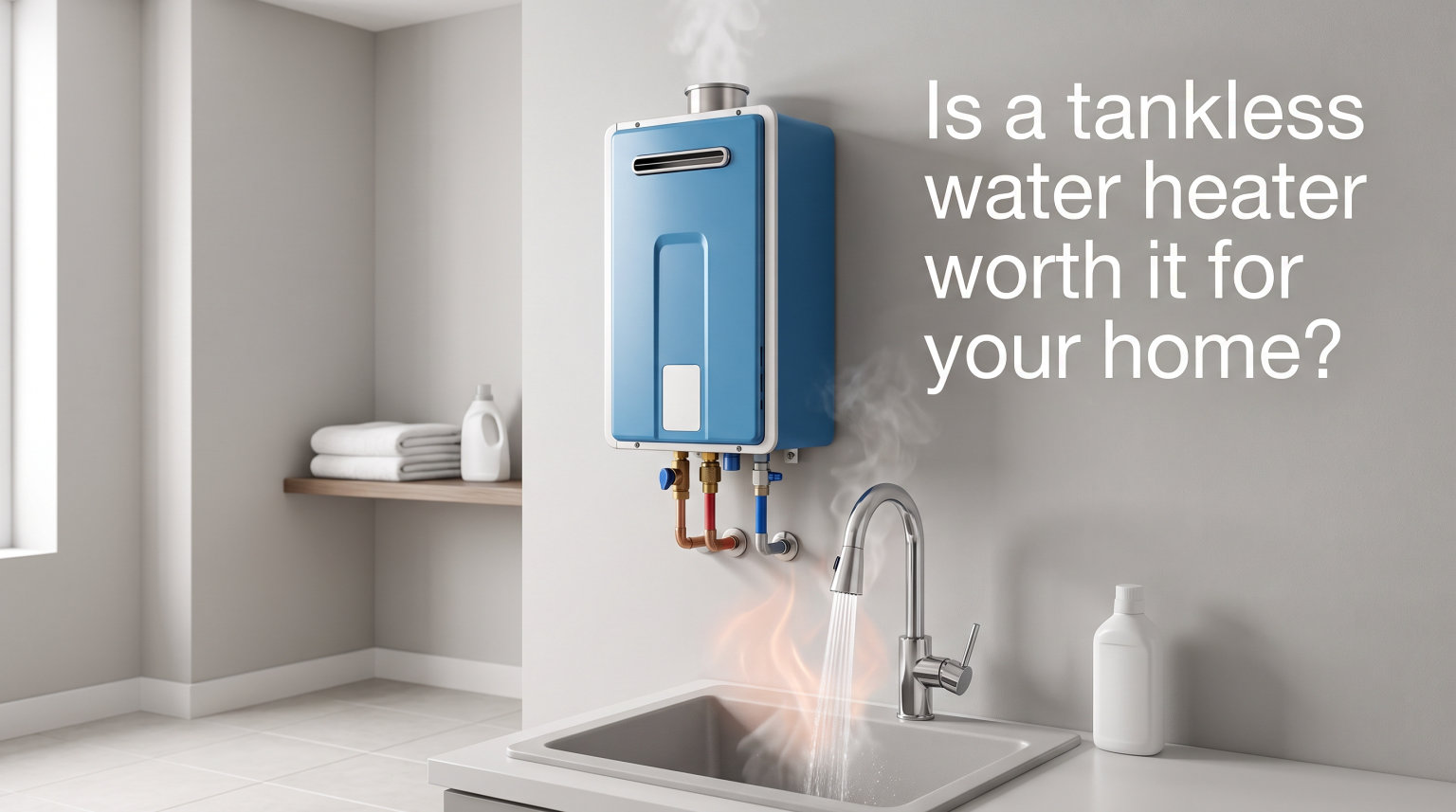
Yes, a tankless water heater is worth it for most homeowners who plan to stay in their home for more than 7 to 10 years, use a moderate to high amount of hot water, and want to cut energy bills by 24 to 34 percent. These on-demand systems heat water only when you need it, which eliminates the standby energy loss that traditional tank heaters waste every single day.
But the answer is not the same for every household. The upfront cost runs significantly higher than a standard tank unit, and installation can get complicated if your home needs gas line upgrades or electrical panel changes. Whether a tankless water heater is worth it depends on your hot water habits, your budget, your climate, and how long you plan to stay put.
Our team dug into Department of Energy data, homeowner forums, plumber recommendations, and real cost breakdowns to give you a straight answer. This guide covers how tankless water heaters work, the pros and cons, a detailed cost analysis, a side-by-side comparison with tank heaters, and a decision checklist to help you figure out if switching makes sense for your home in 2026.
Table of Contents
How Tankless Water Heaters Work?
A tankless water heater, also called an on-demand or demand-type water heater, heats water directly without storing it in a tank. When you turn on a hot water faucet, cold water travels through a pipe into the unit, where either a gas burner or an electric element heats it instantly. This means you get a continuous supply of hot water without waiting for a tank to fill and warm up.
The key difference from a traditional tank heater is simple. Tank heaters keep 40 to 50 gallons of water hot around the clock, reheating it over and over even when nobody is using it. That constant reheating is called standby heat loss, and it accounts for a meaningful chunk of wasted energy in homes with tank systems. Tankless heaters avoid this problem entirely because they only fire up when you actually need hot water.
Understanding Flow Rate (GPM)
Flow rate is the most important spec to understand when evaluating whether a tankless water heater is worth it for your home. Measured in gallons per minute (GPM), it tells you how much hot water the unit can deliver at once. A typical whole-house tankless unit produces between 5 and 10 GPM depending on the model and fuel type.
Here is roughly what different fixtures demand. A shower uses about 2 to 2.5 GPM, a kitchen faucet uses 1.5 to 2 GPM, a washing machine uses 2 to 3 GPM, and a dishwasher uses 1.5 to 2 GPM. If you want to run two showers and a washing machine at the same time, you need a unit rated for at least 7 GPM. This is where flow rate becomes a real limitation that catches some homeowners off guard.
The other factor that affects flow rate is groundwater temperature. In colder climates, incoming water arrives at a lower temperature, which means the heater has to work harder to bring it up to your desired output temperature. A unit rated for 8 GPM in Florida might only deliver 5 GPM in Minnesota during January. Manufacturers list their GPM ratings based on a specific temperature rise, so always check that number against your local groundwater conditions.
Gas vs Electric Tankless Heaters
Gas tankless water heaters typically offer higher flow rates and work better for whole-house applications, especially in cold climates. They burn natural gas or propane and generally deliver 7 to 10 GPM. The trade-off is that they cost more to install and may require a larger gas line, upgraded venting, or a new gas meter to meet the higher BTU demand.
Electric tankless units are more affordable to purchase and install, take up less space, and require no venting. However, they typically deliver lower flow rates of 2 to 5 GPM, which makes them better suited for point-of-use applications or small households. They also draw a large amount of electricity, which may require a panel upgrade if your home has an older 100-amp service.
Pros: Why a Tankless Water Heater Is Worth It
For the right household, switching to a tankless water heater delivers real, measurable benefits. Here are the top advantages that make the investment worthwhile.
1. Energy savings of 24 to 34 percent. According to the U.S. Department of Energy, homes that use 41 gallons or less of hot water per day see 24 to 34 percent more energy efficiency with a tankless heater compared to a conventional tank. Even in homes with higher usage, the efficiency gain still reaches 8 to 14 percent. Over a year, those savings add up on your utility bills.
2. Endless hot water on demand. This is the benefit homeowners mention most. Because the unit heats water as it flows through, you never run out. A teenager can take a 45-minute shower, the washing machine can run right after, and the next person still gets hot water. For large families, this alone makes a tankless water heater worth it.
3. Longer lifespan. A tankless water heater lasts 20 or more years with proper maintenance, roughly double the 10 to 15 year lifespan of a standard tank heater. That extended service life helps offset the higher purchase price because you go longer between replacements.
4. Space-saving design. Tankless units are compact and wall-mounted, taking up a fraction of the space a 50-gallon tank requires. A typical unit measures about 28 inches tall, 20 inches wide, and 10 inches deep. Many homeowners reclaim a closet, corner of the garage, or utility room for storage after switching.
5. Lower risk of catastrophic leaks. A failed tank water heater can dump 40 to 50 gallons of water across your floor, causing thousands of dollars in damage. Tankless units hold very little water at any given time, which dramatically reduces the risk of a major flood from a tank rupture.
6. Cleaner hot water. Traditional tanks can accumulate rust, scale, and sediment over years of sitting water. Tankless heaters deliver freshly heated water on demand, which means you are not bathing in or drinking water that has been sitting in a rusty tank.
Cons: The Downsides You Need to Know
A tankless water heater is not a perfect solution for every home. Before you decide it is worth it, you need to understand the trade-offs and frustrations that real homeowners report.
1. Higher upfront cost. This is the biggest barrier for most people. A tankless water heater costs roughly $1,500 to $4,000 installed, compared to $500 to $1,500 for a standard tank installation. If your home needs gas line upgrades, a new venting system, or an electrical panel upgrade, the total can climb even higher. That price gap takes years to recover through energy savings.
2. Flow rate limitations for simultaneous use. Unlike a tank heater that can draw 50 gallons of stored hot water at once, a tankless unit has a maximum output it cannot exceed. If two showers, the dishwasher, and the washing machine all run at the same time, the unit may struggle to keep up. You end up managing hot water use rather than having unlimited capacity.
3. The cold water sandwich effect. Some users experience a burst of cold water between uses. This happens when hot water left in the pipes from a previous use cools down, and the tankless unit takes a moment to fire up again for the next demand. It is not dangerous, but it is annoying when you step into what you expect to be a warm shower.
4. Descaling and maintenance requirements. Tankless heaters need annual descaling, especially if you live in a hard water area. Mineral buildup in the heat exchanger reduces efficiency and can eventually damage the unit. This means buying a descaling kit, running a vinegar flush through the system, or paying a plumber to handle it. Tank heaters need maintenance too, but tankless units are more sensitive to neglect.
5. Power outage vulnerability. Electric tankless units stop producing hot water during a power outage. Gas tankless units also typically need electricity for their ignition systems and controls, meaning most tankless heaters go dark when the power drops. A standard tank heater, by contrast, holds a reservoir of hot water that remains usable for a while during an outage.
6. Cold climate performance issues. In regions with very cold groundwater, the heater has to work harder to raise the water temperature, which reduces the effective flow rate. Some homeowners in northern climates report that their gas tankless units consume more fuel than expected during winter months, cutting into the projected energy savings.
Cost Breakdown: Purchase, Installation, and Operating Costs
Understanding the full cost picture is essential to deciding whether a tankless water heater is worth it for your situation. Let us break down the three cost categories you need to consider.
Purchase Price
An electric tankless unit typically costs $500 to $1,500 for the unit itself. Gas tankless units range from $1,000 to $2,500. Point-of-use models meant for a single sink or small application sit at the low end, while whole-house units with higher GPM ratings cost more. Premium brands with smart connectivity and self-diagnostic features push toward the top of these ranges.
Installation Costs
Installation is where tankless costs diverge most sharply from tank heaters. Basic installation runs $1,000 to $1,500 if your home already has compatible gas lines or electrical capacity. However, many homes need upgrades. Running a new gas line costs $500 to $2,000. Upgrading an electrical panel from 100 to 200 amps runs $1,500 to $3,000. Specialized stainless steel venting for gas units adds another $300 to $800.
On average, homeowners report spending between $2,000 and $4,500 total for a whole-house tankless installation including all necessary upgrades. Compare that to $1,200 to $2,000 for a standard tank replacement, and the gap becomes clear.
Operating Costs and Energy Savings
This is where tankless heaters start to pay you back. The Department of Energy estimates annual operating costs of $175 for a gas tankless unit and $580 for an electric tankless unit, compared to roughly $300 for a gas tank and $600 for an electric tank. A typical household saves $70 to $100 per year on energy bills with a gas tankless system.
ROI and Break-Even Timeline
Here is the honest math that most articles gloss over. If your tankless installation costs $3,000 more than a tank replacement would have cost, and you save $80 per year on energy, your break-even point is roughly 37 years. That is longer than the unit lasts. However, if the installation premium is only $1,200 and you save $100 per year, you break even in about 12 years, well within the 20-plus year lifespan.
The ROI depends heavily on your specific situation. Homes that use less than 41 gallons of hot water per day see the best returns. Large families with high demand recover costs faster because they waste more standby energy with a tank. Homes with existing compatible gas lines avoid the expensive installation upgrades that kill the payback math.
Tank vs Tankless: Side-by-Side Comparison
To make the tankless vs tank decision clearer, here is how the two types compare across the metrics that matter most.
| Feature | Tankless Water Heater | Tank Water Heater |
|---|---|---|
| Upfront cost (installed) | $1,500 to $4,500 | $500 to $2,000 |
| Lifespan | 20+ years | 10 to 15 years |
| Energy efficiency | 24 to 34 percent more efficient | Baseline (standby loss) |
| Hot water supply | Endless (within flow rate limit) | Limited to tank capacity |
| Space required | Compact, wall-mounted | Large floor footprint |
| Maintenance | Annual descaling required | Periodic flushing |
| Simultaneous use | Limited by GPM rating | Can deplete tank quickly |
| Annual operating cost | $175 to $580 | $300 to $600 |
As the table shows, tankless wins on lifespan, efficiency, space, and operating cost. Tank heaters win on upfront price and simplicity. Your decision comes down to which factors matter most for your household.
When a Tankless Water Heater Is Worth It (and When It Is Not)?
After analyzing the data, homeowner experiences, and cost math, here is a clear decision framework. Use these checklists to determine if a tankless water heater is worth it for your specific situation.
A tankless water heater is worth it if:
You plan to stay in your home for at least 10 years. This gives you enough time to recover the installation premium through energy savings and enjoy the extended lifespan benefit. If you are moving in three years, the math does not work.
Your home already has a gas line and compatible venting. Avoiding gas line upgrades and panel changes keeps your installation cost closer to the $2,000 range, which makes the payback timeline reasonable.
You have a large family with high hot water demand. Households running multiple showers, laundry, and dishes daily waste more standby energy with a tank system, which means bigger savings with tankless.
Space is tight in your home. If you want to reclaim a utility closet or free up garage space, the compact wall-mounted design of a tankless unit delivers real value beyond energy savings.
You are building a new home or doing a major renovation. New construction lets you design the gas lines, venting, and electrical system for tankless from the start, eliminating the expensive retrofit costs.
A tankless water heater is probably not worth it if:
You are replacing a tank on a tight budget. If cost is the primary concern, a high-efficiency tank heater gives you reliable hot water at a fraction of the installed price.
Your home needs extensive electrical or gas upgrades. If you are looking at a panel upgrade plus new gas lines plus venting, your total installation can exceed $5,000, which pushes the break-even point beyond the lifespan of the unit.
You live in a cold climate with very low groundwater temperatures. The reduced flow rate and higher fuel consumption during winter months can erode the energy savings that make tankless attractive.
Your household uses very little hot water. If you live alone and rarely run multiple fixtures at once, the standby energy loss from a tank is small, and the savings from switching are minimal.
You frequently experience power outages. If your area has unreliable electricity, a tank heater provides a reservoir of stored hot water that remains usable during outages, while most tankless units shut down completely.
Frequently Asked Questions About Tankless Water Heaters
Why don’t plumbers like tankless water heaters?
Many plumbers are cautious about tankless water heaters because they are more complex to install correctly. Gas units may require gas line upgrades, specialized venting, and precise sizing that a standard tank replacement does not need. Some plumbers also see more maintenance callbacks with tankless systems, particularly in hard water areas where descaling becomes a recurring issue. However, the notion that plumbers universally dislike tankless heaters is a myth; many recommend them for the right households.
What is the downside to tankless water heaters?
The main downsides are higher upfront cost (often $1,500 to $4,500 installed), flow rate limitations that prevent running multiple high-demand fixtures simultaneously, the need for annual descaling maintenance, potential gas line or electrical panel upgrades, and vulnerability during power outages. Cold climates can also reduce effective flow rates and increase operating costs during winter.
Can you replace a 50 gallon water heater with a tankless water heater?
Yes, you can replace a 50-gallon tank heater with a tankless unit, and most homes do exactly this. You will need a whole-house tankless model rated for at least 5 to 7 GPM depending on your simultaneous hot water needs. Gas tankless units are typically recommended for replacing a 50-gallon tank because they offer the higher flow rates required for whole-house coverage. Be prepared for potential installation upgrades to your gas line and venting.
Do tankless water heaters raise your electric bill?
Electric tankless water heaters can increase your electric bill because they draw a large amount of power to heat water instantly, but they offset this by eliminating standby energy loss. On balance, most households see a net reduction in total energy costs because tankless units are more efficient overall. Gas tankless heaters do not affect your electric bill significantly, though they may slightly increase gas consumption in very cold climates during winter months.
How long does a tankless water heater last?
A tankless water heater typically lasts 20 or more years with proper maintenance, which is roughly double the 10 to 15 year lifespan of a standard tank heater. The key to reaching that full lifespan is annual descaling, especially in areas with hard water. The heat exchanger is the most critical component, and regular maintenance prevents mineral buildup that can shorten the unit’s life.
Conclusion: Making the Right Call for Your Home
So, is a tankless water heater worth it? For homeowners who stay in their house long enough, have moderate to high hot water demand, and avoid expensive installation retrofits, the answer is a confident yes. You get endless hot water, lower energy bills, twice the lifespan, and a compact design that frees up space in your home.
If your situation involves major gas or electrical upgrades, a tight budget, or a move within a few years, a high-efficiency tank heater is the more practical choice. The smartest next step is to get quotes from two or three licensed plumbers who can assess your home’s gas lines, electrical capacity, and water usage to give you a real installation estimate. Only then can you run the numbers and decide with confidence.
Take the decision framework and cost breakdown from this guide, apply it to your specific situation, and you will have a clear answer on whether a tankless water heater is worth it for your home.