
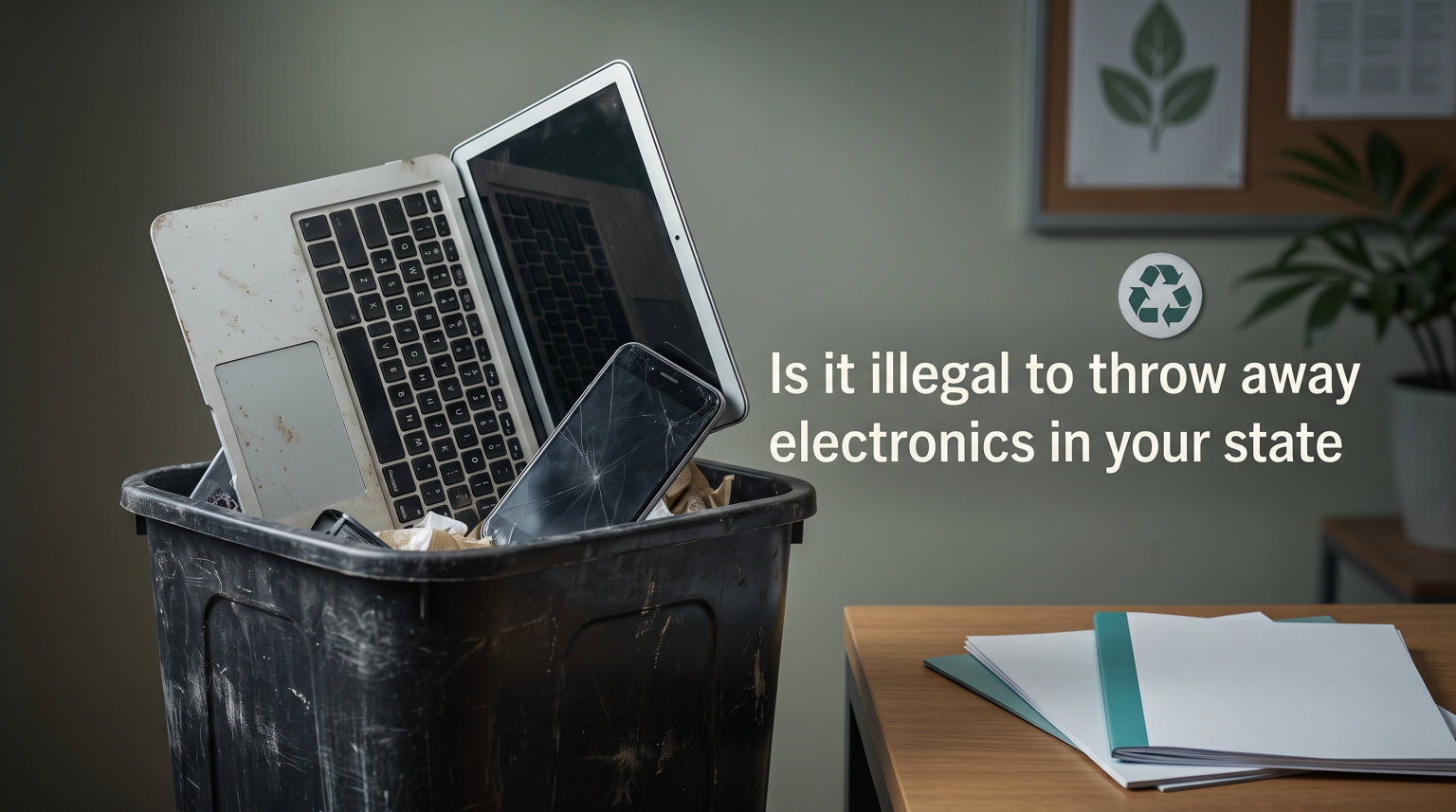
Yes, it is illegal to throw away electronics in the trash in 25 states and the District of Columbia as of 2026. If you live in one of these states and toss an old laptop, television, or monitor into your curbside garbage bin, you could face fines ranging from $25 to several thousand dollars depending on where you live and how many offenses you rack up.
Every month, our team fields questions from people who had no idea their state restricts electronics disposal until a neighbor mentioned it or a waste hauler refused to pick up their bin. The rules are confusing because they change from state to state, and even city to city. What passes as acceptable in Alabama could earn you a citation in California.
This guide breaks down every state’s electronics disposal laws in plain language. We cover which states ban e-waste from landfills, which electronics are covered, what penalties apply, and how to dispose of your old devices legally without paying a dime. Whether you are cleaning out a home office or decommissioning equipment for a business, you will find your state’s rules below.
The question “is it illegal to throw away electronics” does not have a single national answer. The federal government sets a baseline through the Resource Conservation and Recovery Act, but each state decides whether to go further. That patchwork of regulations is exactly why so many people accidentally break the law. Let’s clear up the confusion.
Table of Contents
Is It Illegal to Throw Away Electronics? The Short Answer
It depends entirely on where you live. Twenty-five states plus Washington, D.C. have passed laws that either ban specific electronics from landfills outright or require manufacturers to fund recycling programs that make trashing devices unnecessary. In these states, putting covered electronics in your regular garbage is against the law.
The remaining states have no statewide e-waste disposal ban. However, many individual counties and municipalities within those states have their own local ordinances. New Hampshire has no state-level e-waste law, but several of its cities restrict electronics in curbside collection. Always check local rules even if your state has no formal statute.
The states with the strictest enforcement tend to be those with outright landfill bans, meaning waste facilities are legally required to reject loads containing covered electronic devices. California, New York, Illinois, and Pennsylvania fall into this category. In these states, the ban applies not just to businesses but to individual households as well.
If you are wondering whether is it illegal to throw away electronics in your specific location, the safest approach is to assume yes and seek out a certified recycler. The environmental and legal risks of guessing wrong are simply not worth it.
Why States Created Electronics Disposal Laws
States enacted electronics disposal laws because discarded devices contain toxic materials that contaminate soil and groundwater when buried in landfills. A single old-school CRT television can contain up to eight pounds of lead. Circuit boards, batteries, and screens also harbor mercury, cadmium, chromium, and flame retardant chemicals that persist in the environment for decades.
When rainwater filters through a landfill packed with broken electronics, it picks up these heavy metals and carries them into the surrounding soil and water table. Communities near older landfills have documented elevated lead and mercury levels in local water supplies traced directly to e-waste contamination.
The volume of e-waste is also growing fast. Americans generated roughly 6.9 million tons of electronic waste in 2026, and only about 15 to 20 percent of that gets properly recycled. The rest ends up in landfills, incinerators, or shipped overseas to developing nations with even fewer environmental protections.
State lawmakers recognized that voluntary recycling was not keeping pace with the flood of discarded devices. California passed the first major Electronic Waste Recycling Act in 2003. Within a decade, more than half the country had followed with their own versions. The goal was simple: keep hazardous materials out of landfills while recovering valuable metals like gold, copper, and palladium that can be reclaimed and reused.
There is also an economic argument. Recycling one million laptops saves enough energy to power 3,500 homes for a year. The precious metals in e-waste represent billions of dollars in recoverable resources that go to waste when devices are dumped instead of processed. State e-waste laws turn a pollution problem into a resource recovery opportunity.
Federal E-Waste Laws: The RCRA Framework
There is no single federal law that makes throwing away electronics illegal nationwide. Instead, the federal government regulates hazardous waste through the Resource Conservation and Recovery Act, commonly called RCRA. Enacted in 1976, RCRA established the framework that states use to build their own e-waste programs.
Under RCRA, the Environmental Protection Agency classifies certain electronic components as hazardous waste due to their lead, mercury, and cadmium content. CRT monitors and old tube televisions are specifically identified as hazardous when discarded. However, RCRA includes a “household exemption” that allows individuals to throw small quantities of hazardous waste in regular trash without violating federal law.
This household exemption is exactly why states stepped in. The federal rule let households dump electronics legally, but the cumulative environmental damage was significant. State laws close that loophole by banning electronics from regular waste streams regardless of the federal exemption.
For businesses, the rules are stricter at the federal level. Companies that generate more than 220 pounds of hazardous waste per month are classified as “large quantity generators” and must follow full RCRA compliance procedures for their e-waste. This includes documentation, proper storage, and use of EPA-approved disposal facilities. Small businesses that produce less waste may qualify for reduced requirements under the “small quantity generator” category.
The federal government also supports e-waste recycling through the Sustainable Materials Management program and partnerships with certified recycling standards like R2 (Responsible Recycling) and e-Stewards. These certifications help consumers and businesses identify legitimate recyclers who handle electronics responsibly rather than shipping them overseas.
What Electronics Are Illegal to Throw Away
The specific devices banned from landfills vary by state, but most states with e-waste laws cover a similar core list of “covered electronic devices.” These are the items you cannot legally throw in the trash in states with active bans.
Computers and computer accessories top the list everywhere. This includes desktop computers, laptops, tablets, computer monitors (especially CRT monitors), keyboards, mice, and external hard drives. The lead content in CRT glass makes these particularly hazardous and heavily regulated.
Televisions are banned in nearly every state with an e-waste law. Both old tube TVs and newer flat-screen models contain materials that qualify them for landfill bans. In states like Oregon and Washington, televisions are among the most commonly recycled items through state programs.
Printers, scanners, and fax machines are covered in most states with electronics disposal bans. These devices contain circuit boards, ink cartridges with chemical residues, and plastic components that should be processed through proper channels.
The rules around smaller electronics get more nuanced. Cell phones, MP3 players, and tablets are covered in some states but not others. Minnesota and Illinois have particularly broad definitions that capture most consumer electronics. California’s program focuses heavily on devices with video display screens.
Here is a general list of electronics commonly covered by state e-waste laws:
Desktop and laptop computers
Computer monitors (CRT and LCD)
Televisions (tube, plasma, LCD, LED)
Printers, scanners, and multifunction devices
Fax machines
Computer peripherals (keyboards, mice, cables)
Tablets and e-readers
DVD players, VCRs, and gaming consoles
Stereo equipment and portable music devices
Cell phones and smartphones (in many states)
Microwaves and small kitchen electronics (in some states)
If you are uncertain whether a specific item qualifies, check your state environmental agency’s website. Most maintain a current list of covered devices and accepted recycling locations.
States Where It Is Illegal to Throw Away Electronics
Twenty-five states and Washington, D.C. have enacted laws that regulate or restrict the disposal of electronics in landfills. These laws fall into two main categories: states with outright landfill bans on covered electronics, and states with mandatory manufacturer take-back programs that effectively require recycling.
States with Landfill Bans on Electronics
Landfill ban states make it illegal for waste facilities to accept covered electronic devices. This means even if you put a computer in your trash, the landfill or transfer station must reject it. These states have the strongest e-waste disposal laws:
Illinois banned electronics from landfills starting in 2012 under the Consumer Electronics Recycling Act. Covered devices include computers, monitors, televisions, printers, and gaming consoles. The law applies to both households and businesses.
New York implemented one of the country’s most comprehensive landfill bans in 2015. Under the New York State Electronic Equipment Recycling and Reuse Act, it is illegal for any person to throw covered electronics in the trash. Violators can face fines of $100 per violation.
California took a different approach with its Electronic Waste Recycling Act of 2003. Rather than a simple landfill ban, California charges an Advanced Recycling Fee on covered electronic devices at point of sale and uses the revenue to fund certified recycling. Landfill disposal of covered devices remains prohibited.
Pennsylvania banned covered electronic devices from landfills under the Covered Device Recycling Act of 2010. The law covers televisions, computers, monitors, and peripherals. Waste haulers are instructed not to collect electronics with regular trash.
Vermont, Connecticut, Rhode Island, Oregon, Washington, Wisconsin, Minnesota, Indiana, Michigan, Maryland, New Jersey, North Carolina, South Carolina, Missouri, Oklahoma, Kansas, West Virginia, Virginia, Maine, and Hawaii all have some form of mandatory e-waste recycling law or landfill restriction. Each varies in which devices are covered and how the recycling infrastructure is funded.
States with Manufacturer Take-Back Programs
Some states require electronics manufacturers to fund and operate recycling programs rather than imposing direct landfill bans. Texas, for example, passed the Texas Computer Recycling Act and a separate television recycling program that requires manufacturers to offer free collection of their branded devices. While Texas does not have a blanket landfill ban, the take-back requirement makes proper recycling available statewide.
Indiana operates the Indiana E-Cycle program, which prohibits covered entities from disposing of certain electronics and requires manufacturers to register and meet recycling targets. Public schools, small businesses, and households all fall under the program’s umbrella.
South Carolina banned the disposal of computers, monitors, printers, and televisions in landfills starting in 2011. The state also requires manufacturers to provide free collection programs for covered devices from households.
The District of Columbia also bans covered electronic devices from landfill disposal and requires manufacturers to implement collection programs. D.C. residents can access free recycling drop-off locations for computers, monitors, TVs, and other covered devices.
Keep in mind that local counties and municipalities in any state may add their own restrictions on top of state law. Even if your state does not have a formal e-waste ban, your city or county garbage service may refuse to collect electronics or may offer special e-waste pickup days.
States Without E-Waste Disposal Laws
Approximately 25 states have no statewide law that prohibits throwing electronics in the trash. This includes states like Alabama, Alaska, Arizona, Arkansas, Colorado, Delaware, Florida, Georgia, Idaho, Iowa, Kentucky, Louisiana, Massachusetts (though some local bans exist), Mississippi, Montana, Nebraska, Nevada, New Mexico, North Dakota, Ohio, South Dakota, Tennessee, Utah, and Wyoming.
Even in states without formal e-waste legislation, local governments often step in. Many counties operate household hazardous waste collection programs that accept electronics. These programs are voluntary, meaning there is no legal penalty for using the regular trash, but the recycling option exists for residents who want to dispose of devices responsibly.
Some of these states are actively considering e-waste legislation. The pace of new state laws has slowed in recent years, but several legislatures have introduced bills that could expand coverage. If your state currently lacks an e-waste law, check whether your city or county has its own ordinance.
Living in a state without an e-waste law does not mean you should just throw everything in the trash. The environmental impact is the same regardless of whether your state prohibits it. Recycling programs, manufacturer take-back options, and electronics retailers often accept old devices for free even in states without mandates.
Major retailers like Best Buy, Staples, and Office Depot run nationwide recycling programs that accept many types of electronics at no charge. These programs operate regardless of state law, making responsible disposal accessible even where no legal requirement exists.
Penalties and Fines for Illegal Electronics Disposal
Penalties for illegally disposing of electronics vary dramatically by state and by whether you are an individual or a business. Most states focus enforcement on commercial violators rather than individual households, but the fines on the books can still hit individuals hard.
In New York, the penalty for throwing covered electronics in the trash starts at $100 for a first offense and can escalate for repeat violations. Waste haulers who collect electronics with regular trash also face penalties under the state law.
Illinois imposes penalties on waste haulers and landfills that accept banned electronics, with fines that can reach thousands of dollars. The state focuses enforcement on the waste management industry rather than individual residents, but individuals are still technically violating the law.
California focuses its enforcement on recyclers and collectors rather than individuals, but the state can impose significant fines on unregistered handlers who improperly dispose of covered electronic waste. Businesses that fail to follow the state’s e-waste rules face penalties through the Department of Toxic Substances Control.
Several states take a tiered approach to penalties. A first offense might result in a warning or small fine, while repeat offenses or large-scale dumping can trigger much larger penalties. In states like Minnesota, willful violations of waste regulations can lead to fines of several thousand dollars per day.
For businesses, the penalties are always more severe. Companies that improperly dispose of electronics may face EPA violations under RCRA, state-level fines, and potential liability for environmental cleanup costs. A business caught dumping computers or monitors could face penalties reaching tens of thousands of dollars depending on the scale of the violation.
The practical reality is that most individuals never face fines for throwing away a single phone or small device. Enforcement typically targets bulk dumping, business violations, and waste haulers. But the laws exist on the books, and the financial risk of a citation is real, especially in states like New York and California where enforcement is more active.
Businesses should take these penalties seriously. Documentation of proper disposal through certified recyclers protects your company from liability if questions arise later. Keep receipts and certificates of recycling or destruction for your records, especially for devices that contained sensitive data.
How to Dispose of Electronics Legally
Disposing of electronics legally is easier than most people think. Free and low-cost options exist in every state, even those without mandatory e-waste laws. Here is a step-by-step process to get rid of old devices the right way.
Step 1: Identify What You Have
Sort your electronics into categories: computers and peripherals, televisions, small electronics like phones and tablets, and anything with a rechargeable battery. This helps you find the right recycling path because some programs accept only certain categories.
Step 2: Remove and Protect Your Data
Before recycling any device that stored personal information, wipe the data completely. For computers, use secure erasure software that overwrites the hard drive multiple times. For smartphones, perform a factory reset and remove any SIM or SD cards. If the device contained sensitive financial or business data, consider physical destruction of the hard drive.
Step 3: Check Manufacturer Take-Back Programs
Many electronics manufacturers operate free take-back programs for their own branded products. Apple, Dell, HP, Lenovo, and Samsung all offer mail-in or drop-off recycling for old devices. Some will even send you a prepaid shipping label. Check the manufacturer’s website for their specific program details.
Step 4: Use Retailer Recycling Programs
Best Buy accepts a wide range of electronics at its stores for free, including computers, televisions (with some size limits), phones, and gaming consoles. Staples and Office Depot offer recycling for smaller electronics like phones, tablets, and ink cartridges. Call ahead to confirm what your local store accepts.
Step 5: Find a Certified Local Recycler
For larger volumes or items not accepted by retailers, search for a certified e-waste recycler near you. Look for recyclers certified under the R2 or e-Stewards standards. These certifications require responsible handling, worker safety protections, and a ban on exporting hazardous waste to developing countries.
You can find certified recyclers through the e-Stewards directory or the Sustainable Electronics Recycling International (SERI) website. Your state environmental agency website should also maintain a list of approved recyclers and drop-off locations.
Step 6: Check for Community Collection Events
Many counties and municipalities host free e-waste collection events throughout the year. These events accept a wide range of electronics and are typically open to all residents. Check your local government website or call your county solid waste department to find upcoming events.
Step 7: Donate Working Electronics
If your device still works, donation is often better than recycling. Schools, community centers, and charitable organizations like Goodwill and the Salvation Army accept working computers and electronics. Some refurbishers distribute repaired devices to people in need. Donation extends the life of the device and serves your community.
Step 8: Get Documentation
For businesses, always request a certificate of recycling or data destruction from your recycler. This document proves you disposed of your electronics legally and securely. Keep these records for at least three years in case of audit or liability questions.
Business E-Waste Compliance: What Companies Need to Know
Businesses face stricter electronics disposal requirements than households. If your company generates more than 220 pounds of hazardous waste per month, federal RCRA rules classify you as a large quantity generator and require full hazardous waste documentation for your e-waste.
Most states require businesses to use certified recyclers for electronic waste and to maintain records proving proper disposal. Some states, like California and New York, have specific business compliance requirements that go beyond what residential users face. Fines for business violations are typically much higher than those for individuals.
Companies should establish a formal electronics disposal policy that covers how devices are retired, who handles data destruction, and which certified recycler processes the equipment. This policy protects the company from liability and ensures consistent compliance across departments and office locations.
IT asset disposition (ITAD) companies specialize in helping businesses manage electronics disposal end to end. They handle data destruction, equipment pickup, recycling, and documentation. For companies with significant IT infrastructure, working with an ITAD provider simplifies compliance considerably.
Forum discussions among IT professionals reveal that many companies struggle with finding trustworthy disposal partners. Look for vendors with R2 or e-Stewards certification, clear chain-of-custody documentation, and positive references from other businesses in your industry. Avoid recyclers who cannot explain where your equipment ends up.
Data Security When Disposing of Electronics
Data security is one of the biggest concerns people raise about recycling old electronics. Every computer, phone, and tablet contains personal information that could be exploited if it falls into the wrong hands. Simply deleting files is not enough to protect your data.
For hard drives and solid-state drives, use software that overwrites the entire drive with random data. Programs like DBAN (Darik’s Boot and Nuke) or manufacturer-provided tools can perform a secure wipe that makes data recovery essentially impossible. For maximum security, physically destroy the drive by drilling through it or using a professional shredding service.
Smartphones require a full factory reset plus removal of all accounts. On iPhones, sign out of iCloud before erasing. On Android devices, remove your Google account and encrypt the phone before resetting. This ensures the factory reset destroys the encryption key, making the old data unreadable.
Certified recyclers offer data destruction services with certificates of destruction that document exactly how your data was eliminated. For businesses handling customer data, financial records, or proprietary information, these certificates are essential for regulatory compliance and liability protection.
FAQs
What are the laws for e-waste in Indiana?
Indiana operates the Indiana E-Cycle program under the Indiana Electronic Waste Management Act. The law prohibits covered entities from disposing of computers, computer peripherals, televisions, and other covered electronic devices in landfills. Indiana also requires electronics manufacturers to register with the state and meet annual recycling targets. Households, small businesses, public schools, and charities can use free collection sites throughout the state.
Is it illegal to throw away electronics in Texas?
Texas does not have a blanket landfill ban on electronics, but the state requires manufacturers to offer free recycling programs through the Texas Computer Recycling Act and the Texas TV Recycling Program. While individuals are not fined for throwing electronics in the trash, the state has made manufacturer-funded recycling available so residents have a free and legal alternative to disposal.
Can I just throw an old computer in the garbage?
In about 25 states plus Washington D.C., throwing an old computer in the garbage is illegal. Computers contain lead, mercury, cadmium, and other hazardous materials that can leach into soil and groundwater when buried in landfills. Even in states without a formal ban, you should recycle computers through a certified e-waste program, retailer take-back, or manufacturer program rather than tossing them in the trash.
Can you put electronics in a garbage bin?
Putting electronics in a residential garbage bin is illegal in states with e-waste landfill bans, including New York, Illinois, California, Pennsylvania, and others. Waste haulers in these states are instructed to reject bins containing covered electronic devices. In states without a ban, you technically can put electronics in your bin, but doing so contributes to environmental contamination and wastes recoverable materials.
Where can I dispose of electronics for free?
You can dispose of electronics for free through manufacturer take-back programs (Apple, Dell, HP, Samsung), retailer programs (Best Buy, Staples, Office Depot), and state or county-run e-waste collection events. Many states with mandatory recycling laws also operate free drop-off sites for residents. Search for R2 or e-Stewards certified recyclers in your area for responsible processing.
Why is it illegal to throw away electronics?
It is illegal to throw away electronics in states with e-waste laws because devices contain toxic materials like lead, mercury, and cadmium that contaminate soil and water when buried in landfills. A single CRT monitor can contain several pounds of lead. These laws protect public health and the environment while also recovering valuable metals and materials through proper recycling.
Conclusion
So, is it illegal to throw away electronics in your state? If you live in one of the 25 states or Washington, D.C. with active e-waste disposal laws, the answer is yes. Fines range from $100 to several thousand dollars depending on your state and the nature of the violation. Even if your state has no formal law, local ordinances and common sense both point toward recycling over dumping.
The good news is that legal disposal has never been easier or more accessible. Manufacturer take-back programs, retailer recycling services, state-run collection sites, and certified local recyclers all provide free or low-cost options. You can dispose of old computers, televisions, phones, and other electronics responsibly without spending money or much time.
Before you toss that old device, take five minutes to find a recycling option near you. Your local environment, your community’s water supply, and potentially your wallet will thank you. Check your state environmental agency website or search for an R2-certified recycler today.