
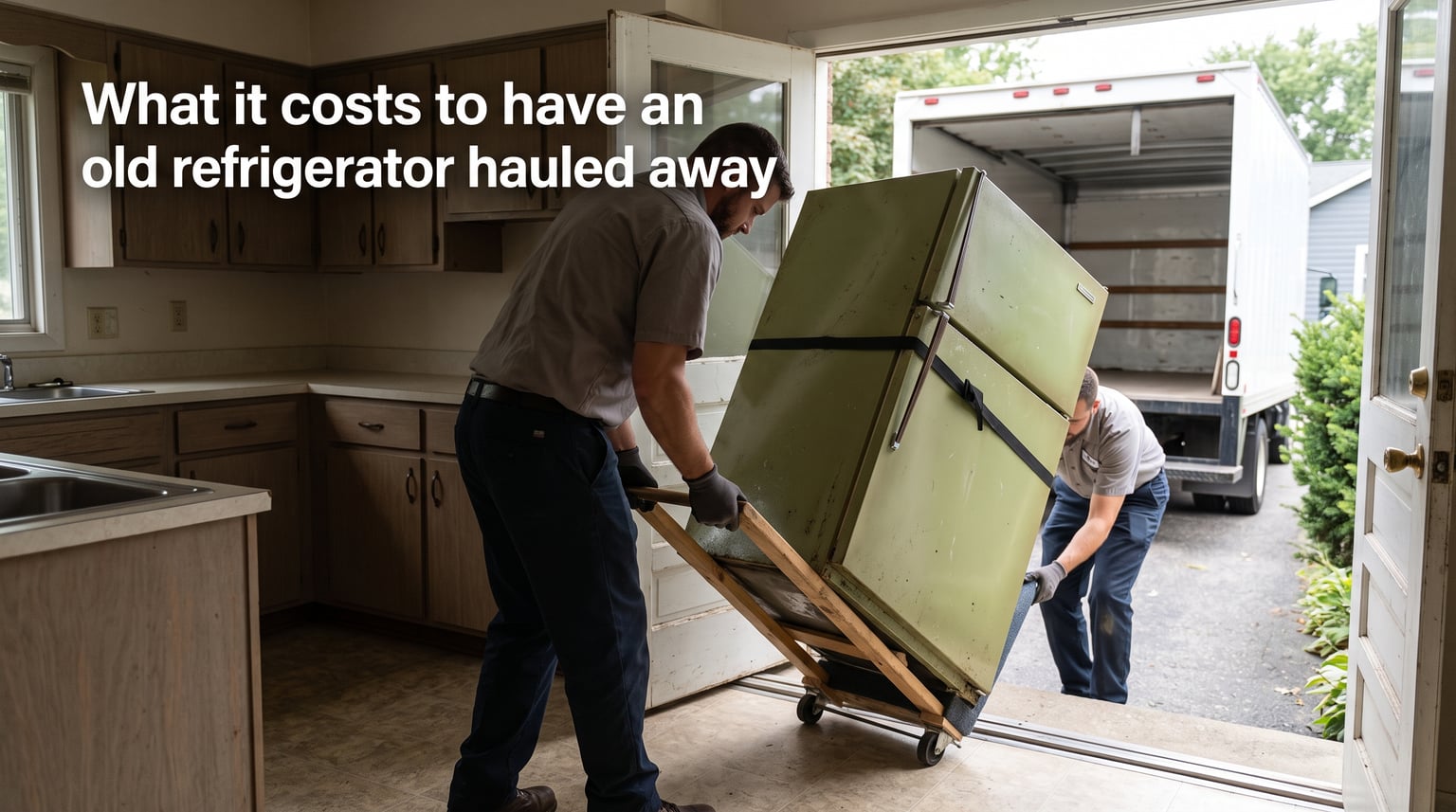
Getting an old refrigerator hauled away costs between $75 and $285 on average in 2026, depending on who you hire, where you live, and how easy the fridge is to reach. Some homeowners pay nothing at all by using utility rebate programs, while others spend over $500 for same-day junk removal of a large unit stuck in a tight basement.
If you are replacing a refrigerator this year, the disposal cost is an easy thing to overlook until the delivery crew mentions it. Our team researched pricing from junk removal companies, major retailers, municipal programs, and utility rebate services across the country to put together the most complete picture of what you will actually pay.
We also pulled real user experiences from community forums where homeowners shared what they were quoted and what they ended up paying. The spread is wide, but the patterns are clear. Here is everything you need to know about what it costs to have an old refrigerator hauled away.
Table of Contents
What It Costs to Have an Old Refrigerator Hauled Away in 2026
The national average to have an old refrigerator hauled away runs between $117 and $285, according to pricing data from Thumbtack, Angi, and Yelp compiled in 2026. At the low end, some homeowners get removal for as little as $50, usually through a retailer haul-away bundled with a new purchase. At the high end, difficult jobs involving stairs, built-in units, or same-day service can push past $600.
Professional junk removal companies like 1-800-GOT-JUNK and College Hunks Hauling typically charge $100 to $200 for a single refrigerator. That price usually includes labor, transport, and the environmental fees required to handle refrigerants properly. Retailer haul-away from stores like Lowe’s or Home Depot runs $25 to $50 when you buy a new appliance from them, and some include it free with delivery.
Here is a quick snapshot of the typical price ranges by disposal method:
Junk removal service (1-800-GOT-JUNK, College Hunks): $100 to $200 per refrigerator
Retailer haul-away (with new purchase): $0 to $50
Independent local hauler: $50 to $150
Municipal bulk pickup: $0 to $108 depending on your city
Utility rebate program: They pay you $35 to $75 for working units
Scrap metal collector: Free pickup, or $15 to $30 in scrap value
For comparison, general appliance removal (washers, dryers, stoves) runs $60 to $180 on average. Refrigerators sit at the higher end of that range because they require special handling for refrigerants and are physically larger and heavier than most other household appliances.
The cheapest possible outcome is getting paid to have your fridge taken away. Utility company rebate programs will pick up a working refrigerator from your home and send you a check, typically $35 to $75. We cover that option in detail below.
Five Factors That Drive Up Refrigerator Removal Costs
Not every refrigerator removal costs the same. Five main factors push your price toward the higher end of the range, and understanding them helps you anticipate the bill before you book a service.
1. Size and Type of Refrigerator
A standard top-freezer refrigerator is the cheapest to remove. French door models, side-by-side units, and large capacity refrigerators over 25 cubic feet cost more because they weigh 250 to 350 pounds and require two people to move safely. Built-in or counter-depth refrigerators that are integrated into cabinetry add significant labor time.
Compact or mini-fridges, on the other hand, often cost $50 or less to haul away and may even qualify for free pickup through some services.
2. Accessibility and Placement
If your refrigerator sits in a first-floor kitchen near an exterior door, removal is straightforward and affordable. But if it is in a basement, up a flight of stairs, wedged into a tight galley kitchen, or behind cabinetry, expect to pay 25% to 50% more. Junk removal companies charge for the extra time and crew members needed.
Homeowners on community forums frequently mention being quoted higher rates once the crew arrived and saw the difficulty of the job. Getting photos or describing the layout when you book can help avoid surprise upcharges.
3. Your Location
Where you live has a major impact on refrigerator disposal cost. Urban areas with more competition among haulers tend to have lower prices. Rural areas, where haulers must drive farther, often add travel fees of $25 to $75.
Regional pricing examples from 2026 data show the spread clearly. In Seattle, municipal bulk pickup charges can run around $108 per item. In Pasadena, residents get two free bulky item pickups per year by calling the city. Some smaller cities offer free appliance pickup while others charge $35 to $75.
Disposal fees at local landfills and transfer stations also vary by region, and those costs get passed on to you through the service price.
4. Environmental and Refrigerant Disposal Fees
Refrigerators contain refrigerants (CFCs, HCFCs, or freon) that the EPA requires to be captured and disposed of by certified technicians. This is the single biggest reason refrigerators cost more to dispose of than other appliances. The environmental fee alone runs $25 to $75 and covers the licensed recovery of refrigerant before the unit can be recycled or scrapped.
Some junk removal companies bundle this fee into their base price. Others list it separately, which can lead to a surprise charge if you only compared the base hauling rate.
5. Whether Disconnection Is Needed
If your old refrigerator is still plugged in and connected to a water line for an ice maker or water dispenser, someone needs to disconnect it before removal. Most junk removal crews will unplug a standard electric fridge at no charge. But water line disconnection, especially if it requires shutting off a supply valve or dealing with a compression fitting, may add $15 to $50.
Gas-powered appliances or units hardwired into the home electrical system need a licensed professional, which is a separate cost entirely. Fortunately, most residential refrigerators simply plug into a standard outlet.
Paid Haul-Away Services and What They Charge
When free options are not available or you need the fridge gone quickly, paid services are the most reliable route. Here is what the major categories of paid haul-away typically cost in 2026.
National Junk Removal Companies
Companies like 1-800-GOT-JUNK, College Hunks Hauling, and LoadUp are the most common choice for refrigerator removal. Their pricing is based on volume and includes labor, transport, and disposal fees.
1-800-GOT-JUNK charges based on how much truck space your items take up. For a single refrigerator, expect $100 to $200. They offer same-day or next-day service in most metro areas and handle everything from in-home pickup to disposal.
College Hunks Hauling lists refrigerator removal at $50 to $150 per unit. Their pricing is more transparent with upfront quotes, and they include the labor for two crew members.
LoadUp typically charges $80 to $150 for refrigerator removal and offers upfront online pricing without an on-site estimate. They are available in most states and often undercut national competitors by 20% to 30%.
Independent Local Haulers
Local hauling companies and solo operators often charge $50 to $150 for refrigerator removal. They can be found on sites like Thumbtack, Angi, or Craigslist. The advantage is usually lower overhead, which translates to a lower price. The tradeoff is less scheduling flexibility and fewer guarantees about proper refrigerant disposal.
Always ask a local hauler whether they are EPA-certified for refrigerant recovery. If they are not, your refrigerator may end up dumped illegally, which creates environmental hazards and could trace back to you.
What Is Typically Included in a Paid Haul-Away
A standard paid refrigerator haul-away should include in-home pickup, loading, transport, and proper disposal or recycling. Most reputable companies also include the refrigerant recovery fee in their quoted price. Curbside pickup (where you wheel the fridge to the curb yourself) is usually $25 to $50 cheaper than in-home service.
What is usually not included: water line disconnection beyond simply unplugging, removal of cabinetry or trim built around the unit, and installation of your new refrigerator. Those are separate services.
Retailer Haul-Away: Lowe’s, Home Depot, and Best Buy
If you are buying a new refrigerator, retailer haul-away is often the most convenient and affordable option. Here is how the major home improvement and electronics retailers handle old appliance removal.
Lowe’s Haul-Away
Lowe’s offers haul-away of your old refrigerator when you purchase a new one and have it delivered. The standard fee is $30 for haul-away, though it is sometimes included free during promotional periods. Lowe’s delivery crews will disconnect and remove your old unit, transport the new one inside, and haul the old fridge away in the same visit.
One important note: Lowe’s typically only hauls away appliances that are already disconnected. If your old refrigerator has a water line that needs professional disconnection, you may need to handle that separately or pay an additional fee.
Home Depot Haul-Away
Home Depot charges approximately $25 to $50 for appliance haul-away with delivery of a new unit. The service includes removing one old appliance per new appliance delivered. Several forum users reported being quoted $50 for haul-away, which prompted them to seek free alternatives like scrap metal pickup.
Home Depot’s service requires the old unit to be unplugged and ready to go. Delivery teams will not uninstall built-in units or handle water line disconnections.
Best Buy Appliance Recycling
Best Buy offers haul-away with delivery of a new appliance, typically charging $19.99 to $39.99. They also have an appliance recycling program where you can drop off old refrigerators at Best Buy stores for free, though large units may require haul-away service rather than drop-off.
Best Buy is one of the few retailers that will recycle appliances even if you did not purchase a replacement from them, though fees may apply in that case.
The retailer haul-away option is best when you were already buying a new refrigerator. It saves a separate trip by a junk removal company and bundles the cost into your delivery. If you are not buying new, skip the retailer route and look at the free options below.
Free Refrigerator Disposal Options That Actually Work
You do not always have to pay to get rid of an old refrigerator. Several free options exist, and some will even pay you. The key is knowing which programs are available in your area and whether your fridge qualifies.
Utility Company Rebate Programs
This is the best deal available. Many electric and gas utility companies offer appliance recycling programs that will pick up your old working refrigerator for free and pay you $35 to $75. Some programs pay up to $50 per unit, and occasionally run bonus promotions offering $75 or more.
ComEd in Illinois pays $50 per working refrigerator. Other utilities across the country pay $35 to $50, with some offering $25 for smaller units or freezers. The refrigerator typically needs to be in working condition and meet a minimum size requirement (usually 10 to 15 cubic feet).
To find your local program, check your utility company’s website or search for “appliance recycling rebate” with your provider’s name. These programs are funded by energy efficiency mandates and are genuinely free. They send a crew to your home, haul the fridge away, and mail you a check within four to six weeks.
Scrap Metal Collectors
Scrap metal collectors will often pick up old appliances for free because they earn money from the metal. However, refrigerators are trickier than other appliances. Many scrap collectors refuse refrigerators specifically because the refrigerant must be recovered by a certified technician before the unit can be processed.
Forum users report that scrap collectors are most interested in washers, dryers, water heaters, and stoves. Refrigerators get refused frequently. When a scrap collector does take a fridge, they typically charge a small fee ($15 to $30) to cover the refrigerant recovery, or they partner with a certified facility.
You can find local scrap collectors on Craigslist, Facebook Marketplace, or by searching “free appliance pickup” in your area. Post your refrigerator with honest details about its condition and make it clear it is available for free pickup.
Donation for Working Refrigerators
If your refrigerator still works, organizations like Habitat for Humanity ReStore, Salvation Army, and Goodwill may accept it as a donation. Some offer free pickup service. Habitat ReStore is particularly receptive to working appliances and will pick up donations in many areas at no charge.
Donated refrigerators must be in working condition, clean, and typically less than 10 years old. Some organizations have strict age limits. The bonus is that your donation may be tax-deductible, which can offset the cost of your new appliance.
Municipal Bulk Pickup Programs
Many cities and counties offer bulk item pickup as part of their regular waste service. The rules vary dramatically by location. Some cities include refrigerator pickup at no additional cost, while others charge a fee or require you to schedule a special pickup.
Pasadena, California offers residents two free bulky item pickups per year. Seattle charges around $108 for bulky item collection, prompting some residents to list items on Craigslist as free to avoid the fee. Check your city’s sanitation or public works website for specific rules.
Municipal programs often have wait times of two to eight weeks, which is a common frustration mentioned in forums. If you need the fridge gone quickly, this may not be the best option.
Craigslist and Nextdoor Free Listings
Listing your old refrigerator as “free to whoever picks it up” on Craigslist, Facebook Marketplace, or Nextdoor can work surprisingly fast. DIYers, landlords, and scrap collectors monitor these listings regularly. A non-working refrigerator may still get picked up by someone who wants the parts or scrap metal.
Be honest about the condition and include photos. If the fridge does not work, say so. You will still get takers if the price is free, but misleading listings waste everyone’s time.
Why Refrigerators Cost More to Dispose Than Other Appliances
Refrigerators are consistently the most expensive household appliance to get rid of, and the reason comes down to one thing: refrigerant.
Older refrigerators contain chlorofluorocarbons (CFCs) or hydrochlorofluorocarbons (HCFCs), commonly known as freon. These chemicals are regulated under the Clean Air Act, and the EPA requires that they be recovered by a Section 608 certified technician before the appliance can be recycled or scrapped. This certification requirement adds time, paperwork, and cost to every refrigerator disposal.
Newer refrigerators use different refrigerants (like R-134a or R-600a), but these still require proper recovery. There is no refrigerator that can simply be tossed into a landfill or scrap pile without processing.
This is also why scrap metal collectors often refuse refrigerators. Without EPA certification, they cannot legally recover the refrigerant, which means they cannot process the unit for scrap value. Washers, dryers, and stoves do not have this requirement, which is why scrap haulers eagerly take those for free.
The environmental disposal fee you see on junk removal quotes ($25 to $75) covers this refrigerant recovery. It is not a markup or a junk removal company trying to pad the bill. It is a legitimate regulatory cost that applies to every refrigerator disposed of in the United States.
How to Save Money on Refrigerator Haul-Away?
Based on the pricing data and user experiences we reviewed, here are the most effective ways to reduce or eliminate your refrigerator disposal cost.
Check your utility company first. If your refrigerator still runs, a utility rebate program is the single best option. You get free pickup and a check for $35 to $75. This should always be your first call.
Bundle with a new purchase. If you are already buying a replacement, retailer haul-away at $0 to $50 is far cheaper than hiring a separate junk removal service at $100 to $200.
Move it to the curb yourself. Most junk removal companies offer curbside pickup for $25 to $50 less than in-home service. If you can safely wheel the fridge to your driveway or curb, you save on labor costs.
Get multiple quotes. Pricing varies significantly between companies for the exact same job. Get quotes from at least three services before booking. Local haulers on Thumbtack or Angi often undercut national brands by 20% to 40%.
Try the free listing route. Posting the fridge as free on Craigslist or Nextdoor costs nothing and takes five minutes. Give it 48 hours. If nobody picks it up, move on to paid options.
Donate if it works. Habitat ReStore and similar organizations pick up working appliances for free, and you may get a tax deduction. This costs you nothing and helps someone in your community.
Ask about neighbor or landlord help. If you live in an apartment or managed property, your landlord or property management company may already have an arrangement for appliance disposal. It never hurts to ask.
Regional Price Differences Across the US
Refrigerator disposal cost shifts noticeably depending on where you live. Labor rates, disposal facility fees, and municipal program availability all vary by region.
In major metropolitan areas like Los Angeles, Chicago, and New York, competition among junk removal companies keeps prices moderate at $100 to $175 for standard refrigerator removal. Rural areas often see higher prices due to travel fees and fewer available services.
Municipal programs make the biggest regional difference. Cities like Pasadena offer free bulky item pickup, while Seattle charges approximately $108. Some smaller municipalities include appliance pickup in standard waste service at no additional cost. Others have no program at all, forcing residents to rely entirely on paid services.
Utility rebate availability also varies by state. Illinois, California, and several New England states have well-funded appliance recycling programs through their utilities. Some states have no rebate program, which means residents in those areas must use paid or scrap options.
Before booking any service, spend ten minutes checking three things: your utility company’s rebate program, your city’s bulk pickup policy, and local scrap collector listings on Craigslist. Those three checks can save you anywhere from $50 to $200.
FAQs
How much does Lowe’s charge to haul away a refrigerator?
Lowe’s charges approximately $30 for haul-away when you purchase and have a new refrigerator delivered. The old unit must be disconnected and ready for removal. During promotional periods, Lowe’s sometimes includes haul-away for free.
How much does 1-800-GOT-JUNK charge to pick up a refrigerator?
1-800-GOT-JUNK typically charges $100 to $200 for a single refrigerator removal. Their pricing is based on truck volume and includes labor, transport, and disposal fees. The exact price depends on your location and the size of the refrigerator.
What is the cheapest way to get rid of a refrigerator?
The cheapest way is through a utility company rebate program, which picks up working refrigerators for free and pays you $35 to $75. Other free options include listing the fridge as free on Craigslist or Nextdoor, donating it to Habitat ReStore if it works, or checking your city’s bulk pickup program.
How much does Home Depot charge to remove old appliances?
Home Depot charges $25 to $50 for appliance haul-away when you purchase a replacement and have it delivered. The old appliance must be unplugged and disconnected before the delivery team arrives. Forum users have reported quotes around $50 for refrigerator haul-away.
How much money do you get if you scrap a refrigerator?
Scrap value for a refrigerator is typically $15 to $30 in steel and other metals. However, many scrap collectors refuse refrigerators because the refrigerant must be recovered by an EPA-certified technician first. When a scrap collector does take a fridge, they often charge a small fee to cover that refrigerant recovery rather than paying you.
Why won’t scrap men take refrigerators?
Scrap collectors refuse refrigerators because they contain refrigerants (CFCs or freon) that the EPA requires to be recovered by a Section 608 certified technician before the unit can be processed. Without that certification, scrap collectors cannot legally drain the refrigerant, making the refrigerator impossible to process for scrap metal value.
How much to dump an old fridge?
Dumping an old refrigerator at a landfill or transfer station is not straightforward because most facilities will not accept appliances with refrigerant. You must take it to a certified recycling facility. Drop-off recycling is often free, but you have to transport the fridge yourself. Professional removal runs $75 to $285 with delivery included.
Can I put a refrigerator on the curb for pickup?
Most cities do not allow refrigerators on the curb for regular trash pickup. Many require you to schedule a special bulk item pickup, which may be free or cost $35 to $108 depending on your municipality. Some cities also require doors to be removed or secured before curbside placement for safety reasons.
The Bottom Line on Refrigerator Haul-Away Costs
Having an old refrigerator hauled away costs $75 to $285 on average, but you can drive that number to zero or even get paid by knowing your options. Start with a utility rebate check if the fridge still works. If you are buying new, take advantage of retailer haul-away at delivery. Only fall back on paid junk removal when speed and convenience matter more than cost.
The most expensive mistake is assuming you have to pay full price without checking the free programs available in your area. Ten minutes of research into your utility company, city bulk pickup rules, and local scrap listings can save you $100 or more. That money is better spent on your new refrigerator than on a disposal fee.