
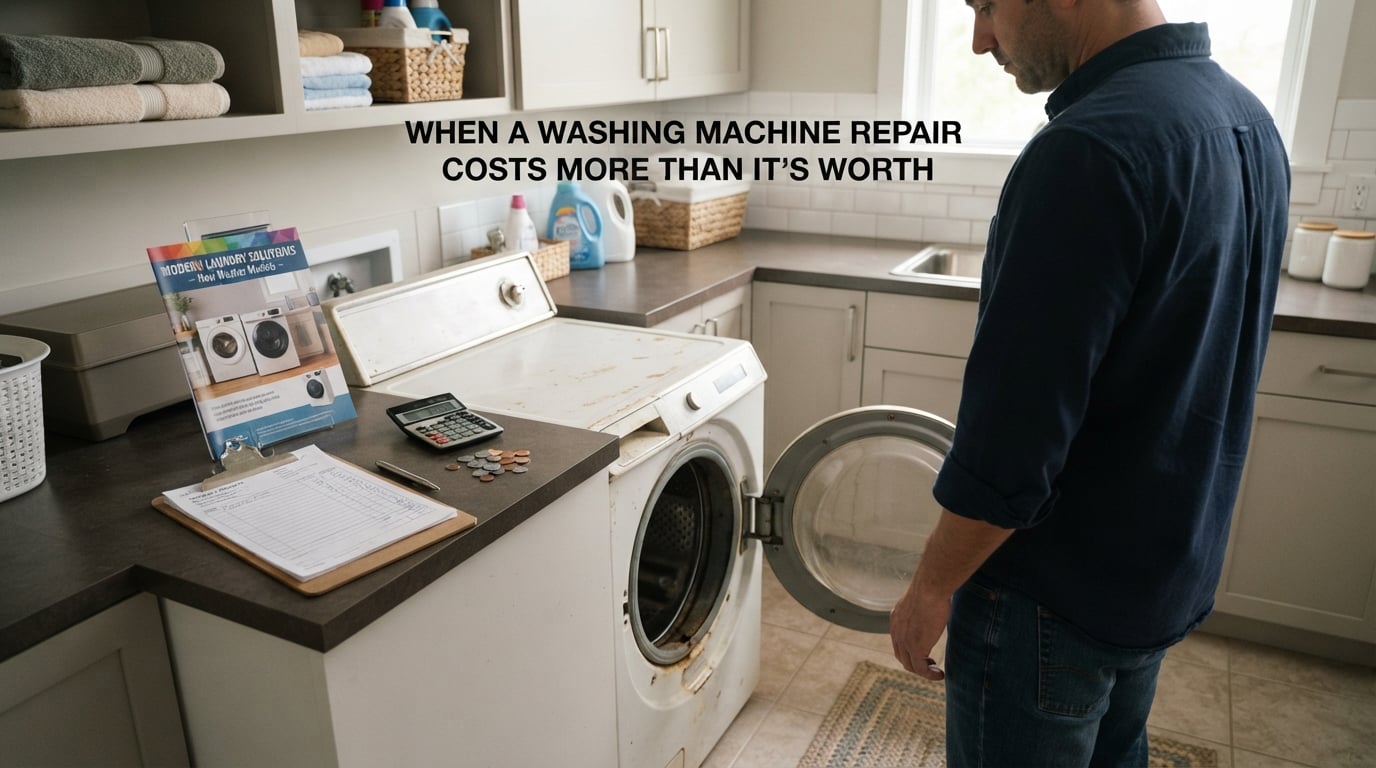
When your washing machine starts making that awful grinding noise or refuses to spin, the first question that hits you is simple but stressful: should I fix this thing or just buy a new one? It is a decision millions of homeowners face every year, and getting it wrong can cost you hundreds or even thousands of dollars.
The average washing machine repair costs between $125 and $450, with most homeowners paying around $155 to $180 per visit. But cost alone does not tell the whole story. You also need to factor in the age of your machine, the specific part that failed, how many times it has broken before, and whether a newer model would save you money on energy bills.
I have spent years researching appliance repair data, digging through forum discussions from homeowners who have been through this exact decision, and studying what consumer advocacy organizations recommend. What I found is that most people oversimplify the choice. They either panic and buy new at the first sign of trouble, or they stubbornly pour money into a machine that is on its last legs.
This guide walks you through a clear framework for deciding when a washing machine repair is worth it and when you should walk away. I will cover the famous 50% rule, break down real repair costs by problem type, explain how appliance age factors in, and give you a quick checklist you can use the next time your washer acts up.
By the end, you will know exactly when fixing your washing machine makes financial sense and when replacement is the smarter long-term move. Let’s start with the single most important rule in appliance repair.
Table of Contents
The 50% Rule Explained: Your Starting Point
The 50% rule for appliance repair is simple: if the cost of a repair exceeds 50% of the price of a replacement, you should buy new instead. This is the gold standard guideline used by consumer advocates, repair professionals, and financial advisors alike.
Here is how it works in practice. Say your washing machine is worth about $500 on the current market, and the repair quote comes in at $300. Since $300 is more than half of $500, the math points toward replacement. A $150 repair on that same machine, however, passes the test comfortably.
The logic behind the rule comes down to diminishing returns. When you sink more than half a machine’s value into a single repair, you are betting that nothing else will break. On an aging appliance, that is a risky bet.
There are exceptions worth knowing. If your washer is relatively new and still under an extended warranty, even an expensive repair may be covered at little or no cost to you. Similarly, if you have a premium machine that originally cost $1,200 to $1,500, a $400 repair might still make sense because the replacement cost is so much higher.
Some repair technicians push the threshold even lower for older machines. They suggest using a 30% rule for washers over ten years old, since the probability of a follow-up repair increases sharply with age. A $200 repair on a machine worth $500 is 40% of its value, which already feels risky on a unit that old.
The 50% rule gives you a quick sanity check, but it works best when combined with two other factors: the age of your machine and the type of repair needed. Let’s look at what different repairs actually cost.
Average Washing Machine Repair Costs by Problem Type
Knowing what specific repairs typically cost helps you judge whether a quote is fair and whether the repair makes sense at all. Most washing machine repairs fall between $125 and $450, but the range varies widely depending on what broke.
Here are the most common washing machine problems and their typical repair cost ranges based on 2026 national averages:
Drain pump replacement: $100 to $320. A failed drain pump leaves water sitting in your drum after the cycle ends. This is one of the more common and affordable repairs, especially on front-load machines.
Water inlet valve replacement: $80 to $200. If your washer will not fill or fills slowly, the inlet valve is usually the culprit. Parts are inexpensive and the fix is straightforward for a technician.
Door seal or gasket replacement: $150 to $350. Front-load washers are prone to door seal leaks over time. Labor drives the cost here since accessing and replacing the seal requires disassembling the front panel.
Door lock or latch replacement: $90 to $250. A faulty latch prevents the machine from starting its cycle. This repair is common on front-loaders and relatively affordable.
Shock absorber replacement: $120 to $300. If your washer violently shakes or walks across the floor during the spin cycle, worn shock absorbers are likely to blame. Most machines use two to four absorbers.
Drive belt replacement: $140 to $220. A snapped or stretched belt means the drum will not turn. The part itself is cheap, often under $20, but you still pay for the service call and labor time.
Agitator repair or replacement: $100 to $350. Top-load machines with agitators can see failures in the agitator assembly or the components beneath it. Costs depend on whether the agitator itself or the transmission driving it is the problem.
Transmission replacement: $300 to $600. This is where repairs start getting expensive. A bad transmission means the washer cannot shift between wash and spin cycles. This major fix often pushes you toward replacement, especially on an older machine.
Drum bearing replacement: $300 to $700. Drum bearing failure produces a loud rumbling or grinding sound during the spin cycle. On many machines, this repair is so labor-intensive that the technician must nearly disassemble the entire washer.
Control board replacement: $250 to $600. Electronic control board failures are becoming more common as washers get smarter and more complex. Diagnosing the issue accurately is critical before committing to a board replacement.
Spider arm or spider assembly replacement: $350 to $650. Corroded spider arms are a known issue on certain front-load washers, particularly in areas with hard water. This is another repair that frequently tips the scale toward replacement.
As a general pattern, anything under $200 is usually worth fixing on a machine under eight years old. Repairs over $400 warrant a serious conversation about replacement, especially if your washer is approaching or past the ten-year mark.
The median out-of-pocket washer repair cost reported by Consumer Reports members is $155. That means half of all repairs cost less, which is encouraging news if your problem turns out to be something simple.
How Long Do Washing Machines Actually Last?
Appliance lifespan is one of the biggest factors in the repair versus replace decision. Knowing where your machine sits in its expected life helps you predict how many good years a repair might buy you.
The typical washing machine lasts between 10 and 14 years. That range breaks down further by machine type and usage patterns.
Top-load washers with agitators: 10 to 13 years. These machines tend to be simpler mechanically, which can mean more repairable components and longer functional life with proper maintenance.
Top-load washers with impellers (HE): 10 to 14 years. High-efficiency top-loaders use impellers instead of agitators. They generally have fewer moving parts in the wash system, which can extend their service life.
Front-load washers: 10 to 14 years. Front-loaders are known for energy and water efficiency but are more prone to seal and bearing issues as they age. Regular door seal cleaning helps extend their life.
Compact or portable washers: 5 to 8 years. Smaller machines typically have shorter lifespans due to lighter-duty components and more frequent relocation stress.
Age alone does not determine whether a repair is worthwhile, but it sets the context. A seven-year-old washer is in the middle of its expected life, so a reasonable repair often makes sense. A twelve-year-old machine is entering the danger zone where each repair carries more risk of a follow-up failure.
Forum discussions from real homeowners reveal an interesting trend that runs counter to what you might expect. Many people report that older washers, particularly those built ten or more years ago, are often more repairable than newer models. They were designed with serviceability in mind, using replaceable parts that are still available through parts suppliers.
Newer machines are increasingly viewed as built to be replaced rather than repaired. Electronic components are harder to diagnose without specialized equipment, and some manufacturers use proprietary parts that are expensive or difficult to source.
This means a repair on a well-built older machine might buy you more reliable additional years than the same repair on a newer, lower-quality unit. The build quality matters as much as the age.
When a Washing Machine Repair Is Worth It
Certain situations make repair the clear financial winner. Here are the scenarios where fixing your washer is almost always the right call.
The machine is under eight years old. At this age, your washer still has several years of expected life remaining. A single repair that costs under $300 is a sensible investment that should pay for itself in continued service.
The repair costs less than half the replacement value. If a $150 drain pump fix gets your $600 machine running again, you are saving $450 compared to buying new. That math works clearly in your favor.
It is the first major repair. A machine that has run reliably for years and suddenly needs one fix is a different situation from a machine that has been in and out of the shop. First-time fixes on a reliable machine are usually worth it.
The machine is still under warranty. Manufacturer warranties or extended protection plans can cover parts and labor entirely. Always check your coverage paperwork before paying anything out of pocket.
It is a simple, well-known problem. Drain pumps, inlet valves, and drive belts are common failures with established repair procedures. These are low-risk fixes with predictable costs and high success rates.
You have a premium machine. High-end washers that originally cost $1,000 or more have a higher replacement threshold. A $300 repair on a machine that would cost $1,400 to replace is a reasonable bet that can extend its life by several years.
Parts are readily available. If the repair technician confirms that the needed part is in stock and not being discontinued, the repair carries less risk. Discontinued or backordered parts are a red flag for older models.
Many homeowners on appliance forums share stories of fixing ten-year-old machines for under $200 and getting several more years of reliable service. The key in every success story is the same: a well-built machine that needed a single, straightforward repair.
When the math works and the machine has life left, a washing machine repair is worth it. Now let’s look at the flip side.
When Replacement Is the Smarter Call
Sometimes walking away from a broken washer is the best financial decision you can make. Here are the clear signals that replacement beats repair.
The repair quote exceeds 50% of a new machine’s cost. If fixing your washer costs $400 and a comparable new model runs $700, you are spending more than half on a repair with no guarantee nothing else will break next month.
The machine is over ten years old. At this age, your washer is in the final stretch of its expected lifespan. Even a successful repair may only buy you one or two more years before something else fails.
This is the second or third repair in a year. Repeated breakdowns are the strongest signal that a machine is reaching end-of-life. One repair is normal wear. Two or three major repairs in a short window mean components are failing across the board.
The failed part is a drum bearing or transmission. These are among the most expensive repairs, often running $400 to $700. On most machines, the cost and labor involved make replacement the better financial option.
Parts are being discontinued. If the manufacturer has stopped making replacement parts for your model, future repairs become difficult or impossible. This is common with machines over twelve years old and signals that the end is near.
Your energy bills are climbing. Older washers use significantly more water and electricity than modern high-efficiency models. The savings on utility bills over several years can partially offset the cost of a new machine, making replacement more attractive.
The machine has a history of the same problem. If the same component has failed twice already, the underlying cause may be a design flaw or deeper systemic wear. Repeating the same repair rarely solves the root issue permanently.
You are planning to sell your home soon. Buyers expect working, relatively modern appliances during inspections. A brand new washer can be a selling point, while a patched-up old machine might raise concerns during a home tour.
Forum discussions consistently highlight $700 repair quotes as the tipping point where homeowners almost universally agree replacement is the better move. At that level, you are paying close to the cost of a new budget-friendly machine for a repair that might not even extend the washer’s life significantly.
The Hidden Costs of Replacement Nobody Mentions
Before you rush to replace your washer, factor in costs beyond the sticker price. Replacement carries several expenses that catch homeowners off guard and can add $200 to $500 to the true cost of going new.
Delivery and installation: $50 to $200. Most retailers charge separately for delivery and hookup. Some include basic installation in the purchase price, but many do not, and these fees add up quickly.
Haul-away of the old machine: $20 to $50. Getting rid of your old washer is often an add-on fee at checkout. Some municipalities offer free appliance recycling programs, but many charge for pickup.
New hoses and connectors: $15 to $40. Even if your old hoses look fine, most installers recommend replacing them during installation. Stainless steel braided hoses cost more but last significantly longer than rubber ones.
Extended warranty: $100 to $300. Many buyers add a protection plan to their new machine for peace of mind. Whether this is worth it depends on the brand’s reliability record and your personal risk tolerance.
Plumbing or electrical modifications: $50 to $500. If you are switching from a top-load to a front-load, or changing brands with different dimensions, you may need adjustments to your laundry area.
Sales tax: varies by location. On a $700 machine, sales tax can add $35 to $70 depending on your state. This is easy to overlook when you are focused on the base price.
When you add all of these together, a $700 washing machine can actually cost $900 to $1,000 out the door. Factoring in these hidden costs often makes a $300 repair on your current machine look more attractive than it first appears.
Always calculate the true total cost of replacement, including every fee and add-on, before making your final decision. The sticker price is just the beginning.
DIY vs Professional Repair: Which Makes Sense?
One way to dramatically reduce repair costs is to do the work yourself. Forum discussions are full of homeowners who fixed their washers for a fraction of what a professional would charge. But DIY is not always the right move, and the line between the two depends on the problem.
When DIY makes sense: Simple problems with easily accessible parts are good candidates for DIY repair. Replacing a drain pump, swapping a drive belt, or cleaning a clogged filter are tasks that many homeowners complete successfully on a weekend afternoon.
The savings can be dramatic. One Reddit user shared a story of paying $13 for a replacement part that a repair company had quoted $375 to fix, including $175 for the diagnostic visit alone and $200 in labor charges.
Online resources have made DIY more accessible than ever. Video tutorials walk you through specific repairs step by step, and parts retailers provide detailed compatibility information so you order the correct component the first time.
When to call a professional: Anything involving the drum bearing, transmission, or electronic control board is usually best left to professionals. These repairs require specialized tools, technical knowledge, and sometimes two people to handle heavy components safely.
Gas-connected machines or repairs near electrical wiring should always involve a licensed professional. The safety risks are simply not worth the money you might save.
If your machine is still under warranty, attempting DIY repairs may void your coverage entirely. Check your warranty terms carefully before picking up a screwdriver.
The diagnostic dilemma: The hardest part of DIY repair is correctly identifying the problem in the first place. A professional technician’s diagnostic fee, typically $75 to $150, buys you an accurate assessment from someone who has seen the issue before.
If you misdiagnose the issue and order the wrong part, your savings evaporate quickly. A reasonable middle ground is to pay for a professional diagnosis, then decide whether to attempt the repair yourself based on what they find.
The Cost Per Year Calculation
The cost per year method gives you a more precise way to evaluate repair versus replacement. It factors in how many additional years each option is likely to give you, rather than just looking at upfront costs.
For repair: Divide the repair cost by the number of additional years you expect the machine to last after the fix. A $200 repair on an eight-year-old machine that might last two more years costs $100 per year of additional service.
For replacement: Divide the total cost of a new machine, including delivery, installation, and haul-away fees, by its expected lifespan. A $900 total investment in a machine that lasts 12 years costs $75 per year.
In that example, replacement wins because the cost per year is lower over the long run. But change the numbers slightly and repair can come out ahead easily.
A $150 repair on a six-year-old machine that might run four more years costs just $37.50 per year. That is very hard to beat with any new purchase, even an efficient one.
Adjusting for risk: The cost per year calculation assumes the machine will actually last as long as you expect. Older machines carry more risk of another breakdown, so you should build this uncertainty into your math.
For example, if a repair on a twelve-year-old machine has roughly a 50% chance of lasting two more years, use one year as your expected lifespan for the calculation. This makes the cost per year higher and may tip the decision toward replacement.
This method takes more effort than the simple 50% rule, but it gives you a clearer financial picture for decisions that fall in the gray zone where the choice is not obvious.
Second Repair Warning Signs: Don’t Get Trapped
One of the biggest mistakes homeowners make is pouring money into a machine that is slowly dying. The second repair is often where people get trapped, and recognizing the warning signs can save you from throwing good money after bad.
The one-year rule. If your washer needs a second major repair within twelve months of the first, the machine is telling you something important. Multiple component failures in a short window indicate systemic wear, not isolated bad luck.
Different systems failing. A transmission failure followed months later by a control board problem suggests that multiple independent systems are reaching end-of-life simultaneously. This pattern is common in machines over ten years old.
Escalating repair costs. If your first repair cost $150 and the next quote comes in at $350, the machine is demanding more and more investment just to keep running. This upward cost trend rarely reverses on aging appliances.
Parts becoming harder to source. If the technician mentions that a part was difficult to find or is on backorder from the manufacturer, future repairs will only get more challenging and expensive.
The cumulative cost approaches the machine’s value. By the time you are considering a third repair, the total amount you have spent often exceeds what the machine is worth. Add up everything you have spent on repairs and compare it honestly to the cost of a new unit.
Reduced performance between repairs. If the washer is not cleaning as well, making more noise than it used to, or vibrating excessively during the spin cycle, these are signs of broader deterioration that a single repair will not fix.
When two or more of these warning signs are present, replacement is almost always the better financial decision. The trap of sunk cost thinking leads people to keep repairing because they already invested in the first fix. Resist that urge and look at each repair decision fresh.
Environmental Impact: The Green Case for Repair
The environmental angle of the repair versus replace decision rarely gets the attention it deserves. Repairing your washing machine is almost always the greener choice, and it is worth factoring into your decision.
Manufacturing a new washing machine requires significant raw materials, including steel, plastic, copper, and rare earth elements for the electronic components. The production and shipping process generates hundreds of pounds of carbon emissions before the machine ever reaches your laundry room.
Keeping your current machine running avoids all of that environmental impact. Even factoring in the resources needed to manufacture replacement parts, repair has a fraction of the footprint of buying new.
There is also the waste issue to consider. Your old machine does not just disappear when it gets hauled away. While many are recycled for scrap metal, a significant portion of components end up in landfills. The plastic parts, rubber seals, and electronic circuit boards are particularly difficult to dispose of responsibly.
That said, there is an environmental case for replacement in one specific scenario. If your current machine is an older model that uses excessive water and electricity, a modern high-efficiency unit can reduce your household’s resource consumption significantly over its lifetime.
Newer machines use less water per cycle and less electricity per load, which lowers your environmental footprint month after month. Over a 12-year lifespan, those savings can be substantial.
The greenest approach is to repair when it makes financial sense, and when you do eventually replace, choose an energy-efficient model and make sure your old machine gets recycled properly rather than sent to a landfill.
Quick Decision Checklist
Use this checklist the next time your washing machine breaks down. Work through each question in order to reach a clear decision quickly.
1. Is the machine still under warranty? If yes, use the warranty and pay little or nothing.
2. How old is the machine? Under 8 years leans toward repair. Over 10 years leans toward replacement.
3. What is the repair cost? Under $200 on a younger machine is usually worth it. Over $400 warrants serious consideration of replacement.
4. Is this the first repair? First repairs favor fixing. Second or third repairs within a year favor replacing.
5. Does the repair exceed 50% of a new machine’s total cost? If yes, lean strongly toward replacement.
6. What part failed? Simple parts like pumps, valves, and belts favor repair. Drum bearings and transmissions favor replacement.
7. Are replacement parts still available for your model? Discontinued parts signal it is time to move on.
8. Run the cost per year calculation for both repair and replacement to find which option delivers better value per year of service.
FAQs
What is the average price to fix a washing machine?
The average washing machine repair costs between $125 and $450, with a typical repair running around $155 to $180 per visit. Simple fixes like replacing a water inlet valve or drive belt cost $80 to $220, while major repairs such as a transmission or drum bearing replacement can run $300 to $700.
Is a 7 year old washing machine worth fixing?
Yes, a 7-year-old washing machine is generally worth fixing if the repair costs less than 50% of a replacement and it is the first major repair. At seven years, most washers are in the middle of their 10 to 14 year expected lifespan, so a reasonably priced repair can still buy several more years of service.
What is the typical life expectancy of a washing machine?
The typical washing machine lasts between 10 and 14 years. Top-load washers with agitators average 10 to 13 years, high-efficiency top-loaders and front-load washers average 10 to 14 years, and compact or portable washers average 5 to 8 years. Regular maintenance and proper loading can help a machine reach the upper end of its range.
What is the 50 rule for appliance repair?
The 50% rule states that if a repair costs more than 50% of the appliance’s current replacement value, you should replace the appliance instead of repairing it. For example, if your washing machine would cost $600 to replace and the repair quote is $350, the repair exceeds 50% and replacement is the better financial choice.
Making Your Final Decision
Deciding whether a washing machine repair is worth it comes down to three core factors working together: the cost of the repair relative to replacement, the age and remaining lifespan of your machine, and the pattern of breakdowns you have experienced.
The 50% rule gives you a fast first checkpoint. If the repair eats more than half of what a new machine would cost, replacement is likely the better path. Pair that with the machine’s age, since washers over ten years old carry significantly more risk of follow-up failures.
Watch for the warning signs of a dying machine. A second major repair within a year, escalating costs, and multiple different systems failing all point toward replacement. Do not fall into the sunk cost trap of repairing just because you already paid for the first fix.
Remember to factor in the hidden costs of replacement too. Delivery, installation, haul-away, and new connectors can add $200 to $500 to the true cost of going new, which makes a moderately priced repair look better than the raw numbers suggest.
If you are still torn, run the cost per year calculation for both options. It cuts through the emotion and gives you a clear dollar figure to compare. When you know what each year of service actually costs, the right choice becomes obvious.
Take a breath, gather your repair quote, check your warranty, and work through the checklist above. The right decision for your wallet is hiding in the numbers, and now you know exactly where to look.