
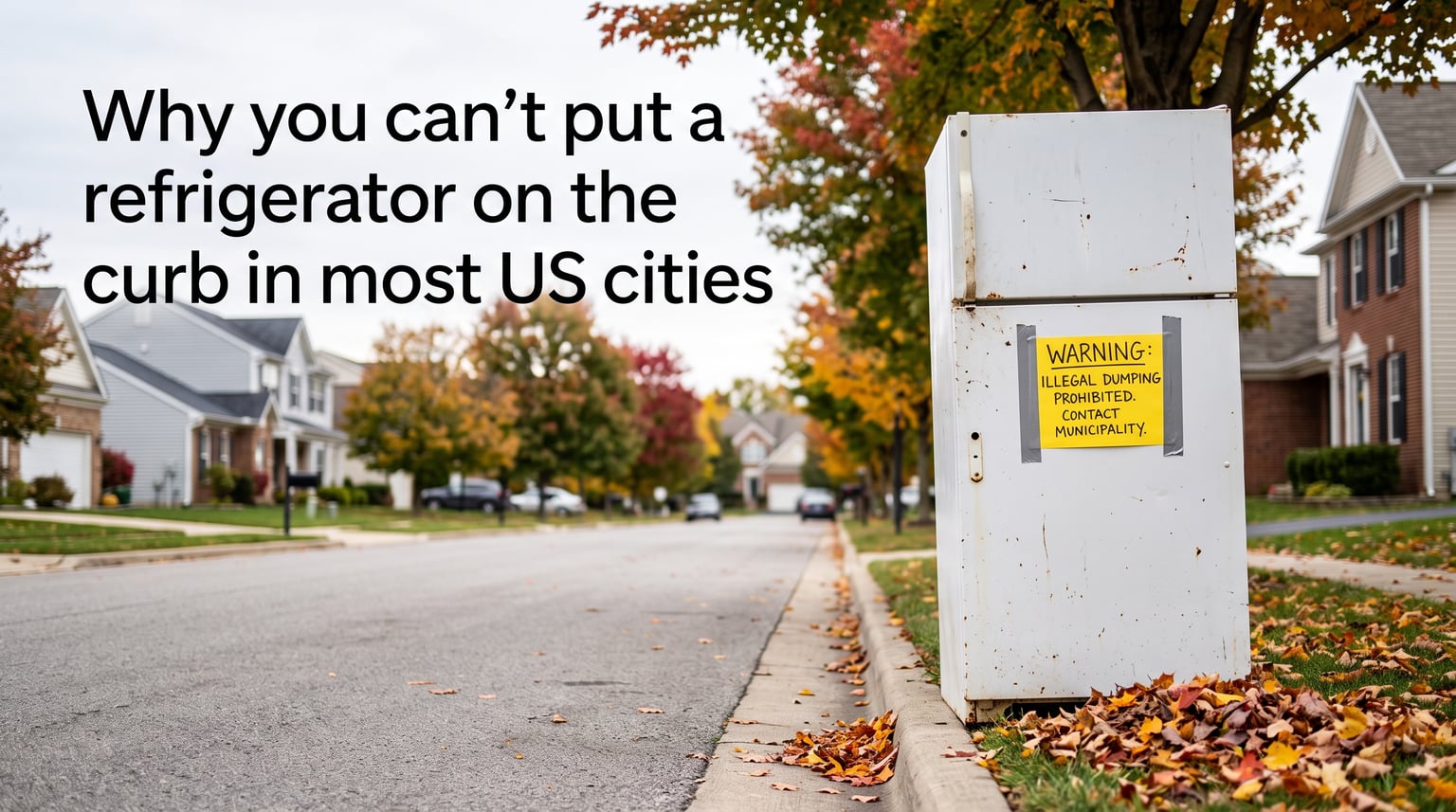
You can’t put a refrigerator on the curb in most US cities because federal law requires certified technicians to recover ozone-depleting refrigerants before the appliance is scrapped, and most municipalities have additional local ordinances banning large appliances from regular trash pickup. Dropping a fridge at the curb can trigger fines of up to $44,539 per day per violation, and it can also create a serious child entrapment hazard.
I dug into the EPA’s Section 608 rules, state landfill bans, and city bulk-pickup requirements while helping a friend replace a 1990s fridge last spring. What I learned is that the curbside ban isn’t one rule. It’s at least four overlapping rules from federal, state, county, and city authorities working together. This guide unpacks each one, shows the penalties you could face, and walks you through the legal ways to get rid of an old refrigerator.
Table of Contents
EPA Section 608 of the Clean Air Act: The Federal Rule Behind the Ban
Section 608 of the Clean Air Act is the main federal law that dictates how refrigerators must be disposed of in the United States. Enforced by the Environmental Protection Agency, the rule is designed to prevent the release of refrigerants that damage the ozone layer and trap heat in the atmosphere.
Under Section 608, anyone who services or disposes of appliances containing refrigerants must use certified technicians and EPA-approved recovery equipment. The rule applies to refrigerators, freezers, window air conditioners, dehumidifiers, and similar household appliances.
The regulation works through a chain of accountability. Manufacturers charge a small fee when selling refrigerant. That fee funds a program that trains and certifies technicians. Certified technicians use specialized recovery machines to pull refrigerant out of old appliances before they are crushed, shredded, or sent to a landfill. The refrigerant is then cleaned, destroyed, or properly stored for reuse.
Three refrigerant types are covered by Section 608. CFCs (chlorofluorocarbons), best known by the brand name Freon, were used in fridges made before 1995. HCFCs (hydrochlorofluorocarbons) replaced CFCs in the 1990s and are still being phased out. HFCs (hydrofluorocarbons) are the modern replacements, but they are powerful greenhouse gases, so they are also regulated under Section 608.
The bottom line: under federal law, refrigerant cannot be vented into the air. It must be recovered, even if the appliance is being scrapped for metal recycling. This is the foundation of why you can’t just leave a fridge on the curb with your regular trash.
What Hazardous Materials Are Hiding in Your Refrigerator
A refrigerator is far more than a metal box. It contains several substances that can harm human health and the environment if released into the air, soil, or water.
Refrigerants are the most concerning. A single older fridge can hold up to one pound of refrigerant. CFCs and HCFCs deplete the stratospheric ozone layer that protects us from ultraviolet radiation. HFCs do not harm the ozone layer, but they trap heat in the atmosphere thousands of times more effectively than carbon dioxide. Even a small amount vented during careless disposal adds up across millions of units.
Compressor oil circulates through the sealed cooling system along with the refrigerant. When a fridge is shredded without proper handling, that oil can contaminate soil and water. The oil also carries dissolved refrigerant into the environment.
Foam insulation in the walls of older refrigerators was often blown with CFCs or HCFCs. When the appliance is crushed or broken, that foam can release the blowing agents it was sealed with. Newer fridges use cyclopentane or other less harmful blowing agents, but millions of older units are still in use.
Mercury switches were common in fridges made before the mid-2000s. They control the interior light when the door opens. Mercury is a potent neurotoxin, and once it leaches into soil or water, it is extremely hard to clean up.
PCBs (polychlorinated biphenyls) were used in capacitors and other components in some appliances manufactured before 1979. They were banned in the US in 1979, but older units may still be in service today.
Leaded glass appears in some older refrigerator shelving. Lead leaches into the environment when glass is broken down in landfills.
All of these materials are why a refrigerator is classified as a “white good” that requires special handling. Your local trash collector is not equipped to deal with any of them.
Federal Penalties for Improper Refrigerator Disposal
The EPA takes refrigerant venting seriously. Under Section 608, civil penalties can reach $44,539 per day per violation. If the EPA determines the violation was knowing or willful, criminal fines can go up to $250,000 for individuals and $500,000 for organizations, with potential prison time of up to five years.
In practice, fines are usually lower than the maximum, but they are real. The EPA settled a case with a Maryland scrap metal company in 2018 for $150,000 after investigators found employees venting refrigerant from crushed appliances. Smaller cases have resulted in fines of $5,000 to $25,000 for contractors who failed to use certified recovery equipment.
You’re unlikely to be personally fined for hauling a fridge to the curb once. The bigger risk is that if you hire an uncertified person to scrap or remove your fridge, you can be held partially responsible if they vent refrigerant into the air. Always ask for proof of certification before letting anyone take your old appliance.
If you suspect someone is illegally venting refrigerant, you can report it to the EPA through your regional office or through the EPA’s national compliance hotline. Violations can also be reported to your state’s environmental agency.
Child Safety and Door Removal Laws
Federal law is not the only reason a fridge can’t go on the curb intact. Child safety is a major concern, and many states have specific laws that require you to remove the doors before disposing of a refrigerator.
The danger is real. Between 2008 and 2018, the Consumer Product Safety Commission documented cases of children who climbed inside discarded refrigerators and became trapped, leading to suffocation deaths. The doors latch firmly and seal the inside, creating an airtight space that can be fatal in minutes.
New York City has one of the clearest door removal laws. NYC Health Code Section 131.13(c) makes it illegal to discard a refrigerator with the doors still attached. The penalty in NYC can run up to $500 for a first offense and higher for repeat violations. Cities including Los Angeles, Chicago, and Boston have similar rules on the books.
Even if your city doesn’t have a specific door removal law, most responsible disposal services will require you to take the doors off. If a child gets into a discarded fridge and is hurt, you could face civil liability on top of any fine.
The fix is simple. Remove the doors completely, or remove the hinges so the doors cannot close and latch. If you can’t take the doors off, secure them with rope, bungee cords, or tape so they cannot swing shut. Never leave a fridge with working latches on the curb, even for a few hours.
State and Municipal Regulations Vary Widely
On top of federal law, most states have their own appliance disposal rules. About 25 states have landfill bans that make it illegal to throw refrigerators and other large appliances in the regular trash. Many states also require retailers to take back old appliances when delivering new ones.
California, New York, Texas, Florida, and Massachusetts have some of the strictest appliance disposal rules. California’s Covered Electronic Waste program includes refrigerators as a category that requires certified recycling. Massachusetts banned CFC-containing appliances from landfills in 1990 and continues to enforce strict recycling requirements.
At the city level, rules get even more specific. In Los Angeles, standard trash pickup will not take a refrigerator. You have to schedule a separate bulky item pickup through LA Sanitation or hire a permitted hauler. In Knoxville, the county convenience centers do not accept refrigerators, and residents are told to call 311 to schedule a special pickup. In Dallas, the utility company Oncor (not ComEd, which is in Illinois) does not pay for fridge pickup, but many Texas utilities run refrigerant recovery programs during ozone season.
Penalties for breaking local rules vary. Littering ordinances can apply, with fines ranging from $50 to $500. Some cities treat illegal appliance dumping as a misdemeanor, which can carry higher fines and even jail time in extreme cases.
The best way to find your local rules is to check your city or county’s solid waste website, or call your local 311 line. Most cities have a one-page guide that explains exactly how to dispose of large appliances in your area.
4 Legal Ways to Dispose of a Refrigerator
Once you know the rules, getting rid of a fridge is straightforward. Here are four legal disposal options, ranked by typical cost.
1. Retailer Haul-Away (Often Free with New Purchase)
Most appliance retailers will haul away your old fridge when they deliver a new one. Home Depot, Lowe’s, Best Buy, and local appliance stores typically offer this service for free or for a small fee of $20 to $50. The retailer is responsible for routing the old unit to a certified recycling partner, so you don’t have to track that yourself.
This is the easiest option for most people. Just ask the salesperson to add haul-away when you order the new fridge. The only catch is that you have to be home for both the delivery and the pickup.
2. Utility Company Rebate Programs (Sometimes Pays You)
Many electric utilities offer cash rebates for turning in old refrigerators, especially energy-guzzling units from the 1990s or earlier. Programs are usually run through statewide energy efficiency initiatives funded by utility ratepayer money.
Rebates typically range from $25 to $75, and some programs include free pickup. Utilities like ComEd in Illinois, ConEd in New York, and Southern California Edison have run appliance recycling programs that pay you to give up an old fridge. Savings are calculated based on the energy the old unit wastes compared to a modern ENERGY STAR model.
To find a program in your area, search “appliance recycling rebate” plus your state name, or check your utility’s website under “energy savings” or “recycling programs.”
3. Municipal Bulk Pickup (Free or Low Cost)
Most cities offer bulk pickup for large appliances, but you usually have to schedule it in advance. New York City, Los Angeles, Chicago, Houston, and Phoenix all have separate bulk pickup programs. Some cities do it for free, others charge $20 to $50 per item.
The key is to follow the local rules exactly. In NYC, you must call 311 or go online to schedule a pickup, remove the doors, and place the unit at the curb only on the scheduled date. Dropping it off without a scheduled pickup can result in a $100 fine.
4. Certified Recycling Center (Free or Pays You for Scrap)
Scrap metal recyclers will often take refrigerators for free because the steel, copper, and aluminum inside are worth money. The recycler must be EPA-certified to recover refrigerant legally, so confirm certification before handing over your appliance.
A good recycler will weigh your fridge on arrival and either charge nothing or pay you based on current scrap metal prices. Recycling centers typically handle refrigerant recovery as part of their standard process.
How to Prepare a Refrigerator for Disposal: Step-by-Step Checklist
Before any disposal method, you need to prep the fridge. Here’s the checklist our team uses after handling dozens of apartment turnovers.
Step 1: Empty the fridge completely. Remove all food, shelves, drawers, and bins. Discard any expired items. Set aside shelves and drawers for recycling if your local program accepts them.
Step 2: Defrost the freezer. Unplug the fridge at least 24 hours before pickup. Leave the freezer door open to let ice melt. Place towels underneath to catch water. Trying to move a fridge with a frozen freezer is heavy and risks damaging the compressor.
Step 3: Clean the interior. Wipe down all surfaces with a mild cleaner or a baking soda solution. This prevents odors and mold during transport. Let it dry completely before sealing.
Step 4: Remove or secure the doors. Take the doors off completely if you can. If you can’t, remove the hinges or use strong tape and rope to keep the doors from closing and latching. This is required by law in many cities.
Step 5: Secure loose parts. Tape down the power cord. Wrap any shelves that you can’t remove in newspaper or bubble wrap so they don’t shift during transport.
Step 6: Photograph the unit. Take a few photos of the fridge’s condition, model number, and serial number. This protects you if the unit is damaged during pickup or if there’s a dispute about the rebate.
Step 7: Confirm pickup details. The day before pickup, confirm the time, location, and any specific placement requirements with the hauler. Some programs require the fridge to be on the curb, others want it in the garage or driveway.
What NOT to Do When Getting Rid of an Old Fridge
Keep in mind these common mistakes that can lead to fines, injuries, or environmental damage.
Don’t leave the fridge on the curb without scheduling a pickup. Even if you intend for it to be picked up, unattended appliances are illegal in most cities and create a child safety hazard.
Don’t try to remove refrigerant yourself. Refrigerant recovery requires EPA-certified equipment and training. Puncturing copper lines to release the gas is illegal and dangerous. Venting refrigerant can result in federal fines and, depending on the chemical, can cause frostbite or respiratory damage.
Don’t hire an uncertified scrap hauler. Anyone offering to take your fridge for “free scrap” without proper certification is likely venting refrigerant. Ask to see their EPA Section 608 certification before letting them take the unit.
Don’t put the fridge in a dumpster. Dumpsters are for regular waste, and most dumpster companies will refuse to haul a refrigerator. If you are caught dumping a fridge in a commercial dumpster, you can be fined for illegal dumping.
Don’t leave foam insulation exposed. If the fridge is damaged in transport, cover any exposed foam with plastic sheeting to prevent it from breaking down and releasing blowing agents.
Frequently Asked Questions
Is it safe to put a fridge on the curb?
It is generally not safe or legal to put a fridge on the curb. Child safety laws in many cities require the doors to be removed, and federal EPA Section 608 rules require refrigerant to be recovered by a certified technician before disposal. An abandoned fridge can trap a child and result in fines of up to $44,539 per day under federal law.
Is it illegal to put a refrigerator on the curb?
Yes, in most US cities it is illegal to put a refrigerator on the curb without a scheduled bulk pickup. Cities including New York City, Los Angeles, Chicago, and Boston have local ordinances that prohibit unattended appliance dumping. Federal EPA Section 608 also requires certified refrigerant recovery before disposal, which regular curbside trash pickup does not provide.
How do you dispose of a refrigerator with Freon?
To dispose of a refrigerator with Freon, you must use a certified technician with EPA Section 608 certification. The technician uses specialized recovery equipment to extract the refrigerant before the appliance is scrapped or recycled. Most utility rebate programs, retailer haul-away services, and certified recycling centers handle this step as part of their standard process.
What appliances does Section 608 apply to?
EPA Section 608 applies to all appliances that contain refrigerant, including refrigerators, freezers, window air conditioners, central air conditioners, heat pumps, dehumidifiers, and commercial cooling equipment. Any device with a sealed refrigerant system requires certified handling before disposal.
Do you have to remove Freon from a refrigerator to scrap it?
Yes, you must remove Freon from a refrigerator before scrapping it. Federal law prohibits venting refrigerant into the atmosphere. Only EPA-certified technicians using approved recovery equipment can legally extract refrigerant. Scrap metal recyclers without certification cannot accept refrigerators with refrigerant still in the system.
How to get rid of an old fridge for free?
You can get rid of an old fridge for free by using a retailer haul-away service when buying a new one, scheduling a municipal bulk pickup through your city’s 311 service, or contacting a utility company rebate program that pays you for the appliance. Many scrap metal recyclers will also pick up for free if the unit has scrap value.
What cities ban refrigerator curb disposal?
Most major US cities ban unattended refrigerator curb disposal, including New York City, Los Angeles, Chicago, Boston, Philadelphia, San Francisco, Seattle, and Washington DC. Even cities without explicit bans typically require scheduling a bulk pickup and removing the doors before disposal. Check your local solid waste website for the exact rules in your area.
Final Thoughts: Why the Rules Exist
Refrigerators are one of the trickiest household items to dispose of, and that’s by design. The rules around why you can’t put a refrigerator on the curb in most US cities exist because refrigerant leaks cause real environmental damage, child entrapment is a genuine safety risk, and scrap metal operations are dangerous without proper handling. Following the legal disposal process protects your wallet, your neighbors, and the ozone layer. If you’re unsure about your local rules, call 311 or your city’s solid waste department before scheduling any pickup.