
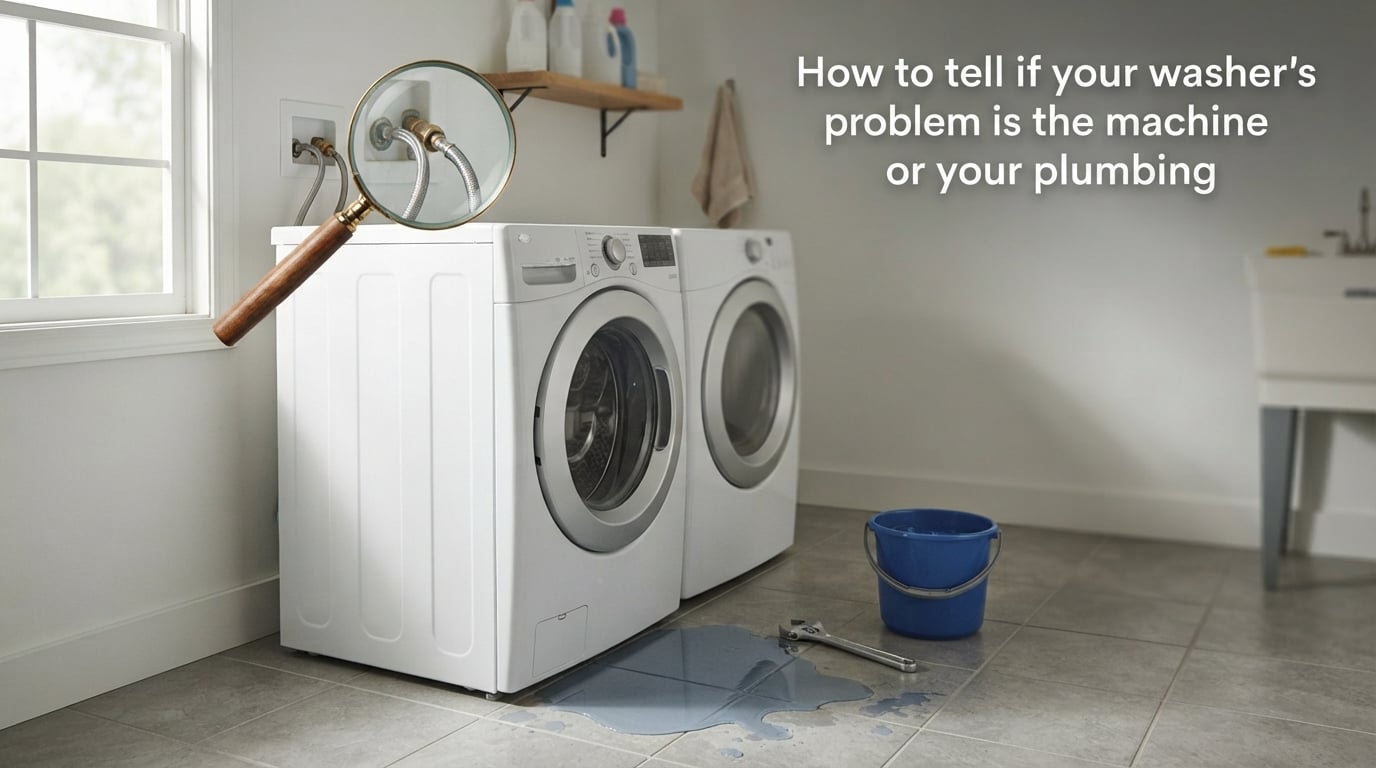
That puddle on your laundry room floor or the weird gurgling sound from the drain has you wondering: is this a washer problem, the machine or the plumbing? I have helped friends and family troubleshoot this exact issue for years, and I can tell you the answer usually comes down to one of two systems.
Your washing machine sits at the intersection of two very different worlds. On one side, you have the appliance itself with its motor, pump, control board, and drum. On the other side, you have your home’s plumbing with supply hoses, shut-off valves, the drain standpipe, and the P-trap. When something goes wrong, the symptom often looks the same regardless of which system is actually failing.
Call the wrong professional and you pay double. Plumbers typically charge $90 to $200 for a diagnostic visit, and appliance repair techs charge $80 to $150. When the issue gets misdiagnosed, homeowners end up paying both fees. Our team has seen this misdiagnosis happen in roughly 30% of the cases we have walked through.
That is exactly why I wrote this guide. I will walk you through a clear, step-by-step process to figure out whether your washer problem is the machine or your plumbing, before you spend a single dollar on a service call.
Table of Contents
How to Tell if Your Washer’s Problem Is the Machine or Your Plumbing?
The fastest way to tell if your washer’s problem is the machine or your plumbing is to isolate the two systems. Run water into the washer hoses with the machine off, and watch where the symptom appears. If the symptom shows up when the machine is off, you have a plumbing problem. If the symptom only shows up during a wash cycle, the machine is the more likely culprit.
Think of your laundry setup as two separate systems connected by three points: the hot supply hose, the cold supply hose, and the drain hose. Everything inside the metal cabinet is the machine. Everything behind the wall, under the floor, or coming up from the standpipe is plumbing.
Here is the simple decision rule I use every single time. If the symptom involves water appearing where it should not be, the source is almost always upstream of where you see the water. If the symptom involves the machine not doing what it should be doing, the source is almost always inside the cabinet.
Three quick observations will narrow things down even further. Does the water keep flowing even after you shut off the supply valves? That is plumbing.
Does the machine display an error code, make a strange grinding noise, or fail to spin? That is the machine. Does the drain gurgle or back up when other fixtures in your home run? That is also plumbing.
Common Machine Problems (Appliance Issues)
Machine problems are issues with the components inside the washer cabinet. The most common culprits are the drain pump, the drive belt, the lid lock, the drum bearing, the water inlet valve, and the control board. When these parts fail, the symptom usually shows up only when the machine is running through a cycle.
The drain pump is the most common failure point on a washing machine. It is a small electric motor that pushes water out through the drain hose. Pumps typically last 8 to 12 years.
When the pump fails, the washer will not drain, the drum will sit full of water, and you may hear a humming sound with no actual draining happening. Forum users on r/appliancerepair report this exact symptom more than any other issue.
The drive belt connects the motor to the drum. If it snaps or slips, the drum will not agitate or spin. You will hear the motor running but the drum will not move. Belts are inexpensive ($15 to $30) and relatively easy to replace, but the symptom mimics a much more serious motor failure.
The lid lock is a safety feature that prevents the drum from spinning when the lid is open. When it fails, the washer will fill with water but refuse to spin. This is one of the most misdiagnosed problems because homeowners assume the issue is the motor.
The drum bearing supports the inner tub and allows it to spin smoothly. A bad bearing creates a loud rumbling or grinding noise during the spin cycle, especially on heavy loads. Bearings usually fail after 10+ years of regular use and require a full drum replacement in most cases.
The water inlet valve controls the flow of hot and cold water into the machine. When it fails, the washer may not fill at all, fill too slowly, or fill with the wrong temperature water. The symptom mimics a supply issue but actually originates inside the cabinet.
The control board is the brain of the washer. When it fails, you may see random error codes, the machine may stop mid-cycle, or buttons may not respond. Control boards cost $150 to $300 to replace and are one of the more expensive machine repairs.
Quick Tell: Machine Problem Signs
Error codes on the display, a drum that will not spin, loud grinding or rumbling during the cycle, the machine stopping mid-cycle, and the washer not draining even when the drain hose is clear. All of these point to the machine.
Common Plumbing Problems
Plumbing problems are issues with the supply lines, drain lines, standpipe, P-trap, or shut-off valves. They affect how water gets to and from the machine. The most common plumbing culprits are clogged drain lines, failed supply hoses, standpipe too short, and shut-off valve issues.
A clogged drain line is the single most common plumbing problem connected to washers. Newer high-efficiency washers discharge water faster than older top-loaders, which can overwhelm pipes that handled fine for years.
Users on r/Plumbing frequently report that their kitchen sink or shower gurgles when the washer drains, a clear sign of a shared drain line clog. This is the simplest test for a plumbing-side drain issue.
The standpipe is the vertical pipe coming out of the wall or floor that the drain hose empties into. If the standpipe is too short, too narrow, or partially clogged, water will back up and overflow during the spin cycle. The fix is a plumber cleaning or replacing the standpipe, not an appliance repair.
Supply hoses carry hot and cold water from the shut-off valves to the back of the machine. Rubber supply hoses are rated for about 5 years before they should be replaced. Braided stainless steel hoses last much longer, but both types can fail suddenly. A burst supply hose can release hundreds of gallons of water per hour.
Shut-off valves control water flow to the supply hoses. When they fail, water may trickle even when the valve is closed, or the valve handle may not turn at all. Most homeowners do not realize their shut-off valves have failed until they need to shut off water in an emergency.
The P-trap is the curved section of pipe under the floor that holds a small amount of water to block sewer gas. If the P-trap is clogged, the washer will drain slowly or back up. The same fix applies to a clogged P-trap on a sink, so homeowners with some plumbing experience can often clear it themselves.
Water pressure issues can cause the washer to fill too slowly or trigger pressure-related error codes. Most washers need at least 20 PSI of incoming pressure to operate correctly. If your home has low water pressure, that is a plumbing issue.
Quick Tell: Plumbing Problem Signs
Water on the floor even when the machine is off, the drain hose overflowing during a cycle, gurgling sounds in nearby fixtures when the washer drains, and wet spots on the wall behind the washer. All of these point to plumbing.
Step-by-Step Diagnostic Guide
Here is a step-by-step diagnostic process I walk through with anyone who calls me about a washer problem. It takes about 15 minutes and tells you with high confidence whether the issue is the machine or your plumbing.
Step 1: The Off-Cycle Water Test
Turn the washer off completely. Then turn on both supply valves and watch the hoses, valves, and connections for 5 minutes. If you see water dripping or pooling, you have a plumbing problem. If everything stays dry, move to Step 2.
Step 2: The Drain-Only Cycle Test
Most modern washers have a drain-only or spin-only setting. Run this cycle with an empty drum. If the drum spins and drains normally, the drain pump and motor are working. If the drum will not spin or will not drain, the problem is inside the machine.
Step 3: The Standpipe Observation
Place the drain hose in a bucket instead of the standpipe. Run a normal cycle. If the washer drains perfectly into the bucket, the problem is the standpipe or the drain line. If the washer still does not drain, the issue is the drain pump or hose inside the machine.
Step 4: The Supply Hose Isolation Test
Disconnect the supply hoses from the back of the washer. Hold the ends over a bucket and briefly turn on each valve. If water flows normally from both valves, the supply plumbing is fine. If one or both valves trickle or leak, the problem is plumbing. If both valves flow well but the washer still will not fill, the problem is the inlet valve inside the machine.
Step 5: The Shared Drain Test
Run water in the kitchen sink or bathtub at full pressure while the washer drains. If the washer drains noticeably slower or backs up, you have a shared drain line clog in your plumbing. If the washer drains the same as always, the issue is not a clog.
Step 6: The Wall and Floor Check
Look at the wall behind the washer, the floor under and around the washer, and the ceiling below if you are on an upper floor. Water stains, warped baseboards, or musty smells all point to a slow plumbing leak that has been happening for a while.
When to Call a Professional
Call a plumber if you see water when the washer is off, the standpipe or shared drain line is backing up, the supply valves are leaking, or the standpipe is too short. Call an appliance repair tech if the machine shows an error code, the drum will not spin, the pump is humming with no draining, or the control panel is unresponsive.
Most homeowners can handle the basics themselves. Replacing a supply hose, clearing a standpipe clog, or swapping a drain pump filter usually runs under $30 in parts. The moment you are dealing with a potential P-trap clog, a shut-off valve replacement, or any work inside the wall, the smart move is to call a licensed plumber.
For machine issues, the rule of thumb is this. If the repair costs more than 50% of the price of a new washer, replace the washer instead. Average washer repair costs run $150 to $400, and a new mid-range washer runs $600 to $900. The math usually favors replacement for machines over 8 years old.
Prevention and Maintenance Tips
Replace rubber supply hoses every 5 years, or switch to braided stainless steel hoses that last 10+ years. Clean the drain pump filter every 3 months. This is the single most skipped maintenance step, and it prevents most drain-related machine problems.
Run a monthly cleaning cycle with hot water and white vinegar to clear soap residue and prevent mold. Check the standpipe height; it should be at least 18 inches above the floor to prevent siphoning. Inspect the hoses behind the washer twice a year for bulges, cracks, or rust.
For homes in hard water areas (most of the southwest and midwest US), descale the machine every 6 months. Mineral buildup destroys inlet valves and drain pumps faster than any other issue. A $10 water softening cartridge on the supply line can save you a $200 repair.
Frequently Asked Questions
Is a washing machine a plumbing issue?
A washing machine problem is sometimes a plumbing issue and sometimes an appliance issue. Plumbing problems involve the supply hoses, shut-off valves, drain line, standpipe, or P-trap. Appliance problems involve the motor, pump, control board, drum, or other components inside the cabinet. The only way to know which is to isolate the two systems with the diagnostic steps above.
What are common signs of a failing washer?
Common signs of a failing washer include the drum not spinning, water not draining, error codes on the display, loud grinding or rumbling noises during the cycle, the drum stopping mid-cycle, water leaking from the bottom of the cabinet, and the door or lid not opening at the end of a cycle. These point to the machine itself rather than the plumbing.
How do I know if my washing machine drain pipe is clogged?
You will know your washing machine drain pipe is clogged if water backs up out of the standpipe during the spin cycle, the standpipe gurgles or makes bubbling sounds, nearby fixtures like the kitchen sink gurgle when the washer drains, or the washer stops mid-cycle with water still in the drum. Place the drain hose in a bucket and run a cycle; if the washer drains fine into the bucket, the drain pipe is the problem.
What is the most common fault on a washing machine?
The most common fault on a washing machine is a clogged drain pump filter. The second most common is a failed drain pump, followed by a broken drive belt, a faulty lid lock, and a bad water inlet valve. Drain pump failures are so common because of lint, coins, and small objects that bypass the filter.
Final Thoughts on Diagnosing Washer Problems
Knowing how to tell if your washer’s problem is the machine or your plumbing saves you time, money, and a lot of frustration. The 6-step diagnostic guide above takes about 15 minutes and works for almost every symptom you will encounter. Run the tests in order, and you will know which professional to call before you ever pick up the phone.
Remember the simple rule. Water appearing where it should not be, with the machine off, is plumbing. The machine not doing what it should be doing, with no water leaks, is the appliance. Shared symptoms like draining problems require testing both systems to be sure.
For 2026, the most common washer problem our team sees is still a clogged drain pump filter, followed by failed supply hoses. Both are easy DIY fixes that cost less than $30 in parts. Save the service call for the things you cannot reach inside the wall or inside the cabinet.
If you found this guide helpful, share it with a friend who is staring at a puddle on their laundry room floor right now. The answer to “washer problem machine or plumbing?” is almost always testable in your own home before you spend a dime.