
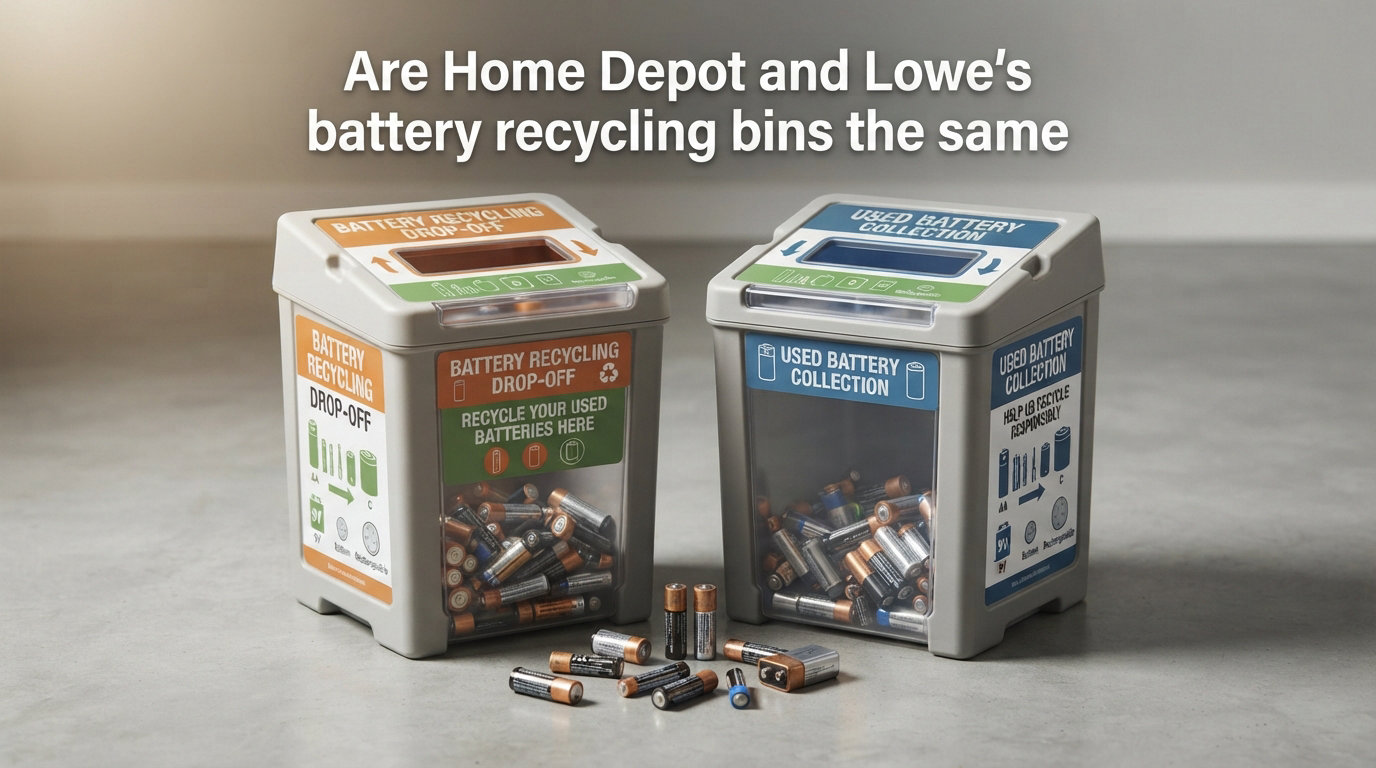
Yes, Home Depot and Lowe’s battery recycling bins are the same. Both retailers use identical Call2Recycle collection bins that accept rechargeable batteries up to 11 pounds and under 300 watt hours. The drop-off is free at every location, with no ID or purchase required, and a plastic bag is provided at the entrance so you can safely bag your batteries before dropping them in.
I pulled together this guide after getting the same question from friends and readers about whether the bins at Home Depot and Lowe’s differ. The short answer is no, but the details about accepted batteries, alkaline alternatives, and safety tips matter if you want to recycle the right way. Here’s everything our team confirmed about how these two programs work.
Table of Contents
What Battery Recycling Bins Do Home Depot and Lowe’s Use?
Home Depot and Lowe’s both use Call2Recycle bins, which is the same program running in both stores. Call2Recycle is a nonprofit battery stewardship organization that partners with major retailers across North America to collect rechargeable batteries at no charge to the consumer.
Lowe’s began its Call2Recycle partnership in 2004, making it one of the earliest big-box adopters. Home Depot followed shortly after and now operates the program at every store in the U.S. The bins themselves are identical orange Call2Recycle containers with the same posted limits and accepted battery list.
If you walk into a Home Depot and a Lowe’s and look at the recycling stations near the front doors, you’ll find the same bin design, the same labels, and the same instructions. The retailers do not run separate private battery programs. They’re both hosting the same Call2Recycle drop-off network.
What Batteries Are Accepted at Both Stores
Both Home Depot and Lowe’s accept rechargeable batteries weighing up to 11 pounds each, with a maximum of 300 watt hours per battery. Anything heavier or higher-capacity needs a different disposal route, typically a municipal hazardous waste facility.
The accepted battery types include the most common rechargeable chemistries used in household and power tool products:
Lithium-ion (Li-ion) – phones, laptops, power tools, e-bikes under the limit
Nickel-cadmium (NiCd) – older cordless tools and emergency lighting
Nickel-metal hydride (NiMH) – cameras, handheld electronics, AA/AAA rechargeables
Small sealed lead-acid (SSLA/Pb) – UPS backups, alarm system batteries under 11 lbs
You’ll find these batteries in cordless drills, string trimmers, robotic vacuums, handheld game consoles, vape devices, and most wall-rechargeable electronics. If your battery recharges via a wall plug or USB, it’s almost certainly accepted.
How to Drop Off Batteries at Home Depot or Lowe’s?
The drop-off process is identical at both stores and takes under two minutes once you’re inside. Both retailers provide free plastic bags at the recycling station so you can isolate your batteries before tossing them in.
Walk to the recycling station near the store entrance. Home Depot and Lowe’s both place the bin at the front of the store, usually alongside the CFL bulb and plastic bag collection.
Grab a plastic bag from the dispenser on or near the bin.
Place each battery in its own section of the bag, or wrap the terminals of 9-volt batteries with tape to prevent contact.
Seal the bag and drop it into the Call2Recycle bin.
Walk out. No ID, no receipt, no purchase required.
Our team has dropped off batteries at both chains in multiple states and never been asked for proof of purchase. The bin is self-service, and the staff is trained to leave it unattended.
Are Alkaline Batteries Accepted at Home Depot or Lowe’s?
No, the Call2Recycle bins at Home Depot and Lowe’s do not accept single-use alkaline batteries like standard AA, AAA, C, D, or 9-volt cells. Call2Recycle is strictly a rechargeable battery program, so alkaline batteries belong in a different disposal stream.
For alkaline batteries, you have a few options. Many states allow alkaline batteries to go in regular household trash because modern formulations no longer contain mercury. Other states and municipalities require alkaline drop-off at hazardous waste facilities or specific recycling events. Check your local government’s waste page before tossing them in the kitchen bin.
Some hardware stores also run their own alkaline battery take-back programs independent of the Call2Recycle bin. If you’re unsure, ask a Home Depot or Lowe’s associate whether your specific store accepts alkaline, since policies can vary by location.
Safety Tips Before You Drop Off Batteries
Battery recycling is safe when you follow a few simple precautions. Lithium-ion cells in particular can short-circuit, overheat, or catch fire if the terminals touch metal objects like keys, coins, or other batteries.
Tape the terminals of 9-volt batteries with clear packing tape before dropping them off. The prongs can easily touch other batteries and spark.
Keep batteries in original packaging when possible, since the packaging keeps terminals separated.
Place each battery in its own plastic bag section if you don’t have the original packaging.
Do not mix damaged, swollen, or leaking batteries with intact ones. Damaged lithium batteries should go to a hazardous waste facility, not a retail bin.
Do not drop off batteries that are still hot right after use. Let them cool to room temperature first.
These tips apply to both Home Depot and Lowe’s since the bin is the same. Bagging and taping the way the program recommends also keeps the bin safe for the next person.
What Happens to Batteries After You Drop Them Off
Once you drop your batteries in the Call2Recycle bin at Home Depot or Lowe’s, they’re picked up by a Call2Recycle logistics partner and shipped to certified processors. The processors sort the batteries by chemistry and dismantle them to recover valuable materials.
Recovered materials include cobalt, nickel, lithium, and lead, which are refined and sold back to manufacturers for new battery production. This closed-loop system keeps toxic heavy metals out of landfills and groundwater while reducing the need for new mining.
Lowe’s has reported recycling more than 6 million pounds of rechargeable batteries since 2004 across its 1,700+ participating stores. Home Depot has collected similar volumes through its storefront partnership, and the combined program handles millions of pounds of batteries each year nationwide.
Choosing Where to Recycle Your Batteries
Since Home Depot and Lowe’s run the same Call2Recycle program, the choice between them comes down to convenience. Pick whichever store is closer, has more flexible hours, or is on a route you already drive. Both chains typically open at 6 a.m. and close at 10 p.m., though hours vary by location.
If you’re running errands, you can drop off batteries at either store without making a special trip. There’s no loyalty requirement, no minimum number of batteries, and no fee, so the barrier is essentially zero.
For people in rural areas without a Home Depot or Lowe’s nearby, Call2Recycle also operates drop-off sites at other retailers, municipalities, and electronics stores. You can search the Call2Recycle locator by ZIP code to find the closest option.
Frequently Asked Questions
Does Lowe’s or Home Depot recycle lithium batteries?
Both Lowe’s and Home Depot recycle lithium-ion batteries through their Call2Recycle bins, as long as each battery weighs under 11 pounds and is rated below 300 watt hours. Common lithium-ion items like power tool batteries, phone batteries, and laptop batteries are all accepted at both retailers.
Does Lowe’s have a battery recycling bin?
Yes, Lowe’s has a Call2Recycle battery recycling bin near the entrance of every participating store. The drop-off is free, no ID or purchase is required, and a plastic bag is provided so you can safely bag your batteries before dropping them in.
Is Home Depot’s battery recycling program free?
Yes, Home Depot’s battery recycling program is completely free. You don’t need to make a purchase, show an ID, or sign up. Just bring your rechargeable batteries to the Call2Recycle bin near the store entrance and drop them in the provided plastic bag.
Can I put AA batteries in my recycle bin?
You should not put AA batteries in your curbside recycling bin. If they’re rechargeable, drop them in a Call2Recycle bin at Home Depot or Lowe’s. If they’re single-use alkaline, dispose of them according to your local municipality’s rules, which often allow them in regular trash but sometimes require hazardous waste drop-off.
Final Thoughts on Home Depot and Lowe’s Battery Recycling Bins
To wrap up, Home Depot and Lowe’s battery recycling bins are the same program. Both retailers host Call2Recycle drop-off stations near the entrance, accept rechargeable batteries up to 11 pounds and 300 watt hours, and provide free plastic bags for safe drop-off. There is no cost, no ID check, and no purchase required at either chain.
Next time you have old power tool batteries, phone batteries, or rechargeable AA cells, drop them in the Call2Recycle bin at whichever store is closer. Just remember to tape 9-volt terminals, keep damaged batteries out of the bin, and check local rules if you’re trying to recycle single-use alkaline batteries. These small steps in 2026 keep toxic metals out of landfills and put valuable materials back into the supply chain.