
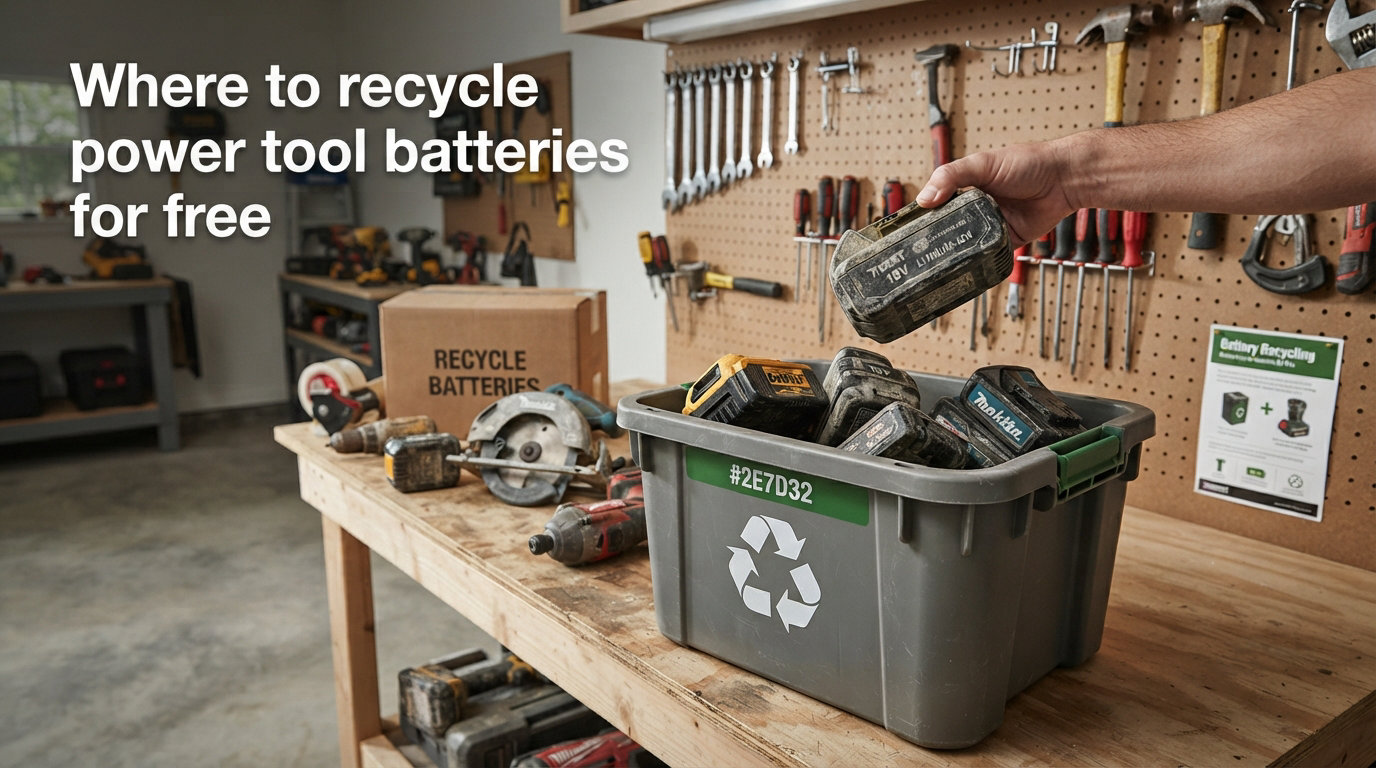
If you have a drawer full of dead drill batteries taking up space, you are not alone. Every homeowner and contractor eventually faces the question of where to recycle power tool batteries for free without paying a disposal fee or risking a fire hazard. The good news is that free recycling is easier to find than most people realize.
Power tool batteries contain lithium, cobalt, cadmium, and other heavy metals that make them dangerous to throw in the trash. When these batteries end up in landfills, those toxic materials leach into soil and groundwater. Recycling keeps those hazards out of the environment and recovers valuable metals for reuse in new products.
In this guide, I walk you through every free recycling option available in 2026, from retail drop-off bins at Home Depot and Lowe’s to mail-in programs and local hazardous waste facilities. You will learn exactly how to prepare your batteries, which brands have specific programs, and what to do if a battery is swollen or damaged.
Our team researched recycling options across all 50 states and combed through dozens of forum threads to find the answers real people need. By the end of this article, you will know exactly where to take your old batteries and how to do it safely.
Table of Contents
Why Recycling Power Tool Batteries Matters?
Recycling your old power tool batteries prevents toxic chemicals from contaminating the environment and reduces the need for destructive mining of raw materials. A single lithium-ion battery pack can contain enough cobalt and nickel to make recycling financially and ecologically worthwhile. When you toss that same battery into a landfill, those resources are lost forever.
Consider this. Americans throw away more than 3 billion batteries every year, and rechargeable power tool batteries make up a growing share of that waste. Each cordless drill battery that reaches a landfill can leak cadmium, lead, or lithium into the surrounding soil for decades. These metals accumulate in plants, animals, and eventually the water supply.
Recycling also prevents fires. Lithium-ion batteries that get crushed in garbage trucks or landfill compactors can ignite and burn for hours. Sanitation workers face real danger from batteries tossed into regular trash. Proper disposal through a recycling program eliminates that risk entirely.
The materials recovered from recycled batteries go straight back into manufacturing. Cobalt, nickel, copper, and lithium get extracted and sold to companies that build new batteries, electronics, and even stainless steel. That closed-loop cycle reduces the demand for new mining operations, which are often environmentally damaging.
Types of Power Tool Batteries You Can Recycle
Almost every type of rechargeable power tool battery can be recycled for free at drop-off locations. The four main chemistries you will encounter are all accepted by Call2Recycle and most retail partners.
Lithium-Ion (Li-Ion) Batteries
Lithium-ion batteries power nearly all modern cordless tools, including drills, impact drivers, circular saws, and string trimmers. They are lightweight, hold a charge for months, and deliver consistent power output. Most Li-Ion tool batteries range from 12V to 80V and carry a watt-hour rating printed on the label. Every major recycling program accepts them, but they require careful handling because damaged cells can catch fire.
Nickel-Cadmium (NiCd) Batteries
Nickel-cadmium batteries were the standard for older cordless tools and are still found in many budget models. They are durable and tolerate deep discharging, but cadmium is a highly toxic heavy metal. This makes recycling NiCd batteries especially important. You will find them accepted at every Call2Recycle drop-off point and hazardous waste facility.
Nickel-Metal Hydride (NiMH) Batteries
Nickel-metal hydride batteries replaced NiCd in many mid-range tools during the 2000s. They offer higher capacity and do not contain toxic cadmium, making them slightly safer. However, they still contain nickel and other metals worth recovering. All standard recycling programs accept NiMH packs without any special preparation beyond taping the terminals.
Nickel-Zinc (NiZn) Batteries
Nickel-zinc batteries are less common in power tools but appear in some specialty and older cordless devices. They are fully recyclable through the same channels as other rechargeable chemistries. If you have one, treat it the same way as a NiMH or NiCd battery for recycling purposes.
Where to Recycle Power Tool Batteries for Free?
You can recycle power tool batteries for free at more than 25,000 drop-off locations across North America through Call2Recycle and its retail partners. Most people live within 10 miles of at least one free drop-off site. Here is a breakdown of every option available to you.
Call2Recycle Drop-Off Network
Call2Recycle is the largest and most accessible battery recycling program in North America. It operates over 25,000 public drop-off locations in the United States and Canada, including retail stores, municipal buildings, and recycling centers. The program is completely free for consumers because battery manufacturers fund it.
To find your nearest location, visit the Call2Recycle website and enter your ZIP code into their locator tool. The tool shows every participating site within a chosen radius, along with hours and the types of batteries accepted. I have used this tool myself and consistently found multiple options within a 5-mile radius in both urban and suburban areas.
Call2Recycle accepts all rechargeable batteries up to 300 watt-hours, which covers every power tool battery on the market. They also accept cell phone batteries, laptop batteries, and other consumer rechargeables. Drop your batteries in the designated bin and walk out. No fees, no paperwork, no questions asked.
Home Depot
Home Depot partners with Call2Recycle and places recycling bins in every single one of its more than 2,000 US stores. Yes, Home Depot does recycle old power tool batteries for free. You will find the Call2Recycle drop-off bins near the front entrance or in the returns area of most locations.
I have dropped off dozens of batteries at Home Depot over the years and never been charged a cent. The bins accept lithium-ion, NiCd, and NiMH batteries from any brand, not just tools sold at Home Depot. You can bring in DeWalt, Milwaukee, Ryobi, Makita, or any other brand without issue.
One thing to note. Home Depot does not always advertise their battery recycling prominently. If you cannot find the bin, ask an associate at the customer service desk. They will point you to it immediately.
Lowe’s
Lowe’s also partners with Call2Recycle and offers free rechargeable battery recycling at all of its stores. The recycling station is typically located near the main entrance or customer service counter. Lowe’s has been part of the Call2Recycle network for years and reports collecting millions of pounds of batteries annually.
Lowe’s accepts the same battery types as Home Depot. Lithium-ion, NiCd, and NiMH power tool batteries from any manufacturer are welcome. The process is identical. Drop them in the bin and you are done.
Forum users on Reddit consistently confirm that Lowe’s is one of the easiest places to recycle tool batteries. Multiple users in the r/HomeImprovement and r/Tools communities report fast, hassle-free drop-offs with no purchase required.
Best Buy
Best Buy runs its own electronics recycling program in addition to partnering with Call2Recycle. Every Best Buy store accepts rechargeable batteries for free, including power tool battery packs. The recycling kiosk is usually located just inside the front doors.
Best Buy also accepts a wider range of items than most hardware stores. Along with power tool batteries, you can recycle old laptops, phones, cables, and small electronics at the same location. This makes it a convenient one-stop drop-off if you are clearing out a garage or workshop.
There is a limit of three items per day per household for some electronics, but loose batteries typically do not count toward that limit. Check with your local store if you have a large quantity.
Local Hazardous Waste Facilities
Most counties and municipalities operate hazardous waste facilities that accept power tool batteries at no charge. These facilities are designed specifically for dangerous materials and can handle damaged, swollen, or leaking batteries that retail stores may refuse.
To find your local facility, search your city or county government website for “hazardous waste disposal” or call your local waste management department. Many facilities hold regular collection events on specific weekends each month.
One advantage of using a hazardous waste facility is that they accept nearly every battery type, including severely damaged ones. If you have a battery that is swollen, corroded, or leaking, this is where you should take it rather than a retail drop-off bin.
Mail-In Recycling Programs
If you live in a rural area or cannot reach a drop-off location, mail-in recycling programs offer a convenient alternative. Call2Recycle offers prepaid shipping boxes that hold up to 25 pounds of batteries. You fill the box, seal it, and drop it in any USPS or FedEx mailbox.
The catch is that these boxes cost money upfront, typically around $45 for a small box. However, if you are recycling a large quantity of batteries or coordinating with neighbors, the per-battery cost drops quickly. Some tool manufacturers also offer their own mail-in programs for their specific brands.
Earth911 is another resource for finding mail-in options. Their recycling database lets you search by material type and location to find programs that accept power tool batteries by mail. Several specialty recyclers like Redwood Materials and Battery Solutions also accept consumer shipments.
Brand-Specific Recycling Tips
One of the most common questions our team found in forum discussions was about brand-specific recycling. Users want to know if DeWalt, Milwaukee, and Ryobi have dedicated programs. The answer is yes, though most routes still run through Call2Recycle.
DeWalt Batteries
DeWalt partners directly with Call2Recycle, which means every drop-off location that accepts rechargeable batteries will take DeWalt packs. You do not need to find a DeWalt-specific location. Just bring your 20V MAX, 60V MAX, or 12V batteries to any Home Depot, Lowe’s, or Best Buy and drop them in the Call2Recycle bin.
DeWalt also runs a battery take-back program through authorized service centers for businesses with large volumes. If you are a contractor with dozens of dead batteries, contact DeWalt customer service to arrange a bulk pickup.
Milwaukee Batteries
Milwaukee Tool batteries, including M12, M18, and MX FUEL packs, are accepted at every Call2Recycle location. The M18 line is one of the most popular cordless tool platforms in America, and recycling options for these batteries are abundant. Drop them at Home Depot, Lowe’s, or any hazardous waste facility.
Reddit users in r/MilwaukeeTool frequently confirm that Home Depot is the most convenient drop-off point for M18 batteries. The bins accept packs of any size, including the high-output 9.0Ah and 12.0Ah batteries.
Ryobi Batteries
Ryobi 18V ONE+ and 40V batteries are fully recyclable through the same Call2Recycle network. Since Ryobi is exclusive to Home Depot, that store is the natural drop-off choice for most users. The Call2Recycle bin accepts Ryobi batteries regardless of voltage or capacity.
Forum discussions in r/ryobi show that many users worry about the 40V packs because of their size and the fire risk associated with lithium-ion chemistry. As long as you tape the terminals before drop-off, these batteries are safe to transport and recycle. More on terminal taping in the preparation section below.
How to Prepare Power Tool Batteries for Recycling
Preparing your power tool batteries for recycling takes about two minutes per battery and makes the process safe for you and the recycling staff. Follow these steps before heading to any drop-off location.
Step 1: Remove the battery from the tool. Never transport a battery while it is attached to a drill, saw, or other device. The tool can accidentally activate during transport and cause injury.
Step 2: Check for damage. Inspect each battery for swelling, cracks, leaks, or corrosion. A healthy battery has a flat surface and no visible deformation. If you see any swelling or leakage, set that battery aside for separate handling at a hazardous waste facility.
Step 3: Tape the terminals. Place a strip of clear packing tape or electrical tape over the positive and negative terminals. This prevents the battery from short-circuiting if metal objects touch the contacts during transport or storage. Taping is mandatory at most recycling locations.
Step 4: Bag or box separately. Place each battery in its own plastic bag, or put multiple batteries in a non-conductive container with cardboard between them. Never throw loose lithium-ion batteries into a bag together without separation, as terminal contact can cause a fire.
Step 5: Drop off within a few weeks. Do not store dead batteries indefinitely. Even disconnected batteries can slowly degrade and become unstable over time. Plan a trip to your nearest recycling location soon after your batteries die.
Safety Tips for Handling Old or Damaged Batteries
Damaged power tool batteries require extra caution because compromised lithium-ion cells can ignite spontaneously. If you notice any swelling, hissing, heat, or chemical smell coming from a battery, treat it as a fire hazard.
Swollen batteries. A battery that looks puffy or has separated at the seams is in a dangerous state. Do not charge it, do not use it, and do not squeeze it. Place it in a fireproof container or on a concrete floor away from flammable materials. Take it directly to a hazardous waste facility, not a retail drop-off bin.
Leaking batteries. If you see white or greenish powder around the terminals, that is corrosion from leaking electrolyte. Wear gloves when handling the battery and avoid touching your face. Place it in a sealed plastic bag and transport it to a hazardous waste facility.
Fire prevention. Never store large quantities of lithium-ion batteries in a hot garage or shed. Heat accelerates chemical degradation and increases fire risk. Keep batteries in a cool, dry location until you can recycle them. If a battery ever feels hot to the touch while not in use, move it outside immediately and away from anything flammable.
Never disassemble. Do not attempt to open a power tool battery pack to remove individual cells. The internal wiring and cell configuration are designed to prevent short circuits. Breaking that housing removes all safety protections and dramatically increases the risk of fire or chemical exposure.
State Regulations You Should Know
Battery disposal laws vary by state, and several states make it illegal to throw rechargeable batteries in the regular trash. California, New York, and Minnesota have the strictest regulations, prohibiting all rechargeable battery disposal in landfills. Other states including Connecticut, Florida, and Maine have similar restrictions or mandates for retailer take-back programs.
In California, it is illegal to dispose of any battery in the trash. State law requires all retailers that sell rechargeable batteries to also accept them for recycling. This means virtually every hardware store, electronics retailer, and big-box store in California must have a recycling bin available.
Even in states without specific bans, landfill operators may refuse batteries at their facilities. The safest approach regardless of where you live is to always recycle. It is free, it takes minutes, and it keeps you on the right side of both environmental and safety regulations.
What Happens to Recycled Power Tool Batteries?
When you drop a battery in a Call2Recycle bin, it moves through a multi-step recycling process at specialized facilities. Batteries are sorted by chemistry type at regional processing centers. Lithium-ion batteries go to facilities that crush and separate the cells, then extract lithium, cobalt, nickel, and copper through chemical and thermal processes.
Recovered materials are sold to manufacturers who use them to build new batteries, electronics, and metal products. Recycling one ton of lithium-ion batteries can recover enough cobalt to manufacture hundreds of new battery packs. Nickel-cadmium batteries are processed separately to safely isolate the toxic cadmium for controlled industrial use.
This closed-loop system means the metals in your old drill battery could end up in a new power tool, an electric vehicle, or a smartphone within months of recycling. Every battery you recycle reduces the demand for environmentally destructive mining and keeps hazardous materials out of the waste stream.
FAQs
How to get rid of old power tool batteries?
Take old power tool batteries to any Call2Recycle drop-off location such as Home Depot, Lowe’s, or Best Buy. The service is free, requires no purchase, and accepts lithium-ion, NiCd, and NiMH batteries from any brand. Tape the terminals before drop-off and place each battery in a separate bag for safety.
Does Home Depot recycle old power tool batteries?
Yes, Home Depot recycles power tool batteries for free at all of its more than 2,000 US stores. The Call2Recycle drop-off bins are located near the front entrance or customer service area and accept batteries from any brand, not just tools sold at Home Depot.
Does Lowe’s recycle power tool batteries?
Yes, Lowe’s partners with Call2Recycle and offers free rechargeable battery recycling at every store location. The recycling station is typically near the main entrance and accepts lithium-ion, NiCd, and NiMH power tool batteries from any manufacturer.
How do you dispose of old tool batteries?
Dispose of old tool batteries by dropping them off at a Call2Recycle partner location, a local hazardous waste facility, or through a mail-in recycling program. Always tape the terminals, bag each battery separately, and never throw rechargeable batteries in the regular trash.
Can you throw power tool batteries in the trash?
No, you should never throw power tool batteries in the trash. In several states including California and New York it is illegal to dispose of rechargeable batteries in landfills. Lithium-ion batteries can ignite when crushed in garbage trucks and cause fires at waste facilities.
Will scrap yards buy old power tool batteries?
No, scrap yards generally do not buy power tool batteries. The lithium content makes them difficult and dangerous to process compared to standard scrap metal. Free recycling through Call2Recycle or a hazardous waste facility is the best and safest way to dispose of them.
Conclusion
Finding where to recycle power tool batteries for free is simpler than most people expect. With over 25,000 Call2Recycle drop-off locations across North America, you are almost certainly within a short drive of a free recycling bin at Home Depot, Lowe’s, or Best Buy. No fees, no purchase required, and no brand restrictions.
The key steps are simple. Remove the battery from your tool, tape the terminals, bag it separately, and drop it off at the nearest location. If a battery is swollen or damaged, take it to a local hazardous waste facility instead. Never throw rechargeable batteries in the trash, both for environmental and legal reasons.
Take five minutes this week to gather your dead batteries and find your nearest drop-off point using the Call2Recycle locator tool. Every battery you recycle keeps toxic metals out of the environment, prevents landfill fires, and feeds valuable materials back into the manufacturing supply chain. Your old drill battery could become part of a new one.